Forensic Physics Tutor Online
My Physics Buddy (MPB) offers 1:1 online tutoring & homework help in Physics and related subjects. Forensic Physics is the application of physical principles — mechanics, optics, acoustics, electromagnetism, materials science, and more — to the investigation, analysis, and reconstruction of events with legal significance. It is a subject that demands both strong physics foundations and the ability to apply those foundations in contexts that are ambiguous, multidisciplinary, and evidence-driven. Students who struggle with it rarely struggle with physics alone — they struggle with the bridge between textbook physics and real-world forensic interpretation. Whether you are an undergraduate in a forensic science programme encountering trajectory analysis and document examination for the first time, a postgraduate student working through fire investigation physics or collision reconstruction, a PhD candidate whose research touches on forensic evidence analysis, or a student preparing for the FACT / FACT+ exam in India where Forensic Physics falls under the Ballistics and Physical Sciences elective — MPB connects you with a tutor who has genuine depth in this subject. If you have been searching for a Forensic Physics tutor near me, our fully online model removes that limitation entirely — sessions run live over Google Meet with digital handwriting tools, from any time zone. Tutoring here is designed to help you aim for confident, working mastery of forensic physical analysis and its scientific foundations.
- 1:1 live online sessions — fully personalised, no group classes or pre-recorded content
- Tutors with graduate-level depth in the physics underpinning forensic investigation methods
- Flexible scheduling for students in the US, UK, Canada, Australia, India, Gulf, and internationally
- Structured learning plan built around your course syllabus, research goals, or exam timeline
- Ethical homework, assignment, lab report, and project guidance — we coach your understanding; you produce and submit your own work
Who This Forensic Physics Tutoring Is For
Forensic Physics is taught across a range of programmes — dedicated forensic science degrees, physics programmes with a forensic elective, and postgraduate forensic science courses. The tutoring here is calibrated for students at all of those entry points, as well as professionals preparing for standardised qualifying assessments.
- Undergraduate students in forensic science, applied physics, or criminal justice science programmes taking a Forensic Physics course or module
- Graduate (MSc) students in forensic science whose programme includes a substantial Forensic Physics component — ballistics, accident reconstruction, document examination, or fire investigation
- PhD students and researchers whose dissertation or project work involves physical evidence analysis, forensic engineering, or related areas
- Students in India preparing for the FACT / FACT+ exam (National Forensic Sciences University, Ministry of Home Affairs) in the Forensic Ballistics and Physical Sciences elective
- Students appearing for the AIFSET or similar forensic science admission tests where physics is a prerequisite knowledge area
- Students in the US, UK, Canada, Australia, Gulf, and internationally needing support aligned to their specific course or institutional programme
- Students who need structured guidance on problem sets, assignments, lab reports, and case study write-ups — approached as coached learning, not answer delivery
Outcomes: What You’ll Be Able to Do in Forensic Physics
Forensic Physics rewards students who can connect physical principles to investigative questions — not just solve equations in isolation. Our tutoring builds that connective ability alongside the underlying physics, so that both layers reinforce each other.
Apply the physics of projectile motion, terminal velocity, and impact mechanics to reconstruct the trajectory and origin of a fired projectile or a falling object with documented, defensible reasoning. Analyse physical evidence — glass fracture patterns, paint layering, tyre mark geometry, bloodstain distribution — using the relevant optical, mechanical, and materials science principles, and communicate those findings clearly in a format suitable for a lab report or expert witness context. Model vehicle collision scenarios using conservation of momentum and energy, estimating pre-impact speeds and impact geometries from physical evidence in ways that align with accepted forensic engineering standards. Interpret document examination evidence — indented writing, ink analysis, paper examination — using the physical and instrumental methods covered in your course. Approach fire and explosion investigation from a physics standpoint — heat transfer, combustion physics, blast wave mechanics — at a level appropriate to your programme.
What We Cover in Forensic Physics (Syllabus & Topics)
The content below reflects the typical structure of Forensic Physics courses at undergraduate and postgraduate level, drawing on standard course structures including those referenced in the FACT / FACT+ syllabus published by the National Forensic Sciences University (NFSU). Exact syllabus content varies by institution — your tutor works directly from your course materials.
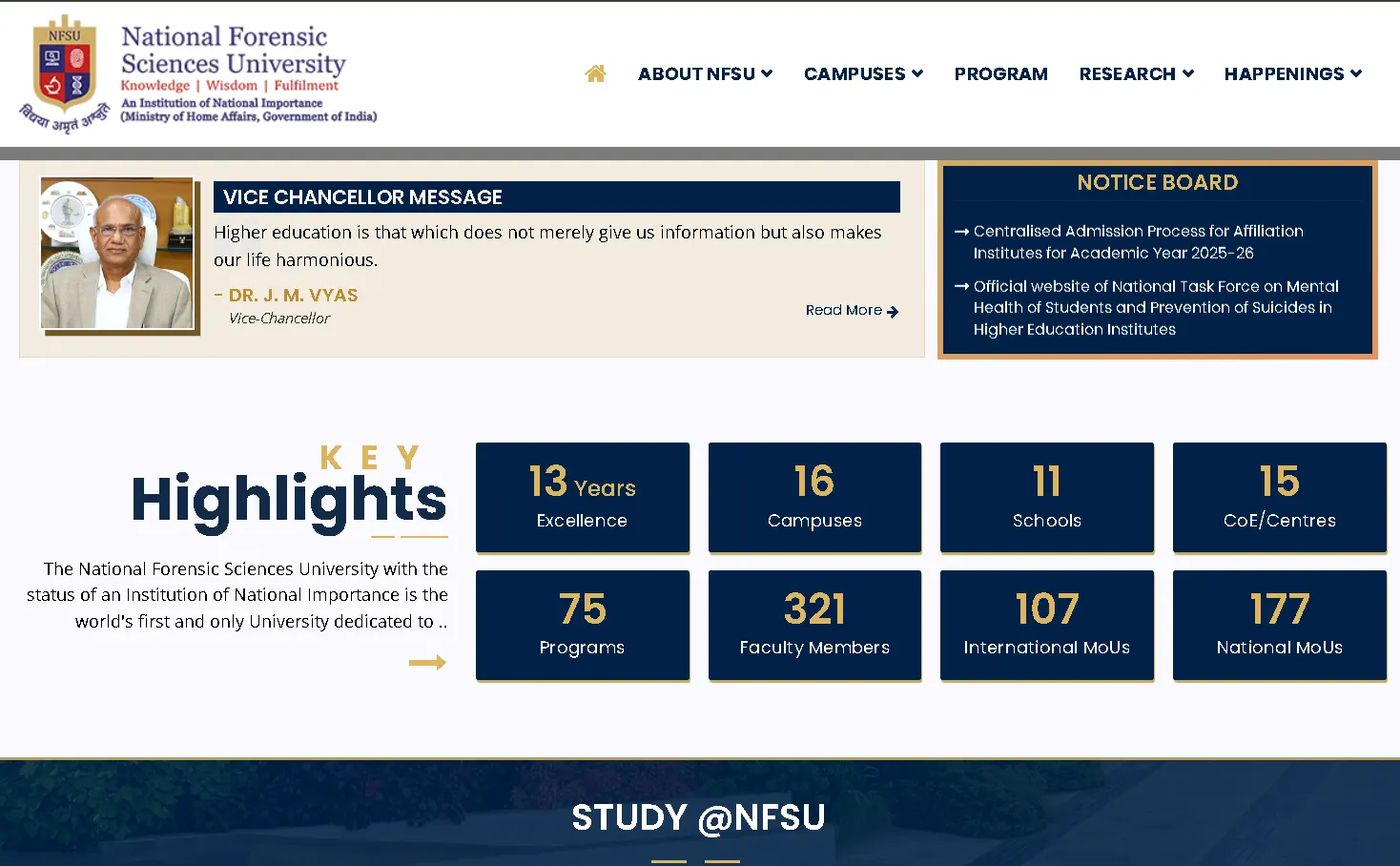
Explore NFSU, India’s leading university dedicated to forensic science, criminology, and investigative research.
Track 1: Physical Evidence — Fundamentals
- Nature and classification of physical evidence: class characteristics vs. individual characteristics
- Locard’s exchange principle — the physical basis and its implications for evidence interpretation
- Collection, preservation, documentation, and chain of custody for physical evidence
- Physical measurements at crime scenes — units, precision, significant figures, and uncertainty
- Statistical tools for forensic physics: t-test, chi-square test, and measurement of uncertainty
- Non-destructive vs. destructive examination methods — principles and trade-offs
Track 2: Forensic Ballistics and Projectile Physics
- Internal ballistics — propellant combustion, pressure-time curves, and bullet acceleration inside the barrel
- External ballistics — projectile trajectory, drag, spin stabilisation, and the effect of environmental conditions
- Terminal ballistics — energy transfer on impact, wound ballistics, and penetration physics
- Gunshot residue (GSR): formation, deposition, and physical analysis
- Cartridge case and bullet examination — striations, lands and grooves, and firearm identification
- Shooting distance estimation — powder deposition patterns and physical interpretation
- Trajectory reconstruction — angle of entry, directionality, and the physics of ricochet
Track 3: Accident and Collision Reconstruction
- Newton’s laws applied to vehicle collisions — momentum conservation and energy methods
- Pre-impact speed estimation from skid marks, crush damage, and throw distance
- Tyre friction physics — coefficient of friction, braking efficiency, and road surface effects
- Pedestrian impact biomechanics — wrap trajectory, vault trajectory, and throw distance models
- Vehicle dynamics — centre of mass, rollover mechanics, and stability analysis
- Airbag and seat belt physics — impulse, force-time curves, and occupant protection mechanics
- Accident reconstruction report structure and the scientific basis for courtroom testimony
Track 4: Glass, Paint, and Trace Evidence Physics
- Glass fracture mechanics — concentric and radial cracks, Hertz cone fractures, and directionality
- Glass physical examination — refractive index, density, elemental composition, and matching criteria
- Fracture pattern analysis for contact force, direction of impact, and sequence of events
- Paint evidence — layer structure, physical and microscopical examination, and transfer mechanism
- Fibre and textile examination — physical properties, weave structure, and damage analysis
- Soil and geological materials — particle size, mineralogy, and physical comparison methods
- Locard transfer physics — how force, contact area, and time affect material transfer and persistence
Track 5: Fire and Explosion Investigation
- Fire physics fundamentals — combustion, heat transfer (conduction, convection, radiation), and fire spread
- Fire scene indicators — burn patterns, char depth, V-patterns, and their physical interpretation
- Point of origin determination — physics-based analysis vs. observer bias in fire investigation
- Electrical faults and fire causation — arc mapping, bead analysis, and the physics of electrical failure
- Explosion mechanics — deflagration vs. detonation, blast wave physics, overpressure, and fragmentation
- Explosive residue identification — physical and chemical signatures and their persistence
- Industrial accident investigation — structural failure, mechanical failure, and physics of industrial disasters
Track 6: Document Examination and Questioned Documents
- Paper examination — physical properties, fibre analysis, watermarks, and manufacturing characteristics
- Ink analysis — physical and optical properties, sequence determination, and age estimation methods
- Indented writing detection — ESDA (Electrostatic Detection Apparatus) and the physics behind it
- Forgery and alteration detection — obliteration, erasure, and the physical evidence of tampering
- Handwriting physics — pen pressure, stroke dynamics, and measurable physical characteristics
- Imaging and photographic techniques in document examination — UV, IR, and multispectral imaging
Track 7: Forensic Photography, Video, and Imaging Physics
- Photography fundamentals — aperture, shutter speed, depth of field, and forensic documentation standards
- Light physics in forensic context — visible, UV, and IR illumination and their applications
- Digital image analysis — pixel resolution, image authentication, and the physics of compression artefacts
- Video analysis — frame rate, spatial resolution, and speed estimation from surveillance footage
- Photogrammetry — 3D reconstruction from 2D images and its forensic applications
- Enhancement vs. manipulation — the physics basis for distinguishing legitimate enhancement from falsification
Track 8: Forensic Engineering and Structural Failure Analysis
- Engineering failure analysis — stress, strain, fracture mechanics, and failure mode identification
- Building materials and structural investigation — concrete, steel, and masonry failure under load or impact
- Civil engineering forensics — road design, defects, and their contribution to accidents
- Mechanical component failure — fatigue, overload, and corrosion-related failure patterns
- Transportation disaster investigation — physics of rail, aviation, and marine incidents at appropriate course level
FACT / FACT+ Exam Coverage (Ballistics and Physical Sciences Elective)
- Section A preparation: forensic aptitude, physical evidence principles, and scene of crime analysis
- Section B — Forensic Ballistics and Physical Sciences: full syllabus coverage as per the NFSU FACT specification
- MCQ question pattern practice — objective questions at low, moderate, and high difficulty levels
- Qualifying criteria: 50% per section and 60% overall (verify current criteria at nfsu.ac.in before your exam date)
- High-yield topic identification and focused revision strategy for the exam timeline
How My Physics Buddy Tutors Help You with Forensic Physics (The Learning Loop)
Diagnose: Every engagement starts with a focused diagnostic. The tutor asks you to work through a problem or explain a concept from the area you find hardest. This reveals whether the difficulty is foundational physics (e.g., shaky mechanics underlying collision reconstruction), applied interpretation (e.g., unable to connect fracture pattern geometry to impact direction), or exam-strategy related (e.g., strong on theory but losing marks on case-based questions that require structured written reasoning).
Explain: The tutor rebuilds each topic from a clear physical foundation. In Forensic Physics, where the same underlying physics — mechanics, optics, wave propagation — appears in multiple very different forensic contexts, the tutor always makes the underlying connection explicit. Understanding that a gunshot trajectory problem and a vehicle throw-distance problem are both applications of projectile mechanics reduces the cognitive load considerably and helps students transfer knowledge more effectively.
Practice: You work through problems live during the session — past exam questions, case study problems, and derivation-based exercises as appropriate to your course. The tutor observes your reasoning process, not just your final answer. For case-based questions, the quality of the physical reasoning and the clarity of the written explanation matter as much as the numerical result.
Feedback: After each problem or question attempt, the tutor gives targeted feedback: where your physical reasoning was incomplete, where an assumption was unstated, and what a thorough coursework or exam answer would include — including how to structure a forensic interpretation in defensible, evidence-based language.
Retest / Reinforce: Topics from earlier sessions are revisited in later sessions with new problems. The tutor confirms understanding is secure before advancing — for example, verifying that projectile mechanics is solid before tackling firearm trajectory reconstruction, or that fracture mechanics is fluent before moving into glass evidence interpretation.
Plan: Each session ends with a clear agenda for the next: topics to cover, problems to attempt, and any reading, lab prep, or case study review to do beforehand.
Accountability: For students on an exam or assignment deadline timeline, the tutor maintains a running checklist of topics covered and flags areas needing focused attention before the deadline.
All sessions run via Google Meet. Tutors use a digital pen-pad or iPad + Apple Pencil so that trajectory diagrams, fracture pattern sketches, collision geometry illustrations, and physical derivations are drawn live on screen in real time. Pace adapts fully to you. Before your first session, share your course syllabus or FACT exam eligibility details, the topics you currently find most challanging, and any upcoming exam or submission dates. The tutor uses this to make the first session immediately productive.
Tutor Match Criteria (How We Pick Your Tutor)
Forensic Physics requires a tutor who can move between rigorous physical theory and applied forensic interpretation — a combination that not every physics or forensic science tutor can offer equally well. Here is how MPB makes that match.
Level and syllabus fit: Tutors for this subject hold graduate degrees in physics, forensic science, forensic engineering, or a closely related field — with documented coursework or research experience in forensic physical analysis, ballistics, accident reconstruction, or related areas.
Topic strengths: We match based on your primary area of difficulty — ballistics, collision reconstruction, glass and trace evidence, fire physics, document examination, or FACT exam preparation — so the tutor has genuine depth in the area where you need the most support.
Tools and setup: Google Meet for video, digital pen-pad or iPad + Apple Pencil for live diagram and derivation work. Trajectory diagrams, fracture mechanics sketches, and collision geometry illustrations are drawn and explained in real time.
Time zone and availability: Tutors cover US, UK, Canada, Australia, India, Gulf, and other international time zones. Evening and weekend sessions are available.
Learning style and pace: Some students want a rigorous, physics-first approach that builds toward forensic application; others want to start from the forensic problem and work backward to the underlying physics. We account for this in matching.
Language and communication preferences: Tutors are selected for clear, precise communication at the right academic level. Regional preferences and familiarity with India-specific curricula and exam structures (FACT / FACT+, NFSU) can be specified.
Goals: Whether your goal is to pass a course exam, complete a research project, prepare for FACT / FACT+, or strengthen the physics underpinning your forensic fieldwork — the tutor match reflects that goal.
Urgency and timelines: Students with an imminent exam or submission deadline are matched for intensive sessions. Students with a full semester are matched for a sustainable weekly rhythm.
Study Plans (Pick One That Matches Your Goal)
MPB offers three broad plan types: a catch-up plan for students facing an imminent exam, assignment, or FACT exam deadline (typically 1–2 weeks of focused, high-frequency sessions on the most urgent topics), a course-aligned exam prep plan for students building toward a midterm, final, or qualifying exam over 4–8 weeks, and an ongoing weekly support plan for students who want consistent help across a semester or research phase. In every case, the specific session plan is built by your tutor after the diagnostic — because the right plan depends on what you actually understand right now, not what the syllabus or exam specification assumes.
Pricing Guide
Forensic Physics tutoring at MPB is priced based on the level of the course, the complexity of the material, and tutor availability. Rates typically start at USD 20 per hour and go up to USD 40 per hour for most undergraduate and graduate-level sessions. For highly specialised support — such as advanced forensic engineering analysis, FACT+ preparation at an intensive pace, or PhD-level research guidance — rates may reach up to USD 100 per hour depending on tutor expertise and timeline requirements.
Price is shaped by academic level, topic complexity, tutor availability, and the amount of lead time you provide. Students who plan ahead generaly find more scheduling flexibility and better-matched tutors at competitive rates.
All rates are confirmed before your first session — no surprises, no hidden fees. WhatsApp for a quick quote.
FAQ
Is Forensic Physics hard?
It is challenging in a specific way. The underlying physics — mechanics, optics, wave theory, thermodynamics — is itself demanding, and Forensic Physics adds the further requirement that you apply these principles to ambiguous, real-world evidence scenarios and communicate your reasoning in precise, defensible language. Students who have strong physics foundations but weak applied reasoning, or strong forensic instincts but shaky physics, both find it difficult. With tuition that builds both layers together, the subject becomes significantly more manageable.
How many sessions are needed?
It depends on your starting point, the breadth of your course, and your timeline. An undergraduate covering Forensic Physics as a single semester module might need 8–12 focused sessions. A postgraduate student working across multiple forensic physics topics for a major course or qualifying exam, or a student preparing intensively for FACT / FACT+, may need 15 or more. Your tutor will give a realistic estimate after the diagnostic.
Can you help with homework, problem sets, and assignments?
Yes — with a clear framing. Tutors explain the physics behind your problem sets, work through parallel examples to build your technique, and coach your reasoning through case-based questions that require structured written interpretation. They do not solve your graded work on your behalf, and you produce and submit your own answers. Our services aim to provide personalised academic guidance, helping students understand concepts and improve skills. Materials provided are for reference and learning purposes only. Misusing them for academic dishonesty or violations of integrity policies is strongly discouraged.
Will the tutor follow my exact course syllabus?
Yes. Share your syllabus, reading list, or FACT / FACT+ exam specification before the first session and the tutor aligns all teaching to your specific course or exam. Forensic Physics courses vary considerably between institutions — some emphasise ballistics and accident reconstruction, others focus more on trace evidence physics and document examination. Your tutor adapts completely to your curriculum’s emphasis and depth.
What happens in the first session?
The session begins with a short diagnostic — a concept explanation or a problem from the area you find hardest. The tutor starts teaching immediately based on what the diagnostic reveals. You leave the first session with a clear 2–4 session plan. There is no lengthy intake or orientation process.
Is online tutoring effective for a subject that involves so much visual and spatial reasoning — trajectories, fracture patterns, collision geometry?
Yes — and the live digital drawing tools make it particularly effective. Tutors use a digital pen-pad or iPad + Apple Pencil to sketch trajectories, fracture pattern diagrams, collision geometries, and fire spread models live on screen as the explanation unfolds. Seeing the spatial reasoning built step-by-step is significantly more effective for this kind of understanding than reading a finished diagram in a textbook or lecture slide.
Can you help with lab reports and crime scene analysis write-ups?
Yes. Tutors can help you understand the physical reasoning behind your lab findings, explain how to apply the correct physical principles to interpret your data, and guide the structure and scientific rigour of your lab report or case study write-up. You produce and submit your own report; the tutor supports your physical understanding and analytical clarity. This is particularly useful for assignments involving glass fracture analysis, collision reconstruction problems, or fire scene interpretation exercises.
Do you specifically support FACT / FACT+ exam preparation in the Ballistics and Physical Sciences elective?
Yes. The FACT and FACT+ exams, conducted by the National Forensic Sciences University (NFSU) under India’s Ministry of Home Affairs, include Forensic Ballistics and Physical Sciences as one of the Section B elective options. MPB tutors familiar with the NFSU syllabus can provide targeted preparation for this elective — covering the relevant physics topics, practising MCQ-format questions, and helping you build the confidence and speed needed to meet the qualifying thresholds. Always verify the current exam format and dates directly on the NFSU official website, as these may vary between exam cycles.
What background physics do I need before starting Forensic Physics?
For undergraduate-level Forensic Physics, a solid foundation in classical mechanics (Newton’s laws, kinematics, momentum, and energy), basic optics, and introductory electromagnetism is important. For postgraduate courses or FACT preparation, additional depth in materials science, wave physics, and thermodynamics is helpful. If your foundational physics is weak in any of these areas, your tutor will identify this in the diagnostic and address it alongside the main forensic content. Students who want to reinforce foundations can also explore MPB’s Classical (Newtonian) Mechanics, Waves and Optics, and Optics pages.
Can you help with thesis or dissertation work in Forensic Physics?
Yes, at a conceptual and analytical guidance level. Tutors can help you understand the physical theory behind the methods you are using in your research, clarify specific analytical frameworks, and discuss how to structure a background or methodology chapter. They do not write dissertation content on your behalf. Think of it as expert conceptual support for your own research thinking and analysis work.
Is Forensic Physics a viable career path, and how does the tutoring help with that?
Forensic Physics graduates and specialists work in roles ranging from forensic laboratory analysts and accident reconstruction consultants to expert witnesses in civil and criminal proceedings. The US Bureau of Labor Statistics projects strong growth in forensic science technician roles through 2033, reflecting broader demand for scientifically rigorous forensic analysis across the justice system. MPB tutoring builds the precise physical reasoning and technical communication skills that distinguish a credible forensic physics professional — skills that are tested directly in coursework, exams like FACT / FACT+, and eventually in professional practice.
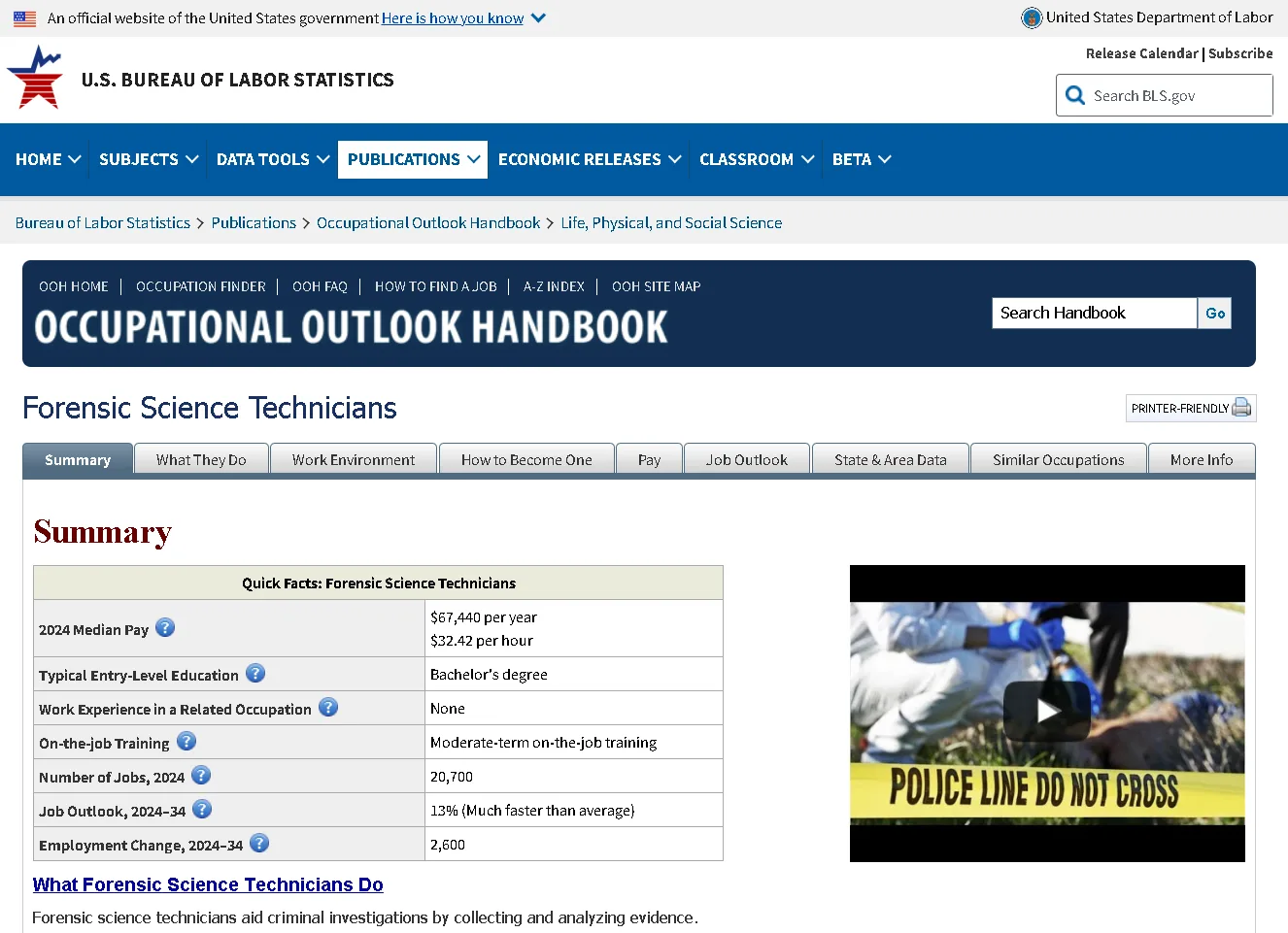
Explore the role of forensic science technicians, including job duties, salary, and career outlook based on BLS data.
Trust & Quality at My Physics Buddy
Tutor Selection
Every MPB tutor goes through a structured vetting process. For Forensic Physics, candidates must hold a graduate degree in physics, forensic science, forensic engineering, or a closely related discipline — with documented coursework or research experience in forensic physical analysis or a relevant applied physics area. They complete a subject knowledge assessment and a live demo session evaluated for both technical accuracy and pedagogical clarity. Ongoing feedback reviews after onboarding ensure quality is sustained, not just screened for at entry.
Academic Integrity
MPB’s position is direct: we guide, you submit your own work. Tutors explain physics, demonstrate solution methods on parallel examples, and give feedback on your reasoning and written interpretation. They do not complete your graded assignments, lab reports, or case study analyses. In a field where the rigour of physical reasoning is precisely what is being assessed — and where that rigour will eventually matter in professional and legal contexts — there is no shortcut worth taking. The American Physical Society’s guidelines on scientific integrity reflect the professional standard that MPB’s academic approach is built around.
We guide, you submit your own work. In a discipline where physical reasoning must withstand courtroom scrutiny, building that reasoning yourself is not optional.
About My Physics Buddy
MPB is a Physics-focused online tutoring platform serving undergraduate students, graduate students, PhD candidates, and their families — as well as academic administrators at universities across the US, UK, Canada, Australia, India, and Gulf countries. Our core is Physics and closely related quantitative subjects. Students working in areas directly adjacent to Forensic Physics can explore dedicated pages for Experimental Physics & Lab Skills, Acoustics & Sound Physics — directly relevant to forensic audio and voice analysis — and Medical Physics, which overlaps with forensic medical imaging and radiation analysis in several postgraduate programmes.
Students whose forensic physics work involves materials analysis at a deeper level can explore MPB’s Condensed Matter (Solid State) Physics page for the foundational theory behind material properties used in trace evidence examination. Those working on thermal or energy-based analysis in fire investigation contexts may find our Thermodynamics and Fluid Mechanics & Dynamics pages useful. Students strengthening their electromagnetism background for instrument-based forensic analysis can explore our Electromagnetism page.
Content reviewed by a Forensic Physics tutor at My Physics Buddy.
“Every contact leaves a trace — and every trace contains physics.”
— Adapted from Edmond Locard’s Exchange Principle, foundational to forensic science, as documented in the US Department of Justice National Criminal Justice Reference Service (OJPNCJRS)
Locard’s Exchange Principle — that every contact between two objects results in a mutual transfer of material — is the physical foundation on which forensic science is built. Understanding the physics that governs how that transfer happens, how much material transfers, how long it persists, and what it reveals about the event is what Forensic Physics training is designed to develop. It is a subject where the physics is not abstract — it is directly and consequentially connected to how justice is administered.
The scientific and institutional framework surrounding forensic physics is rigorous and well-established. The National Institute of Standards and Technology (NIST) Forensic Science programme in the US develops measurement standards and scientific foundations for forensic methods — including physical and materials-based evidence analysis. Their published standards and guidelines are referenced in advanced forensic physics coursework and represent the level of scientific rigour that the field demands.
In the UK, the Forensic Science Regulator publishes Codes of Practice and Conduct that define quality standards for forensic science providers, including physical evidence analysis. Understanding the regulatory context that surrounds forensic physics practice is part of what distinguishes a well-trained forensic physicist from one who only knows the theory in isolation from its professional and legal setting.
“The goal of forensic science is to answer the question ‘what happened?’ — and physics provides the most unambiguous language available for answering it.”
— Adapted from the framing in NIST Forensic Science research communications, National Institute of Standards and Technology
That language — precise, quantitative, and grounded in measurable physical reality — is what every Forensic Physics course is teaching you to speak. Whether you are reconstructing a collision, interpreting a fracture pattern, or estimating the muzzle-to-target distance from a gunshot residue deposit, you are translating physical evidence into physical statements that can withstand scientific scrutiny. MPB tutoring is built to help you develop that ability with the depth it deserves.
Forensic Physics is physics in service of justice. MPB tutors bring the subject depth and applied rigour to make that service genuinely credible — not just academically sufficient.
Next Steps
Share your current course context or exam goal — whether that is an undergraduate forensic physics module, a postgraduate course with a major forensic physics component, FACT / FACT+ preparation in the Ballistics and Physical Sciences elective, or a research project involving forensic physical evidence. Tell us the topics giving you the most difficulty and your exam or assignment timeline. We confirm your time zone and availability, then match you with a tutor whose depth fits your specific needs. In most cases, your first session can begin within a day or two of confirmation.
No long intake forms. No upfront commitment to a session block before you have seen the quality. Just a matched tutor, a diagnostic, and a plan built around your actual gaps.

