D Evans
asked on January 4, 2026
Common AP Physics exam mistakes
What are common AP Physics mistakes students make on the exam?
Need Help?
Hire one of our expert Physics tutor online. 24/7 Service. Available now.
Expert Answer
Answered on January 27, 2026 by EXPERT TUTOR

Dear D Evans,
The most common AP Physics mistakes students make on the exam come down to a handful of recurring conceptual and procedural errors — according to expert tutors at My Physics Buddy. Catching these patterns early and practicing targeted corrections can meaningfully raise your score.
The Most Common AP Physics Exam Mistakes — And How to Fix Them
As an IBDP & A-Level Physics Specialist with over 7 years of teaching experience, I can tell you that students across AP Physics consistently lose marks in the same predictable ways. The good news is that once you recognize these patterns, they are very fixable. Let me walk you through the most important ones, grouped by category.
1. Sign Errors in Kinematics and Newton’s Laws
This is the single most frequent error I see. Students set up the physics correctly but then lose track of positive and negative directions mid-problem. Think of it like driving navigation — if you define “north” as positive and then accidentally report a southward displacement as positive, every answer that follows is wrong even though your method was fine.
The kinematic equation most often mishandled is:
v² = v₀² + 2a·Δx
Where v = final velocity, v₀ = initial velocity, a = acceleration, and Δx = displacement. If an object is thrown upward and you define upward as positive, then a = −9.8 m/s². Students frequently forget to make acceleration negative and end up with a final speed that is impossibly large. Always define your positive direction first, write it down, and stick to it throughout.
2. Forgetting That Acceleration and Velocity Can Point in Opposite Directions
A very common conceptual mistake in AP Physics 1 free-response questions is assuming that if an object is slowing down, the net force must also be small or zero. This is wrong. A ball thrown upward is decelerating because the net force (gravity) points downward while velocity points upward — they are in opposite directions. The magnitude of the net force hasn’t changed at all. Students who misread motion diagrams or force vector diagrams due to this confusion drop easy marks.
3. Misapplying Energy Conservation vs. Newton’s Second Law
Students sometimes use energy methods when Newton’s second law is needed, or vice versa. A good rule of thumb: use energy conservation when you need speeds at different positions and time is not involved. Use F = ma (Newton’s second law) when you need forces, accelerations, or time-dependent quantities.
For example, to find the speed of a block at the bottom of a frictionless ramp of height h, energy is perfect:
mgh = ½mv² → v = √(2gh)
Where m = mass (kg), g = gravitational acceleration (9.8 m/s²), h = vertical height (m), and v = speed at the bottom (m/s). But if friction is present and you need the frictional force itself, energy alone won’t give you F — you need Newton’s second law combined with kinematics. Choosing the wrong tool wastes time and leads to incomplete answers.
4. Drawing Incomplete or Incorrect Free-Body Diagrams
The free-body diagram (FBD) is one of the most-tested skills in AP Physics, and partial credit is very specifically awarded for it. Missing forces (like the normal force or tension), drawing forces that don’t belong (like a “push” force on a projectile mid-air), or placing force arrows at the wrong points are all mark-losing errors. Every force on your FBD must come from a physical interaction with another object. A projectile in flight has only gravity acting on it — there is no “forward force” keeping it moving.
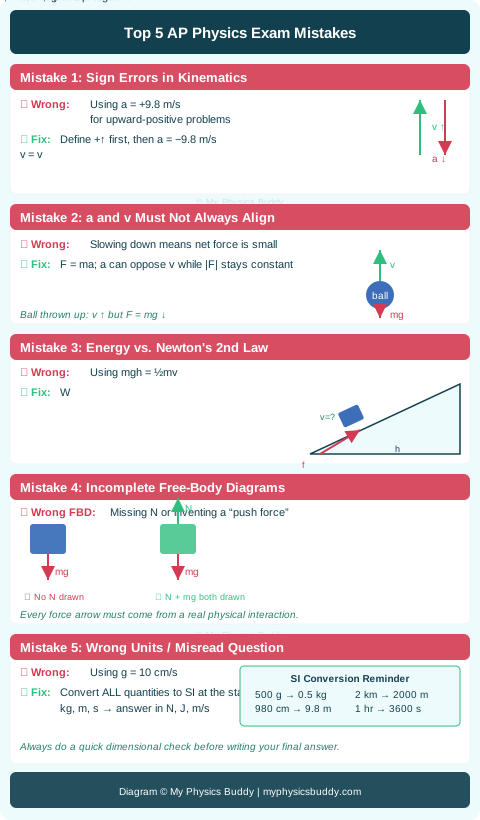
The diagram above summarizes the five most common AP Physics exam mistakes alongside the correct approach for each. Use it as a revision checklist before your exam.
5. Not Checking Units and Not Reading the Question Carefully
Many students calculate correctly but report the wrong unit, or answer a slightly different question than what was asked. If the question asks for the magnitude of the net force in Newtons and you report a component or use the wrong mass units, you lose the mark. Always convert to SI units at the start: kilograms, metres, seconds. A quick dimensional analysis at the end of each calculation is a habit that prevents unnecessary errors.
For a deeper look at how AP Physics exam questions are structured and scored, the College Board AP Physics 1 course page provides official free-response scoring guidelines that are extremely useful for understanding exactly where marks are awarded and lost.
Common Mistakes
✗ Mistake: Defining a positive direction at the start and then switching it inconsistently when a vector points the other way, causing sign errors throughout kinematics and force problems.
✓ Fix: Write your chosen positive direction explicitly at the top of every problem and apply it consistently to every vector — velocity, acceleration, force, and displacement — without exception.✗ Mistake: Drawing free-body diagrams with invented forces (like a “continuing force” on a projectile) or omitting real contact forces like the normal force on an object resting on a surface.
✓ Fix: For each force arrow you draw, name the object exerting it. If you cannot name a real physical source, remove the arrow.✗ Mistake: Applying energy conservation to a problem involving friction and then not accounting for the energy lost to heat, treating the system as if mechanical energy is fully conserved.
✓ Fix: Use the work-energy theorem: Wnet = ΔKE, and explicitly include the work done by friction as a negative term: Wfriction = −fk·d.
Exam Relevance: These common AP Physics mistakes are directly tested across AP Physics 1, AP Physics 2, and AP Physics C: Mechanics. Free-body diagrams, energy methods, and sign conventions appear consistently in both the multiple-choice and free-response sections of all three exams.
Pro Tip from Mamatha M: Before writing a single equation, spend 30 seconds labeling your coordinate system, drawing your FBD, and identifying which law applies. That setup prevents 80% of exam errors.
Related Questions
What is the difference between AP Physics 1 and AP Physics 2?
How to solve Gauss’s law problems in AP Physics 2?
What is the right-hand rule and how to apply it for magnetic fields?
How to calculate electric potential and potential energy?
How does a capacitor work and how to solve RC circuit problems?
What is Bernoulli’s equation and how to apply it to fluid flow?
What is the relationship between period and frequency for oscillations?
How to calculate the speed of a wave on a string?

