L Morris
asked on February 16, 2026
Newton's second law rotational form
How to apply Newton’s second law in rotational form?
Need Help?
Hire one of our expert Physics tutor online. 24/7 Service. Available now.
Expert Answer
Answered on February 26, 2026 by EXPERT TUTOR

Dear L Morris,
Newton’s second law in rotational form states that the net torque acting on an object equals its moment of inertia multiplied by its angular acceleration: τnet = Iα. According to expert tutors at My Physics Buddy, this is the rotational counterpart of F = ma, and mastering it unlocks nearly every rotation problem in AP Physics 1.
Understanding and Applying Newton’s Second Law in Rotational Form
Think of twisting open a stubborn jar lid. The harder you push along the rim (and the farther from the centre you push), the faster the lid starts spinning. That everyday experience captures the rotational version of Newton’s second law perfectly. In linear motion, a net force causes a linear acceleration. In rotational motion, a net torque causes an angular acceleration.
The Core Equation
The rotational form of Newton’s second law is written as:
τnet = I α
- τnet — net torque (N·m): the total rotational “push” acting on the object, found by summing all individual torques with their signs.
- I — moment of inertia (kg·m²): the rotational equivalent of mass; it measures how hard it is to change an object’s rotation. It depends on both the total mass and how that mass is distributed from the axis.
- α — angular acceleration (rad/s²): the rate at which the angular velocity is changing.
Each torque is calculated as:
τ = r F sinθ
- r — the distance from the pivot (axis of rotation) to the point where the force is applied (m).
- F — the magnitude of the applied force (N).
- θ — the angle between the force vector and the position vector (the line from pivot to point of application).
A torque that would cause counter-clockwise rotation is positive by convention; clockwise is negative (though you can choose your own sign convention as long as you stay consistent).
Intuition: Why Does Distribution of Mass Matter?
Imagine two identical dumbbells on a barbell. Slide them close to the centre — easy to spin. Slide them to the ends — much harder to spin, even though the total mass is identical. That difficulty is the moment of inertia I. Because α = τnet / I, a larger I means less angular acceleration for the same torque. As a Masters-level physics specialist, I can tell you that most student errors come from forgetting that I changes with the chosen axis, not just the mass.
Step-by-Step Method
- Identify the axis of rotation. Every torque and every moment of inertia must be calculated about the same axis.
- Draw a free-body diagram showing all forces and their points of application.
- Calculate each torque using τ = r F sinθ, assigning a sign based on your chosen positive direction.
- Sum the torques to find τnet.
- Identify or calculate I for the object about your chosen axis. Common formulas: solid disk I = ½MR², thin rod about centre I = (1/12)ML², point mass I = mr².
- Solve for α using α = τnet / I.
Worked Example
A uniform disk of mass M = 4 kg and radius R = 0.5 m is free to rotate about its centre. A rope wrapped around its rim applies a tangential force of F = 10 N. Find the angular acceleration.
Step 1 — Axis: The centre of the disk.
Step 2 — Torque: The force is tangential (θ = 90°), so sin 90° = 1.
τ = r F sinθ = (0.5 m)(10 N)(1) = 5 N·m
Step 3 — Moment of inertia of a solid disk:
I = ½MR² = ½(4 kg)(0.5 m)² = ½(4)(0.25) = 0.5 kg·m²
Step 4 — Angular acceleration:
α = τnet / I = 5 N·m / 0.5 kg·m² = 10 rad/s²
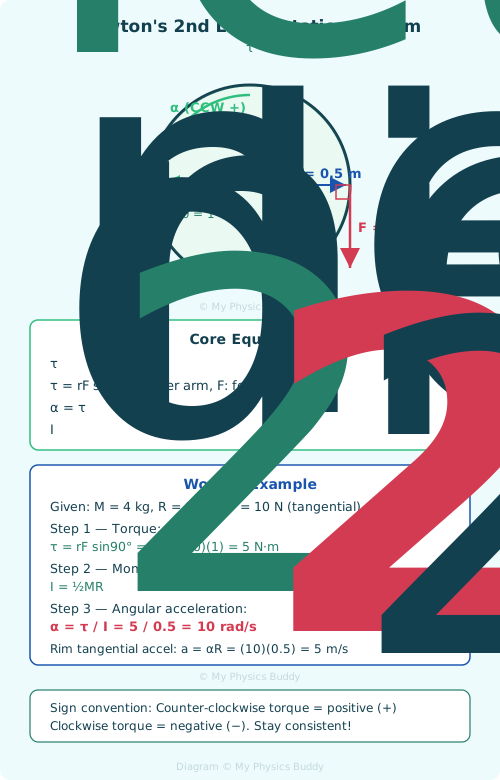
This result means the disk speeds up by 10 rad/s every second. You can connect this to linear quantities: the tangential acceleration of the rim is a = αR = (10)(0.5) = 5 m/s². For more on how torque and rotation connect across topics, visit the AP Physics resource hub. For the official College Board scope on rotation, see the AP Physics 1 Course and Exam Description from College Board.
Common Mistakes
✗ Mistake: Using the full force magnitude in the torque formula without accounting for the angle θ between the force and the lever arm.
✓ Fix: Always use τ = rF sinθ. When a force is applied at an angle, only the perpendicular component contributes to rotation. If the force is exactly tangential, θ = 90° and sinθ = 1.✗ Mistake: Mixing up or forgetting to specify the axis of rotation when calculating I.
✓ Fix: State the axis explicitly at the start of every problem. The same object has a different moment of inertia depending on the axis chosen, and τnet = Iα only holds when both τ and I are computed about the same axis.✗ Mistake: Ignoring sign conventions and treating all torques as positive, leading to incorrect net torques when multiple forces act.
✓ Fix: Declare a positive rotation direction (counter-clockwise or clockwise) before summing torques. Assign a negative sign to any torque that opposes your chosen positive direction, and carry those signs through to the final answer.
Exam Relevance: Newton’s second law in rotational form is explicitly tested in AP Physics 1 (Unit 7: Torque and Rotation) and AP Physics C: Mechanics. It also appears in IB Physics HL and A-Level Physics curricula under rotational dynamics.
💡 Pro Tip from Manikanta J: Always write α = τnet / I first, then substitute values — this habit prevents sign errors and keeps your axis choice visible throughout every rotational problem.
Related Questions
What is the difference between AP Physics 1 and AP Physics 2?
How to solve Gauss’s law problems in AP Physics 2?
What is the right-hand rule and how to apply it for magnetic fields?
How to calculate electric potential and potential energy?
How does a capacitor work and how to solve RC circuit problems?
What is Bernoulli’s equation and how to apply it to fluid flow?
What is the relationship between period and frequency for oscillations?
How to calculate the speed of a wave on a string?

