E Ferguson
asked on May 8, 2025
Mechanical energy conservation conditions
What is mechanical energy and when is it conserved?
Need Help?
Hire one of our expert Physics tutor online. 24/7 Service. Available now.
Expert Answer
Answered on May 23, 2025 by EXPERT TUTOR

Dear E Ferguson,
Mechanical energy is the total of an object’s kinetic energy and potential energy. According to expert tutors at My Physics Buddy, it is conserved whenever only conservative forces — like gravity or springs — do work on the system, meaning no energy is lost to friction or air resistance.
Understanding Mechanical Energy and When It Is Conserved
Mechanical energy (ME) is defined as the sum of two forms of energy that arise purely from an object’s motion and position:
- Kinetic Energy (KE) — the energy of motion: KE = ½mv², where m is mass in kg and v is speed in m/s.
- Gravitational Potential Energy (GPE) — the energy stored due to height: GPE = mgh, where g = 9.8 m/s² and h is height in metres above your chosen reference level.
- Elastic Potential Energy (EPE) — stored in a compressed or stretched spring: EPE = ½kx², where k is the spring constant in N/m and x is the compression or stretch in metres.
So the total mechanical energy at any moment is:
ME = KE + PE = ½mv² + mgh + ½kx²
The Conservation Condition
Mechanical energy is conserved when only conservative forces do work. A conservative force is one whose work depends only on start and end positions — not on the path taken. Gravity and spring forces are the two conservative forces you’ll encounter most in AP Physics 1.
When mechanical energy is conserved, the total stays constant throughout the motion:
MEinitial = MEfinal
KEi + PEi = KEf + PEf
Think of it like a currency exchange: kinetic energy and potential energy swap back and forth, but the total account balance never changes.
The Roller Coaster Analogy
Imagine a frictionless roller coaster. At the top of a hill, the cart moves slowly — mostly GPE, little KE. As it descends, GPE converts to KE and the cart speeds up. At the bottom, nearly all energy is KE. At the next hill it climbs again, converting KE back to GPE. The total ME stays the same at every point. This is the clearest everyday picture of conservation of mechanical energy.
When It Is NOT Conserved
Non-conservative forces — such as friction, air resistance, and applied external forces — do work that either removes energy from the mechanical system (as heat) or adds energy to it. When these forces act, mechanical energy is NOT conserved. The work-energy theorem still applies, but you must account for the energy lost or gained:
MEfinal = MEinitial + Wnon-conservative
where Wnon-conservative is negative if friction removes energy and positive if an engine adds energy.
Worked Example
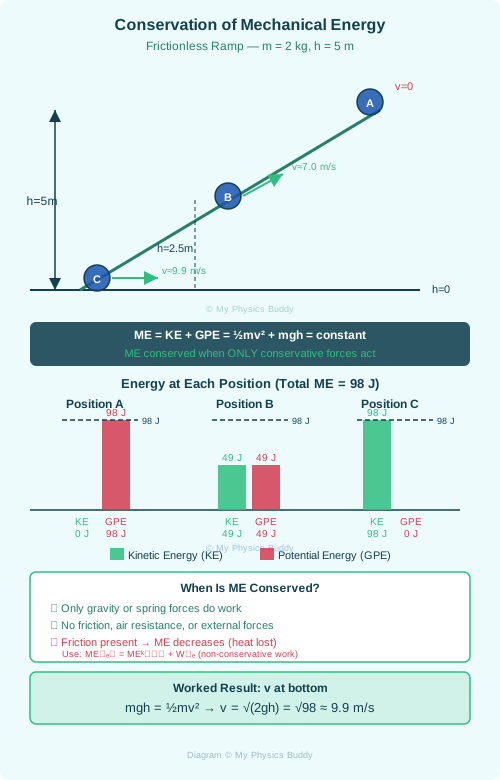
A 2 kg ball is released from rest at a height of 5 m above the ground on a frictionless ramp. What is its speed at the bottom?
Step 1 — Identify the system and forces. Only gravity acts (frictionless), so mechanical energy is conserved.
Step 2 — Write the conservation equation.
KEi + GPEi = KEf + GPEf
Step 3 — Substitute known values. The ball starts at rest (vi = 0) and the ground is the reference level (hf = 0):
0 + mghi = ½mvf² + 0
(2)(9.8)(5) = ½(2)vf²
98 = vf²
Step 4 — Solve for vf.
vf = √98 ≈ 9.9 m/s
Notice the mass cancelled — the final speed is independent of mass. That’s a beautiful and testable result. As a Masters in Physics graduate with over 7 years of teaching experience, I can tell you this mass-cancellation surprises many students the first time they see it, but it follows directly from the algebra every time.
For a deeper exploration of energy concepts within mechanics, visit the AP Physics resource hub. You can also review the official College Board course framework at AP Central — AP Physics 1 for how energy conservation is explicitly tested.
Common Mistakes
✗ Mistake: Setting the reference height h = 0 at a random or inconsistent location, causing sign errors in GPE calculations.
✓ Fix: Choose your reference level once at the start — usually the lowest point in the problem — and use it consistently for both initial and final states.✗ Mistake: Applying conservation of mechanical energy even when the problem mentions friction, a rough surface, or an applied force.
✓ Fix: Always check for non-conservative forces first. If friction or an external force is present, use Wnc = ΔME instead of MEi = MEf.✗ Mistake: Forgetting to include elastic potential energy (½kx²) when a spring is involved, and only using GPE.
✓ Fix: Write out the full ME expression at each position — KE + GPE + EPE — before cancelling terms that are zero.
Exam Relevance: Conservation of mechanical energy is a core topic in AP Physics 1, AP Physics C: Mechanics, IB Physics SL/HL, and A-Level Physics, appearing in both multiple-choice and free-response sections.
💡 Pro Tip from Manikanta J: Always write MEi = MEf in full before substituting numbers — it prevents you from accidentally skipping an energy term under exam pressure.
Related Questions
What is the difference between AP Physics 1 and AP Physics 2?
How to solve Gauss’s law problems in AP Physics 2?
What is the right-hand rule and how to apply it for magnetic fields?
How to calculate electric potential and potential energy?
How does a capacitor work and how to solve RC circuit problems?
What is Bernoulli’s equation and how to apply it to fluid flow?
What is the relationship between period and frequency for oscillations?
How to calculate the speed of a wave on a string?

