Edexcel A Level Physics Tutor Online
My Physics Buddy (MPB) offers 1:1 online tutoring & homework help in Physics and related subjects. Edexcel A Level Physics is one of the most widely taken physics qualifications in the UK and internationally — and it is also one of the most demanding at sixth-form level. The course combines conceptual breadth with genuine mathematical rigour, and the jump from GCSE to A Level catches many students off guard. Whether you are a Year 12 student building your foundations in mechanics and electricity, a Year 13 student working toward your final exams, an international student following the Edexcel specification from outside the UK, or a parent looking for reliable, structured support for your child, MPB matches you with a tutor who knows this specification in depth. If you have been looking for an Edexcel A Level Physics tutor near me, our fully online model means location is never a barrier — sessions run live over Google Meet with digital handwriting tools, from any time zone. Tutoring here is designed to help you aim for strong exam performance and a genuine understanding of the physics, not just mark-scheme familiarity.
- 1:1 live online sessions — fully personalised, no group classes or pre-recorded content
- Tutors with deep familiarity with the Edexcel A Level Physics specification and exam structure
- Flexible scheduling for students in the UK, US, Canada, Australia, Gulf, and internationally
- Structured learning plan built around your specification topics, weak areas, and exam timeline
- Ethical homework, assignment, and coursework guidance — we coach your understanding; you produce and submit your own work
Who This Edexcel A Level Physics Tutoring Is For
This programme is built for students who need focused, expert support for the Edexcel A Level Physics specification — and for the parents and educators who support them.
- Year 12 students in the UK beginning the AS content and building foundations in mechanics, waves, and electricity
- Year 13 students preparing for their final A Level exams and needing to consolidate across the full specification
- International students following the Edexcel specification at schools in the Gulf, South Asia, Southeast Asia, and elsewhere who need timezone-flexible, specification-aligned support
- Students who have fallen behind and need intensive catch-up sessions before mock or final exams
- Students targeting top grades (A and A*) who want to go beyond surface understanding to tackle the harder application and synoptic questions
- Students who need structured homework and assignment guidance — approached as conceptual coaching, never as answer delivery
- Parents seeking a credible, measurable tutoring solution for a high-stakes qualification
Outcomes: What You’ll Be Able to Do in Edexcel A Level Physics
Edexcel A Level Physics demands more than the ability to recall facts and substitute numbers into formulae. The exam rewards students who can reason physically, apply concepts to unfamiliar contexts, and communicate their thinking precisely. Our tutoring is designed to build all of those capabilities together.
Solve multi-step mechanics problems — from projectile motion to circular motion and simple harmonic motion — setting up equations from first principles rather than relying on formula recall alone. Analyse circuits, fields, and wave phenomena with confidence, moving fluidly between graphical, algebraic, and physical descriptions of the same situation. Apply the key ideas of quantum physics, nuclear physics, and astrophysics at the level the specification requires — with clear understanding of the underlying models and their limitations. Explain your reasoning in the structured, precise language that Edexcel examiners reward, rather than vague or incomplete responses. Approach the practical skills assessed in Paper 3 with a clear understanding of experimental design, uncertainty analysis, and the physics behind the method.
What We Cover in Edexcel A Level Physics (Specification Topics)
The content below reflects the Edexcel A Level Physics specification. Exact topic weighting and paper structure should always be verified against the current specification on the Pearson Edexcel A Level Physics qualification page, as details may be updated. Your tutor works directly from your current specification and past papers.
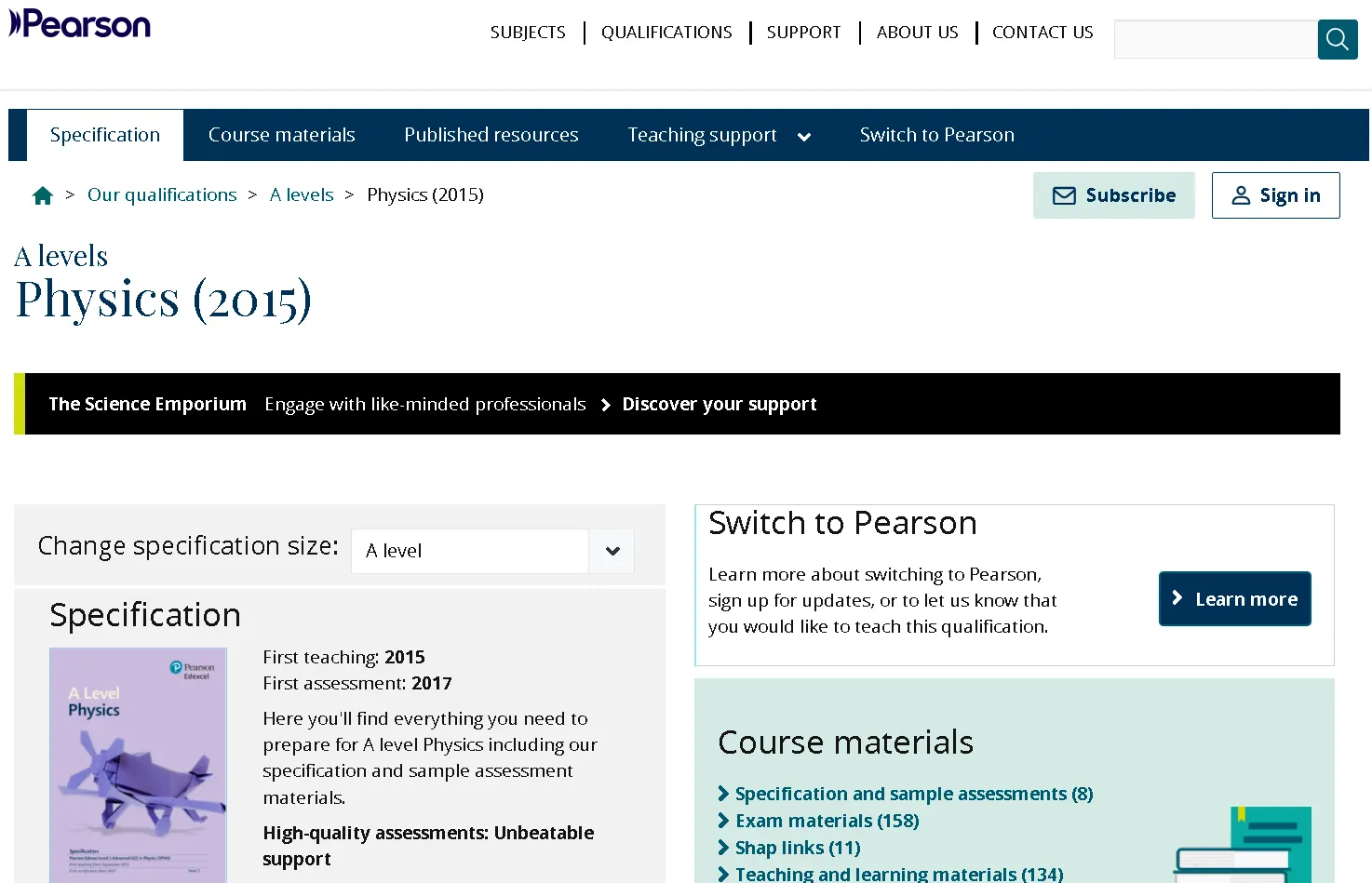
Explore the Pearson Edexcel A Level Physics qualification, including syllabus details, assessments, and teaching support materials.
Topic 1: Working as a Physicist
- SI units, derived units, and dimensional analysis
- Significant figures, orders of magnitude, and estimation
- Experimental skills: planning, data collection, analysis, and evaluation
- Uncertainty: absolute, fractional, and percentage — propagation through calculations
- Graphs: gradient, intercept, linearisation, and error bars
Topic 2: Mechanics
- Scalars and vectors — resolving and combining at angles
- Kinematics: SUVAT equations and their derivation from v-t graphs
- Newton’s laws of motion — applied to systems of particles and connected bodies
- Momentum, impulse, and conservation of momentum in collisions
- Work, energy, and power — including efficiency and energy transformation
- Materials: stress, strain, Young modulus, and stress-strain graphs
Topic 3: Electric Circuits
- Charge, current, potential difference, and resistance — definitions and relationships
- Ohm’s law and I-V characteristics for resistors, filament lamps, and diodes
- Resistivity and its temperature dependence
- Series and parallel circuits — systematic analysis using Kirchhoff’s laws
- EMF and internal resistance — circuit analysis and graphical determination
- Potential dividers and their applications
Topic 4: Materials
- Density and upthrust
- Elastic and plastic deformation, Hooke’s law, and the spring constant
- Young modulus — derivation, measurement, and interpretation
- Stress-strain graphs for different material types and what they reveal about material behaviour
Topic 5: Waves and Particle Nature of Light
- Progressive waves — transverse and longitudinal, amplitude, frequency, wavelength, speed
- The wave equation and its applications
- Superposition, interference, and the conditions for constructive and destructive interference
- Stationary waves — nodes, antinodes, and harmonics in strings and pipes
- Diffraction: single slit and double slit patterns
- The photoelectric effect — Einstein’s equation, work function, and threshold frequency
- Wave-particle duality — de Broglie wavelength and its physical interpretation
- Electron diffraction as evidence for wave nature of particles
Topic 6: Further Mechanics
- Momentum as a vector quantity — 2D collision problems
- Circular motion — centripetal acceleration, centripetal force, and the radian
- Simple harmonic motion — defining equation, solutions, and energy graphs
- Resonance, damping, and forced oscillations — graphical and physical interpretation
Topic 7: Electric and Magnetic Fields
- Electric field strength and field lines for uniform and radial fields
- Coulomb’s law and its comparison with Newton’s law of gravitation
- Electric potential and potential energy in a radial field
- Capacitors: capacitance, charge-voltage relationships, energy stored, and dielectrics
- Capacitor charging and discharging — exponential decay equations and time constants
- Magnetic flux density, force on a current-carrying conductor, and the motor effect
- Faraday’s and Lenz’s laws of electromagnetic induction
- Transformers — ideal and real, with efficiency considerations
Topic 8: Nuclear and Particle Physics
- The nuclear model — Rutherford scattering and what it reveled about atomic structure
- Strong nuclear force and nuclear stability
- Radioactive decay — alpha, beta, and gamma — equations, penetration, and ionisation
- Radioactive decay law — activity, decay constant, and half-life calculations
- Nuclear binding energy, mass defect, and the binding energy per nucleon curve
- Fission and fusion — energy release and the B/A curve
- The particle zoo — leptons, hadrons, quarks, and the Standard Model at A Level depth
Topic 9: Thermodynamics (A Level only)
- Internal energy and the first law of thermodynamics
- Specific heat capacity and specific latent heat — definitions and calculations
- Ideal gas behaviour and the ideal gas law
- Kinetic theory of gases — mean kinetic energy, molecular speed, and temperature
- Gas laws — Boyle’s, Charles’s, and Gay-Lussac’s — experimental verification and graphical forms
Topic 10: Space (A Level only)
- Gravitational fields — Newton’s law of gravitation, field strength, and potential
- Orbital mechanics — circular orbits, Kepler’s third law, and geostationary satellites
- Stellar classification — luminosity, temperature, and the Hertzsprung-Russell diagram
- Cosmology — Hubble’s law, redshift, and the expanding universe model
- The life cycle of stars and their endpoints
Topic 11: Nuclear Radiation (A Level only)
- Medical and industrial applications of radioactive isotopes
- Radiation safety and dose — absorbed dose, effective dose, and risk
- Nuclear reactors — moderation, control, and the fuel cycle
Practical Skills and Paper 3
- Core practicals on the Edexcel specification — method, measurement, and analysis
- Experimental design questions — identifying variables, control strategies, and appropriate instruments
- Uncertainty and error analysis applied to real experimental scenarios
- Data analysis questions — graph construction, gradient interpretation, and anomalous results
How My Physics Buddy Tutors Help You with Edexcel A Level Physics (The Learning Loop)
Diagnose: Every engagement begins with a targeted diagnostic. The tutor asks you to work through a problem or explain a concept from the area you find hardest. This reveals whether the difficulty is conceptual (e.g., not understanding why SHM produces sinusoidal motion), procedural (e.g., incorrect approach to resolving forces on an inclined plane), or exam-strategy related (e.g., losing marks on six-mark written questions because the reasoning is incomplete).
Explain: The tutor rebuilds each topic from a clear physical starting point. For Edexcel A Level Physics, this means connecting the equations to the physical ideas they represent — not just showing you how to rearrange them. The tutor explains both what the mark scheme wants and why the physics behind the answer works the way it does.
Practice: You work through problems live during the session — past Edexcel exam questions wherever possible. The tutor observes your problem-solving process, not just your final answer. For calculation questions, the working is as important as the result; for written questions, structure and precision matter enormously.
Feedback: After each question attempt, the tutor gives targeted, mark-scheme-aware feedback. You learn what examiners are specifically looking for — the key words, the required steps, and the common errors that cost marks even when the underlying physics is understood.
Retest / Reinforce: Topics from earlier sessions are revisited with new questions in later sessions. The tutor confirms understanding is solid before advancing — for instance, verifying that circular motion is fully secure before tackling SHM, which builds on the same centripetal acceleration concept.
Plan: Each session ends with a clear agenda for the next: topics to cover, past paper questions to attempt, and any specification points to revisit independently.
Accountability: For students on an exam timeline, the tutor maintains a checklist of specification topics covered and confidence levels, and flags areas needing attention before mocks or finals.
All sessions run via Google Meet. Tutors use a digital pen-pad or iPad + Apple Pencil so that diagrams, circuit sketches, wave drawings, and worked solutions are written live on screen — not presented as static PDF notes. Pace adapts completely to you. Before your first session, share your current specification topics, the areas you find hardest, your mock results if available, and your exam date. The tutor uses this to make the first session immedietly useful rather than spending it on general orientation.
Tutor Match Criteria (How We Pick Your Tutor)
Not every physics tutor is familiar with the specific demands of the Edexcel A Level specification. The mark scheme language, the practical skills questions, and the synoptic Paper 3 all have particular conventions. Here is how MPB matches you with a tutor who genuinely fits.
Level and specification fit: Tutors for this subject have direct familiarity with the Edexcel A Level Physics specification — not just A Level Physics in general. They know which topics appear in which papers, what the core practicals are, and how Edexcel’s mark schemes are structured.
Topic strengths: We match based on your primary areas of difficulty — whether that is mechanics, fields, waves, nuclear physics, or practical skills — so the tutor has the depth where you need it most.
Tools and setup: Google Meet for video, digital pen-pad or iPad + Apple Pencil for live working. Circuit diagrams, field line sketches, and vector diagrams are drawn in real time — not copied from a textbook.
Time zone and availability: Tutors cover UK, US, Gulf, Australian, and other international time zones. Early mornings, evenings, and weekends are all available.
Learning style and pace: Some students want methodical step-by-step derivations; others want a faster pace through past paper practice. We account for this in matching.
Language and communication preferences: Tutors are selected for clear, accessible communication at the right level for A Level students. Regional preferences can be noted.
Goals: Whether your goal is to pass your exams, achieve an A*, or build solid foundations before university — the tutor match reflects that goal and the timeline it implies.
Urgency and timelines: Students with mocks or final exams approaching are matched for intensive sessions. Students with more time are matched for a sustainable, structured weekly programme.
Study Plans (Pick One That Matches Your Goal)
MPB offers three broad plan types: a catch-up plan for students with an imminent mock or exam deadline (typically 1–2 weeks of focused, high-frequency sessions on the most urgent topics), an exam prep plan for students building systematically toward their A Level exams over 4–8 weeks, and an ongoing weekly support plan for students who want consistent help across Year 12 or Year 13. In every case, the specific session plan is built by your tutor after the diagnostic — because the right plan depends on what you actually know and where your marks are being lost, not what the specification assumes you have covered.
Pricing Guide
Edexcel A Level Physics tutoring at MPB is priced based on the level of support required, tutor expertise, and your scheduling needs. Rates typically start at USD 20 per hour and go up to USD 40 per hour for most A Level sessions. For very advanced content, very short turnaround timelines, or highly specialised tutors, rates may go higher.
Price is influenced by the complexity of the topics, tutor availability, and how quickly you need sessions to begin. Students who plan ahead generaly find more flexibility in both scheduling and rates.
All rates are confirmed before your first session — no surprises, no hidden fees. WhatsApp for a quick quote.
FAQ
Is Edexcel A Level Physics hard?
Yes — it is widely regarded as one of the more demanding A Level subjects. The combination of conceptual depth, mathematical requirement, and the expectation of precise written explanation makes it challenging for many students. According to data published by the Joint Council for Qualifications (JCQ), A Level Physics consistently has a lower proportion of top grades compared to many other A Level subjects, reflecting genuine difficulty rather than just perception. With the right support, the subject becomes structured and manageable.

Understand JCQ malpractice policies, including how to identify, report, and prevent exam misconduct.
How many sessions are needed?
It depends on your starting point, how much of the specification remains, and your exam timeline. A student in Year 13 with solid Year 12 foundations who needs targeted revision over six weeks might need 10–14 sessions. A Year 12 student wanting ongoing weekly support across both years may need significantly more. Your tutor will give a realistic estimate after the diagnostic — not a generic one.
Can you help with homework and assignments?
Yes — with a clear framing. Tutors explain the physics behind your homework problems, work through similar examples to build your technique, and coach your approach to written questions. They do not complete your homework or coursework on your behalf, and you produce and submit your own answers. Our services aim to provide personalised academic guidance, helping students understand concepts and improve skills. Materials provided are for reference and learning purposes only. Misusing them for academic dishonesty or violations of integrity policies is strongly discouraged.
Will the tutor follow the exact Edexcel specification?
Yes. Tutors work directly from the current Edexcel A Level Physics specification. That said, Pearson Edexcel updates its specification and mark scheme guidance periodically, so your tutor will also cross-reference the most current version of the specification and any available examiner reports. Always verify current specification details directly on the Pearson Edexcel qualification page.
What happens in the first session?
The session begins with a short diagnostic — a problem or concept explanation from the topic you find hardest. The tutor starts teaching immediately based on what the diagnostic reveals. You leave the first session with a clear 2–4 session plan. There is no lengthy intake or orientation process.
Is online tutoring as effective as in-person for A Level Physics?
For a specification-focused exam like Edexcel A Level Physics, what matters most is the quality of explanation and the volume of targeted past paper practice — neither of which requires physical presence. Our tutors use live digital handwriting tools so that all working, diagrams, and annotations are visible in real time. Many students find the focused, one-to-one online environment more productive than shared in-person settings.
Can you help specifically with Paper 3 practical skills questions?
Yes. Paper 3 is one of the areas where students most commonly underperform relative to their actual physics knowledge, because it requires a specific set of skills — experimental design, uncertainty analysis, graphical interpretation — that are rarely practised systematically. Tutors cover all of the core practicals on the Edexcel specification and specifically train you for the types of questions that appear in Paper 3.
How does your tutoring handle the synoptic questions in Paper 3?
Synoptic questions draw on multiple topic areas simultaneously — they are designed to test whether you can apply physics flexibly, not just recall individual topics in isolation. Tutors specifically practise these question types in sessions, helping you build the habit of identifying which physics principles are relevant and how to connect them in a structured answer.
My child is struggling but won’t tell me exactly what the problem is. Can tutoring still help?
Yes — this is actually a common situation. The diagnostic in the first session is designed precisely for this: it identifies the real gaps without relying on the student to self-report accurately. Students often believe they struggle with “everything” when the actual problem is one or two foundational misconceptions that, once resolved, unlock a much wider area of the specification.
Do you cover AS Level content as well as the full A Level?
Yes. Whether a student is taking AS Level only, or working through Year 12 content as part of the full A Level, tutors cover the same specification topics. The pacing and depth adapt to whether the student is heading for an AS qualification or continuing to A Level.
Can you help students who are resitting their A Level exams?
Yes. Resit students often have a clear picture of where their marks were lost from their previous exam series, which makes the diagnostic conversation particularly focussed and efficient. Tutors tailor intensive revision directly to the topics and question types that cost the most marks in the previous sitting.
Trust & Quality at My Physics Buddy
Tutor Selection
Every MPB tutor goes through a structured vetting process. For Edexcel A Level Physics, candidates must demonstrate direct familiarity with the specification — not just general physics knowledge. They hold undergraduate or postgraduate degrees in physics or closely related disciplines and complete a subject knowledge assessment, a live demo session, and ongoing feedback reviews after onboarding. Tutors who do not consistently meet student expectations are not retained.
Academic Integrity
MPB’s approach is direct: we guide, you submit your own work. Tutors explain physics, work through parallel examples, and give feedback on your reasoning. They do not complete homework, coursework, or assignments on your behalf. This is not just an integrity requirement — it is the only approach that actually prepares you for the exam room, where no tutor is present. The Joint Council for Qualifications malpractice guidelines set the regulatory standard that MPB’s academic approach reflects.
We guide, you submit your own work. That is the only preparation that actually counts when you sit down in the exam hall.
About My Physics Buddy
MPB is a Physics-focused online tutoring platform serving A Level students, early college students, graduate students, and their families — as well as academic administrators at schools and universities across the US, UK, Canada, Australia, and Gulf countries. Our core is Physics and closely related quantitative subjects. Students working across related UK physics qualifications can explore our dedicated pages for A/AS Level Physics (9702) — the Cambridge International specification — and GCSE Physics for students building their foundations before A Level.
Students who go on to university-level physics after their A Levels may find our pages on Classical (Newtonian) Mechanics, Electromagnetism, and Thermodynamics useful as they transition to degree-level content. Students also taking other standardised physics assessments can explore our AP Physics page for US-curriculum support.
Content reviewed by an Edexcel A Level Physics tutor at My Physics Buddy.
“Physics is really nothing more than a search for ultimate simplicity, but so far all we have is a kind of elegant messiness.”
— Bill Bryson, as cited in APS News, American Physical Society
That elegant messiness is exactly what A Level Physics introduces — a world where the equations are clean but the physical situations they describe are endlessly varied and sometimes counterintuitive. The role of a good tutor is to help you see the simplicity underneath the complexity, topic by topic, until the whole specification feels navigable rather than overwhelming.
The Edexcel A Level Physics qualification is regulated by Ofqual, the Office of Qualifications and Examinations Regulation in England, which sets the standards for all A Level qualifications. Understanding the regulatory framework helps students and parents trust that the qualification carries consistent, recognised weight for university admissions across the UK and internationally.
For university admissions context, physics A Level is listed as a required or strongly preferred subject for physics, engineering, and many mathematics degrees at leading UK universities. UCAS guidance on A Level subject choices confirms the strong preference for physics among STEM applicants, making strong performance in Edexcel A Level Physics directly consequential for university entry.

Understand UCAS entry requirements, including qualifications, grades, and additional criteria for UK university admissions.
Students preparing for the transition from A Level to university physics — particularly those heading into courses that begin immediately with calculus-based mechanics or electromagnetism — may also benefit from exploring MPB’s Engineering Physics and Waves and Optics pages to get a head start on the content that awaits them in first-year university courses.
“The important thing is not to stop questioning. Curiosity has its own reason for existing.”
— Albert Einstein, as quoted in The New York Times, 18 April 1955
That curiosity — the habit of asking why an equation takes the form it does, why a wave behaves the way it does, why a nucleus is stable or unstable — is what separates students who genuinely understand A Level Physics from those who have only memorised it. MPB tutoring is built to develop that habit deliberately, not just to cover the specification efficiently.
Edexcel A Level Physics is a qualification that opens doors — to top university courses, to engineering and science careers, and to a way of thinking about the physical world that stays with you. MPB tutors are matched to help you earn it properly.
Next Steps
Tell us your current year group, which topics are giving you the most difficulty, your mock or exam dates, and how many sessions per week you are looking for. We confirm your time zone and availability, then match you with a tutor whose specification knowledge and teaching style fits your needs. In most cases, your first session can begin within a day or two of confirmation.
No long intake forms. No upfront commitment to a session block before you have seen the quality. Just a matched tutor, a diagnostic, and a plan built around your actual gaps and your exam timeline.

