Hire Best A/AS Level Physics (9702) Tutors Online



Testimonials



A/AS Level Physics (9702) Tutor Online
My Physics Buddy (MPB) offers 1:1 online tutoring & homework help in Physics and related subjects. Cambridge International A Level and AS Level Physics (syllabus code 9702) is one of the most respected and demanding physics qualifications in the world — taken by students in the UK, UAE, Saudi Arabia, Qatar, Singapore, Australia, Canada, and across global Cambridge International schools. MPB connects you with a specialist tutor for live, personalized sessions aligned to the Cambridge 9702 syllabus, your specific paper targets, and your exam session. Whether you are a student searching for an A Level Physics tutor near me, a parent looking for reliable Cambridge Physics support, or a school coordinator seeking qualified online tutoring for students, MPB is built for this qualification. Sessions are designed to help you aim for strong grades at AS or A Level and build the deep conceptual understanding that university Physics and Engineering programs expect.
- 1:1 live sessions — fully aligned to the Cambridge 9702 syllabus and assessment objectives
- Tutors matched by A Level or AS Level target, topic strengths, and your learning pace
- Covers both the academic course content and standardised exam technique for Papers 1, 2, 3, 4, and 5
- Flexible scheduling across UK, UAE, Saudi Arabia, Qatar, Australia, Canada, and US time zones
- Structured learning plan built after a diagnostic session
- Ethical homework and assignment guidance — we explain concepts, you submit your own work
Who This A/AS Level Physics (9702) Tutoring Is For
Cambridge A/AS Level Physics (9702) attracts students from a wide range of school systems and regions. MPB’s tutoring program is built to serve all of them.
- AS Level students in the UK, Australia, or Gulf region working through Year 12 content and preparing for their AS papers or the first year of A Level
- A Level students in Year 13 consolidating the full 9702 syllabus and targeting A or A* grades in the Cambridge International exams
- Students in UAE, Saudi Arabia, Qatar, Bahrain, and other Gulf countries attending British-curriculum or Cambridge-accredited international schools
- Students in Canada, Australia, or the US taking Cambridge A Levels as an alternative or supplement to local qualifications
- Parents of Cambridge Physics students who want accountable, expert weekly support for their child
- Students who need guidance on homework problems, structured notes, past paper technique, or practical (Paper 3 and Paper 5) preparation
- School coordinators or heads of department at international schools looking for vetted online tutor support for multiple students
Outcomes: What You’ll Be Able To Do in A/AS Level Physics (9702)
Cambridge 9702 is a two-year qualification that tests both conceptual depth and exam craft. Strong tutoring builds both. These are the kinds of capabilities that well-targeted preparation develops — they are observable outcomes, not guarantees.
Solve structured exam questions across all major 9702 topic areas — mechanics, electricity, waves, fields, thermal physics, nuclear physics, and more — with the precision Cambridge mark schemes demand. Analyse unfamiliar physical scenarios using first principles, the approach Cambridge consistently rewards in higher-mark questions. Explain physical phenomena clearly and concisely in the language the syllabus uses, matching the assessment objective language for AO1, AO2, and AO3 questions. Write up practical work and data analysis with the accuracy and format Cambridge expects in Paper 3 and Paper 5, including uncertainty estimation, graph work, and conclusion writing. Apply mathematical skills — including algebra, trigonometry, logarithms, and basic calculus concepts — to physics problems in the way the 9702 syllabus requires at A Level.
What We Cover in A/AS Level Physics (9702) (Syllabus / Topics)
MPB’s coverage follows the Cambridge International AS & A Level Physics syllabus (9702), as published by Cambridge Assessment International Education (CAIE). Exact paper structures and topic weightings may vary by exam series — always verify current details with CAIE directly.
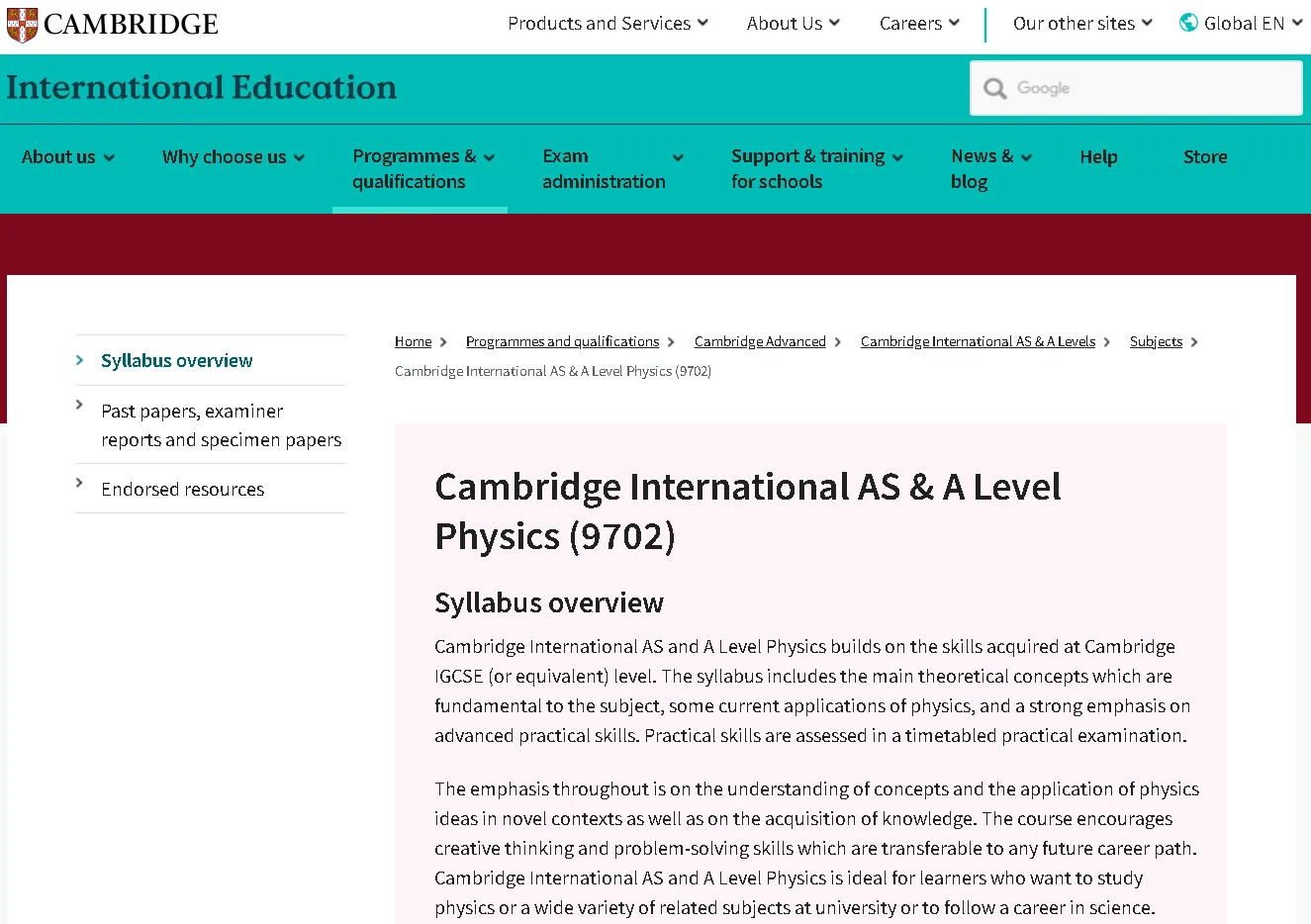
Explore Cambridge International AS & A Level Physics (9702), covering advanced concepts, practical skills, and exam preparation.
AS Level Content (examined in Papers 1, 2, and 3)
- Physical quantities and units: SI units, scalars and vectors, estimation
- Kinematics: uniform acceleration, graphs of motion, projectile motion
- Dynamics: Newton’s laws, momentum, impulse, conservation of momentum
- Forces, density, and pressure: equilibrium, moments, centre of gravity
- Work, energy, and power: conservation of energy, efficiency, power calculations
- Deformation of solids: stress, strain, Young modulus, elastic and plastic behaviour
- Waves: progressive and stationary waves, superposition, diffraction, interference, polarisation
- Superposition: Young’s double slit, diffraction gratings, standing waves on strings and in pipes
- Electric fields: field strength, potential, Coulomb’s law, uniform fields
- Current of electricity: charge, current, potential difference, resistance, Ohm’s law, I-V characteristics
- D.C. circuits: Kirchhoff’s laws, potential dividers, internal resistance, EMF
- Particle and nuclear physics: atomic structure, radioactive decay, nuclear reactions at AS level
A Level Further Content (examined in Papers 4 and 5)
- Motion in a circle: angular velocity, centripetal acceleration and force
- Gravitational fields: Newton’s law of gravitation, field strength, gravitational potential, orbital motion, escape velocity
- Temperature and ideal gases: thermodynamic temperature, gas laws, kinetic model of an ideal gas
- Thermal physics: specific heat capacity, specific latent heat, internal energy
- Oscillations: SHM — defining equation, energy, damping, resonance
- Electric fields (A Level extension): potential energy, capacitance of a sphere
- Capacitance: capacitor charging and discharging, time constant, energy in a capacitor
- Magnetic fields: force on a conductor and moving charge, magnetic flux density, Hall effect
- Electromagnetic induction: magnetic flux, Faraday’s law, Lenz’s law, alternating current, transformers
- Alternating currents: RMS values, rectification, smoothing with capacitors
- Quantum physics: photoelectric effect, Einstein’s equation, wave-particle duality, atomic energy levels, line spectra
- Nuclear physics: binding energy, mass defect, fission and fusion, radioactive decay law, half-life calculations
- Medical imaging (selected schools): X-rays, ultrasound, MRI — varies by school choice
- Astronomy and cosmology (selected schools): Hubble’s law, red shift, Big Bang — varies by school choice
Practical Skills (Papers 3 and 5)
- Planning experiments: identifying variables, writing a method, predicting relationships
- Collecting and recording data: tables, significant figures, units
- Processing data: calculating derived quantities, plotting graphs with error bars
- Evaluating results: identifying sources of error, estimating uncertainties, suggesting improvements
- Paper 5 (A Level planning exercise): full experimental design from a given problem
Exam Technique (Papers 1, 2, 4, and 5)
- Multiple-choice strategy for Paper 1: common distractor patterns, time management
- Structured question technique for Papers 2 and 4: command word interpretation (state, explain, deduce, show that, sketch)
- Mark scheme language: matching Cambridge’s expected phrasing without memorising by rote
- Data response and unfamiliar context questions: strategy for the higher-mark items in Papers 2 and 4
- Past paper practice and examiner report analysis
Students looking to deepen their understanding of specific 9702 topic areas can also explore related MPB tutoring pages including Waves and Optics, Electromagnetism, and Nuclear Physics.
How My Physics Buddy Tutors Help You with A/AS Level Physics (9702) (The Learning Loop)
Diagnose: Every engagement begins with a diagnostic. The tutor identifies which 9702 topics are secure, which are shaky, and where your exam technique breaks down — whether that is explaining phenomena in the right language, handling uncertainty in practical questions, or structuring multi-mark answers. This shapes every session that follows.
Explain: Cambridge 9702 questions regularly test whether you understand the physics at a level beyond the textbook summary. Your tutor goes to first principles when needed — explaining why a standing wave has nodes and antinodes, not just that it does — and adapts the explanation until the concept is genuinely clear, not just familiar.
Practice: You work through Cambridge-style questions live during sessions: Paper 1 MCQs with distractor analysis, structured Paper 2 and 4 questions with mark scheme comparison, and practical Paper 3 and 5 scenarios. The tutor watches your reasoning process, not just your answer.
Feedback: After each question or question set, you receive specific, actionable feedback tied to Cambridge assessment objectives. “You described the observation correctly but the explanation needs the physics mechanism — Cambridge wants you to say why, not just what” is more useful than general encouragement.
Retest / Reinforce: Topics from earlier sessions return in new question contexts. Electromagnetic induction, for example, is tested in multiple question formats across Papers 4 and 5, and each encounter reinforces the core principle from a different angle.
Plan: The tutor updates the session plan based on your mark trajectory, your exam series (May/June or October/November), and your growing confidence across topics. You always know what the next session targets and why.
Accountability: For students on weekly plans, tutors monitor progress between sessions and help you stay on track with your school’s pacing guide and your own revision schedule.
Sessions run live on Google Meet with a digital pen-pad or iPad + Apple Pencil — essential for a subject where drawing circuit diagrams, field line sketches, ray diagrams, and graph annotations are part of understanding the material. Before your first session, share your current syllabus unit, any recent test or paper results, your target grade, and your exam series. The first session typically includes a short diagnostic covering two or three topic areas, a live teaching segment on your most urgent weak point, and a clear plan for the next two to four sessions.
Cambridge International A Level Physics (9702) is recognised by universities across the UK, US, Canada, Australia, and the Gulf as evidence of rigorous scientific preparation. According to Cambridge International’s university recognition database, A Level results are accepted for entry and credit by hundreds of leading universities worldwide. The depth of the 9702 syllabus — particularly at A Level — means that students who master it are genuinely prepared for first-year university physics, not just the qualification itself.
Tutor Match Criteria (How We Pick Your Tutor)
MPB matches you to a tutor based on several specific factors. Here is what goes into the decision for Cambridge A/AS Level Physics (9702):
Level and syllabus fit: Your tutor will have direct, hands-on experience with the Cambridge 9702 syllabus — including its assessment objective structure (AO1, AO2, AO3), its paper formats, and its mark scheme conventions. Tutors distinguish between AS Level content and A Level further content and teach accordingly.
Topic strengths: If your weak area is oscillations and SHM, electromagnetic induction, or practical uncertainty analysis, we match you with a tutor whose demonstrated strength covers that domain precisely.
Tools and setup: All MPB tutors use Google Meet for live sessions and a digital pen-pad or iPad + Apple Pencil for real-time diagram work, graph sketching, and equation annotation — essential for a syllabus where visual problem-solving is frequent.
Time zone and availability: Tutors are available across UK, UAE, Saudi Arabia, Qatar, Australia, Canada, and US time zones, covering the full spread of regions where Cambridge A Levels are taken. Sessions fit around your school timetable and any other exam commitments.
Learning style and pace: Some students need methodical concept-building from first principles before touching exam questions. Others want high-volume past paper practice from session one. Your tutor adjusts the mode to match what works for you.
Language and communication preferences: Clear, accessible English-language instruction is the default, with style adapted to your background and comfort level.
Goals: A student targeting A* at A Level has different session needs than one aiming to pass AS, catch up on missed content, or build confidence before a resit. We align on your goal before sessions begin.
Urgency and timeline: A student six weeks from the May/June exam series gets a compressed, targeted plan. A student starting at the beginning of Year 12 gets a paced, full-course structure. Tutor selection accounts for your remaining time and exam series.
Study Plans (Pick One That Matches Your Goal)
MPB offers three broad plan types for Cambridge 9702: a short catch-up plan (typically one to two weeks) for students who need to close specific topic gaps quickly before an exam, an exam prep plan (typically four to eight weeks) for structured preparation across the full paper set, and an ongoing weekly support plan for students who want consistent expert guidance across Year 12 and Year 13. The tutor builds the specific session-by-session plan after the diagnostic — no fixed schedule is set until your starting point, target grade, and exam series are clearly understood.
Pricing Guide
A/AS Level Physics (9702) tutoring at MPB starts at USD 20 per hour and typically ranges up to USD 40 per hour for most AS and A Level sessions. For students requiring highly specialised A Level further content (nuclear physics derivations, in-depth SHM and oscillation analysis, advanced practical planning) or very compressed exam timelines, rates may go higher — up to USD 100 per hour in some cases.
Pricing depends on the tutor’s qualification and experience level, whether you are targeting AS or full A Level, your exam timeline and session frequency, and the complexity of topics you need covered. All rates are discussed transparently before you commit to any plan.
Cambridge A/AS Level Physics (9702) is both a rigorous academic course and a high-stakes standardised exam. Students who treat it as only one of these two things — either pure content learning without exam technique, or only past paper drilling without conceptual depth — tend to underperform relative to their potential. The most effective preparation addresses both dimensions simultaneously, and that is what structured 1:1 tutoring is designed to do.
FAQ
Is A/AS Level Physics (9702) hard?
Cambridge A Level Physics is widely regarded as a challenging qualification. The A Level content is notably deeper than GCSE or AS Level, and the exam papers test both conceptual reasoning and mathematical application. That said, students who build genuine understanding of core principles — rather than memorising mark scheme answers — consistently find it manageable with consistent effort and good guidance.
How many sessions are needed?
This depends on your current level, target grade, and how far your exam series is. Students doing targeted gap-filling before an exam may need six to ten sessions. Students on a full-year AS or A Level support plan typically benefit from regular weekly sessions across one or two academic years. Your tutor will give a more specific estimate after the diagnostic session.
Can you help with A Level Physics homework or assignments?
Yes — as guided support, not submission. Your tutor will walk through problem-solving approaches, explain the physics behind confusing questions, and help you understand why your answer did or did not match the mark scheme. MPB does not complete or submit work for students. All guidance is for learning and reference purposes only. Academic integrity is non-negotiable, and students are expected to submit their own work at all times.
Does the tutoring exactly match my school’s 9702 syllabus sequence?
MPB follows the official Cambridge International AS & A Level Physics (9702) syllabus. Since schools sequence topics differently, it helps to share your school’s current chapter or unit before the first session. The tutor will align sessions to wherever you are in your school’s teaching order rather than imposing a separate sequence.
What happens in the first session?
The first session includes a short diagnostic covering two or three 9702 topic areas, a live teaching segment on your most urgent weak point, and a clear plan for the next two to four sessions. Come prepared with your current syllabus unit or chapter, any recent test or past paper results, your target grade, and your exam series (May/June or October/November). The session runs on Google Meet with digital pen-pad support.
Is online tutoring as effective as in-person for Cambridge Physics?
For a structured, content-heavy qualification like Cambridge 9702, online tutoring with digital pen-pad tools is highly effective. Your tutor can draw circuit diagrams, field line sketches, ray diagrams, velocity-time graphs, and free-body diagrams in real time while you interact. Research on online STEM learning, including work published by EDUCAUSE, suggests that one-on-one online instruction compares favourably to in-person formats when the tools and tutor quality are strong.
Explore EDUCAUSE research and publications for insights into higher education technology, trends, and digital transformation.
Can you help with Cambridge Paper 3 and Paper 5 practical questions?
Yes. Practical skills are a significant part of the Cambridge 9702 assessment. Your tutor can guide you through planning experiments, identifying variables, drawing and interpreting graphs with error bars, estimating uncertainties, and writing up evaluations. Paper 5 planning exercises — where you design a full experiment from a given scenario — are a particular focus area for A Level students. MPB does not complete practical write-ups for students.
What is the difference between AS Level and A Level for 9702?
AS Level (examined at the end of Year 12 in many schools) covers roughly the first half of the 9702 syllabus, examined through Papers 1, 2, and 3. A Level (end of Year 13) includes the full syllabus — AS content plus further topics such as circular motion, gravitational and electric fields, oscillations, capacitance, electromagnetic induction, quantum physics, and nuclear physics — examined through Papers 1, 2, 3, 4, and 5. Many Cambridge schools offer AS as a standalone qualification or as a stepping stone to the full A Level. Your tutor will focus on whichever level is relevant to you.
Can MPB also help with other Cambridge Physics or related exams?
Yes. MPB supports a wide range of Physics qualifications. Students preparing for IGCSE Physics (0625) before transitioning to A Level, students sitting the GCSE Physics exam, or students exploring IB Physics HL/SL as an alternative to Cambridge A Levels can all find relevant support on MPB.
Do Cambridge A Level Physics results count for university admission in the US?
Yes. Cambridge International A Level results are recognised by many US universities for admission purposes and, in some cases, for course credit. According to Cambridge International’s university recognition information, hundreds of US institutions accept A Level results. Students should check directly with the universities they are applying to for specific credit transfer policies.
What resources does MPB use alongside the 9702 syllabus?
Tutors typically work from the official Cambridge 9702 syllabus document, Cambridge past papers and mark schemes (available via the Cambridge International past papers portal), and examiner reports. Commonly used textbooks include Sang, Jones, Chadha & Woodside (Cambridge University Press) and Muncaster’s A Level Physics. If your school uses a specific text, share it beforehand and the tutor will incorporate it.
Can university students or those beyond A Level also use MPB for physics support?
Yes. While Cambridge 9702 is a pre-university qualification, MPB serves learners at all levels. Students moving into university-level physics who want to consolidate their A Level foundations can explore topics including Classical (Newtonian) Mechanics, Thermodynamics, and Quantum Mechanics on MPB — all of which build directly on the A Level Physics foundation.
Trust & Quality at My Physics Buddy
Tutor selection: MPB tutors for Cambridge A/AS Level Physics (9702) hold degrees in Physics, Engineering Physics, or closely related quantitative fields — many at the postgraduate level. Every tutor goes through a subject screening that includes a live demo session and an ongoing student feedback loop. Tutors are familiar with the Cambridge 9702 assessment objectives, mark scheme conventions, and the specific language that examiners use and reward. They are not generalists assigned to any physics course — they are matched to the Cambridge qualification, level, and topic areas you are preparing for.
Academic integrity: MPB’s position is clear — we guide, you submit your own work. Tutors explain physics concepts, work through similar practice questions, and provide feedback on your reasoning and exam technique. They do not write answers for students to copy or submit. This protects your academic standing and ensures that genuine learning occurs. All guidance is framed as explanation, structured feedback, and conceptual clarification — consistent with Cambridge’s own academic honesty policies and your school’s integrity requirements.
About MPB: My Physics Buddy is a Physics-focused online tutoring platform serving students from early secondary school through to postgraduate level, across the US, UK, Canada, Australia, and Gulf regions. Our core is Physics and closely related quantitative subjects. Students working across related Cambridge qualifications or exploring other advanced physics topics can browse pages including Edexcel A Level Physics, EmSAT Physics (for Gulf-region students), and Physics (general overview) on MPB.
Research in physics education consistently shows that exam performance at A Level is strongly correlated with conceptual understanding, not just procedural fluency. A review published in the Physical Review Physics Education Research journal found that students who received targeted formative feedback during structured problem-solving developed significantly stronger ability to handle unfamiliar question contexts — exactly the kind of questions Cambridge places at the top end of its mark scheme. MPB’s learning loop is built around this evidence base.
APS Journals page featuring Physical Review Physics Education Research, a leading journal publishing research on physics teaching and learning.
“Cambridge International qualifications are designed to develop students’ knowledge, understanding and skills in problem-solving and critical thinking — qualities that universities and employers worldwide recognise and value.”
— Cambridge Assessment International Education, Why Choose Cambridge
Students who complete Cambridge A Level Physics (9702) with a strong conceptual foundation often find university-level courses in Electrodynamics, Statistical Mechanics, and Modern Physics significantly more accessible. MPB supports learners through this transition and beyond — not just at the A Level stage.
“The evidence is clear: students who receive consistent, individualised feedback during their learning outperform those who rely on passive study or group instruction alone — by a margin that no amount of last-minute cramming can replicate.”
— Based on findings in Bloom’s 2-Sigma Study, Educational Researcher (1984)
Content reviewed by an A/AS Level Physics (9702) tutor at My Physics Buddy.
Next Steps
Tell us whether you are preparing for AS Level or the full A Level, your current unit or topic in the 9702 syllabus, your exam series (May/June or October/November), your target grade, and your main challenge areas — whether that is oscillations, electromagnetic induction, practical paper technique, or structuring multi-mark explanations. We will match you with a tutor whose background fits your level and timeline. Most students are matched and into their first session within a few days of reaching out. Scheduling is flexible across all primary time zones.

