Hire Best Quantum Mechanics Tutors Online



Testimonials



Quantum Mechanics Tutor Online
My Physics Buddy (MPB) offers 1:1 online tutoring & homework help in Physics and related subjects. Quantum Mechanics is the theoretical backbone of modern physics — and one of the most conceptually challenging courses in any Physics or Engineering program. MPB connects you with specialist tutors for live, personalised sessions built around your university course, your syllabus, and your goals. Whether you are an undergraduate hitting the subject for the first time or a graduate student deepening your foundations, MPB is built for this level. Searching for a Quantum Mechanics tutor near me? Our fully online format means location is never a barrier.
- 1:1 live sessions — specialist tutors in Quantum Mechanics, not generalists
- Covers introductory through advanced graduate-level Quantum Mechanics
- Tutors matched by topic depth, mathematical level, and your course context
- Flexible scheduling across US, UK, Canada, Australia, and Gulf time zones
- Structured learning plan built after a diagnostic session
- Ethical homework and assignment guidance — we explain concepts, you submit your own work
Who This Quantum Mechanics Tutoring Is For
Quantum Mechanics is taken at multiple levels across Physics, Chemistry, Engineering, and Mathematics programs. MPB serves students at every stage.
- Undergraduate Physics students encountering Quantum Mechanics for the first time — wave functions, operators, and the Schrödinger equation
- Advanced undergraduates working through formalism-heavy second courses — Dirac notation, perturbation theory, angular momentum
- Graduate (Masters) students taking graduate-level Quantum Mechanics from texts such as Sakurai or Shankar
- PhD students consolidating foundations alongside research in condensed matter, particle physics, quantum optics, or quantum information
- Students in the US, UK, Canada, Australia, and Gulf region at universities with strong physics programs
- Students needing guided help with problem sets, derivations, or conceptual questions from standard texts such as Griffiths, Sakurai, or Cohen-Tannoudji
Outcomes: What You’ll Be Able To Do in Quantum Mechanics
Quantum Mechanics builds a new way of thinking about physical systems. Strong tutoring makes that framework feel natural rather than mysterious. These are observable outcomes, not guarantees.
Solve the Schrödinger equation for standard potentials — infinite and finite square wells, harmonic oscillator, hydrogen atom — and interpret the physical meaning of the solutions. Apply operator methods confidently: commutators, ladder operators, eigenstates, and expectation values. Analyse angular momentum and spin using both wave function and Dirac notation approaches, and combine angular momenta using Clebsch-Gordan coefficients. Use perturbation theory — both time-independent and time-dependent — to calculate energy corrections and transition rates for realistic physical systems. Explain the measurement postulates, the uncertainty principle, and the conceptual structure of Quantum Mechanics clearly and precisely, in the way graduate-level exams and research contexts demand.
What We Cover in Quantum Mechanics (Syllabus / Topics)
Quantum Mechanics courses vary by level and institution — from introductory wave mechanics to full graduate formalism. MPB tutors are familiar with the full range, including syllabi built around Griffiths’ Introduction to Quantum Mechanics, Sakurai’s Modern Quantum Mechanics, Shankar’s Principles of Quantum Mechanics, and Cohen-Tannoudji’s two-volume graduate text. Coverage is adapted to your specific course.
Foundations and Wave Mechanics
- The wave function: probability interpretation, normalisation, probability density
- The time-dependent Schrödinger equation: derivation context and structure
- The time-independent Schrödinger equation: stationary states, energy eigenvalues
- Operators and observables: position, momentum, Hamiltonian operators
- Expectation values and the Ehrenfest theorem
- The uncertainty principle: derivation from commutators, physical interpretation
Standard Potential Problems
- Infinite square well: energy levels, wave functions, orthonormality
- Finite square well: bound states, transcendental equations, tunnelling
- Quantum harmonic oscillator: algebraic (ladder operator) and analytic solutions
- Free particle: wave packets, group velocity, dispersion
- Delta function potential: bound state, scattering, transmission and reflection coefficients
- Potential step and barrier: tunnelling, WKB approximation
Formalism and Dirac Notation
- Hilbert space, inner products, bra-ket notation
- Hermitian operators: eigenvalues, eigenstates, completeness, spectral theorem
- Compatible and incompatible observables: commutators and simultaneous eigenstates
- Generalised uncertainty principle: derivation and physical meaning
- Dirac representation of states and operators: matrix mechanics
- Time evolution operator: connection to the Hamiltonian, Heisenberg and Schrödinger pictures
Quantum Mechanics in Three Dimensions
- Schrödinger equation in 3D: separation of variables, spherical coordinates
- Orbital angular momentum: L operators, spherical harmonics, eigenvalue equations
- The hydrogen atom: radial equation, energy levels, quantum numbers, wave functions
- Spin: spin-1/2 particles, Pauli matrices, spinors, Stern-Gerlach experiment
- Addition of angular momenta: Clebsch-Gordan coefficients, total angular momentum states
Identical Particles and Many-Body Basics
- Identical particles: exchange symmetry, bosons and fermions
- The Pauli exclusion principle and its physical consequences
- Two-particle systems: separable and entangled states
- Exchange interaction: brief treatment
- Introduction to second quantisation (graduate level)
Approximation Methods
- Time-independent perturbation theory: non-degenerate and degenerate cases
- Applications: fine structure of hydrogen, Zeeman effect, Stark effect
- Variational principle: ground state energy bounds, trial wave functions
- WKB approximation: semiclassical limit, tunnelling, connection formulae
- Time-dependent perturbation theory: transition rates, Fermi’s golden rule
- Adiabatic approximation and Berry’s phase (advanced/graduate)
Scattering Theory
- Scattering in 1D: reflection and transmission, transfer matrix method
- Scattering in 3D: scattering amplitude, differential cross-section, Born approximation
- Partial wave analysis: phase shifts, optical theorem
- Lippmann-Schwinger equation (graduate level)
Interpretations and Conceptual Foundations
- Copenhagen interpretation: measurement, wave function collapse, complementarity
- Bell’s theorem: EPR paradox, Bell inequalities, entanglement
- Many-worlds interpretation and other alternatives: conceptual overview
- Decoherence: mechanism and its role in the measurement problem
- The classical limit of Quantum Mechanics: correspondence principle
Students strengthening foundations relevant to Quantum Mechanics can also explore related MPB pages including Mathematical Physics, Quantum Field Theory (QFT), and Quantum Optics.
How My Physics Buddy Tutors Help You with Quantum Mechanics (The Learning Loop)
Diagnose: Every engagement starts with a diagnostic. The tutor identifies where your mathematical foundations are strong, where the formalism is causing confusion, and which physical concepts remain unclear. This shapes every session that follows.
Explain: Quantum Mechanics is a subject where the formalism and the physics can easily come apart. Your tutor reconnects them — explaining why the commutator of position and momentum is non-zero before writing down the uncertainty principle, or what the ladder operators are physically doing before applying them to the harmonic oscillator. Explanations adapt until the idea is genuinely clear.
According to the American Physical Society’s education program research, students who engage actively with Quantum Mechanics through guided problem-solving — rather than passive lecture attendance — develop significantly stronger conceptual understanding and exam performance. The subject demands active engagement more than almost any other area of physics.
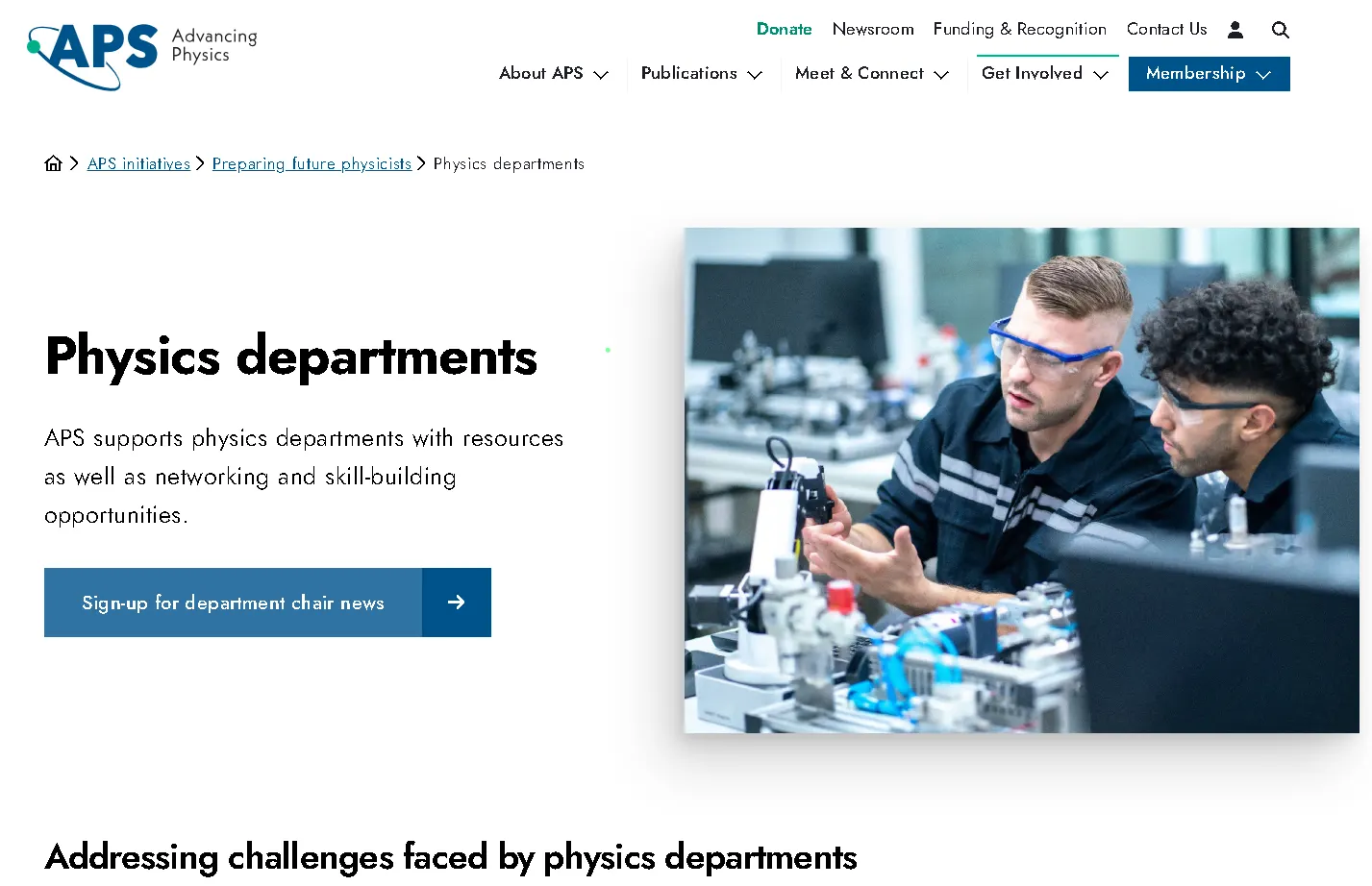
Explore how APS supports physics departments with programs, resources, and initiatives to enhance teaching, diversity, and student success.
Practice: You work through university-level problems live — solving the Schrödinger equation for new potentials, applying perturbation theory, computing matrix elements, and deriving selection rules. The tutor watches your reasoning at every step, not just your final expression.
Feedback: After each problem, you receive targeted, specific feedback. “Your separation of variables is correct but you haven’t applied the boundary condition at the well edge” or “your perturbation calculation is right up to the second line — you need to project onto the correct eigenstate before evaluating the matrix element” — precise and tied to what your course requires.
Retest / Reinforce: Core ideas return in new contexts across sessions. Angular momentum, for instance, reappears in spin, the hydrogen atom, addition of angular momenta, and selection rules — each encounter reinforces the same underlying operator algebra from a different direction.
Plan: The tutor updates the session plan as your course progresses and your confidence grows. You always know what the next session targets and why.
Accountability: For students on weekly plans, tutors help maintain steady progress alongside problem-set deadlines and exam preparation.
Sessions run live on Google Meet with a digital pen-pad or iPad + Apple Pencil — essential for multi-line derivations, wave function sketches, and operator algebra work in real time. Before your first session, share your course level, current chapter, assigned text, and any upcoming deadlines. The first session includes a short diagnostic, a live working-through of your most pressing concept, and a clear plan for the next two to four sessions.
Tutor Match Criteria (How We Pick Your Tutor)
Level and course fit: Your tutor will have direct experience with Quantum Mechanics at your specific level — introductory wave mechanics, second undergraduate course, or graduate formalism. They know the difference between what a Griffiths course and a Sakurai course demand and teach accordingly.
Topic strengths: If your difficulty is in perturbation theory, scattering, or angular momentum coupling, we match you with a tutor whose expertise covers that domain at the right mathematical depth.
Tools and setup: All MPB tutors use Google Meet and a digital pen-pad or iPad + Apple Pencil for real-time derivation work, operator algebra, and wave function diagrams.
Time zone and availability: Tutors are available across US, UK, Canada, Australia, and Gulf time zones, fitting around your university schedule and problem-set deadlines.
Learning style and pace: Some students need careful rebuilding of the mathematical framework. Others want focused, high-volume problem-set practice. Your tutor adjusts the approach to match what works for you.
Goals: A PhD student preparing for a qualifying exam has different needs than a first-year undergraduate working through wave functions. We align on your goal before sessions begin.
Urgency and timeline: A student with a problem set due in two days gets a targeted plan. A student building foundations across a semester gets a paced structure. Tutor selection accounts for your timeline and immediate deliverables.
Study Plans (Pick One That Matches Your Goal)
MPB offers three broad plan types for Quantum Mechanics: a catch-up plan (one to two weeks) for closing specific topic gaps before an exam or deadline, a course support plan (four to eight weeks) for structured assistance across a semester, and an ongoing weekly plan for students who want consistent expert guidance across an academic year or PhD program. The tutor builds the specific session plan after the diagnostic — no fixed schedule is set until your starting point and goals are clearly understood.
Pricing Guide
Quantum Mechanics tutoring at MPB starts at USD 20 per hour and typically ranges up to USD 40 per hour for most undergraduate-level sessions. Graduate and PhD-level sessions — particularly those covering advanced formalism, scattering theory, or research-adjacent topics — generally fall in the USD 50–USD 80 per hour range. For highly specialised or compressed-timeline sessions, rates may reach USD 100 per hour.
Pricing depends on the tutor’s level and specialisation, the depth of content covered, and your session frequency. All rates are discussed transparently before you commit.
FAQ
Is Quantum Mechanics hard?
Quantum Mechanics is widely considered the most conceptually challenging course in undergraduate Physics. The difficulty is not the mathematics alone — it is learning to think about physical systems in an entirely new way. Students who invest in understanding the formalism deeply, rather than pattern-matching solutions, consistently find the subject becomes more manageable as it progresses.
How many sessions are needed?
A student targeting one or two specific topics — perturbation theory or scattering, for example — may need four to eight sessions. A student seeking support across a full-semester course benefits from regular weekly sessions throughout the term. Your tutor will give a more precise estimate after the diagnostic.
Can you help with Quantum Mechanics homework and problem sets?
Yes — as guided support, not submission. Your tutor will work through problem approaches with you, identify where your derivation breaks down, and help you build the understanding to complete the work yourself. MPB does not complete or submit assignments for students. Students are expected to submit their own work at all times.
What happens in the first session?
The first session includes a short diagnostic on two or three topic areas, a live working-through of your most pressing concept or problem, and a clear plan for the next two to four sessions. Come prepared with your current chapter, any assigned text, recent test results if available, and upcoming deadlines. Sessions run on Google Meet with digital pen-pad support.
What mathematical background do I need for Quantum Mechanics?
At the introductory level, single-variable calculus and basic differential equations are sufficient. For second-course and graduate-level Quantum Mechanics, you need linear algebra (vector spaces, eigenvalues, Hermitian operators), multivariable calculus, and ordinary differential equations. Complex analysis and partial differential equations become important at the graduate level. If your mathematical background has gaps, your tutor can identify and address them alongside the physics content. Students who want to strengthen their mathematical foundations can explore Mathematical Physics tutoring on MPB.
What is the difference between introductory and graduate Quantum Mechanics?
Introductory courses (Griffiths level) develop wave mechanics, standard potentials, and basic perturbation theory using a mix of wave function and Dirac notation. Graduate courses (Sakurai or Shankar level) start from abstract Hilbert space formalism, develop the full operator algebra from the outset, and cover more advanced topics — path integrals, advanced scattering, density matrices, and relativistic quantum mechanics. Your tutor will calibrate to whichever level your course is at.
Can you help with Quantum Mechanics for Chemistry or Engineering students?
Yes. Quantum Mechanics appears in Physical Chemistry (molecular orbitals, spectroscopy), Materials Science (band theory, semiconductor physics), and Electrical Engineering (quantum devices, quantum optics). MPB tutors can adapt the focus of sessions to your department’s emphasis — whether that is electronic structure, operator methods, or device physics. Students with a Chemistry focus can also explore Atomic Physics on MPB, which bridges quantum mechanics and spectroscopy directly.
Is online tutoring effective for Quantum Mechanics?
Yes. Quantum Mechanics involves multi-line derivations, operator algebra, and wave function sketches — all of which a tutor can work through in real time on a digital pen-pad via Google Meet. The format closely replicates a one-on-one whiteboard session. Research on one-on-one instruction published by the American Physical Society supports the effectiveness of this model for physics learning at the university level.
Can MPB help with PhD qualifying exams in Quantum Mechanics?
Yes. Qualifying exams typically test the full scope of graduate Quantum Mechanics — formalism, perturbation theory, angular momentum, scattering, and identical particles — at a depth requiring both derivation fluency and physical intuition. Share your qualifying exam syllabus and any past papers and the tutor will build a targeted preparation plan around them.
What related subjects does MPB cover that connect to Quantum Mechanics?
Quantum Mechanics is the foundation for many advanced physics disciplines. Students exploring Quantum Field Theory (QFT), Quantum Computing, Quantum Optics, Condensed Matter (Solid State) Physics, or Particle Physics will find specialist tutoring in all of these areas on MPB. All of them build directly on the quantum mechanical framework developed in this course.
Can you help with thesis or dissertation work involving Quantum Mechanics?
At a guidance level, yes. MPB tutors can help PhD students understand theoretical frameworks relevant to their research, work through derivations that arise in their thesis, and clarify conceptual questions in their specific area. MPB does not write or contribute original research content to theses or dissertations. All support is focused on helping students develop their own understanding and analysis.
Trust & Quality at My Physics Buddy
Tutor selection: MPB tutors for Quantum Mechanics hold postgraduate degrees in Physics, Applied Physics, or closely related fields — many at the PhD level, with specific research or coursework in quantum theory. Every tutor goes through a subject screening that includes a live demo session and an ongoing student feedback loop. Tutors are matched to your specific level and course, not assigned as generalists.
Academic integrity: MPB’s position is clear — we guide, you submit your own work. Tutors explain concepts, work through similar problems, and provide feedback on your derivations. They do not complete assignments or any assessed work for students. All guidance is framed as explanation and conceptual clarification, consistent with your university’s academic integrity policies.
About MPB: My Physics Buddy is a Physics-focused online tutoring platform serving students from undergraduate through postgraduate level, across the US, UK, Canada, Australia, and Gulf regions. Students working on adjacent advanced topics can explore Statistical Mechanics, Atomic Physics, and Modern Physics on MPB — all subjects that sit alongside Quantum Mechanics in most Physics programs.
Physics education research consistently shows that students in conceptually demanding courses like Quantum Mechanics benefit most from frequent, expert feedback on their problem-solving process. A study published in the Physical Review Physics Education Research journal found that students who received targeted formative feedback during active problem-solving retained concepts significantly longer than those who studied passively. MPB’s learning loop is built on this evidence.
“Anyone who is not shocked by Quantum Mechanics has not understood it — but anyone who cannot use it has not learned it either. The goal is both: genuine understanding and real problem-solving fluency.”
— Adapted from a remark attributed to Niels Bohr, as discussed in Griffiths, Introduction to Quantum Mechanics, Cambridge University Press
Students with strong Quantum Mechanics foundations often move naturally into research and advanced coursework in Nuclear Physics, Laser Physics, and Semiconductor Physics — all of which MPB supports at the graduate level.
“The students who succeed in Quantum Mechanics are not those who memorise the most equations — they are those who build real intuition for operators, eigenstates, and measurement, one well-solved problem at a time.”
— Based on findings in Bloom’s 2-Sigma Study, Educational Researcher (1984)
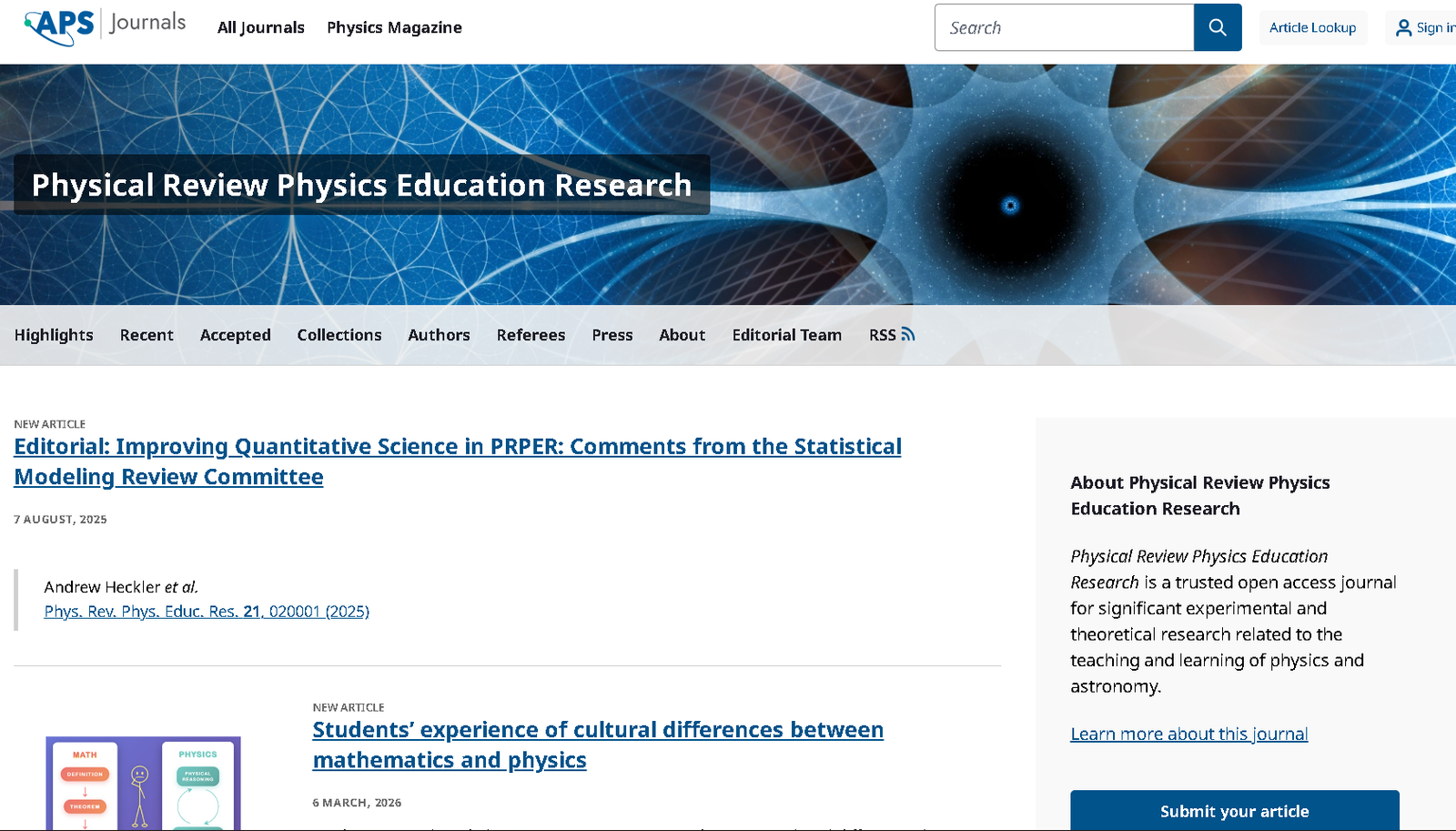
APS Journals page featuring Physical Review Physics Education Research, a leading journal publishing research on physics teaching and learning.
Content reviewed by a Quantum Mechanics tutor at My Physics Buddy.
Next Steps
Tell us your academic level, your university course name, your current topic, any upcoming deadlines, and your main challenge areas — whether that is the Schrödinger equation, perturbation theory, angular momentum, scattering, or the conceptual foundations. We will match you with a tutor whose expertise fits your course depth and timeline. Most students are matched and into their first session within a few days. Scheduling is flexible across all primary time zones.

