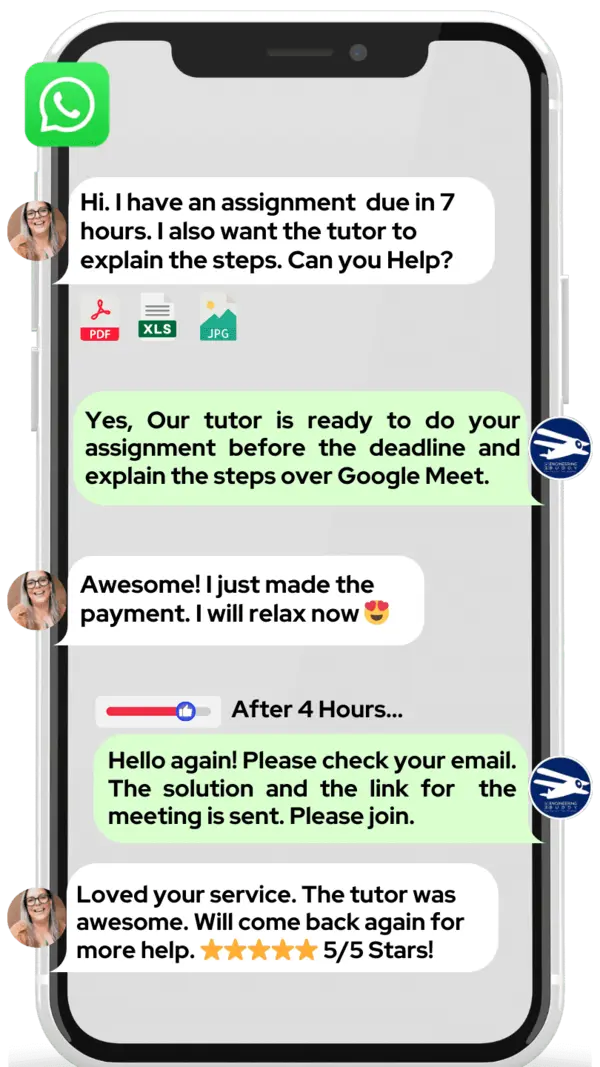
Hire Best Semiconductor Physics Tutors Online

Testimonials



Semiconductor Physics Tutor Online
My Physics Buddy (MPB) provides 1:1 online tutoring & homework help in Physics and related subjects, including Semiconductor Physics at the undergraduate, Masters, and PhD level. Semiconductor Physics is the physical foundation of the modern electronics and photonics industries — a discipline where quantum mechanics, solid-state theory, and device engineering converge in ways that most introductory courses never quite make tangible. Whether you are an undergraduate working through energy bands, carrier statistics, and p-n junction physics for the first time, a Masters student tackling transport theory, heterostructures, and optical properties in depth, or a PhD candidate pushing into quantum confinement, two-dimensional materials, or advanced device simulation, MPB connects you with a Semiconductor Physics tutor matched precisely to your course level and content. If you have been searching for a “Semiconductor Physics tutor near me” with genuine depth in this technically demanding field, live online sessions with MPB give you that access wherever you are.
Our sessions are built to help you aim for stronger grades, sharper problem-solving fluency, and the kind of conceptual clarity that connects the physics you study to the devices and technologies it underlies.
- 1:1 live online sessions — no group classes, no pre-recorded content
- Tutors matched specifically to Semiconductor Physics curricula and your academic level
- Covers undergraduate through to PhD-level Semiconductor Physics
- Flexible scheduling across US, UK, Canada, Australia, and Gulf time zones
- Structured learning plan built after your diagnostic session
- Ethical assignment, lab report, and dissertation guidance — we explain the physics, you produce the work
Who This Semiconductor Physics Tutoring Is For
Semiconductor Physics appears across a wide range of academic programmes — from physics and materials science degrees with a solid-state or electronic materials track, to electrical engineering and photonics programmes where semiconductor device physics is a core requirement. This tutoring is designed for:
- Undergraduate students taking Semiconductor Physics, Solid-State Physics, or Electronic Materials as a module within a Physics, Materials Science, or Electrical Engineering degree
- Masters-level students in Semiconductor Physics, Nanoelectronics, Photonics, Materials Science, or Electronic Engineering programmes needing structured concept and problem-solving support
- PhD students in semiconductor device physics, quantum materials, two-dimensional materials, photovoltaics, or related research areas seeking conceptual clarity or research-level problem-solving guidance
- Students in the US, UK, Canada, Australia, and Gulf whose condensed matter, solid-state, or device physics coursework has significant semiconductor content
- Engineering students who need to understand the physics behind semiconductor devices — not just how to use device models, but why those models work
- Students needing ethical assignment guidance, lab report support, or dissertation-level writing structure without academic shortcuts
- Parents of undergraduate students in physics or engineering programmes looking for accountable, expert academic support in a demanding and commercially important subject
Outcomes: What You’ll Be Able to Do in Semiconductor Physics
Semiconductor Physics requires you to move fluidly between quantum mechanical descriptions of electrons in periodic potentials and the macroscopic transport and optical behaviour those descriptions give rise to. The capabilities built through structured 1:1 tutoring are observable and directly tied to what your course, your examinations, and your research will all demand.
Solve quantitative problems in band structure, carrier statistics, drift-diffusion transport, p-n junction electrostatics, and optical absorption — with the mathematical rigour your programme requires. Analyze the electronic and optical properties of semiconductor materials from their band structure, correctly identifying which physical mechanisms dominate a given phenomenon and why material choice matters at a fundamental level. Model carrier behaviour in bulk semiconductors, heterostructures, and quantum confined systems using the appropriate formalisms — from the Kronig-Penney model and effective mass approximation to drift-diffusion equations and quantum well confinement energies. Explain the operating physics of semiconductor devices — p-n junctions, bipolar transistors, MOSFETs, LEDs, laser diodes, and solar cells — with the physical depth expected in written assessments, viva examinations, and research papers. Apply semiconductor theory to novel materials systems and device architectures, connecting the underlying physics to current research and engineering contexts. Write well-structured analyses, lab reports, and research sections that demonstrate physical reasoning with the precision this subject demands.
What We Cover in Semiconductor Physics (Syllabus / Topics)
Semiconductor Physics curricula vary between institutions and between physics, engineering, and materials science programmes. Tutors at MPB align directly to your specific course materials. The following tracks reflect what is typically covered at each academic stage — always confirm your current syllabus with your institution.
Semiconductor Physics builds on quantum mechanics, statistical mechanics, and solid-state physics. Gaps in any of these foundations surface quickly when students encounter band theory, carrier statistics, or quantum confinement. Your tutor identifies those gaps in the diagnostic and addresses them before progressing — building Semiconductor Physics on shaky foundations is the most common reason students find the subject suddenly stops making sense.
Undergraduate Level
- Crystal structure and reciprocal lattice: Bravais lattices, Miller indices, Brillouin zones, diffraction
- Free electron model: Drude model, Sommerfeld model, density of states, Fermi energy
- Band theory fundamentals: origin of energy bands, Bloch’s theorem, Kronig-Penney model, band gaps
- Semiconductor band structure: direct and indirect band gaps, effective mass approximation, heavy and light holes
- Carrier statistics: Fermi-Dirac distribution, intrinsic and extrinsic semiconductors, carrier concentration calculations
- Doping: donor and acceptor levels, charge neutrality, temperature dependence of carrier concentration
- Carrier transport: drift velocity, mobility, conductivity, Hall effect
- Diffusion and recombination: minority carrier diffusion, continuity equations, recombination mechanisms (radiative, Auger, SRH)
- p-n junction in equilibrium: built-in potential, depletion approximation, space charge region
- p-n junction under bias: ideal diode equation, minority carrier injection, depletion width under forward and reverse bias
- Introduction to bipolar junction transistors and MOSFETs: physical operating principles
- Optical properties: optical absorption, direct and indirect transitions, photogeneration
Advanced Undergraduate and Masters Level
- Advanced band structure: k·p theory, tight-binding model, empirical pseudopotential method (conceptual)
- Heterostructures and quantum wells: band alignment (Type I, II, III), quantum confinement energies, density of states in 2D
- Quantum dots and nanowires: 0D and 1D confinement, size-dependent optical and electronic properties
- Advanced transport theory: Boltzmann transport equation, scattering mechanisms (phonon, impurity, interface), mobility calculations
- High-field transport: velocity saturation, intervalley scattering, hot carriers
- Metal-semiconductor contacts: Schottky barrier, ohmic contacts, thermionic emission theory
- Semiconductor lasers and LEDs: stimulated emission, optical gain, threshold condition, quantum well lasers
- Photodetectors and solar cells: photocurrent, quantum efficiency, p-i-n structures, multi-junction cells
- Two-dimensional materials: graphene band structure, transition metal dichalcogenides, valley physics (introduction)
- Wide-bandgap semiconductors: GaN, SiC — properties and power electronics applications
- Semiconductor characterisation techniques: Hall measurements, photoluminescence, capacitance-voltage profiling
- Introduction to device simulation: drift-diffusion solvers, TCAD concepts
PhD and Research Level
- Advanced quantum transport: non-equilibrium Green’s function (NEGF) formalism (conceptual and application)
- Topological semiconductors: Berry phase, topological insulators, edge states (introductory)
- Spin transport and spintronics: spin-orbit coupling in semiconductors, spin Hall effect, spin-polarised transport
- Advanced optical spectroscopy of semiconductors: time-resolved photoluminescence, pump-probe methods, exciton physics
- Defect physics and reliability: deep-level transient spectroscopy (DLTS), trap characterisation, degradation mechanisms
- Novel device architectures: tunnel FETs, negative capacitance devices, neuromorphic devices (physics overview)
- Computational semiconductor physics: density functional theory (DFT) for band structure, molecular dynamics in semiconductor systems
- Research methodology: materials growth and characterisation, experimental design, uncertainty analysis
- Thesis and dissertation guidance: structuring semiconductor physics arguments in research writing
How My Physics Buddy Tutors Help You with Semiconductor Physics (The Learning Loop)
Diagnose: The first session begins with a diagnostic. The tutor asks you to work through a few representative problems — a carrier concentration calculation, a p-n junction electrostatics problem, a band structure question — and explain your reasoning as you go. This reveals whether your gaps are in the quantum mechanical foundations, the solid-state framework, the mathematical techniques, or the bridge between physical models and device behaviour.
Explain: The tutor does not re-derive what is already in your notes. They explain the physical mechanism — why the effective mass is a tensor and what that means for transport, what the quasi-Fermi level is actually describing when a junction is under bias, why indirect-gap semiconductors are poor light emitters, what the depletion approximation is really assuming and when it breaks down. The physical picture is what makes the mathematics cohere rather than appear arbitrary.
Practice: You attempt problems live, with the tutor observing. In Semiconductor Physics this means carrier statistics calculations, junction electrostatics problems, transport coefficient derivations, optical absorption problems, and extended written explanations connecting physical models to device behaviour. The tutor watches where reasoning breaks down and intervenes at precisely that point.
Feedback: Feedback is specific. Not “your carrier concentration is wrong” but “you used the Boltzmann approximation outside its range of validity here — the Fermi level is too close to the band edge for this to hold, and here is how to check whether you can apply it.” At Masters and PhD level, feedback extends to the rigour of physical argument and the precision of mathematical notation in written work.
Retest/Reinforce: Concepts return in harder forms across sessions. The Fermi-Dirac distribution at undergraduate level reappears inside quasi-Fermi level formalism for devices under bias at Masters level, which connects to non-equilibrium Green’s function transport at PhD level. The tutor tracks this progression and builds on it deliberately.
Plan: After each session the tutor updates your learning plan — more time on areas still weak, progression to harder problem types in areas now solid. No session covers already-mastered ground unnecessarily.
Accountability: Between sessions the tutor may assign specific practice problems, suggest sections of your textbook to work through, or ask you to draft a section of a lab report or problem set for feedback. This structured between-session work compounds the progress made in each live session.
All sessions run via Google Meet with a digital pen-pad or iPad+Pencil setup, so band diagrams, energy level schemes, device cross-sections, and carrier profile plots are all visible, legible, and editable in real time. Before your first session, share your course syllabus or module guide, any topics you already know are weak, upcoming exam or assignment deadlines, and your current level so the tutor can make the diagnostic immediately targeted.
“Semiconductor physics is not just a branch of condensed matter — it is the physical science that made the information age possible. Understanding it deeply means understanding how quantum mechanics operates in the real world at room temperature.”

Read the official Nobel Prize 2000 press release recognizing breakthroughs in semiconductors, laser diodes, and integrated circuits.
Tutor Match Criteria (How We Pick Your Tutor)
Semiconductor Physics spans band theory, transport, optics, device physics, and increasingly nanoscale and quantum effects — matching you to the right tutor requires precision across level and content area.
Level and course fit: A tutor supporting an undergraduate working through p-n junction electrostatics needs different emphasis than one supporting a Masters student in quantum well laser physics or a PhD student in topological semiconductor materials. MPB matches by level and specific content area, not subject label alone.
Topic strengths and tools: Tutors are assessed on their specific competencies in Semiconductor Physics before being recommended — band theory, carrier physics, transport, optical properties, and device physics. Sessions use Google Meet with a digital pen-pad or iPad+Pencil so band diagrams, energy level schemes, and derivations are all fully visible in real time.
Time zone and availability: MPB serves students across the US, UK, Canada, Australia, and Gulf. Sessions are available across all major time zones including evenings and weekends.
Learning style and pace: Some students need careful conceptual scaffolding from quantum mechanics and solid-state foundations upward. Others need fast, targeted problem-solving drill for an imminent exam. The tutor adapts to what you need.
Language and communication preferences: Tutors communicate clearly in English. Students who prefer more visual explanation, more explicit step-by-step working, or particular emphasis on physical intuition over formalism can specify this at the matching stage.
Goals: Exam preparation, assignment understanding, lab report guidance, dissertation support, or research-level conceptual clarity — the tutor shapes sessions around what matters most right now.
Urgency and timeline: Exam next week or building systematic understanding across a full semester or research programme — the tutor builds a realistic plan that fits the time available and the depth required.
Study Plans (Pick One That Matches Your Goal)
MPB offers three broad plan types: a catch-up plan (typically 1–2 weeks) for students behind on specific topics — for example, needing to consolidate carrier statistics and junction physics before the course moves to device models — an exam prep plan (typically 4–8 weeks) for structured coverage of all assessed material ahead of a final or qualifying exam, and a weekly support plan for consistent help throughout a semester, academic year, or research period. After the first diagnostic session, your tutor builds the specific session-by-session plan based on your actual gaps, your timeline, and your available weekly commitment.
Pricing Guide
Semiconductor Physics tutoring at MPB starts at USD 20 per hour and typically ranges up to USD 40 per hour for standard undergraduate sessions. Advanced Masters and PhD-level tutoring — which requires specialist depth in quantum transport, heterostructure physics, advanced device simulation, or research-level topics — can go up to USD 100 per hour depending on topic complexity and tutor profile.
Pricing reflects the level and complexity of the material, tutor experience and availability, your timeline urgency, and whether sessions involve standard coursework or highly specialised research content. All pricing is confirmed before any session begins — no hidden fees.
WhatsApp for a quick quote — share your level, the specific Semiconductor Physics topics you need, and your timeline.
FAQ
Is Semiconductor Physics hard?
Semiconductor Physics is considered demanding because it requires simultaneous fluency in quantum mechanics, statistical mechanics, electromagnetic theory, and solid-state physics — and then asks you to connect all of them to observable device behaviour. Most students struggle not because the material is inherently inaccessible but because several of those foundations were not fully consolidated before the course began. Targeted 1:1 tutoring identifies and fills exactly those gaps.
How many sessions are needed?
It depends on your level, goals, and starting state. An undergraduate catching up on band theory and p-n junction physics before an exam typically needs 6–10 focused sessions. A Masters student working through advanced transport and optoelectronic device physics across a full semester might need 15–25 sessions. After the diagnostic your tutor gives a realistic, honest estimate based on what they observe — not a generic package.
Can MPB help with Semiconductor Physics assignments and lab reports?
Yes — as guided explanation and feedback. Tutors work through the relevant physics, demonstrate similar example problems, and give feedback on your attempts and drafts. For lab reports, guidance covers structure, data analysis approach, uncertainty treatment, and how to connect measured device characteristics to their physical interpretation. The work you submit is always your own. MPB does not write or complete assignments for students. This approach is consistent with academic integrity standards across every institution and region we serve.
Will the tutor cover my exact course syllabus and textbook?
Yes. Tutors are familiar with standard Semiconductor Physics texts including Streetman and Banerjee’s Solid State Electronic Devices, Neamen’s Semiconductor Physics and Devices, Sze and Ng’s Physics of Semiconductor Devices, and Kittel’s Introduction to Solid State Physics, among others. Share your prescribed text and module guide before the first session and the tutor aligns directly to your course content.
What mathematical and physics background is needed?
A solid grounding in undergraduate quantum mechanics, statistical mechanics, and classical electromagnetism is important for getting the most from Semiconductor Physics tutoring. If your background in any of these has gaps, your tutor will identify them in the diagnostic. MPB offers dedicated support through Quantum Mechanics, Statistical Mechanics, and Electromagnetism pages if targeted foundation work is needed.
What happens in the first session?
The first session starts with a short diagnostic — a few representative problems and a conversation about where you feel confident and where you do not. The tutor then teaches a focused concept live, so you leave with something concrete. Before attending, share your syllabus, known weak areas, and any upcoming deadlines so the tutor can make the session immediately relevant and targeted.
Is online Semiconductor Physics tutoring as effective as in-person?
For Semiconductor Physics, online sessions via Google Meet with a digital pen-pad or iPad+Pencil are fully effective. Band diagrams, energy level schemes, p-n junction depletion profiles, device cross-sections, and derivations can all be drawn, annotated, and worked through in real time on a shared digital whiteboard. Students in the US, UK, Canada, Australia, and Gulf consistently find live online sessions as productive as in-person, with the added benefit of flexible scheduling.
Can MPB support PhD students in Semiconductor Physics research?
Yes. MPB works with PhD students on conceptual clarity in specialist research areas — quantum transport formalisms, topological semiconductor physics, two-dimensional material band structure, advanced device simulation, or optical spectroscopy methods. Tutors can discuss dissertation chapters at a conceptual level and give feedback on how physical arguments are structured in research writing. They complement your supervisory relationship — they do not replace it, and they do not write your research.
Does MPB cover device physics alongside semiconductor fundamentals?
Yes. Understanding the physics of semiconductor devices — MOSFETs, bipolar transistors, LEDs, laser diodes, photodetectors, and solar cells — is treated as an integral part of Semiconductor Physics at MPB, not a separate engineering topic. Tutors connect device operating principles directly to the fundamental physics of carrier transport, recombination, and electrostatics rather than treating them as separate boxes to memorise.
Can MPB help with semiconductor device simulation and TCAD?
Yes, at a conceptual and physical level. Tutors can help you understand the physics underlying drift-diffusion device simulation, discuss the meaning of simulation parameters and boundary conditions, and work through the interpretation of simulation outputs. If your course or research involves specific TCAD tools such as Silvaco or Synopsys Sentaurus, share this at the matching stage so the right tutor profile is selected.
How does Semiconductor Physics connect to other subjects at MPB?
Semiconductor Physics sits within the broader field of Condensed Matter (Solid State) Physics and draws directly on Quantum Mechanics and Statistical Mechanics. Students in photonics or optoelectronics programmes will find strong connections to Photonics and Laser Physics. Research-level students working in spintronics or topological materials can also explore Spintronics Physics.
Can tutoring help with semiconductor-related thesis and research paper writing?
Yes — at a guidance level. Tutors can help you structure physical arguments in your writing, work through the logic of your methodology or results sections, and give feedback on how clearly your derivations and physical reasoning are expressed. They do not write your thesis or research papers. The goal is to deepen your understanding so your written work reflects it with precision and clarity.
Our services aim to provide personalised academic guidance, helping students understand concepts and improve skills. Materials and guidance provided are for reference and learning purposes only. Misusing them for academic dishonesty or violations of integrity policies is strongly discouraged.
Trust & Quality at My Physics Buddy
Semiconductor Physics tutors at MPB are vetted specifically for this discipline — not assigned from a generalist pool. Every tutor completes a subject-specific assessment demonstrating competency in the areas they claim to teach before being listed. They are evaluated on technical depth, ability to connect quantum mechanical foundations to device-level behaviour clearly, and familiarity with the assessment styles relevant to their declared level. Student feedback after each session feeds into ongoing quality reviews.
MPB operates on one principle: we guide, you produce the work. Whether you are an undergraduate asking for help understanding a depletion approximation derivation, a Masters student working through a lab report on Hall measurements, or a PhD student structuring a results chapter, the tutor explains, demonstrates, and gives feedback on your work — they do not write it. Research on learning in technically demanding disciplines — including findings from the National Academies of Sciences in How People Learn — consistently shows that active, expert-guided problem solving is what builds durable understanding. That is the model MPB is built on.
MPB is a Physics-focused online tutoring platform serving students from undergraduate through PhD level across the US, UK, Canada, Australia, and Gulf. Semiconductor Physics is one of MPB’s specialist subject areas within a broader condensed matter and materials physics offering. Students working across related subjects can explore dedicated pages for Condensed Matter (Solid State) Physics, Photonics, Laser Physics, Spintronics Physics, and Quantum Computing. Students building foundational depth can find support through the main Physics page, Modern Physics, and Quantum Mechanics.
“The transistor — and everything it made possible — emerged directly from a determined effort to understand the physics of electrons in crystalline solids. That understanding still matters as much today as it did in 1947.”
American Physical Society — Historic Sites: Bell Labs and the Invention of the Transistor
Explore how APS supports physics departments with programs, resources, and initiatives to enhance teaching, diversity, and student success.
Content reviewed by a Semiconductor Physics tutor at My Physics Buddy.
Additional References and Resources
The following credible external resources are useful for students and parents exploring Semiconductor Physics education at different levels:
- American Physical Society — Bell Labs and the Transistor: Historical and scientific context for the development of semiconductor physics, from the APS physics history programme.
- Nobel Prize Committee — Physics 2000 Press Release (Heterostructures): The scientific rationale behind the Nobel Prize awarded for semiconductor heterostructures — directly relevant to modern quantum well and laser physics taught at Masters level.
- Materials Research Society — MRS Bulletin: A leading journal connecting semiconductor physics to materials science and device engineering — useful for students engaging with current research literature.
- IEEE Education — Semiconductor and Electronics Resources: The professional home of semiconductor and electronics engineering, providing educational resources connecting device physics to engineering practice.
- National Institute of Standards and Technology (NIST) — Semiconductor Metrology: NIST’s semiconductor measurement standards and reference data — relevant for students whose coursework includes experimental characterisation and metrology.
- University of Colorado Boulder — Semiconductor Physics and Devices (Bart Van Zeghbroeck, freely available): A comprehensive, freely available academic reference on semiconductor device physics, widely used in undergraduate and graduate programmes globally.
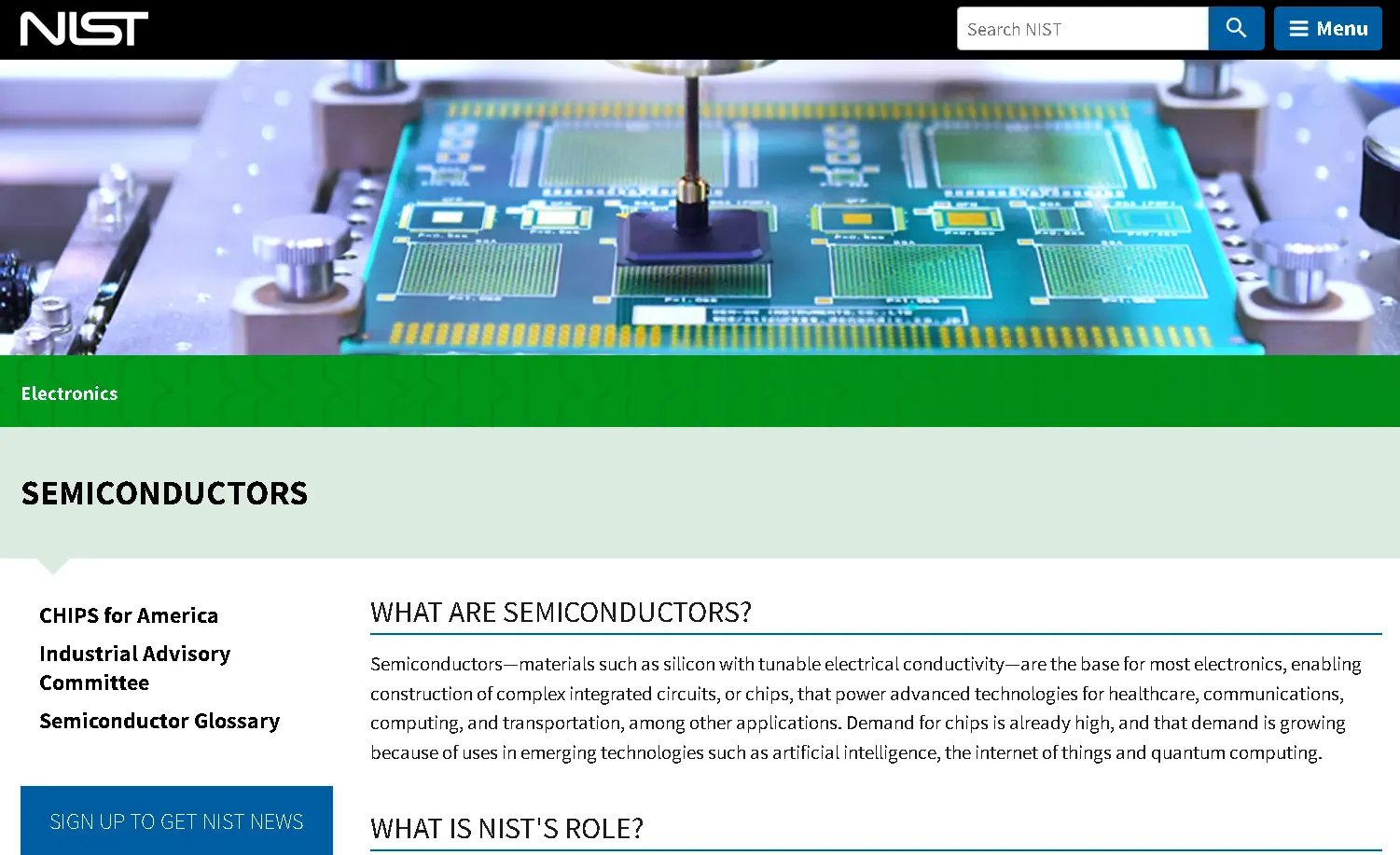
Explore NIST’s semiconductor research, including chip technology, measurement science, and advancements in microelectronics.
Next Steps
Tell us your current level in Semiconductor Physics — undergraduate module, Masters programme, or PhD research area — along with the specific topics you need to focus on and any upcoming exam, assignment, or submission dates. Share your availability and time zone. MPB will match you to a tutor with the right depth in Semiconductor Physics, confirm the fit, and you can begin as soon as the next available slot. Most students are matched and have their first session booked within 24–48 hours.

