
Hire Best Statistical Mechanics Tutors Online



Testimonials



Statistical Mechanics Tutor Online
My Physics Buddy (MPB) provides 1:1 online tutoring & homework help in Physics and related subjects, including Statistical Mechanics at the undergraduate, Masters, and PhD level. Statistical Mechanics is the bridge between the microscopic world of atoms and the macroscopic world of thermodynamic measurements — a subject that demands rigorous probabilistic reasoning, mathematical fluency, and physical intuition all at once. If you are searching for a “Statistical Mechanics tutor near me” who can build genuine understanding rather than formula familiarity, MPB connects you with subject-matched tutors across the US, UK, Canada, Australia, and Gulf — designed to help you aim for the conceptual clarity and problem-solving depth this subject requires.
- 1:1 live online sessions — no group classes, no pre-recorded content
- Tutors matched specifically to Statistical Mechanics curricula and your academic level
- Covers undergraduate through to PhD-level Statistical Mechanics
- Flexible scheduling across all major time zones
- Structured learning plan built after your diagnostic session
- Ethical assignment, problem-set, and dissertation guidance — we explain the physics, you produce the work
Who This Statistical Mechanics Tutoring Is For
Statistical Mechanics appears at multiple stages of a physics education — from its first introduction alongside thermodynamics at undergraduate level, through to its role as a foundational tool in condensed matter, quantum optics, and field theory at graduate level. This tutoring is designed for:
- Undergraduate students encountering Statistical Mechanics for the first time in a thermodynamics and statistical physics module within a Physics, Chemistry, or Materials Science degree
- Intermediate undergraduates working through a dedicated Statistical Mechanics course covering ensembles, partition functions, and quantum statistics in depth
- Masters-level students for whom Statistical Mechanics is a core module in physics, materials science, chemical physics, or biophysics programmes
- PhD students in condensed matter, soft matter, chemical physics, biophysics, or related fields for whom Statistical Mechanics is either a coursework requirement or a daily research tool
- Students in the US, UK, Canada, Australia, and Gulf whose degree programmes include Statistical Mechanics as part of a physics, chemistry, or interdisciplinary science track
- Students needing ethical assignment guidance, problem-set support, or dissertation-level conceptual clarity without academic shortcuts
Outcomes: What You’ll Be Able to Do in Statistical Mechanics
Statistical Mechanics asks you to reason about systems with astronomically large numbers of degrees of freedom using probabilistic methods — and to extract precise, experimentally testable predictions from that reasoning. The capabilities built through structured 1:1 tutoring are directly tied to what your course and any downstream research will both require.
Solve problems in classical and quantum statistical mechanics — computing partition functions, thermodynamic potentials, equations of state, and response functions — with the mathematical rigour your course demands. Analyze physical systems by identifying the correct statistical ensemble, justifying that choice physically, and extracting the right thermodynamic information from it. Model interacting systems using mean field theory, the Ising model, and perturbative or variational approaches — connecting microscopic model parameters to macroscopic observables. Derive thermodynamic relations from statistical foundations — demonstrating that entropy, temperature, pressure, and chemical potential all emerge naturally from the partition function rather than being inserted by hand. Explain quantum statistical phenomena — Bose-Einstein condensation, Fermi degeneracy, blackbody radiation, specific heat anomalies — with the physical clarity expected in examinations and research discussions. Apply Statistical Mechanics methods to modern contexts in condensed matter, soft matter, and biophysics as appropriate to your programme.
Statistical Mechanics is one of those subjects where surface familiarity with the formalism — knowing what a partition function is — and genuine understanding — knowing why it contains all thermodynamic information and how to extract it — are very far apart. The diagnostic session is specifically designed to identify which side of that gap you are on.
What We Cover in Statistical Mechanics (Syllabus / Topics)
Statistical Mechanics syllabi vary between institutions and between the level at which the subject is taught. Tutors align directly to your specific course and textbook. The following tracks reflect what is typically covered at each stage — always confirm your current syllabus with your institution.
Introductory Level (First Encounter — Thermodynamics and Statistical Physics)
- Review of classical thermodynamics: zeroth, first, second, and third laws — entropy, temperature, and thermodynamic potentials
- Microstates and macrostates: the fundamental postulate of statistical mechanics, counting states, the definition of entropy
- The microcanonical ensemble: isolated systems, entropy maximisation, temperature and pressure from entropy
- The canonical ensemble: systems in thermal contact, Boltzmann factor, partition function Z, connection to Helmholtz free energy
- Thermodynamic quantities from the partition function: energy, entropy, heat capacity, pressure — systematic derivation
- Ideal classical gas: translational partition function, equipartition theorem, ideal gas law from first principles
- Diatomic molecules: rotational and vibrational partition functions, heat capacity of diatomic gases
- The grand canonical ensemble: open systems, chemical potential, grand partition function
- Identical particles and quantum statistics: distinguishable vs. indistinguishable particles, Bose-Einstein and Fermi-Dirac distributions
- Blackbody radiation: photon gas, Planck distribution, Stefan-Boltzmann law — derivation from quantum statistical mechanics
- Einstein and Debye models of solids: quantised vibrations, phonon heat capacity, comparison with experiment
Intermediate Level (Dedicated Undergraduate or Early Graduate Module)
- Quantum ideal gases in depth: Fermi gas at zero and finite temperature, Fermi energy, density of states, Sommerfeld expansion
- Bose-Einstein condensation: critical temperature, condensate fraction, thermodynamic properties below Tc
- Classical interacting systems: virial expansion, cluster integrals, van der Waals equation of state as a mean field result
- Phase transitions and critical phenomena: first-order and continuous transitions, order parameters, critical exponents
- Mean field theory: Landau theory, symmetry breaking, free energy expansion, limitations of mean field
- The Ising model: definition, exact solution in 1D, mean field solution, connection to real magnetic systems
- Fluctuations and response: fluctuation-dissipation theorem, susceptibility, compressibility, specific heat — statistical origins
- Density matrix formalism: quantum statistical mechanics, von Neumann entropy, canonical density matrix
- Non-equilibrium statistical mechanics introduction: Boltzmann equation, H-theorem, approach to equilibrium (conceptual)
- Information-theoretic foundations: Shannon entropy, maximum entropy principle, Jaynes’ approach
Advanced Graduate Level
- Renormalisation group: block spin transformations, scaling hypothesis, fixed points, universality classes, critical exponents from RG
- Field-theoretic methods in Statistical Mechanics: Landau-Ginzburg theory, functional integrals, connection to QFT partition function
- Monte Carlo methods in Statistical Mechanics: Metropolis algorithm, importance sampling, ergodicity and detailed balance
- Stochastic processes: random walks, Brownian motion, Langevin equation, Fokker-Planck equation
- Linear response theory: Kubo formula, Green-Kubo relations, connection to transport coefficients
- Quantum phase transitions: transverse field Ising model, quantum critical points, scaling at zero temperature
- Non-equilibrium statistical mechanics: fluctuation theorems (Jarzynski, Crooks), entropy production, driven systems
- Applications to soft matter and biophysics: polymer Statistical Mechanics, membrane physics, protein folding landscape (programme-dependent)
- Thesis and dissertation guidance: structuring Statistical Mechanics arguments in research writing
How My Physics Buddy Tutors Help You with Statistical Mechanics (The Learning Loop)
Diagnose: The first session begins with a focused diagnostic. The tutor gives you a few representative problems — derive the canonical partition function for a simple system, compute a thermodynamic potential, set up the grand canonical ensemble for an ideal Fermi gas — and asks you to explain your reasoning as you work. This immediately reveals whether your gaps are in the thermodynamic foundations, the probabilistic reasoning of the ensemble approach, the mathematical techniques, or the physical interpretation of the quantities you compute.
Explain: The tutor does not re-derive what is already in your lecture notes. They explain why the canonical ensemble gives the same thermodynamic results as the microcanonical for large systems, what the partition function is physically encoding about the system’s accessible states, why entropy is maximised at equilibrium rather than merely asserted to be, and what the chemical potential is actually measuring when you differentiate the grand potential. Understanding the physical logic behind the formalism is what makes Statistical Mechanics coherent rather than a collection of disconnected mathematical tricks.
Practice: You work through problems live. In Statistical Mechanics this means computing partition functions for progressively complex systems, deriving thermodynamic quantities systematically, applying ensemble methods to quantum and classical ideal gases, working through phase transition problems using Landau theory, and constructing mean field arguments from scratch. The tutor observes your reasoning at every step and intervenes where it breaks down.
Feedback: Feedback is specific. Not “your partition function is wrong” but “you have summed over energy levels rather than over states — for a degenerate spectrum, each distinct state must be counted separately, and here is why that changes the result.” At Masters and PhD level, feedback extends to the rigour of physical argument and the precision of the mathematical derivation in written work.
Retest/Reinforce: Statistical Mechanics is deeply cumulative — the partition function introduced in the canonical ensemble reappears inside the grand canonical formalism, which reappears in the derivation of Bose-Einstein and Fermi-Dirac distributions, which reappear in every quantum gas calculation. The tutor tracks this structure and returns to foundational objects in harder contexts deliberately.
Plan: After each session the tutor updates your learning plan. Areas still weak receive more focused attention and alternative explanatory approaches. Areas now solid are pushed to harder problem types. No session wastes time on already-mastered ground.
Accountability: Between sessions the tutor may assign specific problems from your problem set or textbook, ask you to derive a result in full from memory, or suggest a chapter to work through. This between-session structure is what makes each live session build on the last rather than reset it.
All sessions run via Google Meet with a digital pen-pad or iPad+Pencil setup, so partition function derivations, phase diagrams, Ising model lattice diagrams, and renormalisation group flow diagrams are all visible and editable in real time. Before your first session, share your syllabus, prescribed textbook, known weak areas, and any upcoming exam or assignment deadlines.
“Statistical Mechanics is the skeleton key of theoretical physics — the same ensemble methods and partition function machinery appear in quantum field theory, condensed matter, cosmology, and biophysics. Master it once, and it opens everything.”
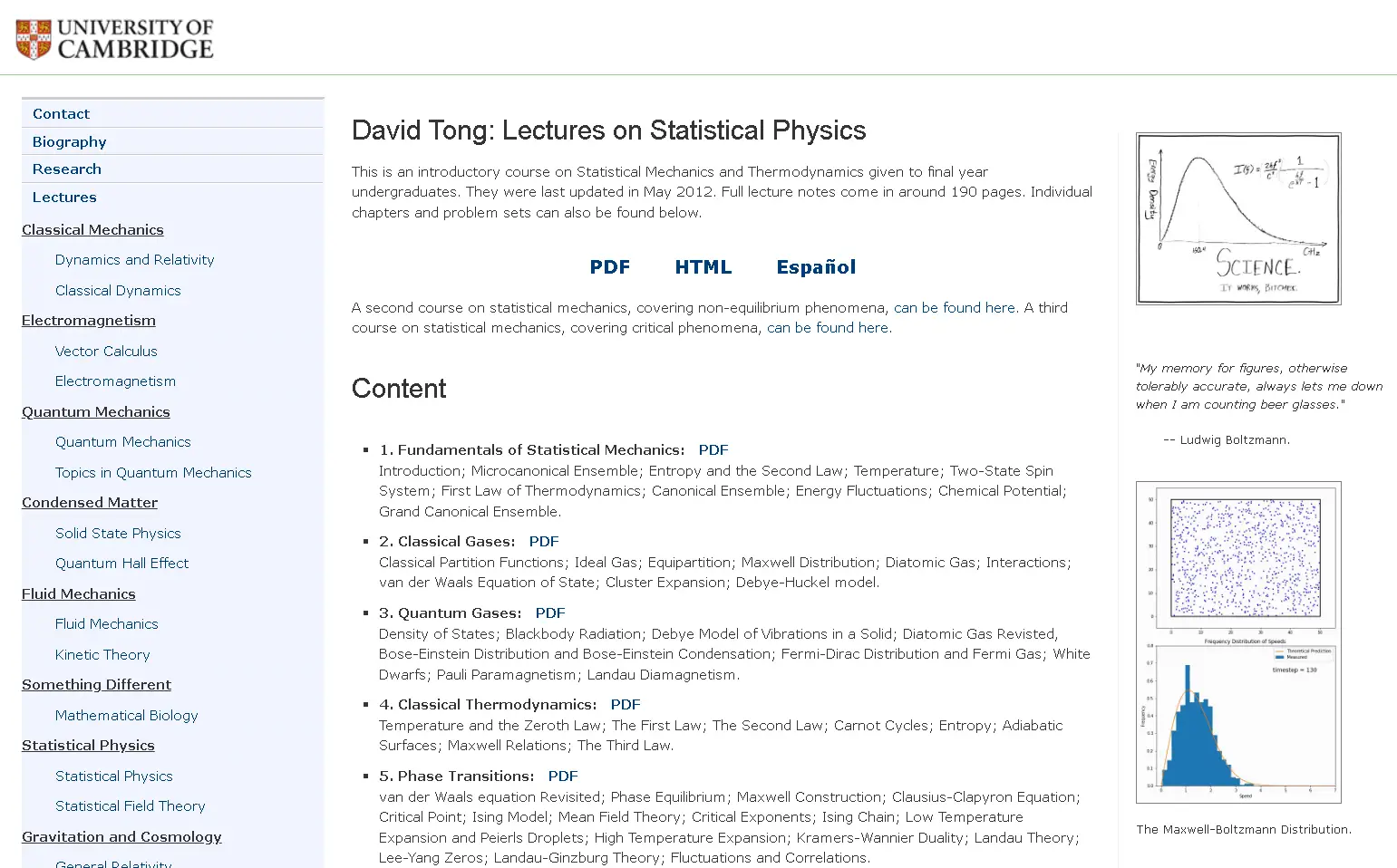
Access Cambridge DAMTP statistical physics lecture notes, reading materials, and academic resources for undergraduate physics study.
Tutor Match Criteria (How We Pick Your Tutor)
Statistical Mechanics is taught across a wide range of levels and disciplinary contexts — physics, chemistry, materials science, biophysics — and the right tutor depends on where you are and what you need.
Level and course fit: A tutor supporting an undergraduate working through the canonical ensemble and ideal quantum gases needs different emphasis than one supporting a PhD student building renormalisation group methods for a condensed matter research project. MPB matches by level and specific content area, not subject label alone.
Topic strengths and tools: Tutors are assessed on their Statistical Mechanics competency across all levels before being recommended — classical and quantum ensembles, phase transitions, mean field theory, renormalisation group, and stochastic methods. Sessions use Google Meet with a digital pen-pad or iPad+Pencil so all derivations, phase diagrams, and partition function calculations are fully visible in real time.
Time zone and availability: MPB serves students across the US, UK, Canada, Australia, and Gulf. Sessions are available across all major time zones including evenings and weekends.
Learning style and pace: Some students need careful conceptual scaffolding from thermodynamic foundations upward. Others need fast, targeted problem-solving for an imminent exam. The tutor adapts to what you need.
Goals: Exam preparation, problem-set support, conceptual clarity before advancing to condensed matter or field theory, or dissertation-level support — the tutor shapes each session to the goal that matters most right now.
Urgency and timeline: Exam next week or building understanding across a full semester — the tutor builds a realistic plan that fits both the time available and the depth required.
Study Plans (Pick One That Matches Your Goal)
MPB offers three broad plan types: a catch-up plan (typically 1–2 weeks) for students behind on specific topics — for example, needing to consolidate partition functions and quantum statistics before the course moves to phase transitions — an exam prep plan (typically 4–8 weeks) for structured coverage of all assessed material, and a weekly support plan for consistent help throughout a semester, academic year, or research period. After the first diagnostic session, your tutor builds the specific session-by-session plan based on your actual gaps, your timeline, and your available weekly commitment.
Pricing Guide
Statistical Mechanics tutoring at MPB starts at USD 20 per hour and typically ranges up to USD 40 per hour for standard undergraduate sessions. Advanced Masters and PhD-level tutoring — covering renormalisation group methods, field-theoretic approaches, stochastic processes, or research-level applications — can go up to USD 100 per hour depending on topic complexity and tutor profile. All pricing is confirmed before any session begins — no hidden fees.
WhatsApp for a quick quote — share your level, the specific topics you need, and your timeline.
FAQ
Is Statistical Mechanics hard?
Statistical Mechanics is widely considered one of the most conceptually challenging subjects in undergraduate and graduate physics. The difficulty is not in any single calculation — the mathematics is often not extreme — but in the reasoning: understanding why a particular ensemble applies, what the partition function is physically encoding, and why thermodynamic quantities emerge from it the way they do. Students who try to learn Statistical Mechanics by memorising results without understanding the probabilistic logic consistently find it collapses under examination pressure. Targeted 1:1 tutoring that builds the logic alongside the formalism is the most effective path.
How many sessions are needed?
An undergraduate catching up on ensembles and quantum statistics before an exam typically needs 6–10 focused sessions. A student working through a full semester covering classical and quantum gases, phase transitions, and mean field theory might need 15–25 sessions. A PhD student building renormalisation group methods or stochastic process theory for research might need 10–20 targeted sessions. Your tutor will give a realistic estimate after the diagnostic — not a generic package.
Can MPB help with Statistical Mechanics problem sets and assignments?
Yes — as guided explanation and worked examples. Tutors work through the relevant formalism, demonstrate similar calculations, and give detailed feedback on your attempts. Solutions you submit are always your own work. MPB does not complete or write problem sets for students. This approach is consistent with the academic integrity standards of every institution and programme MPB serves.
What background is needed before starting?
Solid undergraduate thermodynamics and classical mechanics are essential. For intermediate and advanced Statistical Mechanics, comfort with quantum mechanics and multivariable calculus becomes important — quantum statistics, the density matrix, and the quantum partition function all require QM fluency. If your Thermodynamics or Quantum Mechanics foundations have gaps, your tutor will identify them in the diagnostic and address them before progressing.
What happens in the first session?
The first session starts with a diagnostic — a few representative problems and a conversation about where you feel clear and where you do not. The tutor then teaches one focused concept live, so you leave with something concrete from the first session. Before attending, share your syllabus, prescribed textbook, known weak areas, and any upcoming exam or submission dates so the tutor can make the session immediately targeted.
Is online Statistical Mechanics tutoring as effective as in-person?
For Statistical Mechanics, online sessions via Google Meet with a digital pen-pad or iPad+Pencil are fully effective. Partition function derivations, phase diagrams, Ising model lattice arguments, renormalisation group flow diagrams, and thermodynamic potential calculations can all be written out and annotated in real time. Students across the US, UK, Canada, Australia, and Gulf consistently find live online sessions as productive as in-person, with the flexibility of scheduling across time zones.
What textbooks do Statistical Mechanics tutors work with?
Tutors are familiar with standard texts including Blundell and Blundell’s Concepts in Thermal Physics, Mandl’s Statistical Physics, Kittel and Kroemer’s Thermal Physics, Reif’s Fundamentals of Statistical and Thermal Physics, Pathria and Beale’s Statistical Mechanics, and at the graduate level, Kardar’s Statistical Physics of Particles and Fields and Goldenfeld’s Lectures on Phase Transitions and the Renormalization Group. Share your prescribed text before the first session and the tutor aligns directly to it.
Can MPB support PhD students using Statistical Mechanics in their research?
Yes. Many PhD students in condensed matter, soft matter, biophysics, and chemical physics use Statistical Mechanics methods daily — partition functions, Monte Carlo simulation, Langevin dynamics, Fokker-Planck equations, linear response theory — without having had a course that built those tools carefully. MPB tutors can work with you on whichever specific methods your research demands, starting from wherever your current understanding sits and building toward the depth your work requires.
Does MPB cover the connection between Statistical Mechanics and thermodynamics?
Yes — and making that connection explicit is one of the most important things Statistical Mechanics tutoring can do. Many students have learned thermodynamics as a set of empirical laws and learn Statistical Mechanics as a separate formal apparatus without ever seeing them connect rigorously. Tutors at MPB specifically build that bridge — deriving the laws of thermodynamics from statistical principles and showing how every thermodynamic potential emerges from the appropriate ensemble. The Thermodynamics page also offers dedicated support if foundation work is needed separately.
Can MPB help with Statistical Mechanics applied to condensed matter or soft matter?
Yes. Statistical Mechanics is the foundational tool of both condensed matter and soft matter physics — from the Ising model and mean field theory of magnetic phase transitions, to polymer chain statistics and membrane fluctuations. Students whose programmes or research sit at these intersections can explore dedicated MPB pages for Condensed Matter (Solid State) Physics and Polymer Physics alongside Statistical Mechanics support.
How does Statistical Mechanics connect to other subjects at MPB?
Statistical Mechanics is a foundational tool across a wide range of Physics disciplines. It connects directly to Thermodynamics, Condensed Matter (Solid State) Physics, Quantum Mechanics, and Polymer Physics. At the advanced level it connects to Quantum Field Theory (QFT) through the formal equivalence of the quantum partition function and the QFT path integral. Students in biophysics programmes may also find connections to Biophysics.
Our services aim to provide personalised academic guidance, helping students understand concepts and improve skills. Materials and guidance provided are for reference and learning purposes only. Misusing them for academic dishonesty or violations of integrity policies is strongly discouraged.
Trust & Quality at My Physics Buddy
Statistical Mechanics tutors at MPB are vetted specifically for this discipline across all levels at which it is taught. Every tutor completes a subject-specific assessment before being listed — demonstrating their ability to derive results from ensemble principles rather than recall them, explain the physical reasoning behind the formalism, and adapt their explanations to students at different stages. Student feedback after each session feeds into ongoing quality reviews.
MPB operates on one clear principle: we guide, you produce the work. Whether you are an undergraduate working through canonical ensemble problem sets or a PhD student developing renormalisation group methods for research, the tutor explains, demonstrates, and gives feedback on your work — they do not write it. Research from the National Academies of Sciences, How People Learn, confirms that active expert-guided problem solving in technically demanding subjects is what builds the durable understanding Statistical Mechanics requires.
MPB is a Physics-focused online tutoring platform serving students from undergraduate through PhD level across the US, UK, Canada, Australia, and Gulf. Students working across related subjects can explore dedicated pages for Thermodynamics, Condensed Matter (Solid State) Physics, Quantum Mechanics, Polymer Physics, and Mathematical Physics. Students building foundational depth can also find support through the main Physics page.
“The fact that entropy increases — the second law of thermodynamics — is not a fundamental law of nature. It is a consequence of probability. That realisation, due to Boltzmann, is one of the deepest in all of physics.”
Explore how APS supports physics departments with programs, resources, and initiatives to enhance teaching, diversity, and student success.
Content reviewed by a Statistical Mechanics tutor at My Physics Buddy.
Additional References and Resources
The following credible external resources are useful for students studying Statistical Mechanics at different levels:
- David Tong, University of Cambridge — Lectures on Statistical Physics: Freely available undergraduate and graduate lecture notes, widely used in UK and international physics programmes and considered among the clearest written treatments of the subject.
- American Physical Society — Boltzmann and the Statistical Interpretation of Entropy: Historical context on the foundational ideas of Statistical Mechanics and the intellectual courage behind Boltzmann’s probabilistic interpretation.
- MIT OpenCourseWare — Statistical Mechanics I (8.333): Lecture notes, problem sets, and exams from MIT’s graduate Statistical Mechanics course — a valuable reference for graduate-level students and a benchmark for what PhD-level competency looks like.
- Nobel Prize — Physics 1977 (Phase Transitions and Critical Phenomena): The scientific rationale behind the Nobel Prize awarded for the theory of critical phenomena and the renormalisation group — directly relevant to the most advanced Statistical Mechanics content.
- National Institute of Standards and Technology (NIST) — Fundamental Physical Constants: NIST’s reference values for constants including Boltzmann’s constant, Avogadro’s number, and others that appear throughout Statistical Mechanics calculations.
- IUPAC — Thermodynamic and Statistical Mechanical Quantities and Their Definitions: International authority on the precise definitions of thermodynamic and statistical mechanical quantities — relevant for students who need to be precise about notation and terminology in research writing.
Explore IUPAC’s scientific databases, including chemical terminology, solubility data, and research tools for global chemistry applications.
Next Steps
Tell us your current level in Statistical Mechanics — first encounter in an undergraduate thermodynamics module, a dedicated intermediate course, or graduate-level research application — along with the specific topics you need to focus on and any upcoming exam or submission dates. Share your availability and time zone. MPB will match you to the right tutor, confirm the fit, and most students have their first session booked within 24–48 hours.

