Hire Best Quantum Computing Tutors Online



Testimonials



Quantum Computing Tutor Online
My Physics Buddy (MPB) offers 1:1 online tutoring & homework help in Physics and related subjects. Quantum Computing is a rapidly advancing field that draws on quantum mechanics, linear algebra, information theory, and computer science. MPB connects students with specialist tutors for live, personalised sessions built around your university course and goals. Whether you are searching for a Quantum Computing tutor near me or need targeted help with a specific topic, MPB is built for this level.
- 1:1 live sessions — specialist tutors, not generalists
- Covers undergraduate, graduate, and PhD-level Quantum Computing content
- Tutors matched by topic depth, mathematical level, and your course context
- Flexible scheduling across US, UK, Canada, Australia, and Gulf time zones
- Structured learning plan built after a diagnostic session
- Ethical homework and assignment guidance — we explain concepts, you submit your own work
Who This Quantum Computing Tutoring Is For
Quantum Computing attracts students from Physics, Computer Science, Mathematics, and Engineering. MPB’s program serves all of them.
- Advanced undergraduate students in Physics, Computer Science, or Mathematics taking a Quantum Computing course or elective
- Graduate (Masters) students in quantum information, quantum engineering, or related programs
- PhD students needing to solidify theoretical foundations alongside their research
- Students in the US, UK, Canada, Australia, and Gulf region enrolled at universities with Quantum Computing offerings
- Professionals and researchers transitioning into quantum computing who need structured conceptual support
- Students needing guided help with problem sets, assignments, or understanding derivations from texts such as Nielsen & Chuang
Outcomes: What You’ll Be Able To Do in Quantum Computing
Quantum Computing demands fluency in quantum mechanics and the mathematics of information simultaneously. Strong tutoring builds both. These are observable outcomes, not guarantees.
Solve problems involving qubits, quantum gates, and quantum circuits with confidence in both the Dirac notation and matrix representation. Analyse quantum algorithms — including Grover’s and Shor’s — at the level of understanding why they work, not just what they compute. Derive and interpret key results in quantum information theory: no-cloning theorem, quantum teleportation, superdense coding. Apply quantum error correction concepts, including stabiliser codes and the role of decoherence. Write and present rigorous problem set solutions with the mathematical precision that graduate-level Quantum Computing courses expect.
What We Cover in Quantum Computing (Syllabus / Topics)
Quantum Computing syllabi vary by institution and department — Physics-side courses emphasise quantum mechanics and hardware; Computer Science-side courses lean toward algorithms and complexity. MPB tutors are familiar with both traditions and adapt to your specific course. Coverage aligns with standard texts including Nielsen & Chuang’s Quantum Computation and Quantum Information.
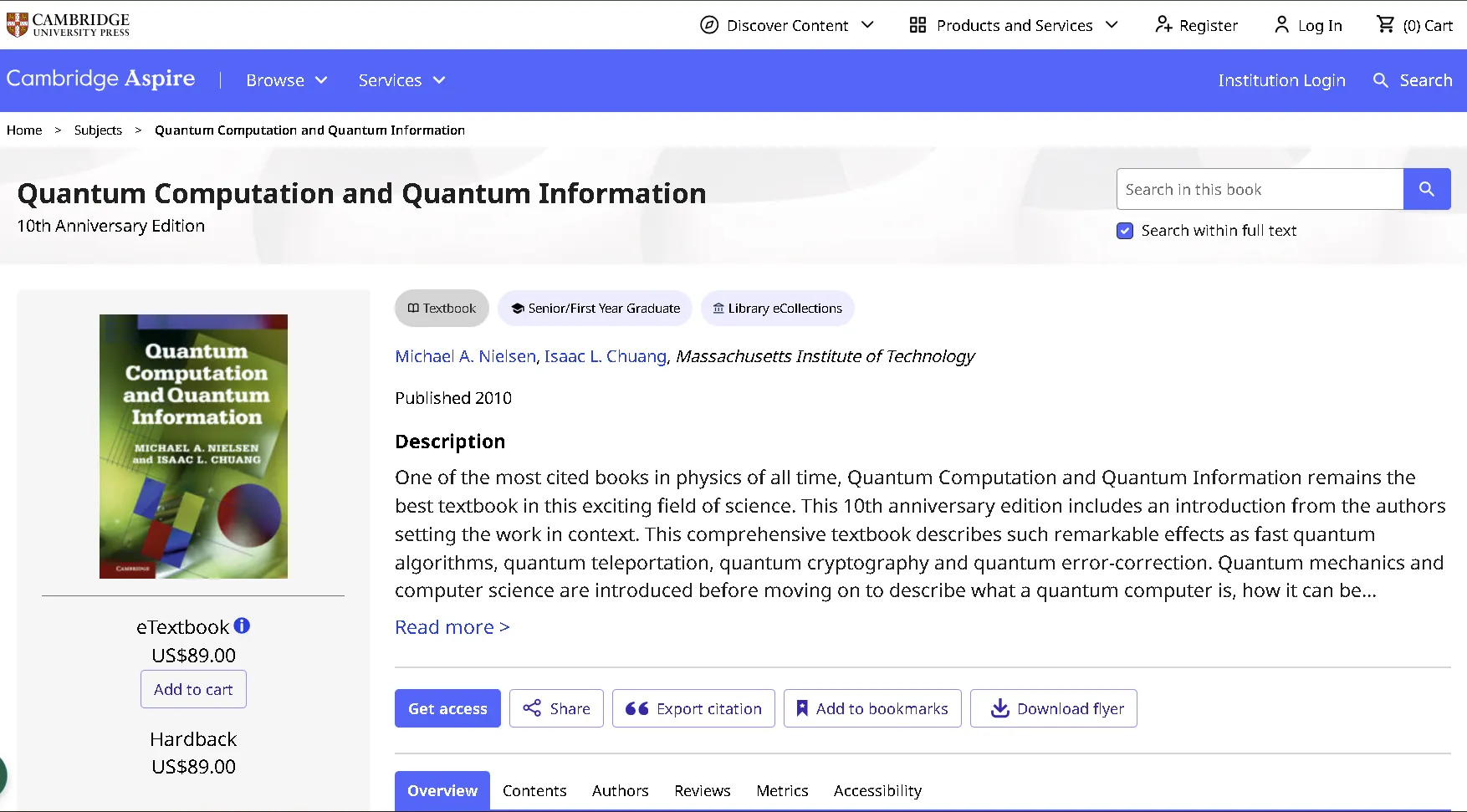
Explore the Quantum Computation and Quantum Information textbook covering quantum algorithms, cryptography, and modern computing concepts.
Quantum Mechanics Foundations for Computing
- Hilbert spaces, Dirac notation, bra-ket formalism
- Quantum states: superposition, normalisation, inner products
- Operators, Hermitian operators, eigenvalues, and measurement postulates
- Tensor products and composite quantum systems
- Density matrices: pure and mixed states, partial trace, reduced density matrix
- Time evolution: unitary operators, Schrödinger equation in matrix form
Qubits and Quantum Gates
- The qubit: Bloch sphere representation, single-qubit states
- Single-qubit gates: Pauli gates (X, Y, Z), Hadamard, phase gate, T gate
- Multi-qubit gates: CNOT, Toffoli, SWAP — matrix representations and circuit diagrams
- Universal gate sets: why a finite gate set can approximate any unitary
- Quantum circuit model: depth, width, reversibility
- Measurement in the computational basis and in other bases
Quantum Entanglement and Information
- Bell states: construction, properties, violation of Bell inequalities
- Entanglement measures: Schmidt decomposition, entanglement entropy
- No-cloning theorem: statement, proof, and implications
- Quantum teleportation: protocol, circuit, and physical interpretation
- Superdense coding: encoding two classical bits in one qubit
- Quantum key distribution: BB84 protocol and security intuition
Quantum Algorithms
- Deutsch-Jozsa algorithm: the first demonstration of quantum advantage
- Bernstein-Vazirani algorithm: linear functions and query complexity
- Simon’s algorithm: hidden subgroup problem, exponential speedup
- Grover’s search algorithm: oracle construction, amplitude amplification, quadratic speedup
- Quantum Fourier Transform (QFT): circuit construction, relationship to classical DFT
- Phase estimation algorithm: precision, circuit depth, applications
- Shor’s factoring algorithm: period finding, continued fractions, classical post-processing
- Variational Quantum Eigensolver (VQE) and QAOA: hybrid classical-quantum algorithms
Quantum Complexity and Computational Models
- Complexity classes: P, NP, BPP, BQP — definitions and relationships
- Oracle separation: why quantum computers are provably faster for some problems
- Query complexity versus circuit complexity
- Quantum Turing machines and equivalence to the circuit model
- QRAM and classical-quantum interface considerations
Quantum Error Correction and Decoherence
- Sources of noise: decoherence, gate errors, measurement errors
- Classical error correction review: repetition code, Hamming code
- Quantum error correction: the three-qubit bit-flip code and phase-flip code
- Stabiliser formalism: Pauli group, stabiliser codes, syndrome measurement
- Shor’s nine-qubit code: correcting arbitrary single-qubit errors
- Surface codes: basic structure and why they are hardware-relevant
- Fault-tolerant quantum computation: threshold theorem (conceptual)
Physical Implementations and Hardware
- DiVincenzo criteria: requirements for a physical quantum computer
- Superconducting qubits: transmon architecture, gate operations, decoherence times
- Trapped ion qubits: laser-driven gates, coherence advantages
- Photonic quantum computing: linear optics, KLM theorem
- Topological qubits: Majorana fermions, basic concepts
- Current hardware landscape: NISQ era, fidelity benchmarks, real-device noise
Students strengthening foundations relevant to Quantum Computing can also explore related MPB pages including Quantum Mechanics, Quantum Field Theory (QFT), and Computational Physics.
How My Physics Buddy Tutors Help You with Quantum Computing (The Learning Loop)
Diagnose: Every engagement starts with a diagnostic. The tutor identifies where your quantum mechanics foundations are solid, where the linear algebra is causing problems, and which algorithmic or error-correction concepts are unclear. This shapes every session.
Explain: Quantum Computing is full of moments where the formalism moves faster than the intuition. Your tutor closes that gap — explaining why Grover’s algorithm works geometrically before writing down the amplitude amplification operator, or what entanglement physically means before formalising it with density matrices. Explanations adapt until the concept is genuinely clear.
Practice: You work through graduate-level problems live — constructing circuits, deriving algorithm correctness, proving information-theoretic results, and analysing error correction schemes. The tutor tracks your reasoning at every step.
Feedback: After each problem, you receive specific, targeted feedback. “Your QFT circuit is structurally correct but you have the bit-reversal permutation in the wrong position” or “your no-cloning proof is almost there — you need to invoke linearity of unitary operators more explicitly” — mathematically precise and tied to what your course requires.
Retest / Reinforce: Core concepts return in new contexts across sessions. The quantum Fourier transform, for instance, reappears in phase estimation, Shor’s algorithm, and quantum simulation — each encounter reinforces the same underlying tool from a different direction.
Plan: The tutor updates the session plan as your course progresses. You always know what the next session targets and why.
Accountability: For students on weekly plans, tutors help maintain steady progress alongside problem-set deadlines and research commitments.
Sessions run live on Google Meet with a digital pen-pad or iPad + Apple Pencil — essential for drawing quantum circuits, Bloch sphere diagrams, and multi-line derivations in real time. Before your first session, share your course syllabus, current topic, assigned text, and any upcoming deadlines. The first session includes a short diagnostic, a live working-through of your most pressing concept, and a clear plan for the next two to four sessions.
Quantum Computing is moving from theory to deployment faster than most fields in physics. According to the National Institute of Standards and Technology (NIST), quantum information science is now a national priority in the US, with significant research investment across academia, government, and industry. Students who build genuine fluency in this subject are positioning themselves at one of the most consequential frontiers in modern science and technology.
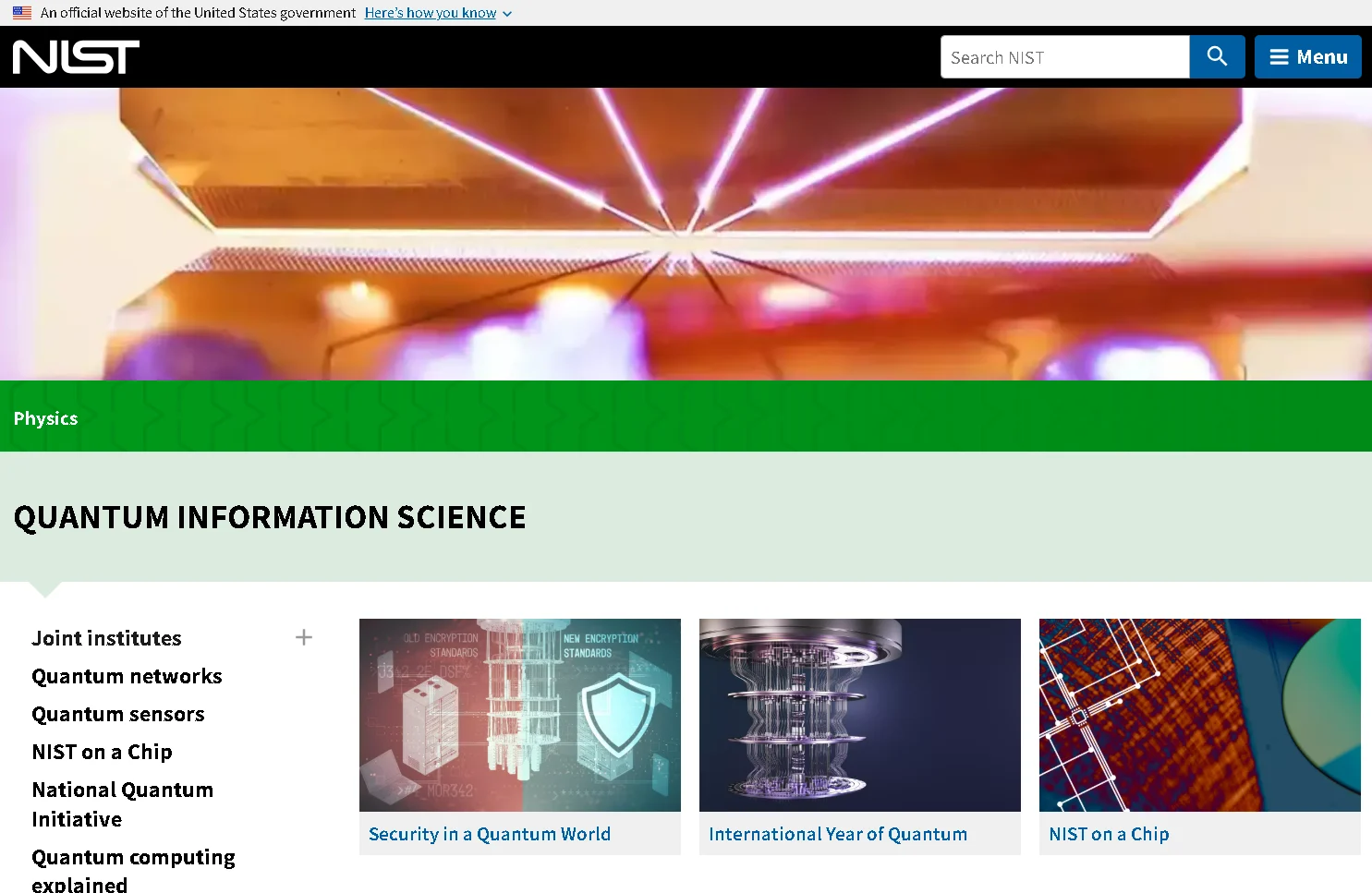
Explore NIST’s quantum information science research, including quantum computing, secure communication, and next-generation technologies.
Tutor Match Criteria (How We Pick Your Tutor)
Level and course fit: Your tutor will have direct experience with Quantum Computing at your specific academic level — undergraduate module, graduate course, or PhD-level study. They understand whether your course leans toward the physics or computer science tradition and teach accordingly.
Topic strengths: If your difficulty is in quantum algorithms, error correction, or hardware implementations, we match you with a tutor whose expertise covers that domain at the right depth.
Tools and setup: All MPB tutors use Google Meet and a digital pen-pad or iPad + Apple Pencil for real-time circuit diagrams, matrix calculations, and derivation work.
Time zone and availability: Tutors are available across US, UK, Canada, Australia, and Gulf time zones, fitting around your university schedule and problem-set deadlines.
Learning style and pace: Some students need systematic rebuilding of the quantum mechanics foundations. Others want focused problem-set work ahead of a deadline. Your tutor adjusts accordingly.
Goals: A PhD student preparing for a qualifying exam has different needs than an undergraduate working through a single module. We align on your goal before sessions begin.
Urgency and timeline: A student with an assignment due in two days gets a targeted plan. A student building foundations across a semester gets a paced structure. Tutor selection accounts for your timeline.
Study Plans (Pick One That Matches Your Goal)
MPB offers three broad plan types for Quantum Computing: a catch-up plan (one to two weeks) for closing specific gaps before an exam or deadline, a course support plan (four to eight weeks) for structured assistance across a semester, and an ongoing weekly plan for PhD students or researchers needing consistent expert guidance. The tutor builds the specific session plan after the diagnostic — no fixed schedule is set until your starting point and goals are clear.
Pricing Guide
Quantum Computing tutoring at MPB starts at USD 20 per hour. Most graduate-level sessions fall in the USD 50–USD 80 per hour range, reflecting the advanced and interdisciplinary nature of the subject. For highly specialised topics or compressed timelines, rates may reach USD 100 per hour.
Pricing depends on the tutor’s specialisation, the depth of topics covered, your level, and session frequency. All rates are discussed transparently before you commit.
FAQ
Is Quantum Computing hard?
Quantum Computing is demanding because it requires simultaneous fluency in quantum mechanics, linear algebra, and computational thinking. Most students find the quantum mechanics foundations the steepest initial hurdle. With methodical support and targeted problem-solving practice, the subject becomes progressively more tractable — but it rewards consistent engagement over cramming.
How many sessions are needed?
A student targeting one or two specific topics may need three to six sessions. A student seeking support across a full-semester course benefits from regular weekly sessions throughout the term. Your tutor will give a more specific estimate after the diagnostic, based on your current level and course timeline.
Can you help with Quantum Computing homework and problem sets?
Yes — as guided support, not submission. Your tutor will work through problem approaches with you, explain where your derivation breaks down, and help you build the understanding to complete the work yourself. MPB does not complete or submit assignments for students. Academic integrity applies at every level, and students are expected to submit their own work at all times.
What happens in the first session?
The first session includes a short diagnostic on two or three topic areas, a live working-through of your most pressing concept or problem, and a clear plan for the next two to four sessions. Come with your course syllabus, current chapter, any assigned text, and upcoming deadlines. Sessions run on Google Meet with digital pen-pad support.
Do I need a strong Physics background to study Quantum Computing?
It depends on which tradition your course follows. Physics-side courses require solid quantum mechanics foundations. Computer Science-side courses often start from linear algebra and abstract qubit models. In either case, your tutor will identify and address prerequisite gaps during the diagnostic. Students who need to strengthen their quantum mechanics first can explore Quantum Mechanics tutoring on MPB.
Is online tutoring effective for this subject?
Yes. Quantum Computing involves circuit diagrams, matrix algebra, and multi-step derivations — all of which a tutor can work through in real time using digital pen-pad tools on Google Meet. The format closely replicates a one-on-one whiteboard session, without the scheduling constraints of in-person availability.
Can you help with quantum programming languages like Qiskit or Cirq?
Yes, at a conceptual and implementation guidance level. MPB tutors can help you understand what a Qiskit or Cirq circuit is doing physically, debug your circuit logic, and connect your code to the underlying quantum algorithm. Share your specific programming environment and what you are building before the session and the tutor will prepare accordingly.
Can MPB help with PhD qualifying exams that include Quantum Computing?
Yes. Qualifying exams that include quantum information or quantum computing typically test algorithm derivations, information-theoretic proofs, and error correction — at a depth requiring both mathematical rigour and physical intuition. Share your qualifying exam syllabus and any past papers and the tutor will build a targeted preparation plan.
What are the key prerequisites for Quantum Computing?
Linear algebra (vector spaces, eigenvalues, unitary matrices) and introductory quantum mechanics are the two most critical prerequisites. Familiarity with probability theory and basic complexity theory is also helpful. If your prerequisites are incomplete, your tutor can address specific gaps alongside the Quantum Computing content. Students who need to strengthen their foundations can also explore Quantum Optics and Mathematical Physics on MPB.
What related subjects does MPB cover that connect to Quantum Computing?
Quantum Computing draws on several adjacent disciplines. Students who need to strengthen foundations in Quantum Mechanics, Statistical Mechanics, or Computational Physics can find specialist tutoring in all of these areas on MPB. Students with interests in quantum hardware can also explore Condensed Matter (Solid State) Physics and Semiconductor Physics.
Trust & Quality at My Physics Buddy
Tutor selection: MPB tutors for Quantum Computing hold postgraduate degrees in Physics, Computer Science, Mathematics, or closely related fields, with specific coursework or research experience in quantum information. Every tutor goes through a subject screening that includes a live demo session and an ongoing student feedback loop. Quantum Computing is a specialised field — MPB’s matching process prioritises demonstrated depth over generalist coverage.
Academic integrity: MPB’s position is clear — we guide, you submit your own work. Tutors explain concepts, work through similar problems, and provide feedback on your derivations. They do not complete assignments, problem sets, or any assessed work for students. All guidance is framed as explanation and conceptual clarification, consistent with your university’s academic integrity policies.
“Quantum computing is not just a faster computer — it is a fundamentally different model of computation that exploits quantum mechanics to solve problems that are intractable for any classical machine.”
— Based on principles outlined in Nielsen & Chuang, Quantum Computation and Quantum Information, Cambridge University Press
About MPB: My Physics Buddy is a Physics-focused online tutoring platform serving students from undergraduate through postgraduate level, across the US, UK, Canada, Australia, and Gulf regions. Students working on related advanced topics can explore Quantum Field Theory (QFT), Particle Physics, and Quantum Optics on MPB — all of which share foundational frameworks with Quantum Computing at the graduate level.
Research consistently shows that students in advanced, mathematically intensive courses perform best when they engage actively through problem-solving and receive regular expert feedback. A study in the Physical Review Physics Education Research journal found that deliberate, feedback-driven practice produces significantly stronger conceptual retention than passive study. MPB’s learning loop is built on this evidence.
“The students who succeed in quantum computing courses are rarely those who simply read more — they are those who work more problems, get faster feedback, and build genuine intuition for the mathematics.”
— Based on findings in Bloom’s 2-Sigma Study, Educational Researcher (1984)

Access millions of peer-reviewed articles and journals on Taylor & Francis Online, a leading academic research platform.
Content reviewed by a Quantum Computing tutor at My Physics Buddy.
Next Steps
Tell us your academic level, your university course name, your current topic, any upcoming deadlines, and your main challenge areas — whether that is quantum gates and circuits, algorithm derivations, error correction, or hardware concepts. We will match you with a tutor whose expertise fits your course depth and timeline. Most students are matched and into their first session within a few days. Scheduling is flexible across all primary time zones.

