Hire Best General Relativity Tutors Online

Testimonials



General Relativity Tutor Online
My Physics Buddy (MPB) provides 1:1 online tutoring & homework help in Physics and related subjects, including General Relativity at the advanced undergraduate, Masters, and PhD level. General Relativity is one of the most mathematically and conceptually demanding courses in all of theoretical physics — a subject where differential geometry, tensor calculus, and deep physical reasoning must develop together. If you are searching for a “General Relativity tutor near me” with genuine graduate-level depth, MPB connects you with subject-matched tutors across the US, UK, Canada, Australia, and Gulf — built to help you aim for real understanding, not surface familiarity.
- 1:1 live online sessions — no group classes, no pre-recorded content
- Tutors with genuine graduate-level depth in General Relativity and differential geometry
- Covers advanced undergraduate through to PhD and research-level General Relativity
- Flexible scheduling across all major time zones
- Structured learning plan built after your diagnostic session
- Ethical problem-set, qualifying exam, and dissertation guidance — we work through the physics with you, you produce the work
Who This General Relativity Tutoring Is For
General Relativity is a graduate-level subject at most institutions. It demands mathematical maturity and a solid prior foundation in Special Relativity, classical mechanics, and electrodynamics. This tutoring is designed for students operating at that level:
- Advanced final-year undergraduate students taking an introductory General Relativity or curved spacetime module as part of a theoretical physics degree
- Masters-level students for whom General Relativity is a core or advanced elective module in theoretical physics, mathematical physics, or astrophysics
- PhD students in general relativity, gravitational wave physics, cosmology, mathematical physics, or high-energy theory for whom GR is either a research tool or a subject being studied for qualifying exams
- Students in the US, UK, Canada, Australia, and Gulf whose graduate programmes include General Relativity as part of a theoretical, mathematical, or astrophysics track
- Students returning to General Relativity after a gap and needing to systematically rebuild their tensor calculus and physical intuition before applying GR in research
- Students needing structured support for GR problem sets, qualifying exam preparation, or dissertation-level conceptual clarity
Outcomes: What You’ll Be Able to Do in General Relativity
General Relativity builds an entirely new framework for understanding gravity, space, and time — one where the mathematical structures and the physical content must be learned simultaneously. The capabilities built through structured 1:1 tutoring are tied directly to what graduate examinations and research both require.
Solve GR problems involving the metric tensor, Christoffel symbols, the Riemann and Ricci tensors, and geodesic equations — carrying out the tensor index calculations with the precision and speed that qualifying exams demand. Analyze spacetime geometries physically — reading off the properties of a metric, identifying symmetries, applying Killing vectors, and connecting the mathematical structure to observable physical predictions. Model physical systems in curved spacetime — particle and photon geodesics in the Schwarzschild geometry, gravitational redshift, perihelion precession, light bending — using the full apparatus of Riemannian geometry. Derive the Einstein field equations from the Einstein-Hilbert action, understand the content of each term, and apply the linearised theory to gravitational wave solutions. Explain the logical and mathematical structure of GR — from the equivalence principle through the geometry of curved manifolds to the physical content of the Bianchi identities and energy-momentum conservation — with the rigour expected in viva examinations and research writing. Apply GR to cosmological models, the FLRW metric, the Friedmann equations, and observational tests of the theory at a level appropriate to your programme.
General Relativity is unusual among graduate physics courses in that it requires you to learn a substantial body of new mathematics — differential geometry and tensor calculus — at the same time as learning the physics. The diagnostic session specifically identifies whether your difficulty is in the mathematics, the physical interpretation, or the connection between the two.
What We Cover in General Relativity (Syllabus / Topics)
GR curricula vary between institutions — some courses lead with the physical and equivalence principle motivation before introducing the geometry, others begin with differential geometry and arrive at the physics. Tutors align directly to your specific course and textbook. The following tracks reflect what is typically covered at each stage — always confirm your current syllabus with your institution.
Introductory and Intermediate GR (Advanced Undergraduate / Early Graduate)
- Review of Special Relativity in covariant form: Minkowski metric, four-vectors, the stress-energy tensor
- The equivalence principle: weak and strong forms, local inertial frames, motivation for curved spacetime
- Manifolds and coordinates: coordinate transformations, tangent vectors, covectors, the metric tensor
- Tensor algebra: contravariant and covariant indices, index raising and lowering, tensor products, contraction
- Covariant differentiation: the Christoffel connection, parallel transport, the covariant derivative
- Geodesics: geodesic equation derivation, affine parameterisation, geodesics as generalisations of straight lines
- Curvature: Riemann tensor definition and symmetries, Ricci tensor, Ricci scalar, Weyl tensor (overview)
- The Einstein field equations: physical motivation, the cosmological constant, stress-energy tensor sources
- Linearised gravity: weak field limit, Newtonian limit recovery, gravitational waves as perturbations of flat spacetime
- The Schwarzschild solution: derivation, Birkhoff’s theorem, coordinate singularities vs. physical singularities
- Physics in the Schwarzschild geometry: gravitational redshift, orbital mechanics, innermost stable circular orbit
- Classical tests of GR: light bending, perihelion precession of Mercury, Shapiro delay
Advanced GR (Graduate Core)
- Differential forms: exterior derivative, wedge product, Stokes’ theorem in differential form language
- Lie derivatives and Killing vectors: symmetries of spacetime, conserved quantities, stationary and static spacetimes
- Geodesic deviation and the Jacobi equation: tidal forces, physical meaning of the Riemann tensor
- The Einstein-Hilbert action: derivation of the Einstein equations from the action principle, variation of the metric
- Energy conditions: weak, strong, dominant, null — physical content and their role in singularity theorems
- Black hole spacetimes: Kruskal-Szekeres coordinates, maximally extended Schwarzschild, Penrose diagrams
- Rotating black holes: the Kerr metric, ergosphere, frame dragging, Penrose process
- Charged black holes: Reissner-Nordström metric, extremal black holes
- Gravitational waves in detail: transverse-traceless gauge, polarisation states, energy carried by gravitational waves, detection principles
- Causal structure: future and past domains of dependence, Cauchy surfaces, global hyperbolicity
- Singularity theorems: Penrose and Hawking theorems — statement, physical content, key assumptions
Specialist and Research-Level GR
- Numerical relativity: overview of 3+1 decomposition (ADM formalism), motivation for computational approaches
- Post-Newtonian approximation: systematic expansion for slowly moving, weakly gravitating systems
- Gravitational wave astronomy: matched filtering, parameter estimation, LIGO/Virgo science (physical basis)
- Black hole thermodynamics: Hawking radiation (conceptual), Bekenstein-Hawking entropy, the four laws
- Cosmological perturbation theory: scalar, vector, tensor decomposition, connection to CMB physics
- Connection to Quantum Gravity: semiclassical gravity, motivation for quantum gravity, string theory and loop quantum gravity as research contexts
- Thesis and dissertation guidance: structuring GR derivations and physical arguments in research writing
- Qualifying exam preparation: systematic coverage of all GR topics assessed in PhD qualifying exams
How My Physics Buddy Tutors Help You with General Relativity (The Learning Loop)
Diagnose: The first session begins with a targeted diagnostic. The tutor gives you a few representative problems — compute the Christoffel symbols for a given metric, derive the geodesic equation, interpret a Penrose diagram — and asks you to work through them explaining your reasoning. This immediately reveals whether your gaps are in the differential geometry formalism, the physical interpretation of geometric objects, the tensor index mechanics, or the connection between abstract mathematics and the physical content of the theory.
Explain: The tutor does not re-derive what is in your lecture notes. They explain what a Christoffel symbol physically represents, why the Riemann tensor measures the failure of parallel transport to be path-independent, what the Bianchi identity is saying physically and why it guarantees energy-momentum conservation, what the Schwarzschild singularity at r=2M actually is and why it is a coordinate artefact. In GR, building physical intuition alongside the formalism is not optional — it is what makes the mathematics interpretable.
Practice: You work through problems live. In General Relativity this means tensor index calculations, Christoffel symbol computations, geodesic equation derivations, metric analysis problems, and extended written arguments connecting physical reasoning to geometric structure. The tutor observes your process at every step — not just the final answer — and intervenes precisely where reasoning or technique breaks down.
Feedback: Feedback is specific and graduate-level. Not “your tensor is wrong” but “you have applied the product rule to a covariant derivative but forgotten the connection term for the second index — here is the systematic rule for how many connection terms appear for a tensor of each rank.” At PhD level, feedback extends to the logical structure of written derivations and the precision with which physical interpretations are stated.
Retest/Reinforce: GR is deeply cumulative — the Christoffel connection reappears in the Riemann tensor, which reappears in the Einstein equations, which reappear in every solution you study. The tutor tracks this structure deliberately, returning to foundational objects in progressively more complex contexts so that each new topic reinforces rather than obscures what came before.
Plan: After each session the tutor updates your learning plan. Areas still unclear receive more sessions and different explanatory approaches. Areas now solid are pushed toward harder applications. No session wastes time on already-mastered material.
Accountability: Between sessions the tutor may assign specific calculations, ask you to write out a derivation in full from memory, or suggest sections of Carroll, Wald, or Misner-Thorne-Wheeler to work through. Structured between-session work is what makes each live session build rather than repeat.
All sessions run via Google Meet with a digital pen-pad or iPad+Pencil setup, so metric computations, Penrose diagrams, tensor index manipulations, and extended derivations are fully visible and editable in real time. Before your first session, share your course syllabus, your prescribed textbook, any problem sets or qualifying exam papers you are working toward, and your specific areas of difficulty.
“Space-time tells matter how to move; matter tells space-time how to curve.”
John Archibald Wheeler — as cited in APS News, History of Physics — Wheeler and the language of General Relativity
Stay updated with APS News featuring the latest stories, research, and insights from the global physics community.
Tutor Match Criteria (How We Pick Your Tutor)
General Relativity is one of the most technically demanding graduate courses in physics. Matching you to the right tutor requires precision across mathematical depth and physical content.
Level and course fit: A tutor supporting an advanced undergraduate working through the Schwarzschild metric and classical tests needs different depth than one supporting a PhD student preparing a qualifying exam on black hole thermodynamics and gravitational wave theory, or a researcher needing to consolidate ADM formalism. MPB matches by level and specific content, not subject label alone.
Mathematical depth: GR tutors at MPB are assessed specifically on their differential geometry and tensor calculus competency — not just their knowledge of the physics results. A tutor who cannot derive the Riemann tensor from first principles or carry out a non-trivial Christoffel symbol calculation fluently is not matched to GR students at MPB.
Topic strengths and tools: Tutors declare their specific competency areas — Schwarzschild and Kerr geometry, gravitational wave physics, cosmological models, black hole thermodynamics — and are matched accordingly. Sessions use Google Meet with a digital pen-pad or iPad+Pencil so all computations, diagrams, and derivations are fully visible in real time.
Time zone and availability: MPB serves students across the US, UK, Canada, Australia, and Gulf. Sessions are available across all major time zones including evenings and weekends to accommodate demanding graduate schedules.
Goals: Coursework problem sets, qualifying exam preparation, research-level conceptual clarity, gravitational wave physics, cosmology, or dissertation support — the tutor shapes each session to the goal that matters most right now.
Urgency and timeline: Qualifying exam in four weeks or building GR foundations across an academic year — the tutor builds a plan that fits both the time available and the depth required.
Study Plans (Pick One That Matches Your Goal)
MPB offers three broad plan types: a catch-up plan (typically 1–2 weeks) for students behind on specific topics — for example, needing to consolidate the Riemann tensor and Einstein equations before the course moves to black holes — an exam prep plan (typically 4–8 weeks) for structured coverage of all assessed material ahead of a final or qualifying exam, and a weekly support plan for consistent help throughout a graduate semester or research period. After the first diagnostic session, your tutor builds the specific session-by-session plan based on your actual gaps, your timeline, and your available weekly commitment.
Pricing Guide
General Relativity tutoring at MPB starts at USD 40 per hour given its graduate-level positioning, and typically ranges up to USD 100 per hour for advanced content — Kerr geometry, gravitational wave physics, cosmological perturbation theory, black hole thermodynamics, or research-level GR applications. GR requires highly specialised tutors and the pricing reflects that.
All pricing is confirmed before any session begins — no hidden fees. Every quote is specific to your level and the topics involved.
WhatsApp for a quick quote — share your programme level, the specific GR topics you need, and your timeline.
FAQ
Is General Relativity hard?
General Relativity is widely regarded as one of the most difficult courses in a graduate physics curriculum — harder than most students anticipate even after being warned. The difficulty is not from any single concept but from the combination of new mathematics (differential geometry, tensor calculus), new physical intuition (curved spacetime, non-inertial observers), and the demand that both develop simultaneously. Students who try to learn GR by memorising results without understanding the geometry consistently find that it does not hold under exam or research pressure. 1:1 tutoring that builds the formalism and the physical picture together is the most effective path through it.
What mathematical background is needed before starting GR?
Solid foundations in Special Relativity, classical mechanics at the Lagrangian level, multivariable calculus, and linear algebra are the minimum. Comfort with index notation from Special Relativity helps enormously. Prior exposure to differential geometry or Riemannian geometry is not required but accelerates progress significantly. If your Special Relativity or Mathematical Physics foundations have gaps, your tutor will identify this in the diagnostic and address those foundations before progressing into the geometry of curved spacetime.
How many sessions are needed?
GR is not a subject that yields to a handful of sessions. A graduate student working through a full-semester GR course typically needs 20–35 sessions spread across the semester to build genuine competency across all topics. A PhD student preparing for a qualifying exam with 6–8 weeks available typically needs 12–20 intensive sessions. A student needing to consolidate a specific area — say, the Kerr metric and rotating black holes — before a research milestone might need 4–8 targeted sessions. Your tutor will give a realistic estimate after the diagnostic, not a generic package.
Can MPB help with GR problem sets and qualifying exams?
Yes — as guided explanation and worked examples. GR problem sets are among the most technically demanding in all of graduate physics, and the tutor will work through the relevant formalism, demonstrate similar calculations, and give detailed feedback on your attempts. Solutions you submit are always your own work. MPB does not complete or write problem sets for students. Qualifying exam preparation is one of the primary reasons PhD students seek GR tutoring at MPB — the tutor can work systematically through all tested areas with the rigour and speed those exams demand.
What textbooks do GR tutors work with?
Tutors are familiar with the standard GR texts: Carroll’s Spacetime and Geometry, Wald’s General Relativity, Misner, Thorne and Wheeler’s Gravitation (MTW), Hartle’s Gravity, Schutz’s A First Course in General Relativity, and at a more advanced level, Hawking and Ellis’s The Large Scale Structure of Space-Time. Share your prescribed text before the first session and the tutor aligns directly to it — different books develop the formalism in very different orders and the tutor respects that structure.
What happens in the first session?
The first session is a focused diagnostic. The tutor gives you a few targeted problems — compute Christoffel symbols for a given metric, work through a geodesic equation, interpret a physical scenario in curved spacetime — and asks you to reason through them openly. The tutor then teaches one focused concept live based on what the diagnostic reveals. Before attending, share your syllabus, your prescribed textbook, any known weak areas, and upcoming exam or submission dates.
Is online GR tutoring as effective as in-person?
For a subject as computation-heavy and diagram-intensive as General Relativity, online sessions via Google Meet with a digital pen-pad or iPad+Pencil are fully effective. Extended tensor index calculations, Penrose diagram constructions, metric computations, and Christoffel symbol derivations can all be written out fully and annotated in real time on a shared digital whiteboard. Graduate students across the US, UK, Canada, Australia, and Gulf consistently find live online sessions as productive as in-person, with the added benefit of scheduling flexibility across demanding research timetables.
Can MPB help with gravitational wave physics?
Yes. Gravitational wave physics — linearised gravity, the transverse-traceless gauge, gravitational wave polarisation, energy flux, and the physical basis of interferometric detection — is covered as an advanced topic within General Relativity. For PhD students whose research is in gravitational wave astronomy or data analysis, tutors can also discuss the broader physical framework at a research-oriented level. The LIGO Scientific Collaboration has made significant educational resources available on the physics of gravitational wave detection.
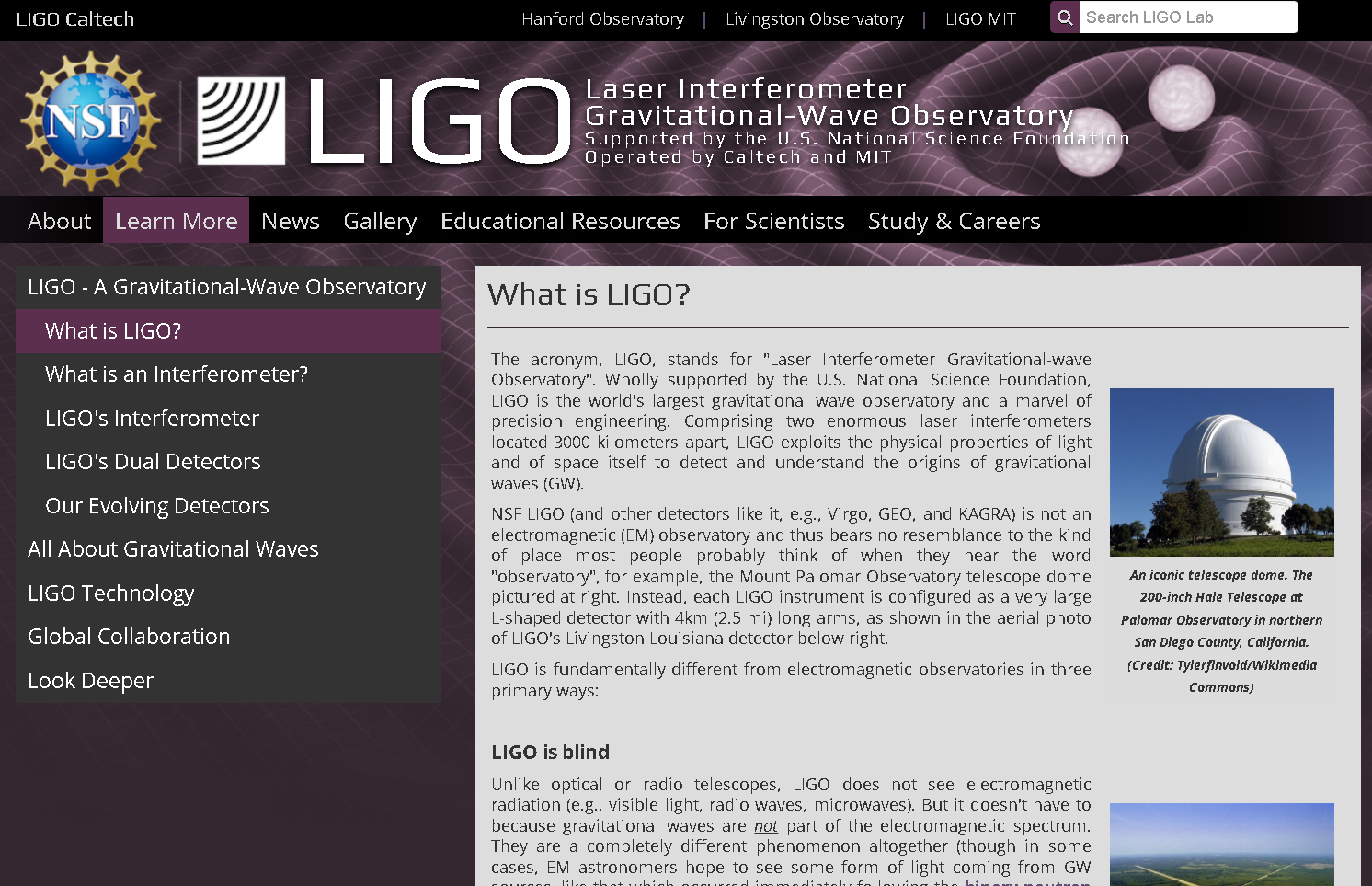
Learn how LIGO detects gravitational waves using advanced laser interferometers to study black holes, neutron stars, and cosmic events.
Can MPB support GR in the context of cosmology?
Yes. The FLRW metric, the Friedmann equations, cosmological horizons, and inflation are all covered as part of the advanced GR curriculum and connect directly to the Cosmology page on MPB. Students in astrophysics or cosmology programmes who need to apply GR to large-scale structure, CMB physics, or dark energy models can discuss this with their tutor at the matching stage so the content emphasis is set appropriately.
Can MPB help with dissertation or thesis chapters involving GR?
Yes — at a guidance level. Tutors can help you structure physical and mathematical arguments in your writing, work through the logic of a derivation for a methods or theory chapter, and give feedback on how clearly your geometric reasoning is expressed. They do not write your dissertation. The goal is to deepen your understanding and sharpen your ability to communicate it — both of which your written work will reflect.
How does General Relativity connect to other subjects at MPB?
General Relativity sits at the intersection of several advanced theory subjects. It is the direct continuation of Special Relativity and connects closely to Cosmology, Quantum Field Theory (QFT) (via semiclassical gravity and quantum gravity motivations), and Particle Physics (via curved spacetime QFT). Students in mathematical physics programmes will also find connections to Mathematical Physics and Orbital & Celestial Mechanics.
Our services aim to provide personalised academic guidance, helping students understand concepts and improve skills. Materials and guidance provided are for reference and learning purposes only. Misusing them for academic dishonesty or violations of integrity policies is strongly discouraged.
Trust & Quality at My Physics Buddy
General Relativity tutors at MPB are vetted at the highest standard MPB applies to any subject — because GR demands it. Every tutor completes a subject-specific assessment that includes live demonstration of tensor calculus competency, ability to derive results from first principles, and capacity to explain geometric concepts clearly to students at different stages. A tutor who cannot fluently handle Christoffel symbol computations, Riemann tensor derivations, and physical interpretation of GR solutions is not listed for GR at MPB. Student feedback after each session feeds into ongoing quality reviews with no exceptions.
MPB operates on one principle: we guide, you produce the work. In a graduate GR context this means the tutor works through the formalism with you — explaining, demonstrating, giving feedback on your derivations — but the problem set solutions, qualifying exam answers, and dissertation chapters are always your own. Research on learning in the most demanding technical disciplines — including findings from the National Academies of Sciences, How People Learn — confirms that active, expert-guided problem solving at the right level of difficulty is what builds the robust understanding GR demands.
MPB is a Physics-focused online tutoring platform serving graduate and advanced undergraduate students across the US, UK, Canada, Australia, and Gulf. Students working across related advanced theory subjects can explore dedicated MPB pages for Special Relativity, Quantum Field Theory (QFT), Cosmology, Particle Physics, and Mathematical Physics. Students whose research involves observational aspects of relativity can also find support through Astronomy & Astrophysics and Orbital & Celestial Mechanics.
“The general theory of relativity is perhaps the most beautiful physical theory ever formulated — and among the most demanding to master. It rewards those who engage with the mathematics honestly and deeply.”
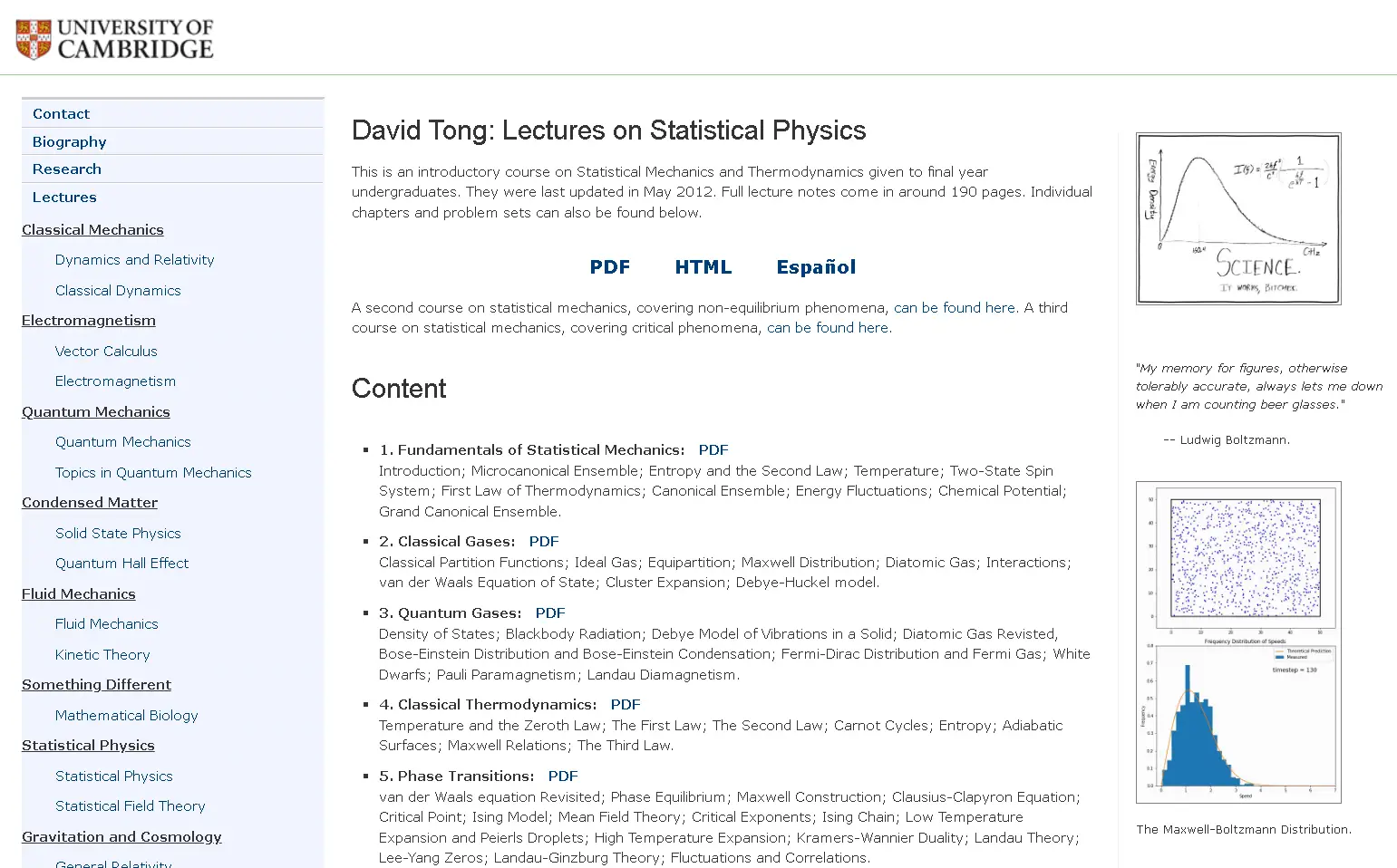
Access Cambridge DAMTP statistical physics lecture notes, reading materials, and academic resources for undergraduate physics study.
Content reviewed by a General Relativity tutor at My Physics Buddy.
Additional References and Resources
The following credible external resources are particularly valuable for students studying General Relativity at graduate level:
- David Tong, University of Cambridge — General Relativity Lecture Notes: Freely available graduate lecture notes widely used in UK and international theoretical physics programmes. Among the clearest written introductions to the subject at graduate level.
- LIGO Scientific Collaboration — What Is LIGO?: The physical and scientific basis of gravitational wave detection, from the laboratory that made the first direct observation of gravitational waves. Essential reading for any GR student interested in the experimental side.
- American Physical Society — Wheeler and the Language of General Relativity: Historical context on John Wheeler’s contributions to GR, including the coining of “black hole” and the development of geometrodynamics.
- Nobel Prize — Physics 2017 (Gravitational Waves): The scientific rationale behind the Nobel Prize awarded for the detection of gravitational waves — connecting GR theory directly to its most celebrated recent experimental confirmation.
- Institute for Advanced Study — Einstein’s General Relativity at 100: A scholarly overview of the centenary of General Relativity from the institution where Einstein worked — covering the theory’s development, predictions, and lasting impact.
- National Academies of Sciences — How People Learn: Research on deep learning in technically demanding disciplines — relevant for understanding why active, expert-guided problem solving is particularly critical in a subject as demanding as GR.
Next Steps
Tell us your current level in General Relativity — advanced undergraduate module, Masters core course, PhD qualifying exam preparation, or active research use — along with the specific topics you need to work through, your prescribed textbook, and any upcoming exam or submission dates. Share your availability and time zone. MPB will match you to a tutor with genuine graduate-level depth in GR, confirm the fit, and most students have their first session booked within 24–48 hours.

