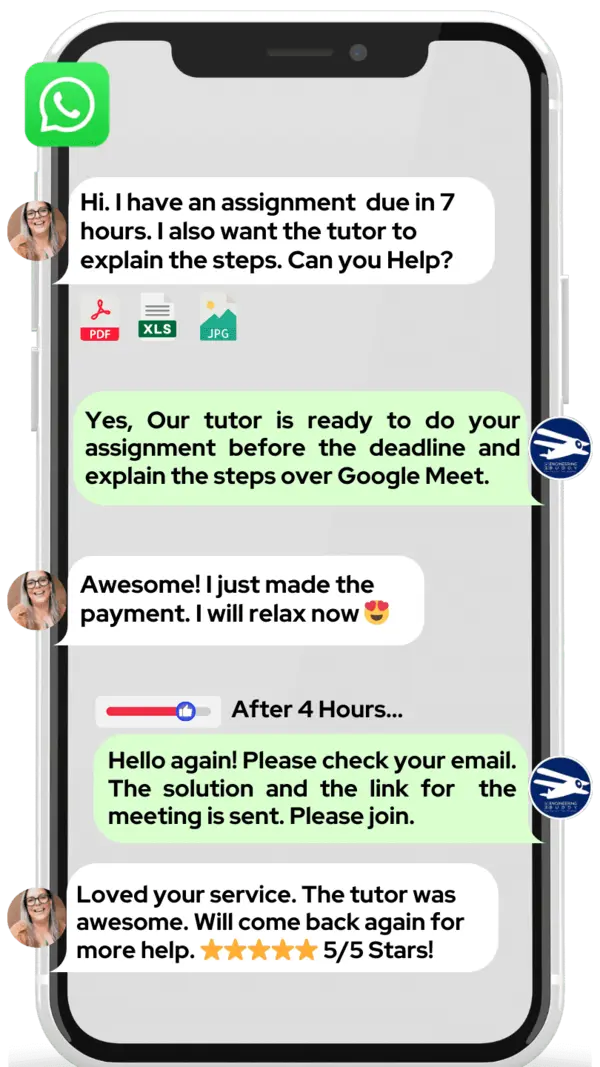
Hire Best Engineering Dynamics Tutors Online

Testimonials



Engineering Dynamics Tutor Online
My Physics Buddy (MPB) offers 1:1 online tutoring & homework help in Engineering Dynamics — a dedicated area for undergraduate civil, mechanical, aerospace, and general engineering students worldwide. Engineering Dynamics is the compulsory sequel to Statics in virtually every engineering program — and consistently one of the most demanding second-year engineering courses students encounter. If you’ve been searching for an Engineering Dynamics tutor near me, MPB connects you with expert tutors who understand both the mechanics and the problem-solving discipline your course demands.
- 1:1 live sessions — fully personalized to your engineering program, current topics, and assessment schedule
- Expert tutors with strong knowledge across all major Engineering Dynamics course areas
- Flexible time zones — sessions conveniently scheduled for the US, UK, Canada, Australia, and Gulf regions
- Structured learning plan built around your syllabus, weakest topics, and upcoming exams
- Ethical homework and assignment guidance — we explain and guide; you complete and submit your own work
“Dynamics is where engineering mechanics becomes real — where you calculate how fast a mechanism moves, how hard a vehicle brakes, and how a rotating machine vibrates. Mastering it is essential for every mechanical and aerospace engineer.”
As broadly reflected in engineering education — see the American Society for Engineering Education (ASEE) — Engineering Mechanics programs

Search ASEE conference proceedings and access engineering education research, papers, and academic resources.
Who This Engineering Dynamics Tutoring Is For
- Second-year undergraduate engineering students in mechanical, civil, aerospace, or general engineering programs taking Dynamics as a compulsory course
- Students who passed Statics but find Dynamics significantly harder — particularly with rotating reference frames, rigid body kinematics, or energy methods for complex systems
- Students facing resit or make-up exams in Dynamics who need intensive, focused remediation before their next attempt
- Students completing homework and problem sets throughout the semester who need regular guided support alongside exam preparation
- Students whose programs include vibrations or mechanical systems content built directly on Dynamics foundations
- International students in US, UK, Canadian, and Australian engineering programs who need flexible, expert support
Outcomes: What You’ll Be Able To Do
Solve Engineering Dynamics problems — from particle kinematics and Newton’s second law through to rigid body motion, work-energy methods, and impulse-momentum — accurately and with clearly shown working. Apply the correct analytical method for each problem type: choosing between Newton-Euler equations, work-energy, and impulse-momentum based on what is given and what is asked. Analyze the kinematics of mechanisms, rotating bodies, and linked systems using relative motion, rotating frames, and instantaneous center methods. Explain dynamic behavior in structured written responses that reflect genuine physical understanding — not just substitution into memorized formulas.
What We Cover (Syllabus / Topics)
Engineering Dynamics course content is broadly consistent across universities worldwide, typically following Hibbeler or Beer & Johnston. The topics below reflect standard coverage across undergraduate Dynamics courses in the US, UK, Canada, Australia, and Gulf region. Always share your course syllabus with your tutor so sessions align precisely to your program’s sequence and depth.
A note on method selection: One of the most challanging aspects of Engineering Dynamics is knowing which method — Newton-Euler, work-energy, or impulse-momentum — to apply to each problem. Your tutor builds this decision-making discipline from the first session alongside topic coverage.
Track 1: Kinematics of a Particle
- Rectilinear motion: position, velocity, acceleration — constant and variable
- Curvilinear motion: Cartesian, normal-tangential (n-t), and polar coordinates
- Projectile motion and constrained motion
- Relative motion of two particles; dependent motion of connected bodies
- Problem types: position-velocity-acceleration relations, projectile, pulley constraint problems
Track 2: Kinetics of a Particle — Force and Acceleration
- Newton’s second law: ΣF = ma in Cartesian, n-t, and polar coordinates
- Free-body diagram and kinetic diagram approach for particles
- Normal and tangential force equations for curvilinear motion
- Equations of motion for systems of particles
- Problem types: circular motion force analysis, particle on a curve, connected particle systems
Track 3: Work, Energy, and Power — Particles
- Work done by a force; kinetic energy and the work-energy theorem
- Conservative forces; potential energy and conservation of energy
- Power and mechanical efficiency
- Spring forces and gravitational potential energy in work-energy problems
- Problem types: velocity from energy methods, spring-mass work-energy, power calculations
Track 4: Impulse, Momentum, and Impact — Particles
- Linear impulse and momentum; conservation of linear momentum
- Impact: direct central and oblique impact; coefficient of restitution
- Angular impulse and angular momentum for a particle
- Problem types: collision velocity, coefficient of restitution, angular momentum conservation
Track 5: Planar Kinematics of a Rigid Body
- Types of rigid body motion: translation, rotation, and general plane motion
- Rotation about a fixed axis: angular velocity, angular acceleration
- Absolute and relative velocity in general plane motion
- Instantaneous center of zero velocity: location and use
- Relative acceleration analysis: normal and tangential components
- Problem types: velocity and acceleration of points on a rigid body, IC method, linkage analysis
Track 6: Planar Kinetics of a Rigid Body
- Equations of motion for a rigid body: ΣF = ma_G and ΣM_G = I_G α
- Moment of inertia: parallel axis theorem, composite body method
- Rolling without slipping: kinetic equations for wheels and cylinders
- Work-energy method for rigid bodies: kinetic energy of rotation and translation
- Impulse-momentum method for rigid bodies: angular impulse and momentum
- Problem types: rigid body Newton-Euler, rolling dynamics, work-energy and impulse for rigid bodies
Track 7: 3D Dynamics and Introduction to Vibrations
- 3D kinematics: angular velocity, Euler angles (overview)
- 3D kinetics: Euler’s equations of motion for a rigid body
- Gyroscopic motion and precession
- Undamped free vibration: equation of motion, natural frequency, and period
- Damped and forced vibration: damping ratio, resonance (overview)
- Problem types: 3D angular momentum, Euler equations, free vibration natural frequency
Students who want to consolidate the Statics foundations this course builds on can explore MPB’s page for Engineering Statics. Students extending further can explore Classical Mechanics, Engineering Physics, and Fluid Mechanics.
How MPB Tutors Help You (The Learning Loop)
Diagnose: The tutor asks about your engineering program and year, current topics, recent test or homework marks, upcoming exam dates, and which problem types feel most unclear — whether that’s rigid body kinematics, method selection, impact problems, or 3D dynamics. This shapes every session.
Explain: Each topic is built from your syllabus using clear, step-by-step explanations that emphasize correct problem setup and method selection — because in Engineering Dynamics, choosing the right approach before writing a single equation is what separates correct solutions from circular dead ends.
“Engineering Dynamics is harder than Statics not because the mathematics is more complex — it is because students must now choose between multiple valid solution methods. The tutor’s job is to make that choice instinctive.”
As broadly affirmed in engineering mechanics education — see the American Society for Engineering Education (ASEE) — Physics for Engineers research
Practice: You work through past exam questions and problem sets matched to your course style — Hibbeler-style or Beer & Johnston-style problems across all major Dynamics topics, with method selection drilled explicitly alongside calculation accuracy.
Feedback: Your tutor reviews your working in detail — identifying incorrect method selection, free-body and kinetic diagram errors, wrong moment of inertia application, and sign convention mistakes — and corrects them with specific, actionable guidance that prevents the same error recurring.
Retest/Reinforce: Topics where errors are consistant are revisited with fresh problems and increasing difficulty, spaced so problem-solving discipline holds under timed exam conditions.
Plan: Your tutor maintains a session roadmap anchored to your syllabus, homework deadlines, and exam schedule — adapting as results come in across the semester.
All sessions run on Google Meet with a digital pen-pad or iPad + Pencil for live free-body and kinetic diagrams, velocity-acceleration sketches, instantaneous center illustrations, and step-by-step equation of motion walkthroughs.
Study Plans (Pick One That Matches Your Goal)
MPB offers three plan types: a catch-up plan (1–2 weeks intensive) for students with an imminent exam or resit, a full course prep plan (4–8 weeks) covering all major topics with systematic problem practice and method selection training, and ongoing weekly support across a full semester. All plans are structured after the diagnostic session based on your syllabus, problem-solving gaps, and assessment schedule.
Pricing Guide
Engineering Dynamics tutoring at MPB starts at USD 20 per hour and typically ranges up to USD 40 per hour. Pricing varies based on tutor experience, session intensity, and timeline. For a specific quote, WhatsApp for quick quote.
FAQ
Is Engineering Dynamics hard?
Engineering Dynamics is consistently rated harder than Statics by most engineering students. The added difficulty comes not from harder mathematics but from the need to select between multiple solution methods — Newton-Euler, work-energy, and impulse-momentum — and to construct both free-body and kinetic diagrams correctly before solving. Rigid body kinematics in particular challanges students who lack a clear systematic approach. With structured 1:1 tutoring, method selection becomes instinctive and marks improve measurably.
What is the difference between Engineering Dynamics and Classical Mechanics?
Engineering Dynamics and Classical Mechanics cover overlapping content — Newton’s laws, energy, momentum, and rigid body motion — but from different perspectives. Engineering Dynamics is applied and problem-focused, using the Newtonian framework with an emphasis on practical mechanism and machine analysis using Hibbeler or Beer & Johnston. Classical Mechanics in a physics program extends further into Lagrangian and Hamiltonian formulations. Students bridging both can explore MPB’s dedicated page for Classical Mechanics.
Can you help with Engineering Dynamics homework and problem sets?
Yes — MPB provides guided homework and problem set support throughout the course. Tutors explain the relevant mechanics principles, walk through analogous worked examples, and review your diagram setup and method selection. Our services aim to provide personalized academic guidance to help you understand concepts and improve skills. You complete and submit your own work in accordance with your institution’s academic integrity policy.
Which textbooks does MPB Engineering Dynamics tutoring cover?
MPB tutors are familiar with the major Engineering Dynamics textbooks used at universities worldwide — including Hibbeler’s Engineering Mechanics: Dynamics, Beer, Johnston & Cornwell’s Vector Mechanics for Engineers: Dynamics, and Meriam & Kraige’s Engineering Mechanics: Dynamics. Share your institution’s prescribed textbook and problem sets with your tutor so sessions align to your specific course materials from the first session.
What happens in the first session?
The first session begins with a short diagnostic — your engineering program, year, current topic, recent homework or test marks, and upcoming exam dates. The tutor then works through a priority problem type with live diagram construction, method selection, and step-by-step solution. The session closes with a concrete plan for the sessions ahead. Bring your course syllabus, a recent problem set, and your exam schedule.
Does strong Dynamics preparation help with later engineering courses?
Yes — significantly. Engineering Dynamics is the direct prerequisite for Mechanical Vibrations, Machine Design, Robotics, Vehicle Dynamics, and Structural Dynamics. Students who genuinely master rigid body kinematics, Newton-Euler equations, and energy-momentum methods find every subsequent dynamics-related engineering course considerably more accessible. Students planning ahead can explore MPB’s pages for Engineering Statics, Engineering Physics, and Fluid Mechanics.
Academic Integrity Note: Our services aim to provide personalized academic guidance, helping students understand concepts and improve skills. Materials provided are for reference and learning purposes only. Misusing them for academic dishonesty or violations of academic integrity policies is strongly discouraged.
Trust & Quality at My Physics Buddy
Tutor selection: Every MPB tutor goes through subject knowledge screening, a live demo session evaluation, and ongoing student feedback review. For Engineering Dynamics, we specifically look for tutors who can teach method selection as a discipline — tutors who do not just solve problems correctly but who can show students how to identify the right approach, construct both diagrams correctly, and execute the solution cleanly under exam conditions.
About My Physics Buddy: MPB is a Physics-focused online tutoring platform serving undergraduate engineering and science students across the US, UK, Canada, Australia, and Gulf regions. Our core is Physics and closely related quantitative subjects. Students in Engineering Dynamics can explore additional support through MPB’s pages for Engineering Statics, Classical Mechanics, Engineering Physics, and Fluid Mechanics. Students looking ahead can also visit our page for Thermodynamics.
Explore Related Physics and Engineering Subjects at MPB: Engineering Dynamics connects directly to several related disciplines. MPB has dedicated pages for Engineering Statics, Classical Mechanics, Engineering Physics, Fluid Mechanics, and Thermodynamics — all directly relevant for engineering students building a strong applied mechanics foundation.
Content reviewed by an Engineering Dynamics tutor at My Physics Buddy.
Next Steps
Share your engineering program and year, your current course topics, the problem types giving you the most difficulty, and your upcoming exam or homework deadlines. Let us know your preferred session times and time zone. MPB will match you with a tutor whose Engineering Dynamics knowledge and availability fit your course needs. Your first session is a diagnostic and live teaching session — so you leave with a clearer understanding of a priority problem type and a concrete plan ahead.

