Hire Best Geophysics Tutors Online

Testimonials


Geophysics Tutor Online
My Physics Buddy (MPB) offers 1:1 online tutoring & homework help in Physics and related subjects. Geophysics is a demanding quantitative discipline that applies the full toolkit of classical physics — mechanics, electromagnetism, thermodynamics, fluid dynamics, and wave theory — to the structure, composition, and dynamics of the Earth and other planetary bodies. It is a subject where the mathematics is rigorous, the physical systems are genuinely complex, and the gap between textbook theory and real field or laboratory data can be wide. Whether you are an undergraduate encountering seismic wave equations and gravity anomalies for the first time, a graduate student working through potential field theory and seismic tomography, or a PhD candidate whose research involves geodynamic modeling or electromagnetic methods in the subsurface, MPB connects you with a tutor who has real depth in this subject. If you have been searching for a Geophysics tutor near me, our fully online model removes that constraint — sessions run live over Google Meet with digital handwriting tools, accessible from any time zone. Tutoring here is designed to help you aim for confident, working mastery of geophysical theory, quantitative methods, and data interpretation skills.
- 1:1 live online sessions — fully personalized, no group classes or pre-recorded content
- Tutors with graduate-level depth in geophysical theory, seismology, potential fields, and applied methods
- Flexible scheduling for students across US, UK, Canada, Australia, and Gulf time zones
- Structured learning plan built around your course syllabus, weak areas, and upcoming exams or research deadlines
- Ethical homework, problem-set, lab report, and assignment guidance — we coach your understanding; you produce and submit your own work
Who This Geophysics Tutoring Is For
Geophysics courses appear across physics, earth science, geology, civil engineering, and environmental science programs. The tutoring here serves students at all of those entry points — from first encounter with the wave equation in a solid Earth context to research-grade application of inversion theory.
- Undergraduate students in physics, geology, earth sciences, or environmental science taking an introductory or intermediate Geophysics course covering seismology, gravity, magnetics, or exploration methods
- Graduate (MS) students in geophysics, applied geophysics, or solid Earth science who need support with more rigorous theoretical treatment — potential field theory, seismic wave propagation, or electromagnetic methods
- PhD students whose research involves geodynamic modeling, seismic tomography, gravity inversion, or any applied geophysical method, and who need conceptual or mathematical reinforcement alongside their research work
- Students in the US, UK, Canada, Australia, and Gulf countries needing support aligned to their specific institutional course or research program
- Students who need structured guidance on problem sets, assignments, field data interpretation, and lab reports — approached as coached learning, not answer delivery
- Parents and academic administrators seeking credible, measurable support for students in advanced earth science or applied physics programs
Outcomes: What You’ll Be Able to Do in Geophysics
A well-taught Geophysics course develops the ability to move between physical theory, mathematical formalism, and real-world data — often simultaneously. Our tutoring is structured to build exactly that kind of integrative competence.
Derive and apply the equations governing seismic wave propagation — P-waves, S-waves, and surface waves — and use travel-time analysis to infer subsurface structure from seismic data. Solve Laplace’s equation in the context of gravity and magnetic potential fields, interpret Bouguer and free-air gravity anomalies, and apply upward continuation and other standard processing steps correctly. Analyze electromagnetic geophysical methods including DC resistivity, magnetotellurics, and ground-penetrating radar at a level appropriate to your course — connecting Maxwell’s equations to subsurface conductivity structure. Model heat flow, isostasy, and lithospheric flexure using the appropriate physical and mathematical frameworks, understanding the assumptions and limitations of each. Write clearly and quantitatively about geophysical results — whether for a problem set, a lab report, a qualifying exam answer, or a research paper section.
What We Cover in Geophysics (Syllabus & Topics)
The content below reflects typical coverage in undergraduate and graduate Geophysics courses. Exact syllabus structure varies considerably by institution, department, and whether the course is oriented toward solid Earth geophysics, exploration geophysics, or environmental geophysics — your tutor works directly from your course materials.
Track 1: Seismology and Elastic Wave Propagation
- Stress and strain tensors in elastic media — definitions, symmetry, and the elastic moduli
- The wave equation in elastic solids — derivation and its solutions for P and S waves
- P-waves, S-waves, Love waves, and Rayleigh waves — physical character, particle motion, and speed relationships
- Snell’s law in elastic media — refraction, reflection, and critical angle
- Travel-time curves for direct, refracted, and reflected waves in layered media
- Seismic refraction and reflection survey design and interpretation
- Normal moveout (NMO), stacking, and the basics of seismic data processing
- Earthquake seismology: fault mechanisms, moment tensors, and focal sphere interpretation
- Seismic tomography — principles of ray-based and waveform inversion
Track 2: Gravity and Geodesy
- Newton’s law of gravitation and the gravitational potential
- Laplace’s equation and its solutions in spherical harmonics — application to the geoid
- The reference ellipsoid, normal gravity, and the International Gravity Formula
- Gravity corrections: free-air, Bouguer, terrain, and tidal corrections
- Bouguer and free-air anomalies — physical meaning and geological interpretation
- Isostasy: Airy and Pratt models, lithospheric flexure, and the isostatic anomaly
- Gravity gradient tensor and its use in exploration and structural geology
- Forward modeling and simple inversion of gravity anomaly profiles
Track 3: Geomagnetism and Paleomagnetism
- The geomagnetic field — components, IGRF, secular variation, and the dynamo hypothesis
- Magnetic potential and the solution of Laplace’s equation for the magnetic field
- Magnetic susceptibility, remanent magnetization, and their geological sources
- Magnetic anomalies over buried bodies — dipole fields, reduced-to-pole transformation
- Aeromagnetic and ground magnetic survey data — acquisition, processing, and interpretation
- Paleomagnetism: magnetic reversal stratigraphy, apparent polar wander, and plate tectonic reconstruction
- Magnetostratigraphy and its application to age dating of sedimentary sequences
Track 4: Electromagnetic Methods
- Maxwell’s equations in conducting media — diffusion approximation and skin depth
- DC resistivity methods: electrode configurations (Wenner, Schlumberger, dipole-dipole), apparent resistivity, and layered Earth interpretation
- Induced polarization (IP) — chargeability, frequency-domain and time-domain measurements
- Magnetotellurics (MT): impedance tensor, phase tensor, and 1D inversion
- Controlled-source electromagnetic (CSEM) methods — time-domain and frequency-domain approaches
- Ground-penetrating radar (GPR): wave propagation in the near-surface, two-way travel time, and velocity analysis
- Airborne electromagnetic methods — principles and geological applications
Track 5: Heat Flow and Geodynamics
- The heat conduction equation — derivation, boundary conditions, and steady-state solutions
- Geothermal gradient, heat flow measurement, and the global heat flow database
- Radioactive heat production and its contribution to continental heat flow
- Oceanic heat flow: cooling of the lithosphere and the half-space cooling model
- Mantle convection — scaling arguments, Rayleigh number, and the physical basis of plate tectonics
- Lithospheric flexure: thin elastic plate model, flexural rigidity, and loading examples
- Postglacial rebound and viscous relaxation — physical framework and observational evidence
Track 6: Exploration Geophysics and Applied Methods
- Survey design principles for seismic, gravity, magnetic, and EM surveys
- Signal processing fundamentals: sampling theorem, Fourier transform, convolution, and filtering applied to geophysical data
- Noise sources, data quality assessment, and quality control in geophysical surveys
- Forward modeling: computing synthetic responses for given subsurface models
- Inverse theory fundamentals: least-squares inversion, regularization, resolution matrices, and model uncertainty
- Well log interpretation and correlation with surface geophysical data
- Environmental and engineering geophysics applications — groundwater, contamination mapping, void detection
Track 7: Global Geophysics and Planetary Physics
- Earth’s internal structure — crust, mantle, outer core, inner core — and the seismic evidence for each boundary
- The reference Earth model (PREM) and what it tells us about composition and physical state
- Plate tectonics as a geophysical system — kinematics, forces, and energy budget
- Rotation of the Earth: polar wander, length-of-day variations, and the Chandler wobble
- Comparative planetary geophysics — interior structure of Moon, Mars, and other bodies from seismic and gravity data
- Space geodesy: GPS, VLBI, and InSAR for measuring crustal deformation
How My Physics Buddy Tutors Help You with Geophysics (The Learning Loop)
Diagnose: Every engagement begins with a focused diagnostic. The tutor asks you to work through a problem or explain a concept from the area you find hardest. This reveals whether the difficulty is mathematical (e.g., uncertain about how to set up the boundary conditions for a layered seismic model), physical (e.g., struggling to connect the abstract wave equation to what a seismometer actually records), or interpretive (e.g., unable to read a gravity anomaly profile and reason about its source geometry).
Explain: The tutor rebuilds each topic from a clear physical foundation. In Geophysics, where the same underlying physics — wave equations, potential theory, heat diffusion — appears in multiple different observational contexts, the tutor always makes those connections explicit. Understanding that the gravity problem and the magnetic problem both reduce to solving Laplace’s equation, for instance, dramatically reduces the cognitive load of the course.
Practice: You work through problems live during the session. The tutor observes your approach and reasoning, not just your final answer. For quantitative topics like travel-time calculation, gravity correction, or resistivity forward modeling, the setup of the problem is as important as the arithmetic.
Feedback: After each problem or derivation attempt, the tutor gives targeted feedback — where your physical reasoning was incomplete, where a boundary condition was missed, and what a thorough exam or assignment answer would include.
Retest / Reinforce: Topics from earlier sessions are revisited with new problems in later sessions. The tutor confirms understanding is solid before advancing — for instance, verifying that travel-time curve interpretation is secure before tackling seismic tomography, or that gravity corrections are fluent before moving into inversion theory.
Plan: Each session ends with a clear agenda for the next: specific topics to cover, problems to attempt, and any reading or data work to do beforehand.
Accountability: For students on a course exam or research deadline timeline, the tutor maintains a running checklist of topics covered and flags areas needing attention before the deadline.
All sessions run via Google Meet. Tutors use a digital pen-pad or iPad + Apple Pencil so that ray diagrams, wavefront constructions, anomaly profiles, and potential field sketches are drawn live on screen — not presented as static slides. Pace adapts fully to you. Before your first session, share your course syllabus, the topics you are currently stuck on, and any upcoming exam, field trip, or assignment dates. The tutor uses this to make the first session immediately useful.
Tutor Match Criteria (How We Pick Your Tutor)
Geophysics spans an unusually wide range of physical and mathematical topics, and not every physics or earth science tutor can cover the full breadth with equal depth. Here is how MPB makes a match that serves your needs.
Level and syllabus fit: Tutors for this subject hold graduate degrees in geophysics, physics, earth sciences, or a closely related field — with documented coursework or research experience in the specific areas your course covers: seismology, potential fields, EM methods, geodynamics, or applied exploration.
Topic strengths: We match based on your primary area of difficulty — whether that is seismic wave propagation, potential field theory, electromagnetic methods, heat flow modeling, or data inversion. Tutors are matched to the area where you need the most depth.
Tools and setup: Google Meet for video, digital pen-pad or iPad + Apple Pencil for live diagram and derivation work. Ray paths, wavefront diagrams, anomaly profiles, and inversion schematics are drawn and worked through in real time.
Time zone and availability: Tutors cover US, UK, Canada, Australia, and Gulf time zones. Evening and weekend sessions are available.
Learning style and pace: Some students want rigorous derivation-first treatment; others want a physical intuition-first approach that builds toward the mathematics. We account for this in matching.
Language and communication preferences: Tutors are selected for clear, precise communication at the appropriate academic level. Regional preferences can be noted.
Goals: Whether your goal is to pass a course exam, interpret your own field or laboratory data, prepare for a qualifying exam, or strengthen the physical foundations of your research — the tutor match reflects that goal.
Urgency and timelines: Students with an imminent deadline are matched for intensive sessions. Students with a full semester ahead are matched for a sustainable weekly cadence.
Study Plans (Pick One That Matches Your Goal)
MPB offers three broad plan types: a catch-up plan for students facing an imminent exam or deadline (typically 1–2 weeks of focused, high-frequency sessions), a course-aligned exam prep plan for students building toward a midterm, final, or qualifying exam over 4–8 weeks, and an ongoing weekly support plan for students who want consistent help throughout a semester or research phase. In every case, the specific session-by-session plan is built by your tutor after the diagnostic — because the right plan depends on what you actually understand right now, not what the syllabus assumes you do.
Pricing Guide
Geophysics tutoring at MPB is priced based on the level of the course, the complexity of the material, and tutor availability. Rates typically start at USD 20 per hour and go up to USD 40 per hour for most undergraduate and graduate-level sessions. For highly specialized support — such as advanced seismic inversion, geodynamic modeling, or PhD-level research guidance — rates may reach up to USD 100 per hour depending on tutor expertise and timeline requirements.
Price is shaped by the academic level and complexity of the content, tutor availability, and how much lead time you provide. Students who plan ahead generally find more scheduling flexibility and better rate options.
All rates are confirmed before your first session — no surprises, no hidden fees. WhatsApp for a quick quote.
FAQ
Is Geophysics hard?
Yes — most students find it genuinely demanding, primarily because it requires applying physics across a wide range of systems simultaneously. The mathematics of wave propagation, potential theory, and heat diffusion are each non-trivial, and the course asks you to switch between them fluidly. The additional challenge of connecting theory to real field data — which is always noisy, incomplete, and ambiguous — adds another layer. With structured expert guidance that links the physics to the observations, the subject becomes coherent and manageable.
How many sessions are needed?
It depends on your starting point, the scope of your course, and your timeline. An undergraduate covering geophysics as a single semester survey course might need 8–12 focused sessions. A graduate student working through a rigorous treatment of seismic methods or potential field theory in depth, or a PhD student needing support for a specific research method, may need 15 or more. Your tutor will give a realistic estimate after the diagnostic.
Can you help with homework, problem sets, and assignments?
Yes — with a clear framing. Tutors explain the geophysical theory behind your problem sets, demonstrate solution approaches on parallel examples, and coach your reasoning through technically involved problems such as travel-time curve construction, gravity anomaly forward modeling, or resistivity survey interpretation. They do not solve your graded work on your behalf, and you produce and submit your own answers. Our services aim to provide personalized academic guidance, helping students understand concepts and improve skills. Materials provided are for reference and learning purposes only. Misusing them for academic dishonesty or violations of integrity policies is strongly discouraged.
Will the tutor follow my exact course syllabus?
Yes. Share your syllabus, lecture notes, or reading list before the first session and the tutor aligns all teaching to your specific course. Geophysics courses vary enormously across institutions — some are seismology-heavy, others are exploration-focused, others emphasize global Earth structure. Your tutor adapts completely to your course’s sequence and emphasis.
What happens in the first session?
The session opens with a short diagnostic — a concept explanation or problem from the area you find hardest. The tutor starts teaching immediately based on what the diagnostic reveals. You leave the first session with a clear 2–4 session plan. There is no lengthy intake or orientation process.
Is online tutoring effective for a subject so dependent on diagrams — ray paths, anomaly profiles, wavefronts?
Yes — and the live digital drawing tools make it more effective than static reference materials. Tutors use a digital pen-pad or iPad + Apple Pencil to draw ray diagrams, wavefront constructions, gravity and magnetic anomaly profiles, and resistivity pseudosections live on screen as the explanation unfolds. Seeing the diagram built step-by-step as the physics is explained is significantly more effective for spatial understanding than reading a finished figure in a textbook.
Can you help with lab reports and field data interpretation?
Yes. Tutors can help you understand the physical meaning of your field or laboratory data, explain how to apply the correct processing and correction steps, and guide the structure and reasoning of your lab report or data interpretation write-up. You produce and submit your own work; the tutor supports your physical understanding and analytical reasoning. This is especially useful for assignments involving seismic refraction surveys, gravity traverse data, or resistivity pseudosections from field campaigns.
Can you help with thesis or dissertation work in Geophysics?
Yes, at a conceptual and analytical guidance level. Tutors can help you understand the theoretical background relevant to your research, work through specific methods or models you are applying, and discuss how to frame a background chapter or methodology section clearly. They do not write dissertation content on your behalf. Think of it as expert conceptual support for your own research thinking and analysis.
What mathematical background do I need before starting?
For undergraduate Geophysics, solid foundations in vector calculus, ordinary differential equations, and introductory physics (mechanics and electromagnetism) are essential. For graduate-level courses, partial differential equations, Fourier analysis, and basic linear algebra are also required — these tools appear throughout seismic wave theory, potential field analysis, and inversion methods. If any of these foundations are weak, your tutor will address them alongside the main content. Students who want to reinforce related physics foundations can also explore MPB’s Waves and Optics, Electromagnetism, and Fluid Mechanics & Dynamics pages.
What resources and textbooks do tutors use?
Tutors are familiar with the standard texts used across geophysics curricula — including works by Telford, Geldart & Sheriff, Sherriff & Geldart, Stein & Wysession, and Blakely — as well as technical resources from leading institutions. The IRIS Incorporated Research Institutions for Seismology educational resources and the USGS Earthquake Hazards Program are among the most authoritative references for seismological content. Sessions draw from your course’s assigned reading wherever possible.
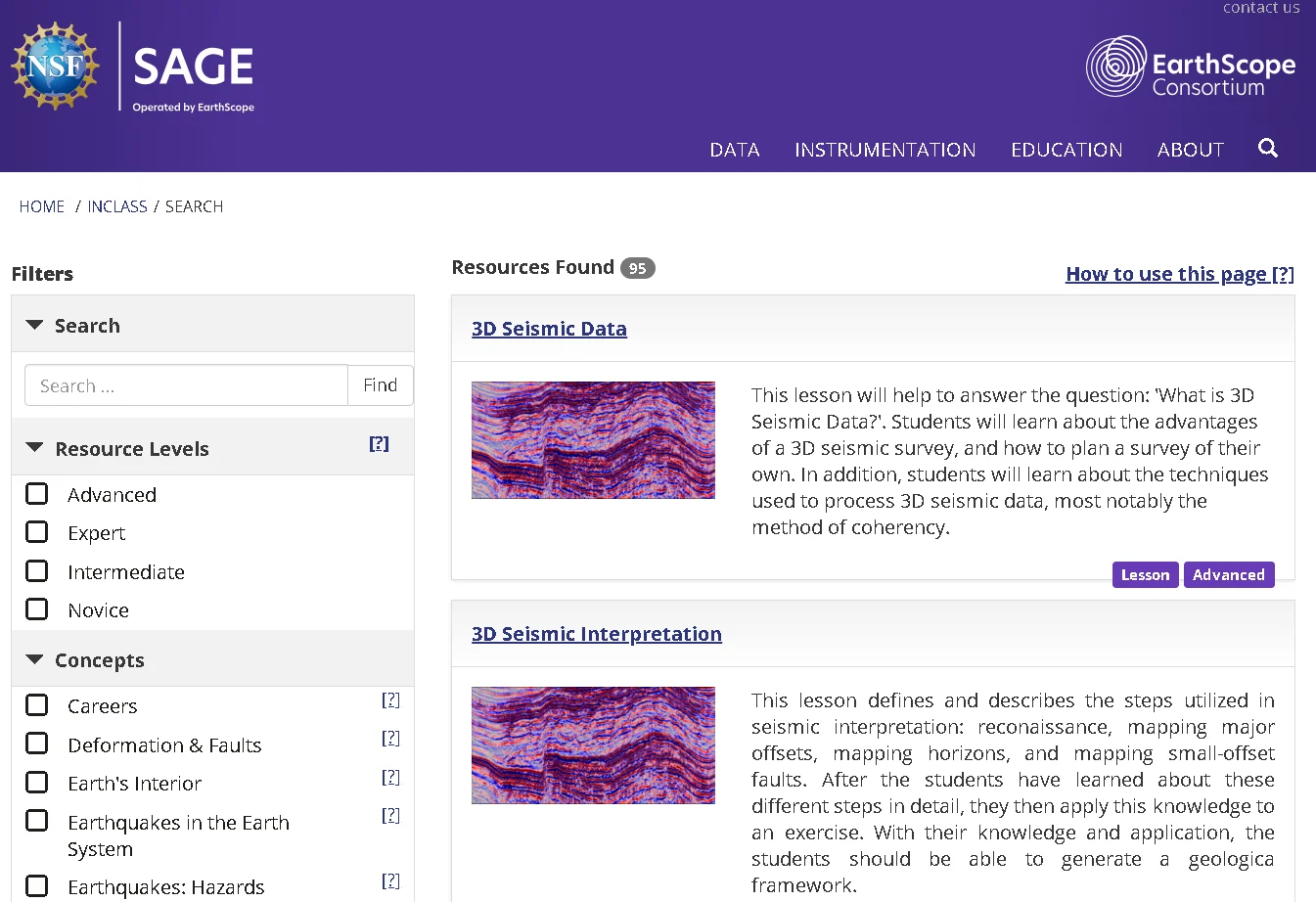
Browse IRIS educational resources for seismology, including lessons, animations, and interactive tools for teaching earthquakes and earth science.
Can you help with computational and data processing assignments in Geophysics?
Yes, at the level of understanding the physics and methods behind the computation. Tutors can explain what a seismic processing step — NMO correction, deconvolution, migration — is physically doing to the data, why a particular inversion formulation is chosen, or how to interpret the output of a modeling run in physical terms. Deep software debugging and coding support may be better addressed alongside your course instructor or software documentation, but the physical and methodological understanding of what the code is doing is very much within scope.
Trust & Quality at My Physics Buddy
Tutor Selection
Every MPB tutor goes through a structured vetting process. For Geophysics, candidates must hold a graduate degree in geophysics, physics, earth sciences, or a closely related discipline — with documented coursework or research experience in the specific geophysical methods and theory relevant to your course. They complete a subject knowledge assessment and a live demo session evaluated for both technical accuracy and pedagogical clarity. Ongoing feedback reviews after onboarding ensure quality is maintained, not just screened for at entry.
Academic Integrity
MPB’s position is direct: we guide, you submit your own work. Tutors explain theory, demonstrate solution methods on parallel examples, and give feedback on your reasoning. They do not complete your graded problem sets, lab reports, or field data assignments. For students whose work involves interpreting their own field or research data, this matters especially — your ability to read and reason about geophysical data is the skill your career depends on. The American Geophysical Union’s scientific ethics policy reflects the professional standard that MPB’s academic approach is built around.
We guide, you submit your own work. In a field where interpreting ambiguous data from the real Earth is the daily task, there is no substitute for understanding it yourself.
About My Physics Buddy
MPB is a Physics-focused online tutoring platform serving undergraduate students, graduate students, PhD candidates, and their families — as well as academic administrators at universities across the US, UK, Canada, Australia, and Gulf countries. Our core is Physics and closely related quantitative subjects. Students working in areas directly adjacent to Geophysics can explore dedicated pages for Fluid Mechanics & Dynamics, Thermodynamics, and Waves and Optics — all of which provide direct theoretical foundation for major topics in geophysical coursework.
Students whose geophysics work intersects with electromagnetic theory at a deeper level can explore MPB’s Electrodynamics and Electromagnetism pages. Those working on the mechanical and dynamical side of Earth systems may find Classical (Newtonian) Mechanics and Orbital & Celestial Mechanics useful for strengthening the underlying physics. Students bridging into complex Earth system dynamics can also explore our Complex Systems Physics page.
For students preparing for related standardized assessments or needing support in foundational physics that underpins their geophysics coursework, our broader Physics tutoring page offers a strong starting point.
Content reviewed by a Geophysics tutor at My Physics Buddy.
“The solid Earth is a physical system like any other — it obeys the same laws of mechanics, thermodynamics, and electromagnetism. The challenge of geophysics is to read those laws in the signals the Earth sends us.”
— Adapted from the foundational framing in Stein & Wysession, An Introduction to Seismology, Earthquakes, and Earth Structure, Cambridge University Press
That framing — the Earth as a physical system whose signals can be decoded using the laws of physics — is the intellectual foundation of every Geophysics course. The seismic wave that travels from an earthquake source to a network of seismometers is not a geological curiosity; it is a solution to the elastic wave equation in a heterogeneous medium, carrying information about everything it has passed through. Learning to extract that information is what geophysical training is built to develop.
The depth and global reach of geophysical research is reflected in the institutions and infrastructure dedicated to it. The IRIS Consortium maintains one of the world’s largest open archives of seismic waveform data, freely accessible for educational and research use. The American Geophysical Union, with over 60,000 members across 137 countries, publishes the primary research journals — including Journal of Geophysical Research, Geophysical Research Letters, and Geochemistry, Geophysics, Geosystems — that graduate students in Geophysics are trained to read and contribute to.
Students who want to strengthen the wave physics foundations that underpin seismology can explore MPB’s Acoustics & Sound Physics page — acoustic wave propagation shares deep mathematical structure with seismic P-wave propagation. Those interested in the broader environmental and planetary context of geophysical systems may find our Environmental Physics page a useful complement.
“Seismology is the telescope through which we view the interior of the Earth — a telescope that works by listening rather than looking.”
— Adapted from materials published by the United States Geological Survey, Earthquake Hazards Program
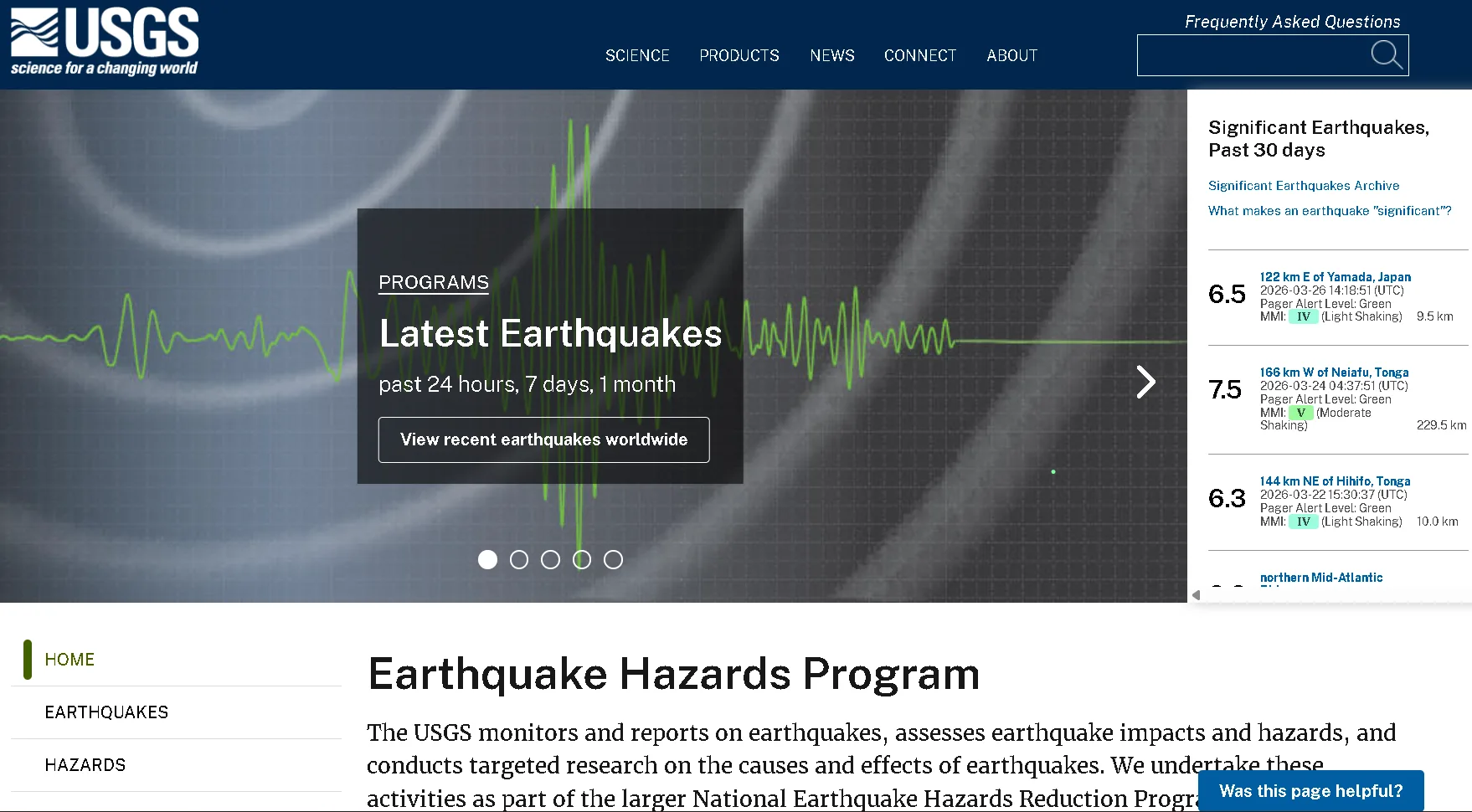
Explore real-time earthquake data, hazard maps, and research from the USGS Earthquake Hazards Program.
That listening — precise, quantitative, and theory-grounded — is what distinguishes a trained geophysicist from someone who simply knows that earthquakes make waves. Building that precision is what MPB Geophysics tutoring is designed to achieve, one session at a time.
Geophysics is physics applied to the largest laboratory available — the Earth itself. MPB tutors bring the theoretical depth and pedagogical clarity to make that application genuinely rigorous, not just descriptive.
Next Steps
Share your current course context or research setting — whether that is seismology, potential fields, EM methods, geodynamics, or applied exploration — the topics giving you the most difficulty, and your exam or assignment timeline. We confirm your time zone and availability, then match you with a tutor whose depth fits your specific needs. In most cases, your first session can begin within a day or two of confirmation.
No long intake forms. No upfront commitment to a session block before you have seen the quality. Just a matched tutor, a diagnostic, and a plan built around your actual gaps.

