A Long
asked on July 19, 2025
Potential divider circuit CIE physics
How does a potential divider circuit work in CIE physics?
Need Help?
Hire one of our expert Physics tutor online. 24/7 Service. Available now.
Expert Answer
Answered on October 1, 2025 by EXPERT TUTOR

Dear A Long,
A potential divider circuit works by connecting two or more resistors in series across a supply voltage, so that the voltage is shared between them in proportion to their resistances. You can then tap off a fraction of the total voltage from across one resistor. According to expert tutors at My Physics Buddy, this is one of the most practically important circuits in A/AS Level Physics (9702).
How a Potential Divider Circuit Works — The Full Physics
Think of a potential divider like two people sharing a single pizza. If one person takes a bigger slice, the other gets less. The total pizza stays the same — just like the total supply voltage across the series resistors never changes. The fraction each resistor “takes” depends on how large its resistance is compared to the total.
The Core Idea: Voltage Sharing in a Series Circuit
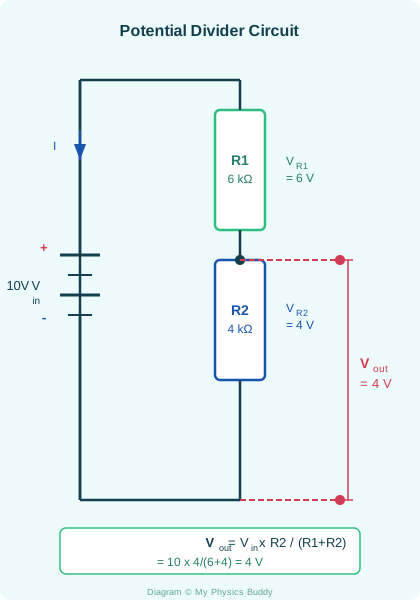
When two resistors, R1 and R2, are connected in series across a supply voltage Vin, the same current I flows through both. By Ohm’s Law, the voltage across each resistor is proportional to its resistance. The output voltage Vout is taken across R2 (the lower resistor).
Since the current through both resistors is the same:
I = Vin / (R1 + R2)
The voltage across R2 is:
Vout = I × R2 = Vin × R2 / (R1 + R2)
Where:
- Vin = supply (input) voltage in volts (V)
- R1 = upper resistor in ohms (Ω)
- R2 = lower resistor in ohms (Ω) — output is taken across this
- Vout = output voltage in volts (V)
This is the potential divider equation, and you must be completely comfortable with it for your CIE 9702 exam.
Worked Example
A potential divider has R1 = 6 kΩ and R2 = 4 kΩ connected in series across a 10 V supply. What is Vout across R2?
Step 1 — Identify values:
Vin = 10 V, R1 = 6000 Ω, R2 = 4000 Ω
Step 2 — Apply the potential divider equation:
Vout = 10 × 4000 / (6000 + 4000)
Vout = 10 × 4000 / 10000
Vout = 10 × 0.4
Vout = 4 V
Notice that R2 is 4/10 of the total resistance, so it takes 4/10 of the total voltage. This proportional logic is the fastest way to check your answer under exam conditions.
Using a Variable Resistor (Potentiometer)
In many CIE 9702 questions, R2 is replaced by a light-dependent resistor (LDR), a thermistor, or a variable resistor. This is where potential dividers become genuinely powerful. As the sensor’s resistance changes — say, as light intensity increases and an LDR’s resistance falls — Vout changes too. This varying output voltage can then trigger switching circuits or feed into data loggers.
As an IBDP and A-Level Physics Specialist, I can tell you that the single most common mistake I see students make here is forgetting that connecting a load (like a voltmeter or a device) across R2 changes the effective resistance of the lower branch, which changes Vout. This only becomes negligible when the load resistance is very much greater than R2. For a high-resistance voltmeter, this is usually a safe assumption — but CIE exam questions will explicitly test whether you understand this condition.
Summary Table: Effect of Changing R2 on Vout
| Condition | Effect on Vout |
|---|---|
| R2 increases (e.g. LDR in dark) | Vout increases |
| R2 decreases (e.g. LDR in light) | Vout decreases |
| R2 = R1 | Vout = Vin / 2 |
| R2 very small compared to R1 | Vout approaches 0 V |
For a deeper look at how these circuits connect to broader electrical concepts, the CIE A-Level electricity revision resources at Physics and Maths Tutor are well worth bookmarking. You should also explore related topics through our Physics resources to strengthen your overall circuit analysis skills.
Common Mistakes with Potential Dividers
✗ Mistake: Using the potential divider formula with resistors in parallel instead of in series.
✓ Fix: The formula Vout = Vin × R2/(R1+R2) only works when R1 and R2 are in series. Always confirm the circuit topology before applying the equation.✗ Mistake: Forgetting that connecting a load across R2 reduces the effective lower resistance and lowers Vout.
✓ Fix: When a load RL is connected across R2, calculate the parallel combination of R2 and RL first, then use that combined value as the lower resistance in the formula.✗ Mistake: Assuming Vout is taken across R1 (the upper resistor) rather than R2 (the lower resistor).
✓ Fix: Always identify which resistor the output terminals are connected across in the circuit diagram. CIE questions deliberately vary this, so label both resistors and output terminals clearly before calculating.
Exam Relevance: Potential divider circuits appear in CIE A/AS Level Physics 9702, Edexcel A Level Physics, and OCR A Level Physics examinations. Questions test both the calculation of Vout and the qualitative reasoning about sensor-based divider circuits.
Pro Tip from Mamatha M: Always write the potential divider equation with R2 in the numerator matching the resistor your output is taken across — this one habit eliminates the most common calculation error instantly.
Related Questions
What is the difference between AP Physics 1 and AP Physics 2?
How to solve Gauss’s law problems in AP Physics 2?
What is the right-hand rule and how to apply it for magnetic fields?
How to calculate electric potential and potential energy?
How does a capacitor work and how to solve RC circuit problems?
What is Bernoulli’s equation and how to apply it to fluid flow?
What is the relationship between period and frequency for oscillations?
How to calculate the speed of a wave on a string?

