Ultrasound Physics Tutor Online
My Physics Buddy (MPB) offers 1:1 online tutoring & homework help in Physics and related subjects — and Ultrasound Physics is one of our most specialized tutoring areas for sonography students, healthcare professionals, and medical imaging practitioners worldwide. Ultrasound Physics sits at the intersection of academic study and professional certification — it is taught as a formal course in diagnostic medical sonography programs at colleges and universities, and it forms the core content of the ARDMS Sonography Principles and Instrumentation (SPI) examination, which is the mandatory gateway certification for earning RDMS, RDCS, RVT, and RMSKS credentials. Whether you are a sonography student working through your program coursework, a graduate preparing for the ARDMS SPI exam, a healthcare professional adding a new imaging credential, or an international applicant sitting the SPI at an overseas Pearson VUE center, MPB connects you with tutors who understand the academic content and the certification demands equally well. If you’ve been looking for an Ultrasound Physics tutor near me and want the depth and flexibility of personalized online learning, you are in the right place. Our sessions are designed to build genuine physical understanding, instrumentation knowledge, Doppler competency, and exam confidence — with honest, structured guidance and no over-promises.
- 1:1 live sessions — fully personalized to your course level, program stage, or SPI exam timeline
- Expert tutors with strong knowledge of ultrasound physics academic content and the ARDMS SPI exam content domains
- Flexible time zones — sessions conveniently scheduled for students across the US, UK, Canada, Australia, and Gulf regions
- Structured learning plan built around your program syllabus, diagnostic weak areas, and SPI exam date
- Ethical homework and assignment guidance — we explain and guide; you complete and submit your own work
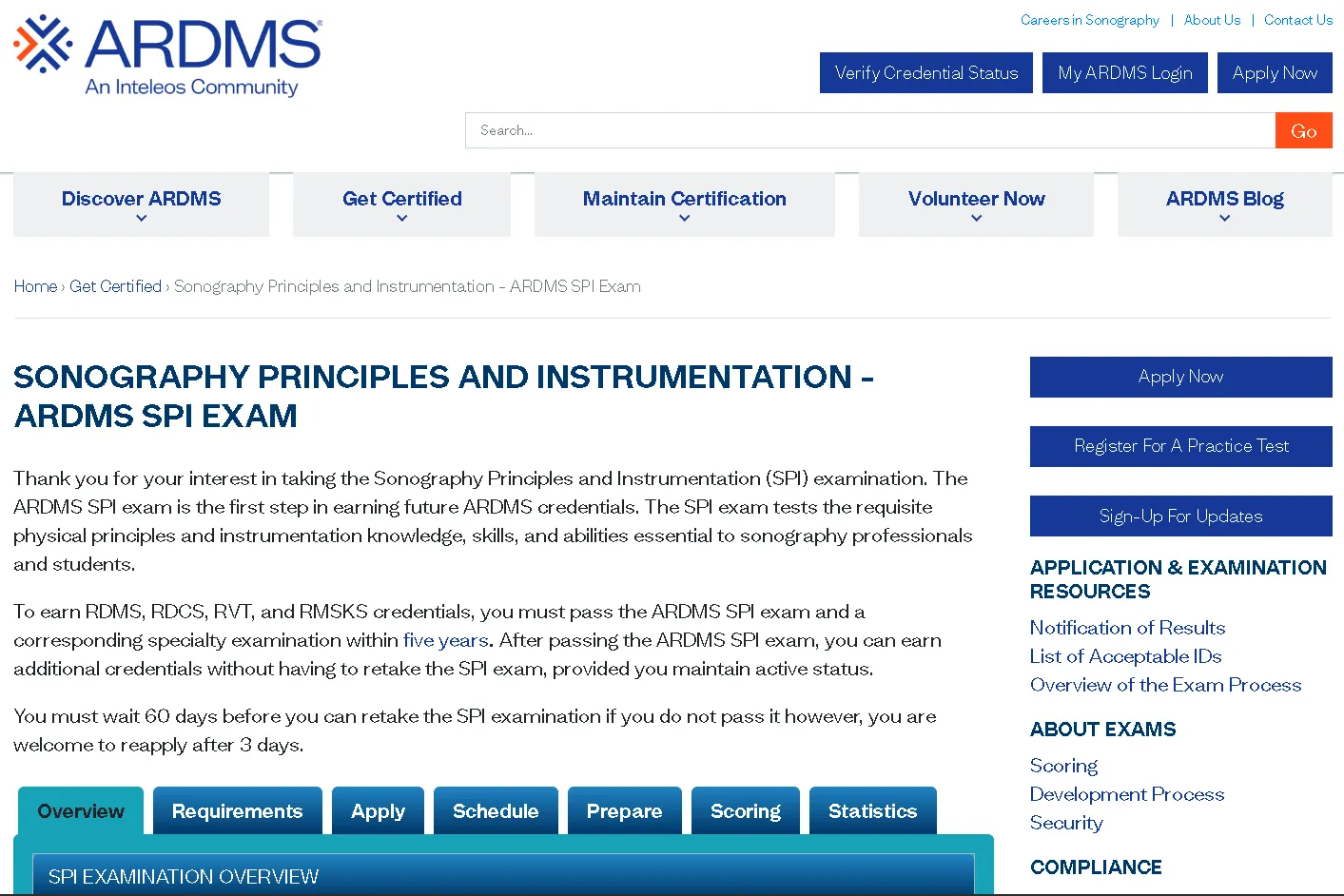
Learn about the ARDMS SPI exam, including requirements, eligibility, and preparation for sonography certification.
Who This Ultrasound Physics Tutoring Is For
Ultrasound Physics is encountered at the college level in diagnostic medical sonography programs, in radiologic technology programs, and in continuing medical education settings. This tutoring is for anyone who needs expert, personalized support — whether the immediate goal is passing a course, preparing for the ARDMS SPI exam, or building clinical competency in ultrasound imaging.
- Sonography students in associate, bachelor’s, or post-graduate diagnostic medical sonography programs who are studying ultrasound physics as a formal academic course
- Students preparing for the ARDMS SPI exam — the mandatory physics and instrumentation certification exam required for all RDMS, RDCS, RVT, and RMSKS credentials
- Radiologic technologists, nurses, and other healthcare professionals transitioning into sonography who need to build or consolidate ultrasound physics knowledge for the SPI
- Students who have failed the ARDMS SPI exam and are preparing for a retake with targeted, structured support on their weakest content domains
- Obstetricians, gynecologists, and physicians pursuing ARDMS credentials or CME-based ultrasound physics education — including those working toward credentials recognized by organizations such as the International Society of Ultrasound in Obstetrics and Gynecology (ISUOG)
- International students and professionals in the UK, Canada, Australia, and Gulf region sitting the ARDMS SPI or pursuing ultrasound physics education as part of clinical training
- Students needing homework, problem set, and assignment guidance throughout their sonography program alongside SPI preparation
Outcomes: What You’ll Be Able To Do in Ultrasound Physics
Consistent, structured work with an MPB Ultrasound Physics tutor is designed to build real, observable skills across every content domain tested in academic programs and in the ARDMS SPI examination.
Explain the fundamental physical principles governing ultrasound wave generation, propagation, reflection, refraction, and attenuation in biological tissue — in terms that connect directly to image quality and clinical sonographic interpretation. Analyze Doppler physics — continuous wave, pulsed wave, color flow, and power Doppler — including the Doppler shift equation, angle dependence, aliasing, and the clinical significance of spectral waveform analysis, which accounts for approximately 34% of the ARDMS SPI exam. Apply transducer physics and instrumentation knowledge — piezoelectric effect, transducer construction, beam geometry, focusing, dynamic range, and gain controls — to understand how image optimization decisions are made in clinical practice. Identify ultrasound artifacts — acoustic shadowing, enhancement, reverberation, side lobes, grating lobes, mirror image, and others — and explain their physical origins, which is a consistently high-yield topic in both program exams and the SPI. Perform quality assurance reasoning and apply ultrasound safety principles — thermal and mechanical bioeffects, ALARA, thermal index, and mechanical index — which are assessed in both academic and certification contexts.
What We Cover in Ultrasound Physics (Syllabus / Topics)
Ultrasound Physics course content in sonography programs is broadly aligned with the ARDMS SPI content outline, though individual programs vary in sequence and depth. The SPI examination is administered by the American Registry for Diagnostic Medical Sonography (ARDMS) and consists of approximately 110 multiple-choice questions over 2 hours, with a passing scaled score of 555 on a 300–700 scale. Content is distributed across five domains. Details may vary — always verify current specifications directly with ARDMS. The coverage below reflects both typical academic program content and the SPI content domains.
Track 1: Physical Principles of Sound and Ultrasound
- Nature of sound: longitudinal mechanical waves, frequency, wavelength, period, amplitude, and wave speed
- The ultrasound frequency range and its medical imaging applications
- Propagation speed in biological tissues; the assumed soft tissue propagation speed (1540 m/s)
- Acoustic impedance and its role in reflection and transmission at tissue boundaries
- Reflection, refraction, scattering, and absorption as interaction mechanisms
- Attenuation: definition, the attenuation coefficient, and the half-value layer concept
- Intensity, power, and their relationship to beam cross-sectional area
- Problem types: propagation speed calculations, attenuation problems, impedance mismatch scenarios
Track 2: Transducers and Beam Properties
- Piezoelectric effect: direct and reverse; crystal materials and their properties
- Transducer construction: matching layers, backing material, lens, and housing
- Pulse duration, spatial pulse length, duty factor, and pulse repetition frequency
- Near field (Fresnel zone) and far field (Fraunhofer zone): beam geometry and divergence
- Focusing: internal vs. external; fixed vs. dynamic focusing; focal zone and focal length
- Transducer types: single element, linear array, curved array, phased array, and mechanical transducers
- Beam steering and dynamic aperture in array transducers
- Problem types: near field length calculations, transducer frequency selection reasoning, array configuration questions
Track 3: Pulse-Echo Instrumentation and Image Formation
- Pulse-echo principle: how depth is calculated from round-trip travel time
- A-mode, B-mode, and M-mode imaging: principles and clinical applications
- Real-time imaging: frame rate, line density, and the depth-frame rate tradeoff
- Dynamic range, gray scale, and digital scan converters
- Overall gain, time gain compensation (TGC), and depth gain compensation (DGC)
- Harmonic imaging: tissue harmonics and contrast harmonic imaging principles
- Image storage, digital image formats, and DICOM basics
- Problem types: frame rate vs. depth calculations, TGC reasoning, pulse repetition frequency scenarios
Track 4: Doppler Physics and Hemodynamics (approx. 34% of ARDMS SPI)
- The Doppler Effect: shift frequency, the Doppler equation, and angle dependence
- Continuous wave (CW) Doppler: principles, range ambiguity, and clinical use
- Pulsed wave (PW) Doppler: sample volume, aliasing, and the Nyquist limit
- Color flow Doppler: color assignment, variance mapping, and frame rate constraints
- Power Doppler: advantages, limitations, and comparison with color flow
- Spectral analysis: fast Fourier transform (FFT), spectral waveform interpretation
- Hemodynamic principles: laminar vs. turbulent flow, resistance indices, Poiseuille’s Law
- Problem types: Doppler shift calculations, aliasing identification, Nyquist limit problems, waveform interpretation
Track 5: Artifacts in Ultrasound Imaging
- Enhancement and acoustic shadowing: causes and clinical significance
- Reverberation artifacts: comet-tail, ring-down, and mirror image
- Refraction artifacts: edge shadowing and spatial misregistration
- Side lobe and grating lobe artifacts in array transducers
- Speed error artifacts and their effect on depth accuracy
- Aliasing in Doppler: causes, identification, and correction strategies
- Speckle and its relationship to resolution and image texture
- Problem types: artifact identification from image descriptions, cause-and-correction reasoning questions
Track 6: Image Quality and Optimization (approx. 26% of ARDMS SPI)
- Resolution types: axial, lateral, elevational (slice thickness), and temporal resolution
- Factors affecting axial resolution: spatial pulse length and frequency
- Factors affecting lateral resolution: beam width, focusing, and transducer aperture
- Tradeoffs in image optimization: frequency vs. penetration, frame rate vs. line density
- Scan image quality assessment and phantom-based quality assurance testing
- Problem types: resolution comparison questions, optimization tradeoff reasoning, QA phantom interpretation
Track 7: Bioeffects, Safety, and Quality Assurance (approx. 10% of ARDMS SPI)
- Thermal bioeffects: tissue heating, the thermal index (TI), and its subtypes (TIS, TIB, TIC)
- Mechanical bioeffects: cavitation (stable and inertial), the mechanical index (MI)
- ALARA principle: as low as reasonably achievable — clinical application
- Output display standard (ODS) and on-screen safety indices
- Ultrasound safety in obstetric, neonatal, and ophthalmic applications
- Quality assurance: phantom testing protocols, system performance checks, preventive maintenance
- Problem types: TI and MI interpretation, ALARA application scenarios, QA protocol questions
Students whose programs or clinical work also involve related physics and imaging content can explore MPB’s dedicated pages for Medical Physics, Radiographic Physics, and Waves and Optics.
How My Physics Buddy Tutors Help You with Ultrasound Physics (The Learning Loop)
Diagnose: Every engagement starts with a structured diagnostic. The tutor asks about your program type, current course unit or SPI exam date, which content domains feel weakest — Doppler physics, artifacts, transducer principles, or safety — and, for SPI retakers, your previous score report domain breakdown. A short diagnostic problem set is often used in the first session to map your actual starting point accurately.
Explain: The tutor builds each content area using clear, clinically grounded explanations that connect physical principles to what they mean at the transducer and on the image. For Ultrasound Physics, abstract concepts — like acoustic impedance mismatch, aliasing in pulsed Doppler, or grating lobe artifact origins — become meaningful when explained in terms of what actually happens in the scanning room.
Practice: You work through course-style and SPI-format multiple-choice questions across all content domains, with increasing emphasis on timed conditions as your exam or assessment date approaches. Question selection is targeted toward the highest-yield SPI domains — Doppler (34%), image optimization (26%), and ultrasound examinations (23%) — while ensuring all domains recieve adequate coverage.
Feedback: After each practice block, your tutor reviews your reasoning in detail — identifying whether errors stem from conceptual misunderstanding, formula misapplication, artifact misidentification, or Doppler reasoning gaps. SPI-specific traps — confusing TI subtypes, misidentifying aliasing vs. other artifacts, incorrect Nyquist limit reasoning — get addressed directly and corrected with precise explanations.
Retest/Reinforce: Domains where errors cluster are revisited with fresh question types and increasing difficulty. Reinforcement is deliberately spaced so that recall under timed exam conditions improves consistently — particularly important for the Doppler domain, which many students find the most conceptually demanding.
Plan: Your tutor maintains a domain-by-domain roadmap anchored to your SPI exam date or course assessment schedule. The plan continuously shifts emphasis based on your practice performance data, ensuring the most preparation time goes to the domains with the highest exam weight and your lowest current accuracy.
Accountability: For SPI candidates, structured self-study between sessions is essential. Tutors assign specific timed practice sets, domain reviews, and formula consolidation tasks, and track completion and performance across sessions to build cumulative preparation momentum.
All sessions run on Google Meet, with a digital pen-pad or iPad + Pencil for live diagrams of beam geometry, Doppler waveforms, artifact mechanisms, and transducer construction schematics. Tutors calibrate explanation depth to your background — a sonography student in their first physics course receives different pacing than a radiology tech sitting the SPI for the second time.
First session flow: Your first session starts with a diagnostic discussion covering your program type, current course stage or SPI exam date, your physics background, and your weakest content areas. The tutor then works through a short diagnostic problem set across 3–4 key domains and delivers immediate feedback. The session closes with a clear, prioritized preparation plan. Before the session, it helps to share your course syllabus or SPI content outline, any recent test scores or previous SPI score reports, and your exam or assessment date.
Tutor Match Criteria (How We Pick Your Tutor)
MPB selects your Ultrasound Physics tutor based on several overlapping criteria — familiarity with both the academic and certification context is essential at this level.
Level and exam fit: Your tutor will have strong command across all ultrasound physics content areas — acoustic principles, transducer physics, Doppler, artifacts, image optimization, and safety — and will be familiar with the ARDMS SPI content outline, domain weightings, and question style. Tutors with direct experience supporting SPI candidates are prioritized for exam-focused preparation.
Topic strengths and tools: For Ultrasound Physics, we look for tutors who are equally confident in conceptually demanding areas like Doppler physics and transducer beam theory as they are in the more descriptive artifact and safety domains. Tools used include Google Meet and digital pen-pad or iPad + Pencil for live diagrams and problem walkthroughs.
Time zone and availability: Tutors are matched for availability across US (ET, CT, PT), UK (GMT/BST), Canada, Australia (AEST/AEDT), and Gulf (GST/AST) time zones. Flexible scheduling is available for students and working professionals managing clinical hours, coursework, and SPI preparation simultaneously.
Learning style and pace: Some students need a concept-first approach before tackling exam-style questions; others learn best by drilling practice questions and filling gaps from their errors. Your tutor adapts to whichever approach builds both understanding and SPI exam performance most effectively for your background.
Language and communication preferences: All MPB tutors communicate in clear English, adjusting technical depth to your program level — from introductory sonography physics coursework through to advanced SPI-level instrumentation and Doppler content.
Goals: Whether you are targeting a specific course grade, aiming to pass the SPI on a first attempt, retaking the SPI after a previous near-miss, or building clinical physics understanding as a practicing sonographer, the tutor’s session structure is calibrated to that specific goal.
Urgency and timelines: Students with an SPI exam or course assessment weeks away get an intensive, domain-triage structure focused on highest-yield content. Students starting preparation months out get a more systematic, concept-by-concept build across all domains. Both are planned explicitly after the diagnostic session.
Study Plans (Pick One That Matches Your Goal)
MPB offers three broad plan types for Ultrasound Physics: an intensive catch-up plan (typically 1–2 weeks) for students with an imminent SPI exam or course assessment who need rapid consolidation across the highest-yield domains, a full exam or course prep plan (typically 4–8 weeks) that works systematically through all SPI content domains with targeted practice questions, timed sets, and domain-by-domain review, and ongoing weekly support for students moving through a sonography program who want consistent expert guidance as they cover ultrasound physics alongside clinical training. The specific session plan — domain sequence, practice question focus, and timed drill schedule — is built by your tutor after the diagnostic session, ensuring it reflects your actual background, domain-level gaps, and SPI or course timeline.
Pricing Guide
Ultrasound Physics tutoring at MPB starts at USD 20 per hour and typically ranges up to USD 40 per hour for standard course support and SPI exam preparation sessions. Pricing varies based on the tutor’s expertise, the depth of content required, and the timeline. Short-timeline, intensive SPI preparation or requests for advanced Doppler physics and instrumentation content may be priced toward the higher end. Supply and demand also plays a role — tutor availability and session frequency can affect the final rate.
For a specific quote based on your program level, SPI timeline, and goals, WhatsApp for quick quote.
FAQ
Is Ultrasound Physics hard?
Most sonography students find Ultrasound Physics one of the more challenging parts of their program — particularly Doppler physics, transducer beam theory, and artifact identification, which require both conceptual understanding and the ability to apply principles to clinical imaging scenarios. The ARDMS SPI exam adds time pressure to that challenge. With structured 1:1 support, the content becomes significantly more manageable and the SPI pass rate for well-prepared first-time candidates is considerably higher than for those who study independently alone.
What is the ARDMS SPI exam and do I need to take it?
The ARDMS SPI (Sonography Principles and Instrumentation) exam is the mandatory physics and instrumentation certification examination required for all ARDMS credentials — RDMS, RDCS, RVT, and RMSKS. It consists of approximately 110 multiple-choice questions over 2 hours, administered at Pearson VUE test centers globally. The passing scaled score is 555 on a 300–700 scale. You must pass the SPI and a corresponding specialty examination within five years to earn your credential. The SPI exam fee is USD 275, and a 60-day wait is required before a retake if you do not pass.
How many sessions are needed for Ultrasound Physics or SPI prep?
It depends on your sonography program background, how recently you studied the content, and your SPI exam date. Students doing a focused 4–8 week SPI preparation plan typically benefit from 2–3 sessions per week. Students integrating ultrasound physics tutoring into ongoing program coursework often do 1–2 sessions per week. Your tutor will give a specific estimate after the first diagnostic session once your domain-level starting points are mapped.
Can you help with ultrasound physics homework, assignments, and program coursework?
Yes — MPB provides guided homework and coursework help throughout your sonography program. Tutors explain the relevant physics principles, walk through similar worked examples, and review your reasoning and approach. Our services aim to provide personalized academic guidance to help you understand concepts and improve your skills. Materials provided are for learning purposes only. Submitting another person’s work as your own or misusing guidance in ways that violate your program’s academic integrity policy is strongly discouraged. You complete and submit your own work.
What are the five ARDMS SPI content domains?
According to the official ARDMS SPI content outline, the five domains and their approximate exam weightings are: Apply Doppler Concepts (34%), Optimize Sonographic Images (26%), Perform Ultrasound Examinations (23%), Provide Clinical Safety and Quality Assurance (10%), and Manage Ultrasound Transducers (7%). Doppler alone accounts for over one-third of the exam — making it the highest-yield domain and the one where most underprepared candidates loose the most marks.
What happens in the first session?
The first session begins with a diagnostic discussion — your sonography program stage, previous SPI attempt and score report if applicable, weakest content domains, and your exam or assessment date. The tutor then works through a short diagnostic problem set across key domains and gives immediate feedback. The session closes with a clear, prioritized preparation plan. Bring your course syllabus or SPI content outline, any previous score reports, and your exam date details.
Is online tutoring effective for Ultrasound Physics and SPI preparation?
Yes — for Ultrasound Physics specifically, online 1:1 sessions are very well suited. The tutor can draw beam geometry diagrams, Doppler waveforms, artifact schematics, and transducer construction diagrams live on a digital whiteboard, and work through SPI-style questions and clinical scenarios in real time. Sonography students and working professionals across the US find online scheduling significantly more flexible given the demands of clinical rotations, program coursework, and SPI preparation running simultaneously.
What is the ARDMS SPI pass rate?
According to ARDMS official pass rate data, first-time SPI candidates passed at a rate of 72% in 2023, with an overall pass rate (including retakes) of 65%. Pass rates have ranged from approximately 68–83% for first-time takers across recent years. These figures illustrate that while the majority of first-time candidates pass, a meaningful proportion do not — and structured preparation makes a measurable difference in outcome.
Does MPB cover Doppler physics in depth?
Yes — Doppler physics is one of the most heavily weighted and most commonly misunderstood areas of Ultrasound Physics, and MPB tutors give it the depth it deserves. Sessions cover the Doppler equation, angle dependence, CW vs. PW Doppler, aliasing and the Nyquist limit, color flow vs. power Doppler, spectral waveform analysis, and hemodynamic principles — all at the level required for both program exams and the ARDMS SPI. Students who want additional depth in the underlying wave physics can also explore MPB’s page for Acoustics & Sound Physics.
Can I prepare for the SPI exam if I haven’t taken a formal sonography program?
ARDMS requires applicants to demonstrate eligibility — either through a completed sonography program or through documented clinical experience plus a physics course or CME-accredited physics review. If you meet the ARDMS eligibility requirements through a non-program pathway, MPB can provide focused SPI content tutoring. Always verify your specific eligibility pathway directly with ARDMS before applying, as requirements vary by prerequisite pathway and credential sought.
Academic Integrity Note: Our services aim to provide personalized academic guidance, helping students understand concepts and improve skills. Materials provided are for reference and learning purposes only. Misusing them for academic dishonesty or violations of academic integrity policies is strongly discouraged.
Trust & Quality at My Physics Buddy
Tutor selection: Every MPB tutor goes through a subject knowledge screening, a live demo session evaluation, and an ongoing student feedback review process. For Ultrasound Physics, we specifically look for tutors who understand the ARDMS SPI content domains, the domain weightings, and the specific reasoning demands of SPI-style questions — not just tutors with general physics or medical imaging backgrounds. The ability to explain Doppler physics, artifact mechanisms, and transducer beam theory clearly and accurately is evaluated in the screening process.
Academic integrity: MPB’s role is to guide and explain — not to complete work for students. In all homework, coursework, and SPI practice support, tutors explain concepts, work through analogous examples, and provide feedback on the student’s own reasoning. Students write, calculate, and submit their own work. This builds the genuine understanding that holds up in timed SPI conditions and in clinical practice — where physics knowledge directly affects patient care quality.
About My Physics Buddy: MPB is a Physics-focused online tutoring platform serving students, healthcare professionals, and their families across the US, UK, Canada, Australia, and Gulf regions. Our core is Physics and closely related quantitative subjects. Students and professionals studying Ultrasound Physics can also explore subject-specific depth through MPB’s pages for Medical Physics, Biophysics, Radiographic Physics, and Fluid Mechanics & Dynamics. Students interested in the broader physics of waves and acoustic propagation can also visit our pages for Acoustics & Sound Physics and Waves and Optics.
“The SPI exam tests the requisite physical principles and instrumentation knowledge, skills, and abilities essential to sonography professionals and students. To earn RDMS, RDCS, RVT, and RMSKS credentials, you must pass the ARDMS SPI exam and a corresponding specialty examination within five years.”
American Registry for Diagnostic Medical Sonography (ARDMS) — official SPI examination overview
“Understanding ultrasound physics and Doppler fundamentals is crucial because it forms the foundation for effectively using and interpreting ultrasound technology in medical diagnostics. Knowledge of ultrasound physics helps clinicians optimize image quality, troubleshoot technical issues, and understand the limitations of the technology.”
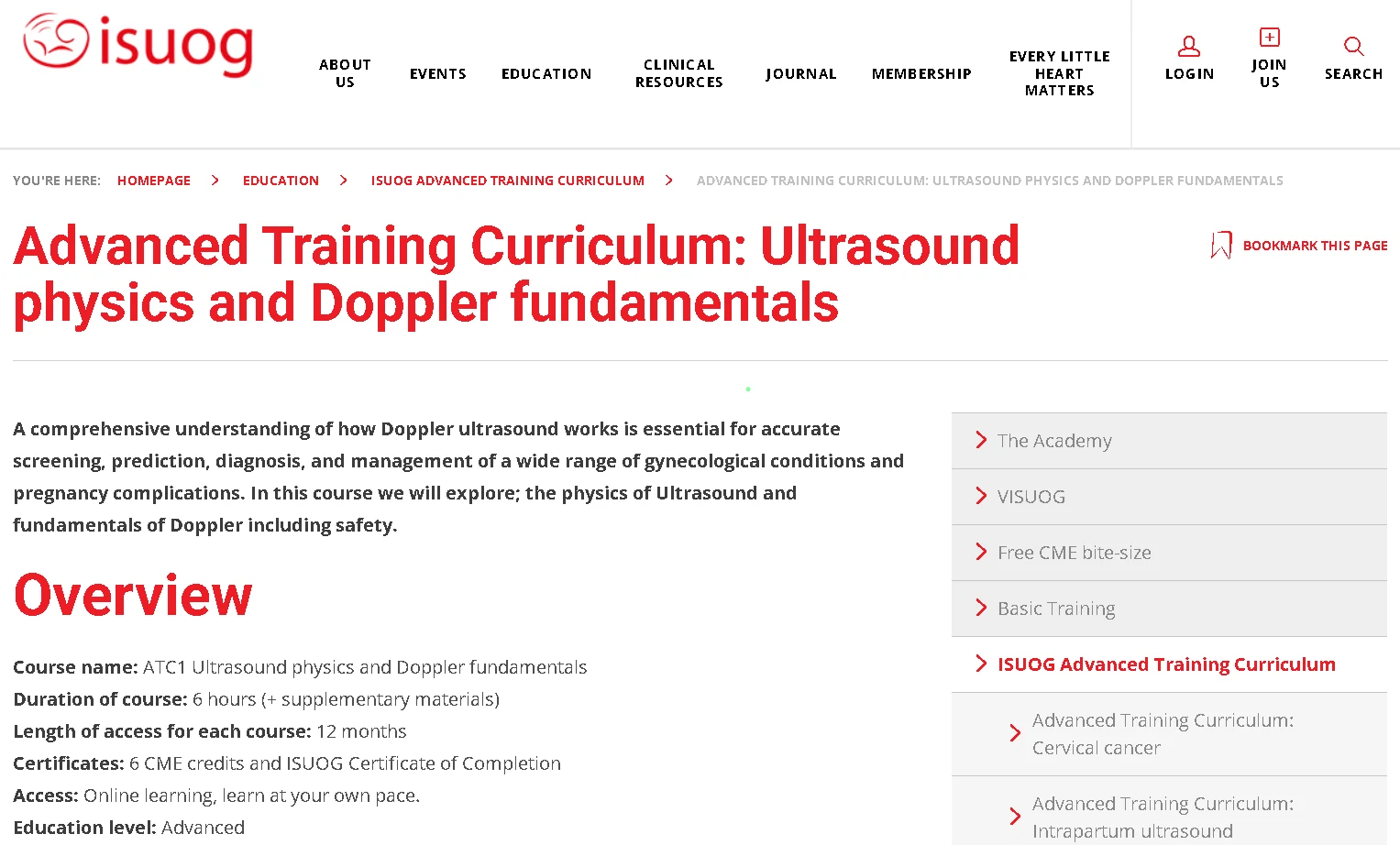
Learn ultrasound physics and Doppler fundamentals with ISUOG’s advanced online training for healthcare professionals.
Explore Related Physics Subjects at MPB: Ultrasound Physics draws on several core physics disciplines that MPB supports at the subject level. Our dedicated pages for Acoustics & Sound Physics, Medical Physics, Fluid Mechanics & Dynamics, Optics, and Radiation Physics are all relevant for students and professionals who want deeper focused support on specific content areas that underpin ultrasound physics in clinical and academic settings.
Content reviewed by an Ultrasound Physics tutor at My Physics Buddy.
Next Steps
Getting started is straightforward. Share your sonography program stage or SPI exam date, the content domains where you feel least confident, any previous SPI score report if applicable, and your preferred session times and time zone. MPB will match you with a tutor whose Ultrasound Physics content knowledge, SPI exam familiarity, and availability fit your preparation needs. Your first session is a diagnostic and live teaching session — so you leave with a mapped starting point across key content domains and a concrete, prioritized plan for the sessions ahead.

