OAT Physics Tutor Online
My Physics Buddy (MPB) offers 1:1 online tutoring & homework help in Physics and related subjects — and OAT Physics is one of our focused, high-stakes tutoring areas for pre-optometry students across the US, Canada, and internationally. The Optometry Admission Test (OAT) is a standardized examination administered by the Association of American Optometric Colleges (AAOC) and is required for admission to all accredited optometry schools in the United States and Canada. Physics is one of four science sections tested and appears in the Survey of Natural Sciences portion of the exam alongside biology, general chemistry, and organic chemistry. Many pre-optometry students have not studied physics recently and find the OAT Physics section one of their most underprepared areas when they begin practice testing. Whether you are a college junior beginning OAT preparation, a post-baccalaureate applicant returning to physics after years away, or a student retaking the OAT targeting a stronger section score, MPB connects you with tutors who understand exactly what the OAT tests in physics and how to build the reasoning speed and conceptual accuracy the exam rewards. If you’ve been looking for an OAT Physics tutor near me and want the focus and flexibility of personalized online preparation, you are in the right place. Our sessions are designed to rebuild content confidence, sharpen physical reasoning, and develop the test-taking skills the OAT Physics section specifically demands — with honest, structured guidance and no over-promises.
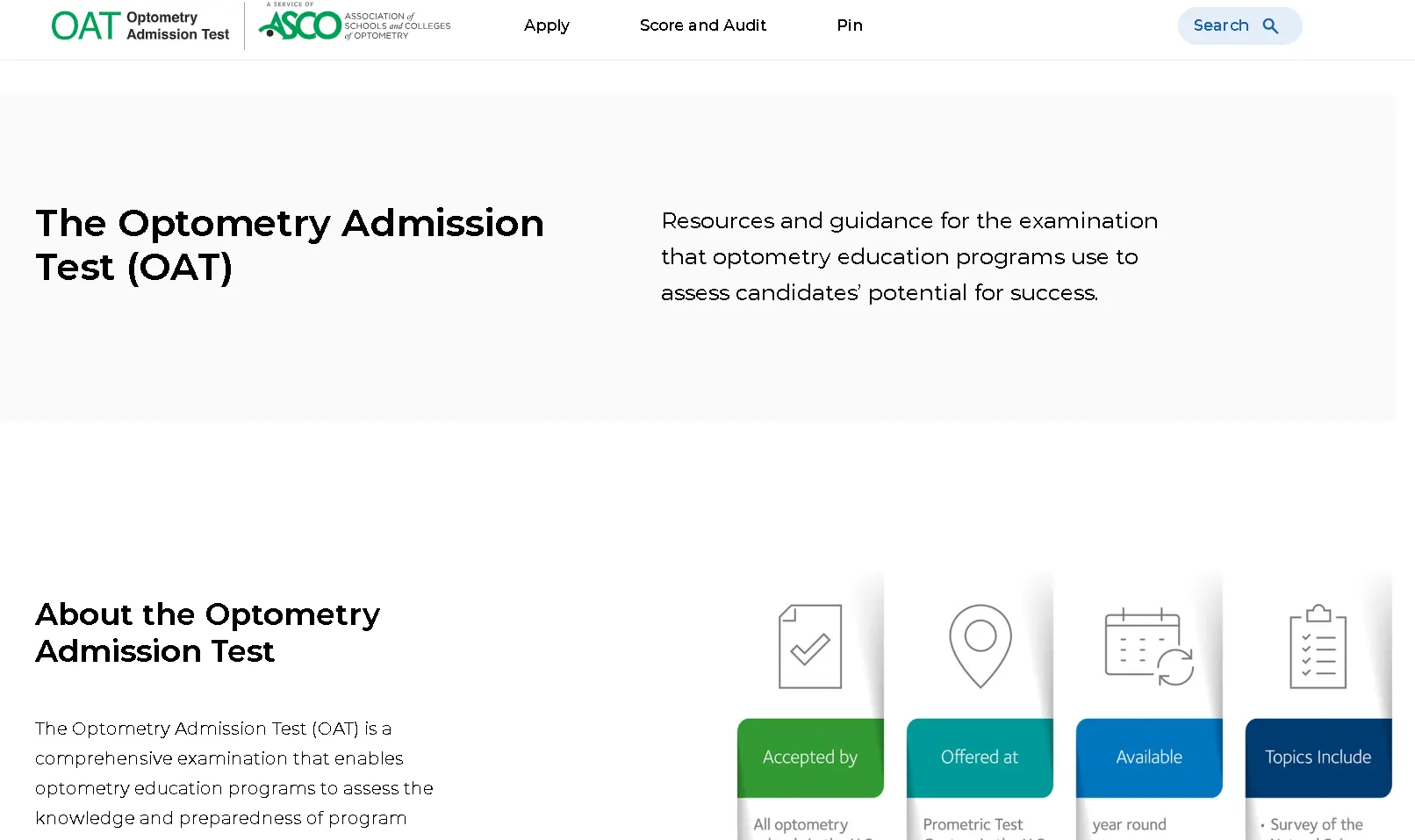
Overview of the Optometry Admission Test (OAT), highlighting resources and guidance for aspiring optometry students.
- 1:1 live sessions — fully personalized to your OAT preparation timeline and physics background
- Expert tutors with strong knowledge of OAT Physics content categories and the AAOC content outline
- Flexible time zones — sessions conveniently scheduled for students across the US, UK, Canada, Australia, and Gulf regions
- Structured learning plan built around your diagnostic performance, weakest content areas, and target test date
- Ethical guidance on practice and review — we explain, walk through, and reinforce; you develop and own the understanding
Who This OAT Physics Tutoring Is For
OAT Physics preparation is for pre-optometry students who need expert, focused support on the physics content tested in the Survey of Natural Sciences section of the OAT.
- College juniors and seniors in the US and Canada beginning OAT preparation who need to review and consolidate introductory physics content
- Post-baccalaureate pre-optometry students who studied physics one or more years ago and need to rebuild confidence and accuracy under timed conditions
- Students retaking the OAT who want targeted support on the specific physics content areas where their previous section score was weakest
- Students with strong biology or chemistry backgrounds but weaker physics foundations who need structured help to bring OAT Physics performance up to the level competitive optometry applications require
- International pre-optometry applicants in Canada, the UK, and other regions applying to US optometry schools where the OAT is required
“The OAT is a standardized examination used to measure general academic ability and comprehension of scientific information. Physics is one of the four science disciplines tested and is integral to understanding the optical and physiological principles that underpin clinical optometric practice.”
Association of American Optometric Colleges (AAOC) — official OAT overview
Outcomes: What You’ll Be Able To Do in OAT Physics
Structured, consistent preparation with an MPB OAT Physics tutor is designed to build the specific, observable skills the OAT rewards in its physics content section.
Solve OAT-style physics problems across all tested content categories — mechanics, waves, optics, electricity, and modern physics — quickly and accurately, applying the estimation and reasoning strategies that work best under OAT time constraints. Analyze physics scenarios in the context of optometric and biological applications — particularly optics questions, which carry significant weight in the OAT Physics section given the clinical relevance to optometry. Apply conceptual physics reasoning to unfamiliar problems, since the OAT does not simply test formula recall but expects students to understand which principles apply in a given situation and why. Identify the fastest, most reliable solution path for each OAT Physics question type — a trainable skill that directly impacts your section score given the pace requirements of the full OAT examination.
What We Cover in OAT Physics (Syllabus / Topics)
OAT Physics content is specified by the Association of American Optometric Colleges (AAOC). Physics questions appear in the Survey of Natural Sciences section of the OAT and test introductory physics at the college level. The OAT Physics section consists of 40 questions and students are given 30 minutes, making time management a critical skill alongside content knowledge. All questions are multiple-choice. Always verify current content specifications and exam format details directly with the AAOC, as details may be updated.
Note on OAT Physics and Optics: Optics carries particular weight in OAT Physics given its direct relevance to optometric clinical training. Lens systems, image formation, refraction, mirrors, and the human eye are high-yield areas that appear consistently across OAT physics content and connect directly to the visual science content of optometry programs.
Track 1: Mechanics
- Kinematics: displacement, velocity, acceleration, and equations of motion
- Projectile motion: horizontal and vertical component analysis
- Newton’s laws of motion; free-body diagrams and net force
- Work, energy, and power; conservation of mechanical energy
- Momentum, impulse, and conservation of momentum
- Circular motion: centripetal force and acceleration
- Torque and lever arms; mechanical equilibrium
- Problem types: multi-step calculations, energy conservation, momentum collisions
Track 2: Waves and Sound
- Wave properties: frequency, wavelength, amplitude, wave speed, period
- Transverse and longitudinal waves; sound as a mechanical wave
- Intensity, loudness, and the decibel scale
- The Doppler Effect: qualitative and quantitative treatment
- Standing waves: strings and air columns; harmonics
- Interference and superposition; resonance
- Problem types: wave speed calculations, Doppler scenarios, standing wave harmonics
Track 3: Optics (High Yield for OAT)
- Nature of light: the electromagnetic spectrum; wave and particle models
- Reflection: laws of reflection; plane, concave, and convex mirrors; image formation
- Refraction: Snell’s Law, refractive index, and total internal reflection
- Converging and diverging lenses: thin lens equation, magnification, image formation
- Lens power (diopters) and corrective lenses for myopia and hyperopia
- The human eye: near point, far point, accommodation, and vision defects
- Dispersion and the visible spectrum
- Problem types: lens equation calculations, mirror image scenarios, vision correction questions
Track 4: Electricity and Magnetism
- Electric charge, Coulomb’s Law, and electric fields
- Electric potential and potential energy
- Current, resistance, Ohm’s Law, and electrical power
- Series and parallel circuits; Kirchhoff’s rules
- Capacitance and energy stored in capacitors
- Magnetic fields: sources and force on moving charges; Fleming’s rules
- Problem types: circuit analysis, Coulomb’s Law calculations, capacitor scenarios
Track 5: Thermodynamics
- Temperature scales; thermal equilibrium and heat transfer
- Specific heat capacity and calorimetry
- Thermal expansion of solids, liquids, and gases
- The ideal gas law; kinetic molecular theory
- Laws of thermodynamics and their applications
- Problem types: calorimetry calculations, gas law scenarios, thermodynamic reasoning
Track 6: Modern Physics and Atomic Structure
- Atomic structure: Bohr model, energy levels, emission and absorption spectra
- The photoelectric effect; photon energy and Einstein’s photoelectric equation
- Radioactive decay: alpha, beta, gamma; half-life calculations
- Nuclear reactions: fission, fusion, and mass-energy equivalence
- Wave-particle duality and de Broglie wavelength (conceptual level)
- Problem types: photoelectric threshold, half-life calculations, photon energy scenarios
Students who want deeper subject-level support on specific OAT physics content areas can explore MPB’s dedicated pages for Waves and Optics, Electrostatics, and Optics.
How My Physics Buddy Tutors Help You with OAT Physics (The Learning Loop)
Diagnose: Every engagement starts with a structured diagnostic. The tutor reviews your undergraduate physics background, how recently you studied physics, any previous OAT practice test performance in the Survey of Natural Sciences section, and which content areas feel weakest. A short diagnostic problem set across key OAT physics topics is often used in the first session to map your actual starting performance accurately.
Explain: The tutor rebuilds and sharpens each content area using clear, OAT-appropriate explanations that prioritize conceptual clarity and solution speed. For OAT Physics, the emphasis is on recognizing the correct principle quickly and applying it accurately under time pressure — not on mathematical derivation or university-depth treatment.
Practice: You work through OAT-format multiple-choice practice questions across all tested content categories, with increasing emphasis on timed conditions as your test date approaches. Optics questions receive particular attention given their high yield and direct clinical relevance to optometry programs.
“Physics is foundational to optometric science — from the optics of the human eye and corrective lens design to retinal imaging technologies and tonometry. Pre-optometry students who understand physics deeply enter clinical training with a genuine and lasting advantage.”
As broadly affirmed in optometric education literature — see the National Institutes of Health (NIH) — PubMed Central: Physics and Optics in Optometric Education
A surreal distorted reflection blending a human face with natural and urban elements, symbolizing perception and visual distortion.
Feedback: After each practice block, your tutor reviews your reasoning in detail — where you applied the wrong principle, where estimation would have been faster than full calculation, and which content categories are costing the most points per question. Feedback is specific, actionable, and anchored to the OAT’s tested content areas.
Retest/Reinforce: Content areas where errors cluster are revisited with fresh question types and increasing difficulty. Reinforcement is deliberately spaced so recall and accuracy under timed OAT conditions improves consistantly — not just in the session where a topic was last covered.
Plan: Your tutor maintains a content-area roadmap anchored to your target test date and diagnostic performance, shifting emphasis continuously toward the highest-yield areas and the content categories where your per-question accuracy is lowest as the OAT approaches.
Accountability: For OAT preparation, structured self-study between sessions is essential. Tutors assign specific timed practice sets, content review tasks, and formula consolidation work, and track performance across sessions to build cumulative preparation momentum through to test day.
All sessions run on Google Meet, with a digital pen-pad or iPad + Pencil for live problem walkthroughs, optics ray diagrams, circuit analysis, and worked examples. Tutors calibrate explanation depth to the OAT level — sessions stay focused on reasoning speed and conceptual accuracy, not university-depth derivations.
First session flow: Your first session starts with a diagnostic discussion covering your undergraduate physics coursework, how recently you studied each content area, any previous OAT practice test scores, and your target test date. The tutor works through a short diagnostic problem set across 3–4 key content areas and delivers immediate feedback. The session closes with a clear, prioritized preparation roadmap. Before the session, it helps to share your previous OAT or practice test scores, your undergraduate physics course history, and your target test date and optometry school application timeline.
Tutor Match Criteria (How We Pick Your Tutor)
MPB selects your OAT Physics tutor based on several overlapping criteria — OAT-specific content knowledge is just as important as general physics expertise.
Exam content and format fit: Your tutor will have direct familiarity with the AAOC OAT content specifications, the Survey of Natural Sciences section format, and the specific physics content categories the OAT tests — including the high-yield optics content that distinguishes OAT Physics from other pre-professional physics exams.
Topic strengths and tools: For OAT Physics, we look for tutors who are confident across all tested categories and who understand how to teach optics clearly in the clinical optometry context the OAT favors. Tools used include Google Meet and digital pen-pad or iPad + Pencil for live ray diagrams, circuit analysis, and worked problem walkthroughs.
Time zone and availability: Tutors are matched for availability across US (ET, CT, PT), UK (GMT/BST), Canada, Australia (AEST/AEDT), and Gulf (GST/AST) time zones. Flexible scheduling is important for pre-optometry students managing coursework, volunteering, shadowing, and OAT preparation simultaneously.
Learning style and pace: Some students need a content-rebuilding approach first; others have the content but need to develop speed and multiple-choice strategy under timed conditions. Your tutor adapts to the approach that best maximizes your OAT Physics section performance given your background and timeline.
Goals: Whether you are targeting a specific OAT Academic Average, trying to bring a weak physics section score up, or doing a focused physics content review as part of a broader OAT preparation plan, the tutor’s session structure is calibrated to that goal from the first session.
Urgency and timelines: Students with a test date weeks away get an intensive, highest-yield-first structure focused on optics, mechanics, and waves. Students preparing months out get a more thorough, category-by-category content build. Both are planned explicitly after the diagnostic session.
Study Plans (Pick One That Matches Your Goal)
MPB offers three broad plan types for OAT Physics: an intensive catch-up plan (typically 1–2 weeks) for students with an imminent test date who need rapid consolidation across the highest-yield OAT physics content categories, a full content prep plan (typically 4–8 weeks) that works systematically through all AAOC-specified physics content areas with targeted practice questions and timed sets, and ongoing weekly support for students preparing over a longer timeline who want consistent expert guidance alongside their full OAT preparation schedule. The specific session plan — content area sequence, practice question focus, optics emphasis, and timed drill schedule — is built by your tutor after the diagnostic session, ensuring it reflects your actual undergraduate physics background, current gaps, and test date.
Pricing Guide
OAT Physics tutoring at MPB starts at USD 20 per hour and typically ranges up to USD 40 per hour for standard content preparation and weekly support sessions. Pricing varies based on the tutor’s experience, the depth of content review required, and the timeline. Short-timeline, intensive sessions may be priced toward the higher end. Supply and demand also plays a role — tutor availability and session frequency can affect the final rate.
For a specific quote based on your preparation timeline and goals, WhatsApp for quick quote.
FAQ
How much physics is on the OAT?
OAT Physics appears in the Survey of Natural Sciences section alongside biology, general chemistry, and organic chemistry. The physics subsection consists of 40 questions answered in 30 minutes. This is a significant portion of the Survey of Natural Sciences and a section where many pre-optometry students are underprepared, making structured review one of the highest-return investments in an OAT preparation plan.
Is OAT Physics hard?
OAT Physics is challanging primarily because it demands accurate, fast application of introductory physics principles under significant time pressure — approximately 45 seconds per question. Many pre-optometry students studied introductory physics one or more years before the OAT, making content recall unreliable when it matters most. With structured 1:1 tutoring, both content confidence and time management improve measurably.
Why is optics so important in OAT Physics?
Optics is uniquely high-yield in OAT Physics because it connects directly to the clinical foundation of optometry — lens design, refractive correction, image formation, and the human eye. OAT Physics routinely tests optics at a level of detail that reflects its centrality to the profession, making it the single most important content category to master. MPB tutors give optics the depth and practice time it genuinely deserves in OAT preparation.
Does OAT Physics require calculus?
No — OAT Physics is algebra-based and does not require calculus. The exam tests conceptual understanding and the ability to apply introductory physics principles quickly and accurately. Students who studied calculus-based university physics will still find the content familiar, but no calculus is required or tested on the OAT.
How many sessions are needed for OAT Physics?
It depends on your undergraduate physics background, how recently you studied the content, and your OAT preparation timeline. Students doing a focused 4–8 week physics content review typically benefit from 2–3 sessions per week. Students integrating OAT Physics tutoring into a longer preparation plan often do 1–2 sessions per week. Your tutor will give a specific estimate after the first diagnostic session.
What happens in the first session?
The first session begins with a diagnostic discussion — your undergraduate physics courses, how recently you studied each content area, any previous OAT practice test scores, and your target test date and optometry school application timeline. The tutor then works through a short diagnostic problem set across key content areas and delivers immediate feedback. The session closes with a prioritized preparation roadmap. Bring any previous practice test score reports and your test date details.
Is online tutoring effective for OAT Physics preparation?
Yes — for OAT preparation specifically, online 1:1 sessions are very well suited. The tutor can draw optics ray diagrams, work through circuit problems, and annotate worked examples live on a digital whiteboard in real time. Pre-optometry students across the US find online scheduling significantly more flexible given the demands of coursework, clinical shadowing, and OAT preparation running simultaneously.
How does OAT Physics differ from MCAT Physics?
Both are algebra-based, multiple-choice, introductory physics exams for pre-health professional students, but they differ in important ways. OAT Physics places significantly greater emphasis on optics — particularly geometric optics, lens systems, and the human eye — reflecting the optical focus of optometric practice. MCAT Physics emphasizes physics in biological and medical contexts, including fluids, circuits in nerve conduction, and radiation in imaging. Students preparing for the OAT specifically benefit from a tutor who understands and prioritizes this optics emphasis rather than defaulting to a generic pre-health physics approach.
Can MPB help with the full OAT Survey of Natural Sciences section?
MPB’s core expertise is Physics and closely related quantitative subjects. For the OAT’s physics content, MPB provides focused, expert support. Students who also need broader science support can explore our pages for Optics, Waves and Optics, and Medical Physics for physics content that bridges directly into the applied science context of optometric education.
Academic Integrity Note: Our services aim to provide personalized academic guidance, helping students understand concepts and improve skills. Materials provided are for reference and learning purposes only. Misusing them for academic dishonesty or violations of academic integrity policies is strongly discouraged.
Trust & Quality at My Physics Buddy
Tutor selection: Every MPB tutor goes through a subject knowledge screening, a live demo session evaluation, and an ongoing student feedback review process. For OAT Physics, we specifically look for tutors who understand the AAOC content specifications, the high-yield optics emphasis of the exam, and the reasoning speed demands of the 40-question, 30-minute physics section — not just tutors with strong general physics backgrounds. The ability to explain optics in clinical optometry contexts and to build fast, accurate problem-solving habits under OAT time pressure are both evaluated in the tutor screening process.
Academic integrity: MPB’s role is to guide and explain — not to complete work for students. All preparation work is the student’s own. This approach builds the genuine, fast-recall reasoning that the OAT actually tests and that no amount of shortcutting can replicate under timed examination conditions.
About My Physics Buddy: MPB is a Physics-focused online tutoring platform serving undergraduate students, pre-health professional students, and their families across the US, UK, Canada, Australia, and Gulf regions. Our core is Physics and closely related quantitative subjects. Students preparing for OAT Physics can also explore subject-specific depth through MPB’s dedicated pages for Optics, Waves and Optics, Electrostatics, and Thermodynamics. Students who also want to build broader pre-health physics understanding can visit our pages for Medical Physics and Kinematics.
Explore Related Physics Subjects at MPB: OAT Physics draws on several core physics disciplines that MPB supports at the subject level. Our dedicated pages for Optics, Waves and Optics, Electrostatics, Thermodynamics, and Atomic Physics are all relevant for students who want deeper focused support on specific OAT physics content categories alongside their broader preparation.
Content reviewed by an OAT Physics tutor at My Physics Buddy.
Next Steps
Getting started is straightforward. Share your undergraduate physics background, the OAT content areas where you feel least confident, any previous OAT or practice test scores, and your target test date and optometry school application timeline. Let us know your preferred session times and time zone. MPB will match you with a tutor whose OAT physics content knowledge, optics expertise, and availability fit your preparation needs. Your first session is a diagnostic and live teaching session — so you leave with a mapped starting point and a concrete, prioritized preparation plan for the weeks ahead.

