Hire Best Kinematics Tutors Online

Testimonials



Kinematics Tutor Online
My Physics Buddy (MPB) offers 1:1 online tutoring & homework help in Physics and related subjects, including Kinematics at secondary school, undergraduate, and engineering level. Kinematics — the study of motion without regard to its causes — appears early in every physics and engineering programme and forms the foundation for everything that follows. If you are a student struggling with projectile motion, relative velocity, or the correct application of kinematic equations, or a parent looking for focused, structured support, MPB connects you with specialist tutors who know the subject at every level. If you have searched for a Kinematics tutor near me and want the flexibility of high-quality online sessions, MPB is designed to help you aim for genuine mastery of motion analysis and confident exam performance.
- 1:1 online sessions aligned to your specific Kinematics course and syllabus
- Tutors experienced across school, undergraduate, and engineering Kinematics curricula
- Flexible time zones — sessions available across the US, UK, Canada, Australia, and the Gulf
- Structured learning plan built after a diagnostic session
- Ethical homework and assignment guidance — we explain the approach so you can solve independently
Who This Kinematics Tutoring Is For
MPB’s Kinematics tutoring serves learners across a wide range of levels and programmes — all sharing a need for clear, methodical, one-to-one instruction in motion analysis.
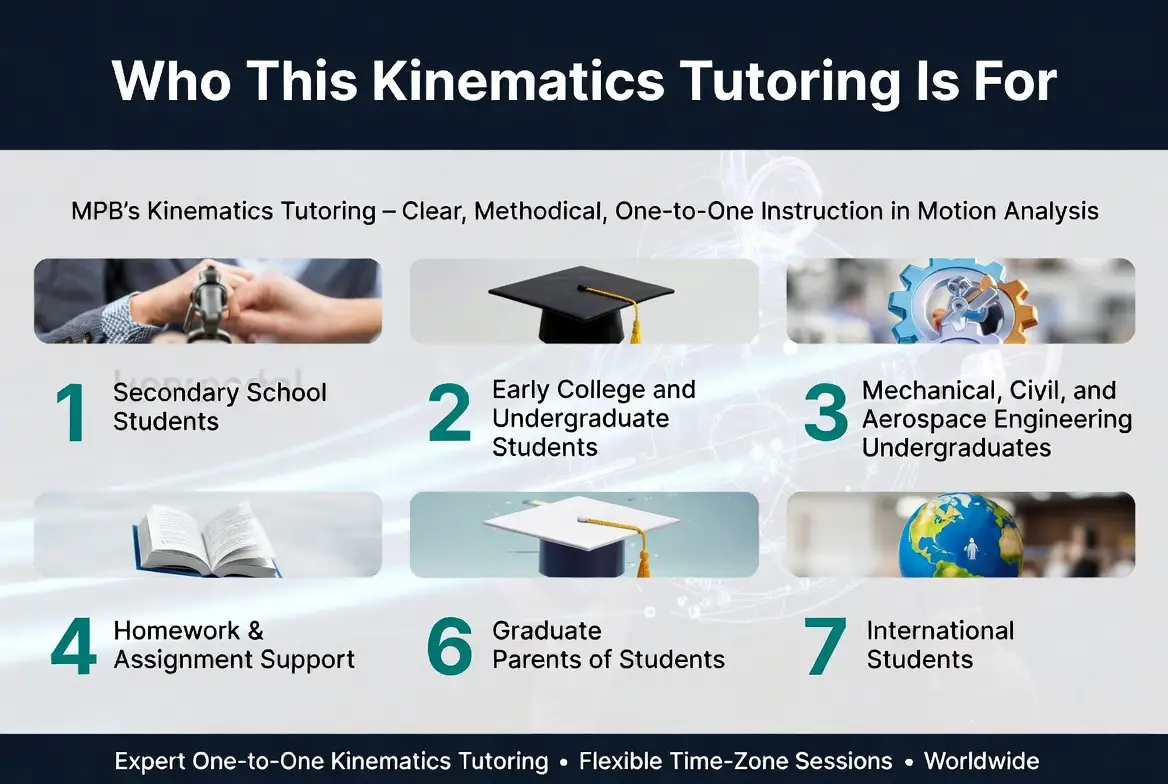
- Secondary school students in the US, UK, Canada, Australia, and the Gulf taking Physics at GCSE, A Level, AP, IB, or equivalent level where Kinematics is a core unit
- Early college and undergraduate students encountering Kinematics as part of an introductory Physics or Engineering Mechanics course
- Mechanical, Civil, and Aerospace engineering undergraduates taking Engineering Dynamics where kinematic analysis of particles and rigid bodies is required
- Students who need structured homework and assignment guidance to consolidate what was covered in lectures or class
- Graduate students revisiting kinematic fundamentals as part of robotics, biomechanics, or advanced dynamics coursework
- Parents of school or university students who want to ensure their child receives focused, individual support that a classroom or lecture hall cannot offer
- International students following US, UK, or Australian curricula from the Gulf or other regions who need time-zone-flexible sessions
Outcomes: What You’ll Be Able To Do in Kinematics
Every session is focused on building skills that are directly observable in problem sets, labs, and examinations.
Solve one-dimensional and two-dimensional motion problems using kinematic equations — correctly identifying knowns, unknowns, and the appropriate equation for each situation. Analyse projectile motion by decomposing initial velocity into components and solving horizontal and vertical motion independently, including problems with non-zero launch heights and angled surfaces. Model circular motion problems involving angular velocity, angular acceleration, and the relationships between linear and angular quantities. Apply relative velocity and relative acceleration to problems involving multiple moving reference frames — a skill that appears across transport engineering, robotics, and fluid mechanics. Interpret and construct motion graphs — position–time, velocity–time, and acceleration–time — and extract correct physical meaning from each, including the significance of gradients and areas. Extend kinematic reasoning to rigid body motion, including rotation about fixed and moving axes, for students in engineering dynamics programmes.
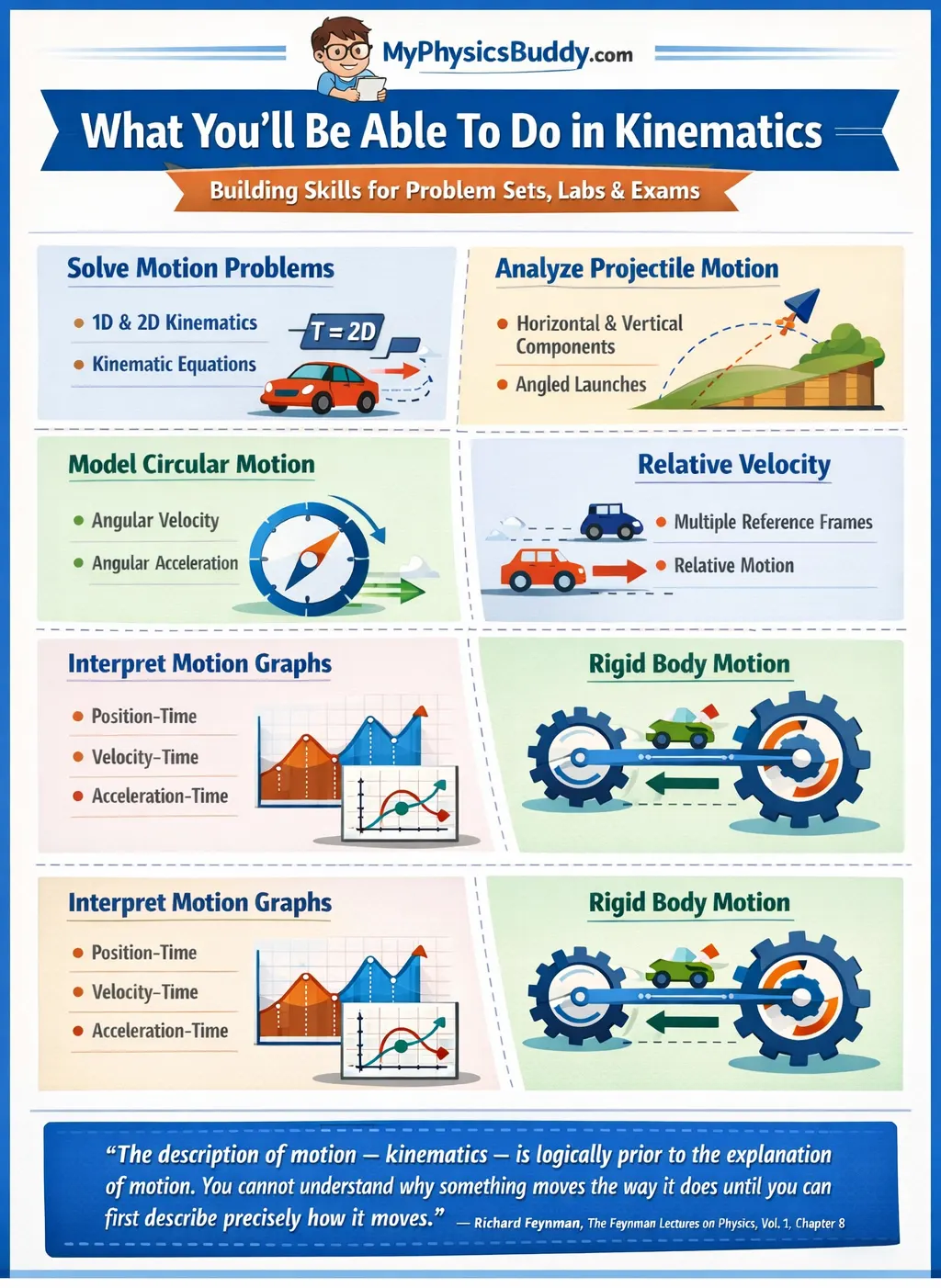
“The description of motion — kinematics — is logically prior to the explanation of motion. You cannot understand why something moves the way it does until you can first describe precisely how it moves.”
— Richard Feynman, The Feynman Lectures on Physics, Vol. I, Chapter 8 — Caltech
What We Cover in Kinematics (Syllabus / Topics)
MPB tutors align sessions to your exact course structure, textbook, and assessment format. The topics below reflect the Kinematics content taught across school-level physics, introductory university physics, and engineering dynamics programmes. Always share your syllabus so the tutor can align topics and problem types precisely. Exam and course structures vary by board and institution — details may vary.
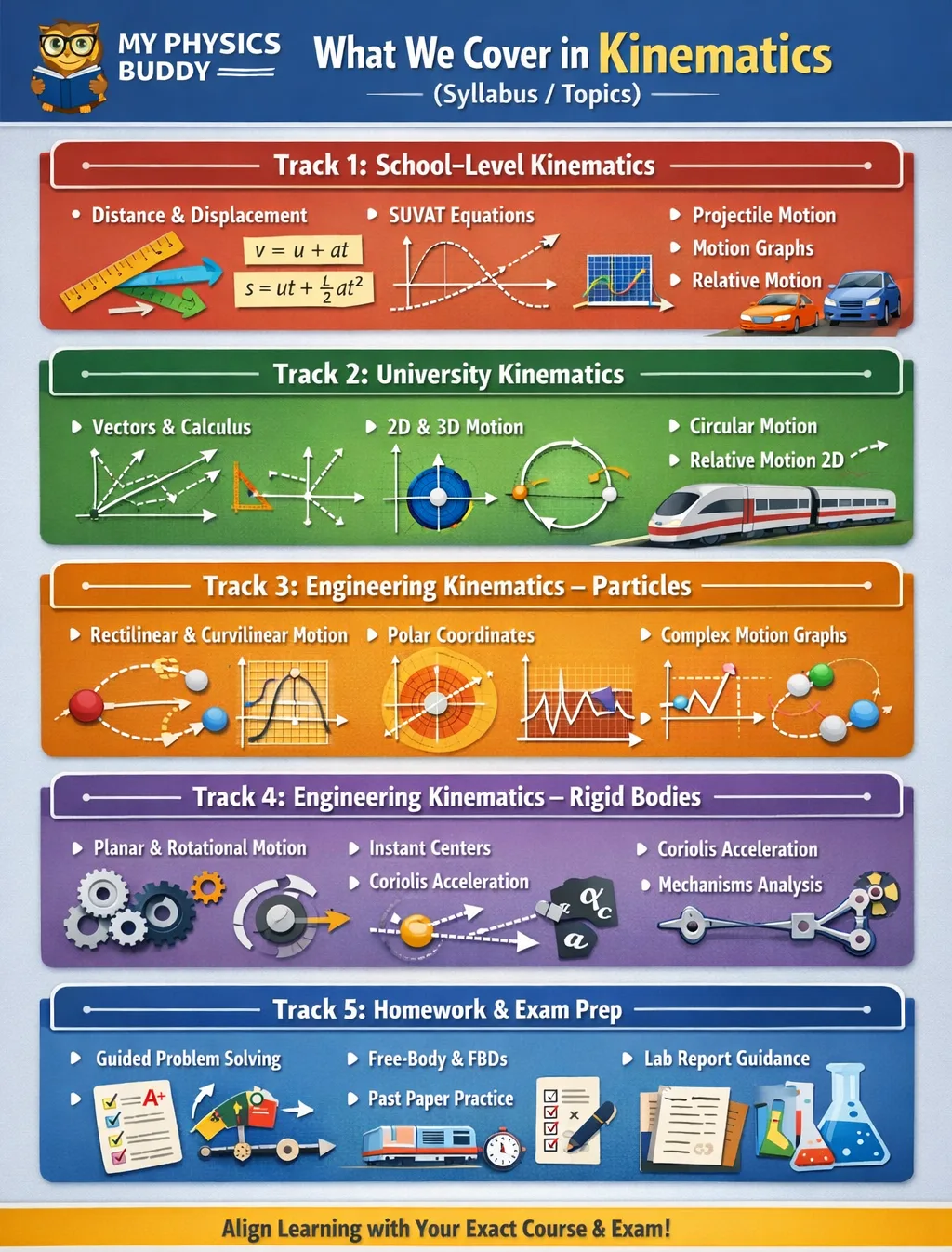
Track 1: School-Level Kinematics (Secondary / Pre-University)
- Distance and displacement; speed and velocity — scalar versus vector distinction
- Uniform acceleration: the four kinematic (SUVAT) equations and their correct application
- Vertical motion under gravity: free fall, upward projection, and objects dropped from height
- Motion graphs: drawing and interpreting displacement–time, velocity–time, and acceleration–time graphs
- Projectile motion: horizontal and vertical components, time of flight, range, and maximum height
- Relative motion in one dimension: overtaking problems, approaching objects, and combined velocities
- Common problem types: SUVAT equation selection, graph gradient and area calculations, multi-stage motion problems, projectile landing point calculations
- Syllabus contexts: GCSE Physics, A Level Physics (AQA, OCR, Edexcel, Cambridge), AP Physics 1, IB Physics, IGCSE, HSC, and equivalents
Track 2: Introductory University Kinematics (Undergraduate Physics)
- Vectors in two and three dimensions: vector addition, subtraction, components, and unit vectors
- Position, velocity, and acceleration as vector functions of time
- Differentiation and integration applied to kinematic quantities: deriving velocity from position, acceleration from velocity, and vice versa
- Two-dimensional projectile motion with vector methods
- Uniform circular motion: centripetal acceleration, period, frequency, and angular velocity
- Non-uniform circular motion: tangential and radial components of acceleration
- Relative motion in two dimensions: reference frame transformations and the addition of velocities
- Common problem types: vector kinematics problems, calculus-based motion analysis, circular motion calculations, relative velocity in two dimensions
Track 3: Engineering Kinematics — Particles (Engineering Dynamics)
- Rectilinear kinematics of a particle: position, velocity, and acceleration as functions of time, position, or velocity
- Erratic motion: piecewise kinematics problems and interpretation of complex motion graphs
- Curvilinear motion in Cartesian coordinates: two- and three-dimensional particle motion
- Curvilinear motion in normal–tangential (n–t) coordinates: centripetal and tangential acceleration components
- Curvilinear motion in polar coordinates: radial and transverse velocity and acceleration components — essential for orbital and mechanism analysis
- Projectile motion treated as curvilinear particle motion
- Relative motion of two particles: translating reference frames and the relative motion equations
- Common problem types: Hibbeler-style Engineering Mechanics problems, coordinate system selection, erratic motion graph analysis, polar coordinate kinematics
Track 4: Engineering Kinematics — Rigid Bodies (Advanced Engineering Dynamics)
- Planar rigid body kinematics: translation, rotation, and general plane motion
- Rotation about a fixed axis: angular displacement, velocity, and acceleration relationships
- Absolute and relative velocity methods for rigid bodies in general plane motion
- Instantaneous centre of zero velocity: location and application to velocity analysis
- Absolute and relative acceleration methods: normal and tangential components, Coriolis acceleration
- Rotating reference frames: the rotating frame derivative and the Coriolis term — a common source of student errors
- Kinematic analysis of mechanisms: four-bar linkages, slider-cranks, and gear trains
- Three-dimensional rigid body kinematics: introduction for upper-level courses
- Common problem types: velocity and acceleration diagrams, instantaneous centre problems, mechanism analysis, rotating frame problems
Track 5: Homework, Assignment, and Exam Preparation Guidance
- Guided walkthroughs of homework and problem set questions — tutor explains the method, student executes the solution
- Selecting the correct coordinate system and reference frame for each problem type
- Building correct free-body and kinematic diagrams as a foundation for problem setup
- Exam preparation: past paper practice, timed problem-solving, and structured checking of answers
- Lab report guidance for motion experiments — structure, data analysis, and conclusion writing — MPB does not write reports for students
How My Physics Buddy Tutors Help You with Kinematics (The Learning Loop)
Diagnose: The first session opens with a focused diagnostic. The tutor identifies your current course level, the specific problem types causing difficulty, and whether the gap is conceptual (not understanding what a kinematic quantity represents physically) or procedural (knowing the concept but making systematic errors in execution). This shapes every session that follows.
Explain: Concepts are built from physical reasoning first. Tutors use digital pen-pads or iPad with Apple Pencil so kinematic diagrams, vector decompositions, motion graph sketches, and worked solutions are drawn live on screen — step by step, exactly as you would need to reproduce them in an exam.
Practice: You attempt problems during the session with the tutor present. Problems are drawn from your textbook, past papers, or the tutor’s own question library — matched precisely to your course level and the topic being covered in that session.
Feedback: The tutor reviews your working in detail. Kinematics errors are often systematic — wrong sign convention, mixing scalar and vector quantities, incorrect coordinate system choice, or skipping a diagram step — and catching these live is far more effective than discovering them after a marked script is returned.
Retest / Reinforce: Each session begins with a brief check on the previous topic. If it is secure, the tutor moves forward. If gaps remain, they are addressed before new material is introduced. Kinematics is the foundation for dynamics, so an unresolved gap here creates compounding problems in every subsequent mechanics course.
Plan: After each session, the tutor shares a brief summary — what was covered, what to review independently before next time, and what comes next. For students with assessments approaching, this includes a prioritised topic and problem-type list.
Accountability: For students on ongoing weekly plans, the tutor stays in light contact between sessions — answering a quick query, confirming the next topic, or reviewing a student’s attempt at a practice problem — so momentum is maintained throughout the term.
All sessions run via Google Meet — no download required, works on any device. Before your first session, it helps to share your course syllabus or textbook name, a recent homework or test result, and your upcoming assessment dates. The tutor will use this to structure the diagnostic, teach one live topic, and outline a clear plan by the end of the session.
“Personalised tutoring — where an expert identifies exactly what the student does not yet understand and addresses it directly — consistently produces learning gains far beyond what standard classroom instruction achieves.”
— Education Endowment Foundation, One-to-One Tuition Toolkit
Tutor Match Criteria (How We Pick Your Tutor)
Kinematics is taught at very different levels of rigour — from GCSE motion graphs to rotating reference frames in engineering dynamics. Every student is matched with a tutor whose expertise fits their exact level and course context.
Level and syllabus fit: The tutor must be comfortable with your precise level and syllabus — whether that is A Level, AP Physics, IB, introductory university physics, or engineering dynamics. Tutors confirm familiarity with your course and textbook before the first session.
Topic strengths: If your difficulty lies in polar coordinate kinematics or rotating frame problems, your tutor has direct expertise there — not just general mechanics familiarity.
Tools and setup: Tutors use Google Meet with a digital pen-pad or iPad and Apple Pencil. Kinematics requires live diagram drawing — velocity diagrams, vector decompositions, motion graph sketches — and a tutor who cannot show working visually is not suitable for this subject.
Time zone and availability: Sessions are scheduled to fit students in the US, UK, Canada, Australia, and the Gulf, including evenings and weekends.
Learning style and pace: Some students need slow, physical reasoning-first explanations; others want to move quickly through problem types for an imminent exam. The tutor calibrates from the first session.
Language and communication: Clear, precise technical communication in English — adapted in tone and depth to whether the student is a secondary school pupil or a graduate engineering student.
Goals: Whether the goal is to pass a school exam, understand projectile motion, nail an engineering dynamics mid-term, or build a solid foundation before starting a dynamics or robotics course — the tutor aligns entirely to that goal.
Urgency and timelines: Students with imminent assessments or homework deadlines are matched with tutors who have immediate availability.
Study Plans (Pick One That Matches Your Goal)
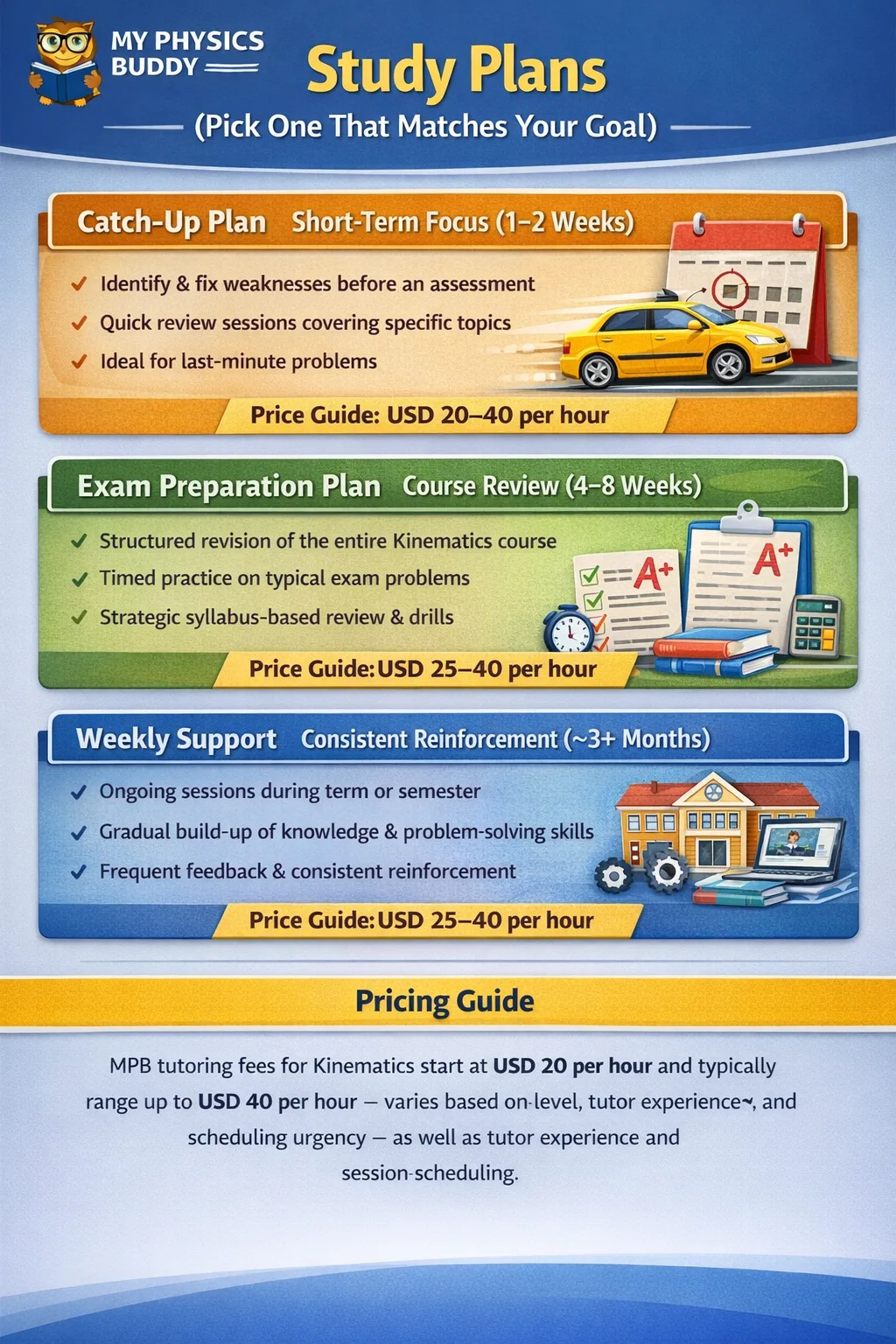
MPB offers three main plan types for Kinematics: a short catch-up plan (typically 1–2 weeks) for students behind on a specific topic or problem type before an upcoming assessment; an exam preparation plan (typically 4–8 weeks) for students working through their full Kinematics course systematically before finals or a qualifying paper; and ongoing weekly support for consistent reinforcement throughout a school term or university semester. The tutor builds the specific session plan — topics, problem sources, diagram practice, and pacing — after the diagnostic, not before.
One of the most common patterns MPB tutors observe in Kinematics students is strong performance on basic SUVAT problems combined with complete breakdown on two-dimensional or relative motion problems. This is almost always a sign that the student has learned to apply equations without building a clear physical picture first — a habit that works at low difficulty and fails at moderate difficulty. MPB tutors address this directly by making diagram construction and physical reasoning the first step of every problem, before any equation is written.
Pricing Guide
MPB tutoring fees for Kinematics start at USD 20 per hour and typically range up to USD 40 per hour. Pricing varies based on the level of the course — school-level Kinematics is priced lower than engineering dynamics or graduate-level content — as well as tutor experience and session scheduling. Advanced engineering topics such as rigid body kinematics, rotating reference frames, or mechanism analysis may be priced toward the higher end of the range. Shorter timelines and urgent exam preparation may also affect availability and rate.
FAQ
Is Kinematics hard?
Kinematics is often considered an entry-level topic, but students frequently find it harder than expected once two-dimensional motion, relative velocity, or engineering-level rigid body analysis enters the picture. The difficulty is usually not the mathematics itself but setting up problems correctly — choosing the right reference frame, drawing an accurate diagram, and selecting the appropriate equations before any calculation begins.
How many sessions are needed?
This depends on your level and goal. A school student who needs help with projectile motion before an upcoming paper may need 2–4 sessions. An engineering student working through particle and rigid body kinematics over a semester may need 10–18 sessions. The tutor gives a clearer estimate after the diagnostic.
Can tutors help with homework and assignments?
Yes, through guided explanation. The tutor explains the relevant method, works through a parallel example, and helps you identify where your own approach breaks down. You complete and submit your own work. MPB does not solve or submit assignments on behalf of students. Academic integrity is a firm and non-negotiable principle at MPB.
Will the tutor match my exact syllabus?
Tutors work from your course syllabus, textbook, and past papers. Coverage, notation, and problem style vary across exam boards and universities — sharing your syllabus and a recent homework or test paper before the first session allows the tutor to align precisely to what your assessors expect.
What happens in the first session?
The first session includes a short diagnostic to identify your current level and the specific problem types where you are losing marks, followed by live teaching on the highest-priority topic. By the end of the session, the tutor will outline a plan covering what to address, in what order, and over what timeframe.
Is online tutoring effective for a practical subject like Kinematics?
Yes. Kinematics is a diagram-heavy, problem-solving subject — and with a digital pen-pad, the tutor can draw velocity diagrams, vector decompositions, and motion graphs live on screen exactly as a teacher would on a whiteboard. Research published by the American Physical Society supports active, expert-guided problem-solving as the most effective approach to building physics problem-solving skills.

Can the tutor help with my mechanics lab report?
Yes. Tutors can help you understand the motion theory underlying your experiment, structure your report correctly, analyse your data, and improve your conclusion. MPB does not write lab reports for students. All written content must be the student’s own work.
What textbooks does MPB support for Kinematics?
For school level: standard A Level, AP, and IB Physics textbooks. For university and engineering level: Hibbeler’s Engineering Mechanics: Dynamics, Meriam and Kraige, Beer and Johnston, Halliday, Resnick and Krane, and Serway and Jewett. Share your textbook and edition at booking and the tutor will prepare accordingly.
My child keeps making the same errors on projectile problems. Can MPB help?
Yes — and this is one of the most common requests MPB receives for Kinematics. Repeated errors on projectile problems are almost always diagnostic of a specific, fixable misconception — usually related to sign conventions, component decomposition, or the independence of horizontal and vertical motion. A tutor can identify the exact source of the error within the first session and address it directly.
What if I need support in both Kinematics and related dynamics topics?
Kinematics is the starting point for a much broader mechanics sequence. Students who are also studying the forces and causes behind motion will find MPB’s Classical (Newtonian) Mechanics and Engineering Dynamics pages relevant. Those studying related physics topics such as Engineering Statics or Fluid Mechanics & Dynamics may also benefit from combined support. Tutors can sometimes cover adjacent topics within the same session if requested.
Kinematics is not just a topic to get through — it is the conceptual language of motion that physics and engineering students use in every subsequent mechanics, dynamics, and control systems course they take. Students who develop a genuine feel for velocity diagrams, reference frame selection, and the physical meaning of acceleration components carry that advantage forward into orbital mechanics, vibrations, robotics, and fluid dynamics. Building Kinematics properly the first time saves far more time than patching it later.
Trust & Quality at My Physics Buddy
Tutor selection: MPB tutors hold degrees in Physics, Mechanical Engineering, Aerospace Engineering, or closely related disciplines. Every tutor is vetted through subject knowledge checks, a live demonstration session, and ongoing student feedback review. For Kinematics specifically, tutors are assessed on their ability to draw clear diagrams, explain physical reasoning in plain language, and guide students through multi-step problems at the appropriate level of rigour. Tutors who receive consistently poor feedback are not retained on the platform.
Academic integrity: MPB’s role is to teach, guide, and explain — never to complete work for students. Every homework walkthrough, problem set discussion, and exam preparation session is structured so the student builds genuine understanding and submits their own work. We guide — you submit your own work. This is non-negotiable at every level and in every subject at MPB. Students are encouraged to review their institution’s academic integrity policies, such as those published by the Accreditation Board for Engineering and Technology (ABET).

About MPB: My Physics Buddy is a Physics-focused online tutoring platform serving school students, undergraduates, graduate students, and their parents across the US, UK, Canada, Australia, and the Gulf. The platform covers Physics and engineering science subjects in depth — from school-level motion problems to advanced engineering dynamics. Students working across connected physics and engineering topics may also find the following pages relevant: Physics, Orbital & Celestial Mechanics, Waves and Optics, and AP Physics 1: Algebra Based. Students preparing for UK-based physics examinations that include Kinematics as a core unit may also find A/AS Level Physics (9702) and GCSE Physics pages useful. For further reading on physics education research and how students develop problem-solving skills in mechanics, the Force Concept Inventory research at PhysPort provides well-documented evidence on how students build and consolidate understanding of motion concepts.
“Research on physics problem-solving shows that expert physicists consistently draw a diagram and identify physical principles before writing any equations — while novice students often skip directly to formula selection. Teaching this expert habit explicitly is one of the most impactful things a tutor can do.”
— Physical Review Physics Education Research, Expert vs. Novice Problem-Solving in Physics
Content reviewed by a Kinematics tutor at My Physics Buddy.
Next Steps
Tell us your current course level (school, undergraduate, or engineering), your syllabus or textbook, the specific Kinematics topics where you are losing marks, and your upcoming exam or assignment dates. Share your time zone and available session times. MPB will match you with a Kinematics tutor who fits your course, level, and schedule — and you can get started within days.

