Acoustics & Sound Physics Tutor Online
My Physics Buddy (MPB) offers 1:1 online tutoring & homework help in Physics and related subjects, including specialist support for Acoustics & Sound Physics. This subject spans the physical behaviour of sound waves, vibration and resonance, room acoustics, psychoacoustics, and signal analysis — drawing on classical wave physics, fluid mechanics, and mathematics in equal measure. Students encounter it in physics degrees, mechanical and civil engineering programmes, audio engineering, and architectural acoustics courses. If you have been looking for an Acoustics & Sound Physics tutor near me, MPB’s fully online model connects you with an expert tutor — wherever you are — at hours that fit your schedule. Sessions are designed to build genuine understanding, improve problem-solving accuracy, and support you through assignments and exams.
- 1:1 live sessions matched to your course level, institution, and syllabus
- Expert tutors with strong backgrounds in wave physics, applied acoustics, and signal analysis
- Flexible scheduling across US, UK, Canada, Australia, and Gulf time zones
- Structured learning plan built around your coursework deadlines and exam dates
- Ethical guidance on homework, assignments, lab reports, and research paper structure
Who This Acoustics & Sound Physics Tutoring Is For
Acoustics & Sound Physics tutoring at MPB serves a broad range of students across disciplines and countries. It is well matched to the following profiles.
- Undergraduate physics students taking wave mechanics or acoustics as a core or optional module at universities in the US, UK, Canada, Australia, or Gulf region
- Mechanical and Civil Engineering students encountering acoustics, vibrations, and noise control as part of their degree programme
- Audio Engineering, Music Technology, and Architectural Acoustics students who need stronger physics and mathematics foundations
- Graduate and Masters students working on research or advanced coursework in acoustical physics, noise engineering, or ultrasonics
- PhD students needing conceptual clarification on specific acoustics topics relevant to their thesis or dissertation work
- Parents of undergraduate students who want reliable, expert academic support available around their child’s timetable
- Students needing ethical guidance on structuring and understanding homework, lab reports, and assignments in acoustics courses
Outcomes: What You’ll Be Able To Do in Acoustics & Sound Physics
Tutoring at MPB targets specific, observable skills — not vague improvements. After working with an MPB tutor, students are in a stronger position to do the following.
Solve wave equation problems in one, two, and three dimensions — deriving solutions, applying boundary conditions, and interpreting physical meaning. Analyse standing waves, resonance modes, and harmonic content in strings, pipes, and cavities with confidence. Model sound propagation in different media, accounting for reflection, transmission, diffraction, and absorption. Explain psychoacoustic phenomena — such as loudness perception, the decibel scale, masking, and frequency selectivity — accurately and in terms connected to underlying physics. Apply Fourier analysis to decompose and interpret complex sound signals, understanding spectra and their physical significance. Write structured lab reports on acoustic experiments with clear methodology, data presentation, and physical interpretation of results. Present derivations and solutions in a logical, methodical format appropriate for exam and assignment submission.
“Acoustics is one of the most interdisciplinary branches of physics. It draws on classical mechanics, thermodynamics, fluid dynamics, and signal processing simultaneously. Students who struggle often do so not because the physics is uniquely hard, but because they have not yet built the connecting framework that shows how these topics are all describing the same underlying wave behaviour in different contexts.”
— Perspective consistent with educational guidance from the Acoustical Society of America Education in Acoustics programme

Explore Acoustics Today by the Acoustical Society of America, featuring research articles, editor insights, and acoustic science topics.
What We Cover in Acoustics & Sound Physics (Syllabus / Topics)
MPB tutors work directly from your course syllabus, textbook, and past exam papers. The topic tracks below reflect the standard content of Acoustics & Sound Physics courses from introductory undergraduate through to advanced graduate level. Exact coverage depends on your programme and institution.
Wave Fundamentals and the Physics of Sound
- Mechanical waves: transverse and longitudinal; wave equation derivation
- Speed of sound in solids, liquids, and gases; temperature dependence
- Wavelength, frequency, period, and wavenumber relationships
- Superposition principle, interference, and coherence
- Phase velocity and group velocity
- Energy, intensity, and power in wave propagation
Sound Levels and the Decibel Scale
- Sound pressure level (SPL): definition, reference values, and calculation
- Intensity level and power level; combining decibel values
- Weighting curves: A-weighting, C-weighting, and their physical basis
- Near-field and far-field behaviour of sound sources
- Directivity and radiation patterns of sound sources
Standing Waves and Resonance
- Standing waves in strings: fixed-fixed, fixed-free boundary conditions
- Acoustic resonance in pipes: open, closed, and half-open configurations
- Harmonics, overtones, and modal analysis
- Resonance in two- and three-dimensional cavities and rooms
- Helmholtz resonator: derivation, applications, and frequency response
Sound Propagation and Reflection
- Reflection and transmission at interfaces; acoustic impedance matching
- Snell’s law for sound; refraction in stratified media
- Diffraction of sound around obstacles and through apertures
- Doppler effect: derivation and applications for moving sources and observers
- Attenuation: geometric spreading, absorption, and scattering losses
Room Acoustics and Architectural Applications
- Reverberation and the Sabine equation; RT60 measurement and prediction
- Absorption coefficients and acoustic materials
- Early reflections, late reverberation, and their perceptual effects
- Room modes and modal distribution; flutter echo and acoustic defects
- Basic principles of acoustic design for performance spaces and studios
Psychoacoustics
- The auditory system: anatomy and function at a physics level
- Frequency response of the ear; equal-loudness contours and phons
- Masking: simultaneous and temporal masking effects
- Critical bands and auditory filters
- Pitch perception, timbre, and sound localisation cues
Signal Analysis and Fourier Methods
- Fourier series: representation of periodic signals
- Fourier transform: from time domain to frequency domain
- Spectra, power spectral density, and their physical interpretation
- Convolution and impulse response in acoustic systems
- Discrete Fourier transform (DFT) and fast Fourier transform (FFT) at conceptual level
Vibration and Structural Acoustics (where included in course)
- Free and forced vibration of mechanical systems; natural frequency and damping
- Single-degree-of-freedom oscillator: equations of motion and frequency response
- Vibration of beams, plates, and membranes: modes and boundary conditions
- Sound radiation from vibrating structures; radiation efficiency
- Noise and vibration control: damping, isolation, and barrier design at introductory level
Advanced Topics (Graduate Level)
- Nonlinear acoustics: shock waves, acoustic streaming, and finite-amplitude effects
- Underwater acoustics and sonar principles
- Ultrasonics: applications in medical imaging, non-destructive testing, and sensing
- Aeroacoustics: sound generated by turbulent flow and aerodynamic sources
- Computational acoustics: finite element methods and boundary element methods at conceptual level
Acoustics & Sound Physics is a subject where weak foundations in wave physics compound quickly. A student who does not fully understand why boundary conditions determine resonance modes will struggle with room acoustics, structural vibration, and signal analysis further into the course — because these topics all rest on the same mathematical foundation. MPB tutors build that foundation first, then connect it directly to the specific problems and assignments your course requires you to solve.
How My Physics Buddy Tutors Help You with Acoustics & Sound Physics (The Learning Loop)
Diagnose: Your first session starts with a diagnostic. The tutor works through a short set of questions with you — covering wave fundamentals, decibel calculations, standing wave analysis, and any specific topics your course is currently covering — to identify where your understanding is strong and where gaps exist. This shapes the entire plan that follows.
Explain: Tutors do not simply rework textbook derivations line by line. They connect the physical picture to the mathematics — explaining why the wave equation takes the form it does, what acoustic impedance physically represents, and how Fourier decomposition relates to what you actually hear. Explanations are anchored to the types of questions your specific course asks.
Practice: You work through problems drawn from your own lecture notes, past exam papers, and standard textbooks — such as those by Kinsler et al., Rossing, or Pierce — depending on your course. The tutor observes your reasoning process, not just whether the final number is correct.
Feedback: After each problem or set of problems, your tutor gives specific feedback on method. If you set up boundary conditions incorrectly, misread a decibel combination, or confused intensity with pressure level, the tutor identifies the exact point of divergence and explains how to correct it going forward.
Retest and Reinforce: Topics are revisited with fresh problems in later sessions to confirm that understanding is retained and can be applied independently — not just reproduced immediately after explanation.
Plan: Between sessions, the tutor sets targeted practice matched to your weak areas and upcoming deadlines — specific problem types, derivation exercises, or Fourier analysis practice, depending on what is most needed.
Accountability: For students juggling multiple assignments and lab submissions, regular sessions help maintain forward progress through the course rather than accumulating confusion topic by topic.
All sessions run live via Google Meet. Tutors use a digital pen-pad or iPad with Apple Pencil, so wave diagrams, standing wave sketches, phasor representations, and signal diagrams are all drawn and annotated live in real time. Before your first session, share your course syllabus or textbook name, the topics currently being lectured, any specific homework or assignment problems you are stuck on, and your upcoming exam or submission dates. This allows the tutor to arrive fully prepared for a focused, immediately productive first session.
Tutor Match Criteria (How We Pick Your Tutor)
MPB matches students to tutors on criteria specific to Acoustics & Sound Physics — not just the subject name.
Level and syllabus fit: Introductory wave physics, applied engineering acoustics, and advanced graduate-level ultrasonics are very different in depth and mathematical demand. Tutors are matched to the correct level for your course.
Topic strengths: If your course is focused heavily on room acoustics and architectural applications, psychoacoustics, structural vibration, or signal analysis, the tutor match reflects that specific emphasis rather than generic acoustics knowledge.
Tools and setup: All tutors use Google Meet with a digital pen-pad or iPad and Apple Pencil. For acoustics, this is particularly important — wave diagrams, standing wave sketches, frequency spectra, and resonance mode illustrations need to be drawn and discussed live.
Time zone and availability: Tutors are matched for your region — US, UK, Canada, Australia, or Gulf — with session slots available across morning, afternoon, and evening hours local to you.
Learning style and pace: Some students need a conceptual, physics-first approach before engaging with mathematics. Others are confident with the maths but need help building physical intuition. Tutor selection accounts for this preference.
Language and communication: Clear English-medium instruction is standard. Additional language preferences are accommodated where tutor availability allows.
Goals and urgency: Whether you need to pass an upcoming exam, understand a specific topic holding back your assignment, or build deeper knowledge for research purposes, tutor matching and session intensity are calibrated to your timeline and goals.
“The most effective way to learn a technically demanding subject is not to read more — it is to attempt problems, make errors, and receive immediate, specific feedback from someone who can pinpoint exactly where the reasoning went wrong. That feedback loop, delivered consistently over time, is what separates students who understand acoustics from those who have merely been exposed to it.”
— Consistent with cognitive science research on learning and feedback, as reviewed by the American Psychological Association education resources
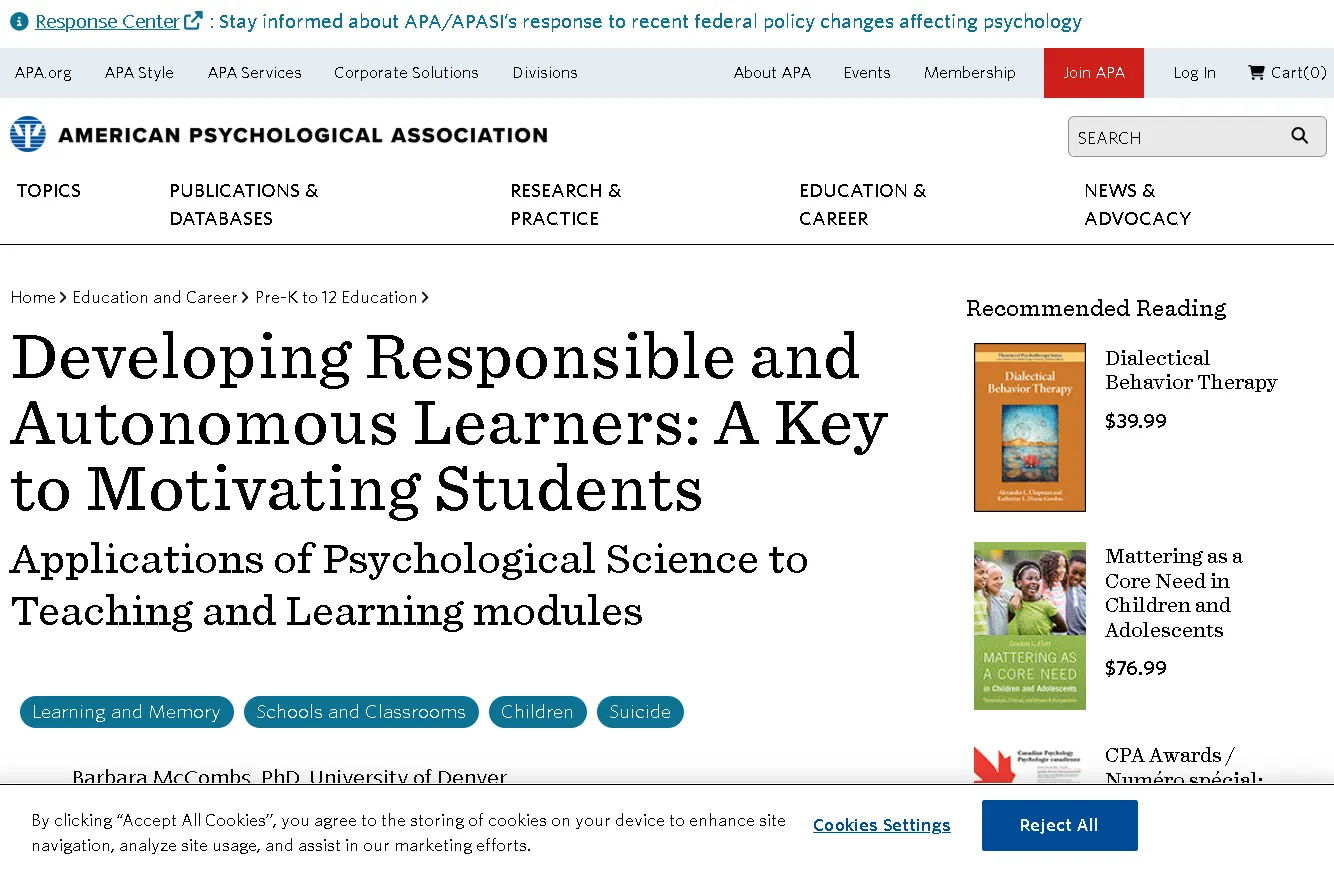
Learn how psychological science helps develop responsible, autonomous learners and improve student motivation in education.
Study Plans (Pick One That Matches Your Goal)
MPB offers three plan types for Acoustics & Sound Physics support: a short catch-up plan (1–2 weeks) for students close to an exam or assignment deadline who need rapid, targeted help on specific topics; a structured semester support plan (4–8 weeks) covering the course progressively in parallel with lectures; and ongoing weekly support for students who want a consistent tutor throughout the entire term. After your diagnostic session, the tutor builds the specific session-by-session plan based on your actual syllabus, weak areas, and deadlines — the above are starting frameworks, not fixed schedules.
Pricing Guide
Acoustics & Sound Physics tutoring at MPB is priced based on the expertise level required, the complexity and depth of your course content, and tutor availability. Hourly rates generally start at USD 20 and range up to USD 40 for most undergraduate-level sessions. For specialist graduate-level content — such as aeroacoustics, nonlinear acoustics, or ultrasonics research support — rates may go higher, up to USD 100 per hour in some cases.
Factors influencing pricing include your academic level (undergraduate vs. Masters vs. PhD), how close your deadline is, and whether you need intensive daily sessions or standard weekly support. Shorter timelines with higher session frequency typically sit toward the upper end of the range.
FAQ
Is Acoustics & Sound Physics hard?
It is considered challenging because it draws on wave mechanics, calculus, Fourier mathematics, and physical intuition simultaneously. Students from different backgrounds — physics, engineering, and audio technology — often find different aspects difficult. Targeted tutoring helps identify which layer of the subject is causing the most difficulty and address it directly.
How many sessions are needed?
This depends on your current level and how much ground needs to be covered. Students targeting one specific exam or assignment typically benefit from 4–8 focused sessions. Those wanting full-semester coverage work with a tutor regularly throughout the term. Your tutor will recommend a session frequency and plan after the diagnostic.
Can you help with homework, assignments, and lab reports?
Yes — within clear academic integrity limits. Tutors explain the physics and mathematics behind problem types similar to your homework, help you identify where your reasoning goes wrong, and provide feedback on the structure and physical interpretation sections of your lab reports. MPB provides guidance and explanation. You complete and submit your own work. We do not write or submit assignments on your behalf, and we strongly discourage any use of our support that would violate your institution’s academic integrity policies.
Do your tutors match my exact university syllabus?
Tutors work directly from your course materials — your textbook, lecture notes, and past exam papers — wherever possible. Core acoustics content is broadly consistent across programmes, though depth and topic order vary. Sharing your syllabus before the first session ensures the tutor covers what your course actually requires.
What happens in the first session?
The first session includes a short diagnostic — a few questions across wave fundamentals, decibel calculations, and any specific topics your course is currently covering. The tutor then works on one or two of your most pressing topics and outlines a session plan. Come prepared with your syllabus, recent lecture notes, and any specific problems or concepts you are stuck on.
Is online tutoring effective for acoustics — a subject that involves sound?
For physics and mathematics problem-solving, yes — fully. The subject is taught through equations, wave diagrams, and derivations, all of which translate directly to a live shared digital board via Google Meet. For topics like psychoacoustics, auditory demonstrations can be shared as audio files or discussed at a conceptual level. The online format is not a limitation for the academic study of acoustics.
Which textbooks do MPB tutors use?
Common acoustics textbooks include Kinsler, Frey, Coppens & Sanders’ Fundamentals of Acoustics, Rossing’s The Science of Sound, and Pierce’s Acoustics: An Introduction to Its Physical Principles and Applications. At graduate level, Morse and Ingard’s Theoretical Acoustics is widely used. Share your course textbook when booking and the tutor will align sessions to it.
Can MPB help with research on ultrasonics or medical acoustics?
MPB tutors can support the conceptual physics underpinning ultrasonics, acoustic imaging, and medical acoustics at a level consistent with graduate coursework and early-stage research. For detailed clinical or biomedical instrumentation content, tutor availability for that specific specialisation should be confirmed at the time of enquiry. Students interested in the medical imaging side may also find MPB’s Medical Physics tutoring page relevant.
Can you help me understand Fourier analysis as it applies to acoustics?
Yes — Fourier analysis is a core skill in acoustics and one that tutors frequently work on. Sessions cover the physical meaning of frequency spectra, how Fourier decomposition connects to harmonic content in real sounds, and how to work through Fourier transform problems in a physics or engineering context. Understanding Fourier methods properly makes a significant difference across multiple acoustics topics.
What related subjects does MPB support that overlap with acoustics?
Acoustics draws heavily on several related areas where MPB also offers tutoring. Students working in acoustics frequently benefit from additional support in Waves and Optics, Fluid Mechanics & Dynamics, Thermodynamics, and Mathematical Physics — all of which provide foundational knowledge directly relevant to acoustic phenomena.
MPB’s academic integrity commitment is straightforward: tutors explain, demonstrate, and give feedback. Students do the thinking, the working, and the submitting. In Acoustics & Sound Physics — where lab reports, derivation questions, and signal analysis problems all require your own demonstrated understanding — the ability to work independently through problems is exactly what gets tested in exams and assessments. Our goal is to make sure you can do that, not to do it for you.
Trust & Quality at My Physics Buddy
Tutor selection: Every MPB tutor is assessed through a subject-knowledge screening and a live demonstration session before being placed with students. For Acoustics & Sound Physics, this means working through representative problems — from standing wave analysis and decibel calculations to room acoustics and Fourier methods — and demonstrating the ability to explain physical reasoning clearly at the appropriate level. Tutors typically hold undergraduate or postgraduate degrees in Physics, Mechanical Engineering, Acoustical Engineering, Audio Technology, or closely related fields from recognised universities. Student feedback is reviewed regularly and informs ongoing tutor quality monitoring.
Academic integrity: MPB’s role in homework and assignment guidance is clear and consistent. Tutors explain methods, identify errors in your reasoning, and help you understand the physics. They do not produce solutions for submission or write lab reports on your behalf. This principle is stated clearly to every student and is consistent with the academic integrity standards of institutions across the US, UK, Canada, Australia, and the Gulf. Building genuine understanding is the goal — not providing shortcuts that would misrepresent your abilities.
About MPB: My Physics Buddy is a Physics-focused online tutoring platform serving undergraduate students, graduate students, and advanced learners across the US, UK, Canada, Australia, and Gulf region. Acoustics sits at the intersection of several disciplines MPB covers well. Students working across related areas may find it useful to explore MPB’s pages on Experimental Physics & Lab Skills, Optics, and Computational Physics for overlapping support. Those pursuing specific physics qualifications alongside their acoustics studies can also explore A/AS Level Physics (9702), AP Physics 2: Algebra Based, and Engineering Physics tutoring pages for related subject support.
The Acoustical Society of America is the primary international scientific organisation for the field and publishes peer-reviewed research, educational resources, and career guidance for students of acoustics. Students wanting to explore the breadth of acoustics as a discipline — from architectural applications to biomedical ultrasonics — will find their resources valuable alongside any tutoring they undertake. Additionally, NIST’s acoustics and vibration measurement resources provide authoritative reference material on acoustic measurement standards and physical definitions used throughout the subject.
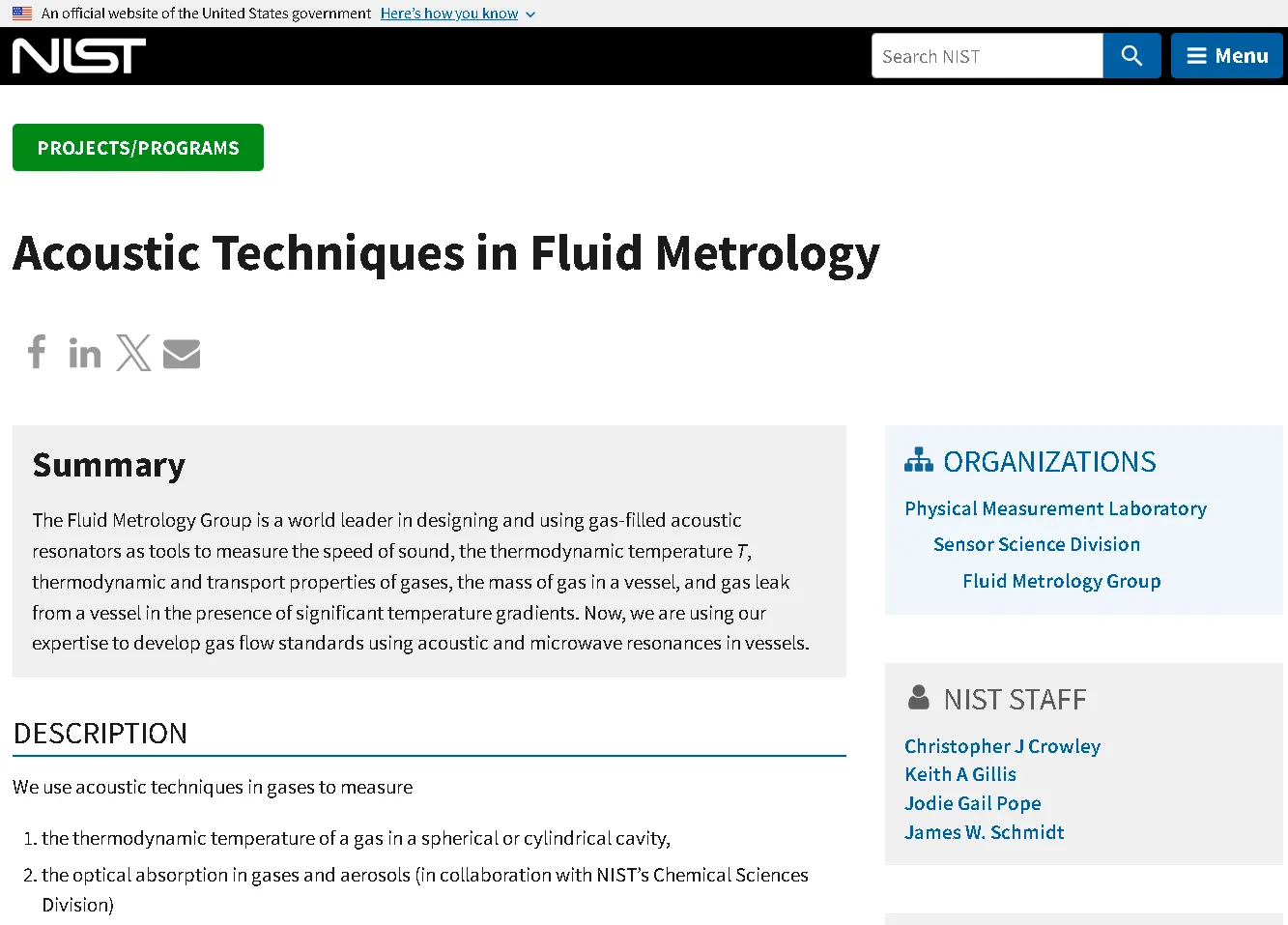
Explore NIST research on acoustic techniques used in fluid metrology for precise gas measurement and thermodynamic analysis.
Content reviewed by an Acoustics & Sound Physics tutor at My Physics Buddy.
Next Steps
Share your course level, institution, the topics currently being covered in your lectures, and any upcoming deadlines or exam dates. MPB will identify a matched tutor available in your time zone and get you into a first session promptly — typically within a few days of your enquiry. The first session includes a diagnostic and begins working on your most urgent topics immediately. Most students leave the first session with a clearer approach to at least one concept or problem type that was previously causing difficulty.

