Optics Tutor Online
My Physics Buddy (MPB) offers 1:1 online tutoring & homework help in Physics and related subjects, with dedicated support for students studying Optics at every level. From geometric ray diagrams to wave interference, polarisation, and Fourier optics, the subject rewards students who build strong conceptual foundations alongside calculation skills. Whether you need an Optics tutor near me or prefer the flexibility of expert online sessions across any time zone, MPB matches you with a qualified tutor aligned to your exact course, textbook, and timeline. Sessions are structured to help you aim for stronger grades, clearer problem-solving, and genuine understanding of how light behaves.
- 1:1 live online sessions — tailored entirely to your syllabus and pace
- Tutors with Physics or Applied Physics backgrounds and optics-specific depth
- Flexible scheduling across US, UK, Canada, Australia, Gulf, and global time zones
- Structured learning plan built around your course outline, assignments, and exam dates
- Ethical homework and assignment guidance — we explain the method; you do the work
My Physics Buddy is a specialist online tutoring platform for Physics and closely related quantitative subjects. Optics students — from introductory college courses through graduate-level wave theory — benefit from structured 1:1 sessions that go beyond worked examples in a textbook. MPB tutors work through your actual course material, lecture problems, lab report concepts, and exam-style questions with you in real time, adapting the depth and pace to where you are right now.
Who This Optics Tutoring Is For
Optics appears across many levels and disciplines — from a single unit in a general Physics course to a full-semester advanced subject in Physics or Engineering. MPB serves students across this entire range.
- Undergraduate students taking introductory or intermediate Optics as part of a Physics, Engineering Physics, or Applied Physics degree
- Graduate students in Physics, Electrical Engineering, or Photonics who need support with wave optics, Fourier methods, or coherence theory
- Advanced high school students in the US, UK, Canada, Australia, and Gulf countries whose Physics curriculum includes optics units
- Students in programs covering Optics within broader Physics courses — including those taking AP Physics or IB Physics HL/SL
- Engineering students whose coursework requires understanding of optical systems, fibre optics, or photonic devices
- Students needing homework guidance, lab report structure help, or assignment problem support
- Parents looking for accountable, structured online Physics support for their child in any primary region
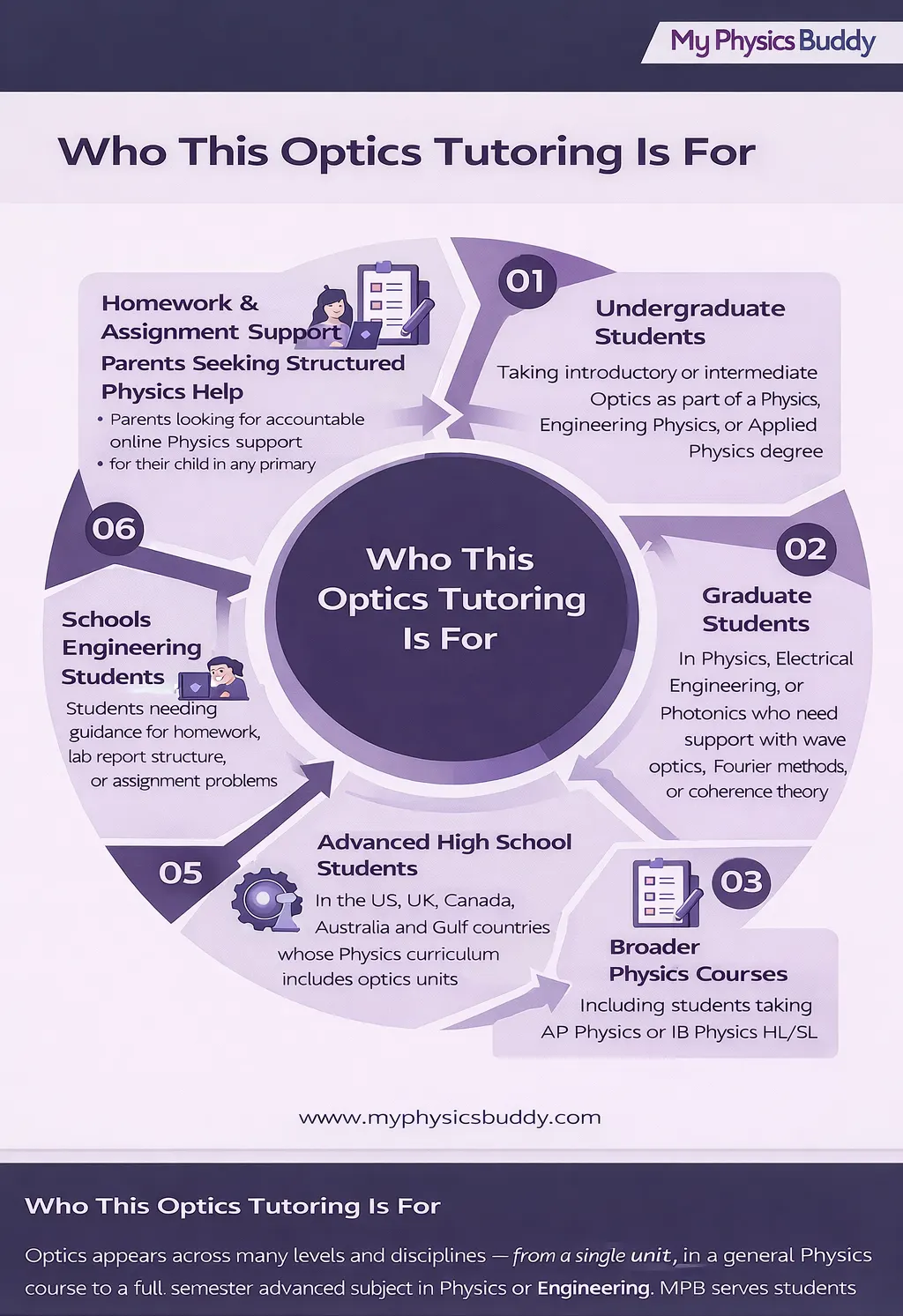
Creative circular infographic explaining the types of students who benefit from optics tutoring, including physics, engineering, and high school students worldwide.
Outcomes: What You’ll Be Able To Do in Optics
Optics rewards students who can reason geometrically, apply wave mathematics, and connect abstract theory to real physical systems. The goal of MPB tutoring is to build all three. After consistent work with an MPB tutor, you should be able to approach new problems with confidence rather than pattern-matching to memorised formulas.
Solve geometric optics problems involving mirrors, lenses, and optical instruments by applying ray-tracing rules and the thin lens equation with clarity and speed. Analyse interference and diffraction patterns — from double-slit setups to diffraction gratings — and predict fringe spacing, minima, and maxima from first principles. Model polarisation states and apply Malus’s Law, Brewster’s angle, and birefringence concepts to structured problems. Explain the physical basis of phenomena like total internal reflection, dispersion, and the photoelectric effect in the context of light’s dual nature. Apply Fourier techniques in advanced courses to decompose and reconstruct optical signals, understanding their role in imaging and wave propagation.
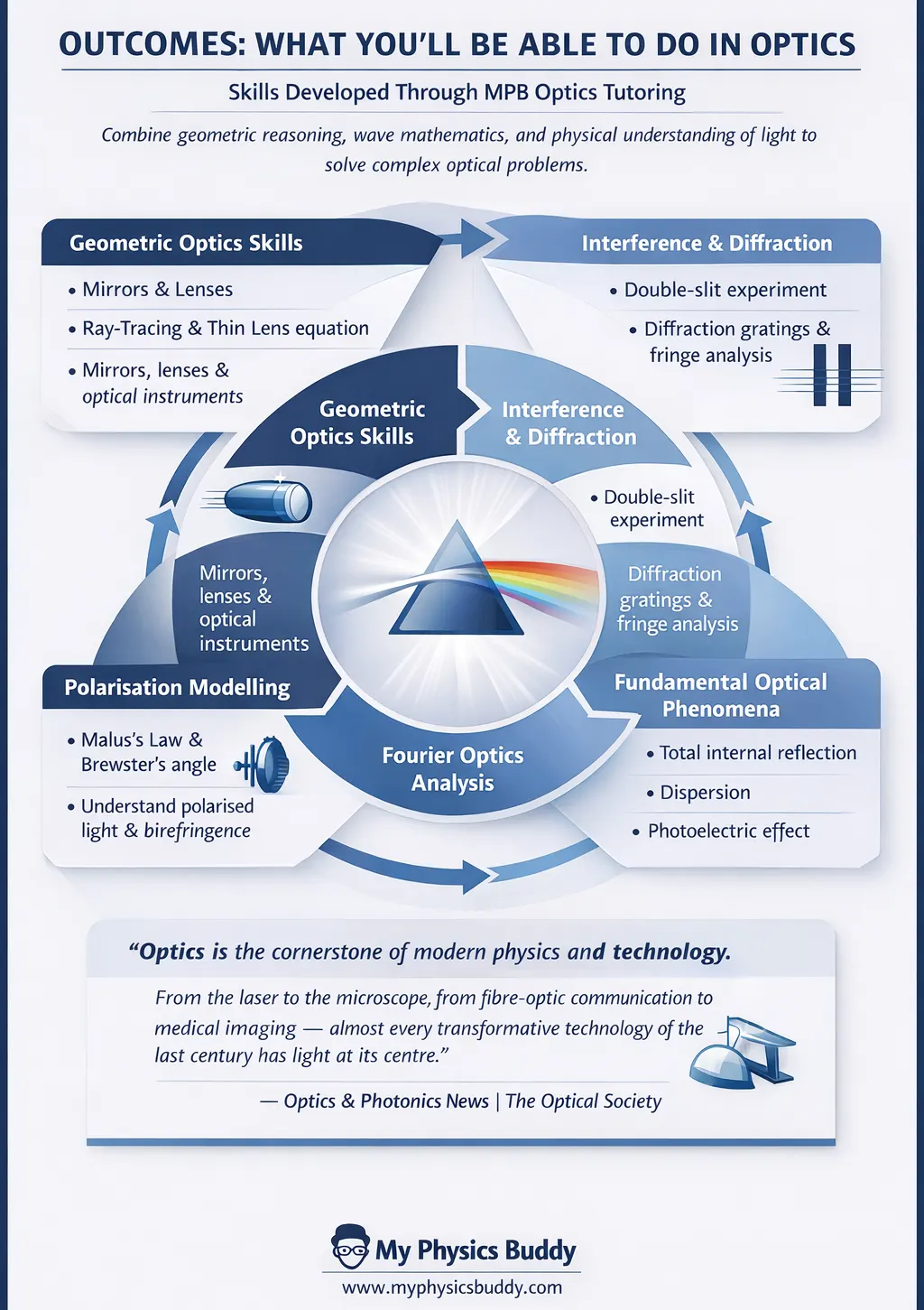
Key skills students develop in optics, including ray tracing for mirrors and lenses, interference and diffraction analysis, polarization using Malus’s Law, fundamental light phenomena such as total internal reflection and dispersion, and Fourier optics for imaging and wave propagation.
“Optics is the cornerstone of modern physics and technology. From the laser to the microscope, from fibre-optic communication to medical imaging — almost every transformative technology of the last century has light at its centre.”
— Optics & Photonics News, The Optical Society
What We Cover in Optics (Syllabus / Topics)
Optics courses vary significantly by level and institution. MPB tutors work from your actual course outline and required textbook. The tracks below cover the most common structures. All topic details and assessment formats vary by institution and course level — always refer to your official syllabus.
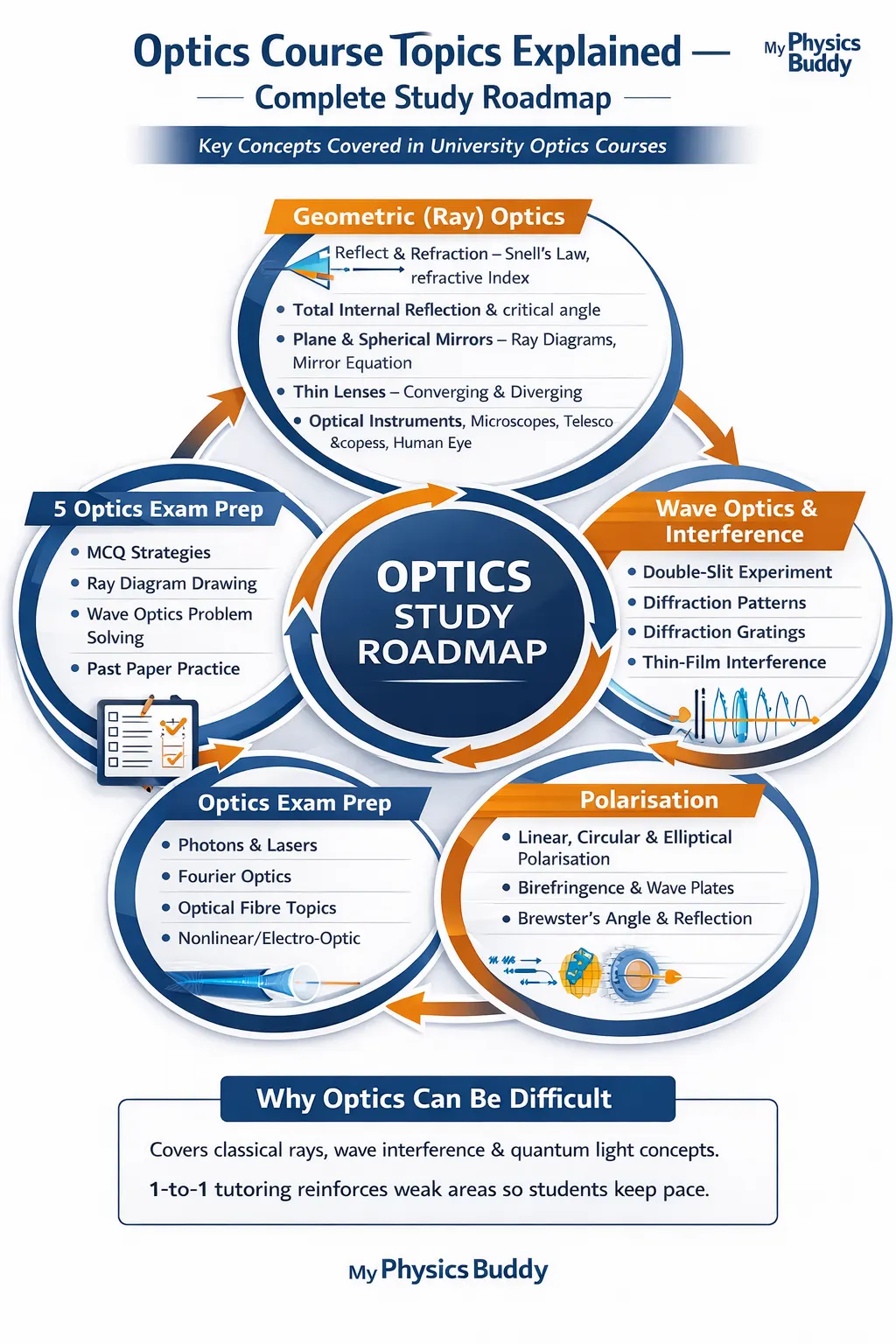
A visual overview of the major topics covered in university optics courses including ray optics, interference and diffraction, polarization, modern optics, and exam preparation strategies.
Track 1 — Geometric (Ray) Optics
- Reflection and refraction: Snell’s Law, index of refraction
- Total internal reflection and critical angle
- Plane mirrors and spherical mirrors: ray diagrams, mirror equation
- Thin lenses: converging and diverging, lens maker’s equation
- Optical instruments: microscopes, telescopes, cameras, the human eye
- Aberrations: spherical, chromatic, and astigmatism at an introductory level
- Dispersion and prisms
Track 2 — Wave Optics and Interference
- Huygens’ principle and wave fronts
- Young’s double-slit experiment: fringe spacing, path difference, coherence
- Single-slit diffraction: intensity pattern derivation and problem-solving
- Diffraction gratings: resolving power, grating equation
- Thin-film interference: Newton’s rings, anti-reflection coatings
- Michelson interferometer and applications
- Spatial and temporal coherence
Track 3 — Polarisation
- Linear, circular, and elliptical polarisation
- Malus’s Law and polariser problems
- Brewster’s angle and polarisation by reflection
- Birefringence and wave plates (quarter-wave and half-wave)
- Optical activity and applications
Track 4 — Modern and Advanced Optics
- Photons and the photoelectric effect in the context of light
- Laser fundamentals: stimulated emission, population inversion, cavity modes
- Gaussian beams and beam propagation
- Fourier optics: spatial frequency, the lens as a Fourier transform system
- Optical fibre: modes, numerical aperture, signal propagation
- Holography at a conceptual and mathematical level
- Nonlinear optics and electro-optic effects (graduate level)
Track 5 — Exam and Assignment Preparation
- Multiple-choice strategy for Optics questions in broad Physics exams
- Ray diagram drawing technique and common mistakes
- Structured problem-solving for wave optics calculations
- Lab report structure: experimental method, results analysis, error discussion
- Past paper and problem set practice with tutor feedback
- Closing specific topic gaps before midterms or finals
Optics courses cover an unusually wide conceptual range — from classical ray-tracing geometry all the way through to quantum descriptions of light. Students who fall behind on one foundational concept often find the next topic harder than it should be. Targeted 1:1 tutoring allows a student to revisit and solidify exactly the concept they missed, at the level they need, without waiting for the next lecture or office hour cycle. That responsiveness is what makes the 1:1 model particularly well-suited to Optics.
“Light is the oldest tool we have for exploring the universe — from Galileo’s telescope to the James Webb Space Telescope, from Newton’s prism to modern fibre-optic networks. Understanding how light works is not just academic; it is foundational to virtually every modern technology.”
— NASA, James Webb Space Telescope Mission Overview
How My Physics Buddy Tutors Help You with Optics (The Learning Loop)
Research from the Australian Curriculum, Assessment and Reporting Authority and education researchers broadly support the principle that structured, feedback-rich practice in quantitative subjects produces significantly better outcomes than passive study. MPB’s learning loop is built around this evidence.
Official Australian Government page explaining the Australian Curriculum and its learning framework for schools and students across Australia.
Diagnose: The tutor begins by identifying your exact course level, the topics you are currently working through, where your confidence drops, and what assessments are coming up. This takes 10–15 minutes and shapes the entire session plan.
Explain: Concepts are introduced or revisited using clear language, visual diagrams on a shared digital whiteboard, and physically grounded examples — not abstract derivations in isolation. If a concept is not landing, the approach shifts.
Practice: You attempt problems yourself while the tutor observes. This is deliberate — the tutor steps back while you work, intervening only at meaningful decision points, not at every step.
Feedback: Errors are unpacked, not just corrected. The tutor explains where the reasoning went wrong, what the correct physical intuition looks like, and why the method works — so the error does not persist.
Retest/Reinforce: A follow-up question — similar in structure but with different numbers or a slight variation — confirms whether understanding is solid or still surface-level.
Plan: Each session ends with a clear direction — specific problems to attempt independently, a concept to review, or a topic to flag for next time.
Accountability: For ongoing students, tutors track what has been covered, what is still weak, and adjust the plan as exam or assignment deadlines approach.
All sessions run on Google Meet. Tutors use digital pen-pads or iPads with Apple Pencil to draw ray diagrams, sketch wavefronts, and work through derivations in real time — making the session feel close to working at a whiteboard. Before your first session, it helps to share your course syllabus or textbook name, your upcoming exam or assignment dates, and the topics where you feel least confident. The first session begins with a short diagnostic, moves into live teaching on your most urgent topic, and ends with a clear plan for what to work on before you meet again.
Optics sits at the intersection of classical wave theory and modern Physics, which means weak foundations in either area compound quickly. Students who struggle often do so not because the mathematics is too hard, but because the physical picture behind the equations is never made clear. MPB tutors prioritise building that physical picture first — before the formulas — because students who understand what an equation is modelling almost always find the algebra easier to follow and remember.
Tutor Match Criteria (How We Pick Your Tutor)
Matching the right tutor matters more in a specialised subject like Optics than in many other areas. Here is what MPB considers when selecting your tutor.
Level and syllabus fit: Tutors are matched to your specific course level — introductory, intermediate, or graduate — and to your institution’s depth of coverage. A tutor supporting a graduate course in Fourier optics is not the same as one supporting a high school optics unit.
Topic strengths: Some tutors specialise in geometric optics and optical instruments; others are stronger in wave theory, polarisation, or photonic systems. Your weakest topic areas are matched to appropriate tutor expertise.
Tools and setup: All tutors use Google Meet with a digital pen-pad or iPad and Apple Pencil for live working. Optical ray diagrams and wavefront sketches require this — text-only explanations are not adequate for Optics.
Time zone and availability: MPB serves students in the US, UK, Canada, Australia, and the Gulf. Tutors are available across time zones, with flexible options for evenings and weekends suited to university and school schedules.
Learning style and pace: Whether you prefer a conceptual walk-through before equations, or you learn best by attempting problems and identifying gaps in real time, the tutor adapts.
Language and communication: Clear English instruction is the standard. Communication style — more visual, more structured, more conversational — is matched to your stated preference.
Goals: Whether you need to pass an upcoming exam, understand a specific concept for a lab report, or work through an advanced topic for a research course, tutor selection reflects your goal.
Urgency and timelines: If a deadline is close, session structure and tutor availability are adjusted accordingly.
“Students who receive timely, specific, and corrective feedback during problem-solving practice in STEM subjects show significantly greater conceptual gains than those relying on end-of-unit assessments alone. The quality and immediacy of feedback is the single largest instructional variable under teacher control.”
— John Hattie, Visible Learning Research, referenced by the Victorian Department of Education
ARC Education platform offering lesson plans, professional learning resources, and curriculum-aligned tools for Victorian teachers.
Study Plans (Pick One That Matches Your Goal)
MPB offers three broad plan types for Optics students: a short catch-up sprint of one to two weeks for students facing an imminent exam, quiz, or assignment deadline; a structured exam prep block of four to eight weeks for students working systematically through a full optics course or a major exam; and ongoing weekly support for students who want consistent help across a semester. After the diagnostic in the first session, the tutor builds the specific session plan — which topics to cover, in what order, and at what depth — based on your actual gaps and your timeline. No two students receive the same plan.
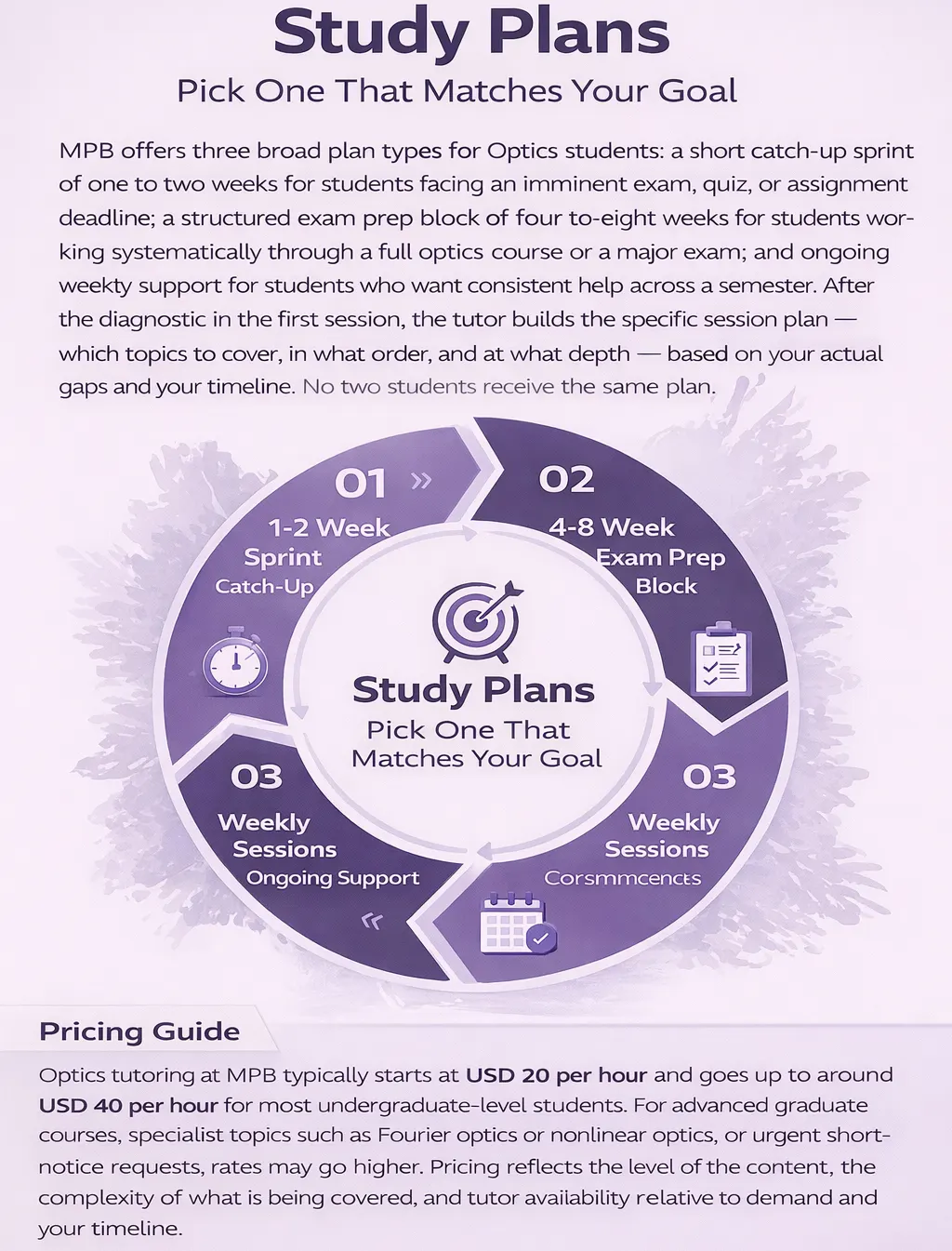
Flexible optics tutoring plans by My Physics Buddy including short catch-up sessions, structured exam preparation, and ongoing weekly support with pricing typically ranging from USD 20 to USD 40 per hour.
Pricing Guide
Optics tutoring at MPB typically starts at USD 20 per hour and goes up to around USD 40 per hour for most undergraduate-level students. For advanced graduate courses, specialist topics such as Fourier optics or nonlinear optics, or urgent short-notice requests, rates may go higher. Pricing reflects the level of the content, the complexity of what is being covered, and tutor availability relative to demand and your timeline.
For a personalised quote based on your course, goals, and schedule, WhatsApp for quick quote.
FAQ
Is Optics a hard subject?
Optics is considered moderately to highly challenging depending on the level. Geometric optics is approachable for most students with solid algebra skills. Wave optics introduces trigonometric and complex exponential mathematics that many students find demanding. Advanced topics like Fourier optics and coherence theory require comfort with higher-level mathematics and physical intuition built over time.
Optics is one of those subjects where the gap between a student who understands the physics and one who is only applying memorised formulas becomes obvious very quickly. Ray diagram problems, interference calculations, and polarisation questions all require the student to reason through what is physically happening — not just substitute into an equation. MPB tutoring focuses on building that reasoning ability, not just drilling formula application.
How many sessions are needed?
It depends on your current level, the depth of your course, and your upcoming deadlines. A student with one weak topic and an exam in two weeks might need two to four focused sessions. A student working through a full semester optics course typically benefits from weekly sessions across the term to keep pace with new material.
Can MPB help with Optics homework and assignments?
Yes — tutors provide guidance on problem sets, assignments, and structured coursework. The tutor explains the underlying concept, works through an example of the method, and supports you as you attempt the problem yourself. MPB does not solve or submit work on your behalf. All guidance is aimed at building your own ability to complete the work independently, in line with academic integrity policies at your institution.
Can MPB help with Optics lab reports?
Yes. Tutors can help you understand the experimental principles behind optics labs — such as diffraction grating measurements, Michelson interferometer setups, or polarisation experiments — and guide you on how to structure your results, analyse your data, and discuss sources of error. MPB does not write lab reports for students. The guidance focuses on understanding the physics and the scientific reporting process.
Will the tutor match my exact course syllabus?
Tutors work from your actual course outline, textbook, and lecture notes when you share them. Because Optics courses vary significantly between institutions and levels, sharing your syllabus and the textbook your course uses at the start of the first session helps ensure sessions are targeted to exactly what you are being assessed on.
What happens in the first session?
The first session includes a short diagnostic — the tutor asks about your course level, current topic, recent test results, and where your confidence is weakest. Live teaching begins in the same session. You will leave with at least one topic clarified and a clear plan for what to work on independently before the next session.
Is online Optics tutoring effective given all the diagrams involved?
Very much so. Tutors use digital pen-pads or iPads with Apple Pencil during live Google Meet sessions, which means ray diagrams, wavefront sketches, and phase diagrams can be drawn in real time and shared on screen. Many students find the visual clarity of a shared digital whiteboard actually better than a physical whiteboard because they can refer back to what was drawn throughout the session.
Can the tutor help with thesis or dissertation work involving Optics?
Yes, at a conceptual and structural level. MPB tutors can help graduate students understand advanced optics theory relevant to their research, work through mathematical derivations, and understand literature in the field. Guidance is provided on understanding and structuring ideas — MPB does not write thesis content for students.
What textbooks do MPB Optics tutors work with?
MPB tutors are familiar with widely used texts including Hecht’s Optics, Saleh and Teich’s Fundamentals of Photonics, Goodman’s Introduction to Fourier Optics, and Born and Wolf’s Principles of Optics, among others. Share your course textbook at the start and the tutor will align sessions to its notation and approach.
Does MPB offer support for Optics within broader Physics courses?
Yes. Many students studying AP Physics 2: Algebra Based or A/AS Level Physics (9702) encounter optics as part of a broader Physics curriculum. MPB tutors can focus specifically on the optics component of these courses while keeping the broader context in mind.
Trust & Quality at My Physics Buddy
MPB tutors are selected based on strong academic qualifications in Physics or closely related fields, demonstrated ability to explain optics concepts clearly at the relevant course level, and performance in a structured onboarding process that includes a teaching demonstration. Student feedback is reviewed after sessions and is used to maintain quality. According to research published in the Physical Review Physics Education Research journal, expert-guided deliberate practice with immediate corrective feedback consistently produces superior conceptual gains in Physics compared to self-study alone — and this is the model MPB tutoring follows.
APS Journals page featuring Physical Review Physics Education Research, a leading journal publishing research on physics teaching and learning.
On academic integrity: MPB’s role is to explain, guide, and support your learning — not to produce work on your behalf. Tutors help you understand how to approach a problem, work through the reasoning with you, and give feedback on your attempt. Any materials produced in a session are for your learning and reference only. Submitting work completed by a tutor or any external party as your own would violate your institution’s academic integrity policies. MPB does not support or facilitate this. We guide; you submit your own work.
“Academic integrity is not a bureaucratic requirement — it is the foundation of what a qualification actually means. A student who genuinely understands Optics because they worked through it with expert guidance is far better served than one who submitted work they did not understand.”
— Adapted from the International Center for Academic Integrity — Fundamental Values of Academic Integrity
My Physics Buddy is a Physics-focused online tutoring platform serving early college students, graduate students, advanced high school students, and their families across the US, UK, Canada, Australia, and the Gulf. Optics is one of several specialist areas within MPB’s Physics expertise. Students working across related subjects can also explore support on other MPB tutoring pages — including Waves and Optics, Photonics, and Laser Physics. Students interested in the quantum side of light and matter can find dedicated support on the Quantum Optics tutoring page.
Students exploring foundational topics that underpin Optics — such as Electromagnetism — will also find relevant tutoring pages on MPB. For students studying Physics at a broader level, the main Physics tutoring page provides an overview of all subjects MPB covers.
Content reviewed by an Optics tutor at My Physics Buddy.
Next Steps
Share your course level, the optics topics you are currently working through, your upcoming exam or assignment date, and where your confidence is lowest. MPB will match you with a tutor suited to your specific course and get your first session booked. Most students can start within a few days of reaching out.

