Hire Best MCAT Physics Tutors Online

Testimonials



MCAT Physics Tutor Online
My Physics Buddy (MPB) offers 1:1 online tutoring & homework help in Physics and related subjects — and MCAT Physics is one of our focused and high-stakes tutoring areas for pre-medical students across the US, Canada, and internationally. The Medical College Admission Test (MCAT) is both a rigorous academic subject review and a standardized examination administered by the Association of American Medical Colleges (AAMC). Physics and physical sciences content appears primarily in the Chemical and Physical Foundations of Biological Systems section of the exam and is one of the areas where many pre-med students have the weakest preparation, often having taken introductory physics years before test day. Whether you are a college junior beginning MCAT preparation, a gap-year applicant returning to physics content after time away, or a student retaking the MCAT and targeting a stronger score, MPB connects you with tutors who understand exactly what the MCAT tests in physics and how to build the reasoning skills the exam rewards. If you’ve been looking for an MCAT Physics tutor near me and want the focus and flexibility of personalized online preparation, you are in the right place. Our sessions are designed to rebuild conceptual clarity, sharpen physical reasoning, and develop the passage-based problem-solving skills the MCAT demands — with honest, structured guidance and no over-promises.
- 1:1 live sessions — fully personalized to your MCAT preparation timeline and physics background
- Expert tutors with strong knowledge of MCAT physics content, passage-based question formats, and AAMC content specifications
- Flexible time zones — sessions conveniently scheduled for students across the US, UK, Canada, Australia, and Gulf regions
- Structured learning plan built around your diagnostic performance, weakest content areas, and target test date
- Ethical guidance on practice and review — we explain, walk through, and reinforce; you develop and own the understanding
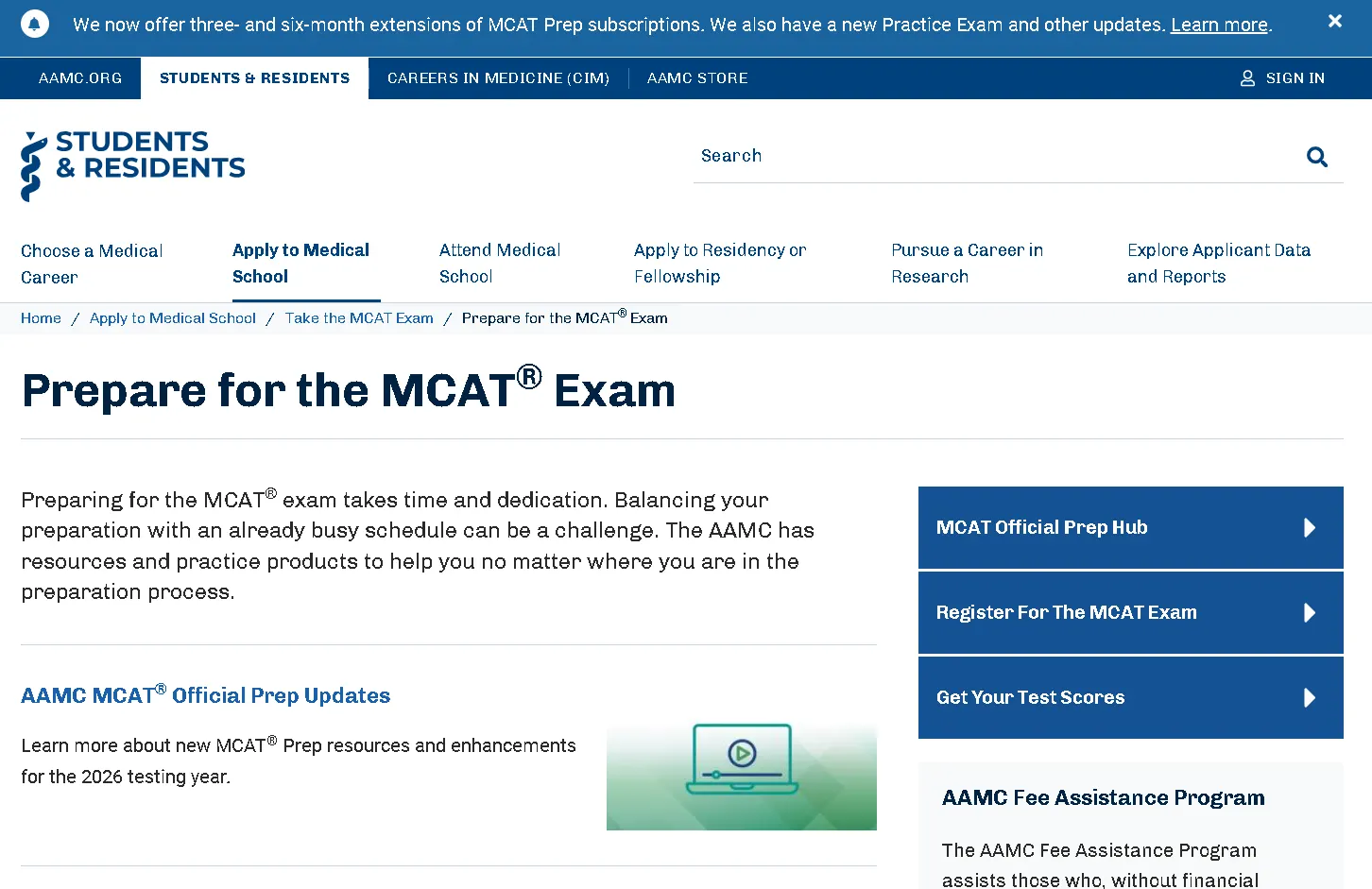
Prepare for the MCAT exam with official AAMC resources, including study plans, practice tests, and prep tools.
Who This MCAT Physics Tutoring Is For
MCAT Physics preparation is for pre-medical students who need expert, focused support on the physics and physical sciences content tested in the Chemical and Physical Foundations of Biological Systems section of the MCAT.
- College juniors and seniors in the US and Canada beginning MCAT preparation who need to review and consolidate introductory physics content
- Gap-year applicants who studied physics one or more years ago and need to rebuild confidence and accuracy across all tested content areas
- Students retaking the MCAT who want targeted support on the specific physics content areas where their previous score was weakest
- International pre-medical students in the UK, Australia, and Gulf applying to US or Canadian medical schools where a competitive MCAT score is required
- Students with strong biology backgrounds but weaker physics foundations who need structured expert guidance to bring their physical sciences performance up to the level the MCAT requires
- Post-baccalaureate pre-med students returning to science coursework and needing to rapidly consolidate physics content alongside other MCAT preparation
Outcomes: What You’ll Be Able To Do in MCAT Physics
Structured, consistent preparation with an MPB MCAT Physics tutor is designed to build the specific, observable skills the MCAT rewards in its physics and physical sciences content.
Solve MCAT-style physics problems across all tested content areas — fluids, circuits, optics, waves, thermodynamics, and kinematics — quickly and accurately, applying the estimation and approximation strategies that are essential under MCAT time pressure. Analyze passage-based physics scenarios — a format unique to the MCAT — extracting the relevant physical information from dense biological and experimental contexts and applying the correct physics principles to answer questions that are rarely straightforward. Apply conceptual physics reasoning to unfamiliar situations, which is exactly what the MCAT tests, since the exam rarely asks you to simply recall a formula but instead tests whether you understand what the formula means and when it applies. Explain physical phenomena in the biological contexts the MCAT favors — blood flow and fluid dynamics, sound and the ear, light and the eye, electricity and nerve conduction — so that physics concepts connect naturally to the medical applications tested in the exam. Identify the fastest, most reliable solution path for each MCAT physics question type — a distinct and trainable skill that directly impacts your score given the time constraints of the full MCAT examination.
What We Cover in MCAT Physics (Syllabus / Topics)
MCAT Physics content is defined by the AAMC MCAT 2015 Content Specifications and appears primarily in the Chemical and Physical Foundations of Biological Systems section (Section 1) of the exam. Physics content is tested both as standalone discrete questions and within passage-based question sets that integrate physics with chemistry, biochemistry, and biology. The coverage below reflects the core physics content areas as specified by the AAMC. Always verify current content specifications directly with the AAMC, as details may vary by test year.
Track 1: Kinematics and Mechanics
- Linear motion: displacement, velocity, acceleration, equations of motion
- Projectile motion and two-dimensional kinematics
- Newton’s laws of motion and free-body diagrams
- Work, energy, power, and conservation of mechanical energy
- Momentum, impulse, and conservation of momentum
- Torque, lever arms, and mechanical advantage — common in biological system contexts
- Circular motion and centripetal acceleration
- Problem types: multi-step calculations, passage-based force and energy scenarios, biological mechanics applications
Track 2: Fluids and Solids
- Density, specific gravity, and buoyancy — Archimedes’ principle
- Hydrostatic pressure and Pascal’s Law
- Fluid flow: continuity equation, Bernoulli’s equation
- Viscosity, laminar vs. turbulent flow, and Poiseuille’s Law
- Surface tension and adhesion/cohesion in biological contexts
- Elasticity, stress, strain, and Young’s modulus in biological materials
- Problem types: blood flow passage questions, buoyancy scenarios, Bernoulli application problems
Track 3: Thermodynamics and Heat
- Temperature, heat, and thermal equilibrium
- Specific heat capacity and calorimetry
- Laws of thermodynamics in biological and chemical contexts
- Heat transfer: conduction, convection, radiation
- Ideal Gas Law and kinetic theory of gases
- Entropy and spontaneity in thermodynamic processes
- Problem types: calorimetry calculations, gas law scenarios, thermodynamic reasoning in biological passages
Track 4: Electricity and Magnetism
- Electric charge, Coulomb’s Law, and electric fields
- Electric potential and potential energy
- Current, resistance, Ohm’s Law, and power in circuits
- Series and parallel circuits; Kirchhoff’s rules
- Capacitance and dielectrics
- Magnetic fields and forces on moving charges
- Electromagnetic induction concepts (high-level, as tested on MCAT)
- Problem types: circuit analysis, nerve conduction passage questions, capacitor scenarios
Track 5: Waves and Sound
- Wave properties: amplitude, wavelength, frequency, wave speed
- Transverse and longitudinal waves; sound as a longitudinal wave
- Intensity, loudness, and the decibel scale — tested in audiology contexts
- The Doppler Effect and its medical imaging applications
- Interference, superposition, and standing waves
- Ultrasound principles relevant to medical imaging passages
- Problem types: sound intensity calculations, Doppler shift scenarios, wave interference
Track 6: Light and Optics
- The electromagnetic spectrum and properties of light
- Reflection and refraction; Snell’s Law and total internal reflection
- Converging and diverging lenses; image formation; the thin lens equation
- Mirrors: plane, concave, and convex; ray diagrams
- The human eye, vision correction, and corrective lens power — frequently tested in MCAT passages
- Dispersion, polarization, and interference of light (conceptual level)
- Problem types: lens equation calculations, vision correction scenarios, eye passage questions
Track 7: Atomic and Nuclear Physics
- Atomic structure, energy levels, and emission/absorption spectra
- The photoelectric effect and photon energy
- Radioactive decay: alpha, beta, gamma; half-life calculations
- Nuclear reactions and mass-energy equivalence (high level)
- Radiation in medical imaging contexts: X-rays, PET scans, MRI (conceptual physics)
- Problem types: half-life calculations, photon energy, radiation passage questions
Students who want deeper subject-level support in specific MCAT physics content areas can explore MPB’s dedicated pages for Waves and Optics, Electrostatics, and Thermodynamics.
How My Physics Buddy Tutors Help You with MCAT Physics (The Learning Loop)
Diagnose: Every engagement starts with a structured diagnostic. The tutor reviews your undergraduate physics background, how recently you covered each content area, your diagnostic MCAT practice test performance across the physical sciences section, and which specific content areas feel weakest. A short diagnostic problem set across key MCAT physics topics is often used in the first session to map your actual starting performance rather than relying on self-assessment alone.
Explain: The tutor rebuilds and sharpens each content area using clear, MCAT-appropriate explanations that connect physical concepts directly to the biological and medical contexts the exam favors. For MCAT Physics, the goal is not mathematical derivation — it is fast, accurate, conceptual reasoning applied to passage-based scenarios under time pressure.
Practice: You work through official AAMC practice materials and high-quality supplemental MCAT physics questions across all tested content areas, with increasing emphasis on passage-based formats and timed conditions as your test date approaches. Question selection mirrors the style and reasoning demands of the actual MCAT Chemical and Physical Foundations section.
Feedback: After each practice block, your tutor reviews your reasoning process in detail — where you identified the wrong physical principle, where you applied the right principle incorrectly, where you lost time on a question that should have been fast, and which content areas are costing you the most points. Feedback is specific and anchored to AAMC content specifications.
Retest/Reinforce: Content areas where errors cluster are revisited with fresh passage-based and discrete question types. Reinforcement is spaced deliberatly so that recall and application under timed MCAT conditions improves consistently — not just in the session where a topic was last reviewed.
Plan: Your tutor maintains a content-area roadmap anchored to your test date and diagnostic performance. The plan shifts emphasis continuously toward the highest-yield areas and the content categories where your per-question accuracy is lowest as the MCAT approaches.
Accountability: For MCAT preparation, structured self-study between sessions is essential. Tutors assign specific timed practice sets, content review tasks, and AAMC material sections, and track performance data across sessions to build cumulative preparation momentum.
All sessions run on Google Meet, with a digital pen-pad or iPad + Pencil for live problem walkthroughs, diagram annotation, passage analysis, and conceptual reasoning practice. Tutors calibrate explanation depth to MCAT requirements — sessions focus on reasoning speed and conceptual clarity, not on the mathematical depth of a university physics course.
First session flow: Your first session starts with a diagnostic discussion covering your undergraduate physics coursework, time since last studying physics, any previous MCAT attempt and section score, and your target test date. The tutor then works through a short diagnostic problem set across 3–4 key MCAT physics content areas and delivers immediate feedback. The session closes with a clear, prioritized preparation roadmap. Before the session, it helps to share any previous MCAT practice test scores, your undergraduate physics course history, and your target test date and medical school application timeline.
Tutor Match Criteria (How We Pick Your Tutor)
MPB selects your MCAT Physics tutor based on several overlapping criteria — MCAT-specific knowledge is just as important as subject depth.
Exam content and format fit: Your tutor will have direct familiarity with the AAMC MCAT content specifications, the Chemical and Physical Foundations section format, the passage-based question structure, and the specific reasoning style the MCAT rewards — which is distinct from standard university physics problem-solving.
Topic strengths and tools: For MCAT Physics, we look for tutors who are confident across all tested content categories and who understand how physics concepts are embedded in biological and medical contexts in MCAT passages. Tools used include Google Meet and digital pen-pad or iPad + Pencil for live problem walkthroughs and passage analysis.
Time zone and availability: Tutors are matched for availability across US (ET, CT, PT), UK (GMT/BST), Canada, Australia (AEST/AEDT), and Gulf (GST/AST) time zones. Flexible scheduling is important for pre-med students managing coursework, clinical hours, and MCAT preparation simultaneously.
Learning style and pace: Some students need a content-rebuilding approach first; others have the content but need to develop passage-based reasoning and time management skills. Your tutor adapts to the approach that maximizes your MCAT physical sciences section performance given your specific background and timeline.
Language and communication preferences: All MPB tutors communicate in clear English, calibrating explanation depth to the MCAT’s conceptual rather than derivation-heavy approach to physics.
Goals: Whether you are targeting a specific total MCAT score, trying to bring a weak Chemical and Physical Foundations section score up, or doing a focused physics content review as part of a broader MCAT preparation plan, the tutor’s session structure is calibrated to that goal from the first session.
Urgency and timelines: Students with a test date weeks away get an intensive, highest-yield-first content triage. Students preparing several months out get a more thorough, content-area-by-area rebuild. Both are planned explicitly after the diagnostic session.
Study Plans (Pick One That Matches Your Goal)
MPB offers three broad plan types for MCAT Physics: an intensive catch-up plan (typically 1–2 weeks) for students with an imminent test date who need rapid consolidation across the highest-yield MCAT physics content areas, a full content prep plan (typically 4–8 weeks) that works systematically through all AAMC-specified physics content categories with passage-based practice and timed question sets, and ongoing weekly support for students preparing over a longer timeline who want consistent expert guidance alongside their full MCAT preparation schedule. The specific session plan — content area sequence, practice question focus, and passage-based reasoning development — is built by your tutor after the diagnostic session, ensuring it reflects your actual undergraduate physics background, current gaps, and test date.
Pricing Guide
MCAT Physics tutoring at MPB starts at USD 20 per hour and typically ranges up to USD 40 per hour for standard content preparation and weekly support sessions. Pricing varies based on the tutor’s experience, the depth of content review required, and the timeline. Short-timeline, intensive sessions or requests for comprehensive MCAT physical sciences preparation across an extended programme may be priced toward the higher end. Supply and demand also plays a role — tutor availability and session frequency can affect the final rate.
For a specific quote based on your preparation timeline and goals, WhatsApp for quick quote.
FAQ
How much physics is on the MCAT?
Physics content on the MCAT appears primarily in the Chemical and Physical Foundations of Biological Systems section (Section 1). According to AAMC content specifications, approximately 25% of this section is introductory physics, with additional physics concepts embedded in chemistry and biology passages throughout the exam. It is a signifcant portion of one of the four scored sections and cannot be safely deprioritized.
Is MCAT Physics hard?
MCAT Physics is challenging primarily because it is tested in unfamiliar, passage-based biological contexts — not as straightforward calculation problems. Many pre-med students studied introductory physics years before the MCAT and find content recall unreliable under exam conditions. The reasoning demands of MCAT passages, combined with time pressure across 59 questions in 95 minutes, make structured preparation essential for strong performance.
How many sessions are needed for MCAT Physics?
It depends on your undergraduate physics background, how recently you studied the content, and your overall MCAT preparation timeline. Students doing a focused 4–8 week physics content review typically benefit from 2–3 sessions per week. Students integrating physics tutoring into a longer MCAT preparation schedule often do 1–2 sessions per week alongside their broader study plan. Your tutor will give a specific estimate after the first diagnostic session.
Can you help with MCAT practice questions and passage review?
Yes — MPB provides guided practice question review and passage analysis throughout your preparation. Tutors work through official AAMC practice materials and supplemental MCAT physics questions with you, explaining the reasoning behind correct answers, identifying faster solution paths, and reviewing errors in detail. Our services aim to provide personalized academic guidance to help you understand concepts and improve skills. All practice work is your own.
Does MCAT Physics require calculus?
No — MCAT Physics is algebra-based and does not require calculus. The exam tests conceptual understanding and the ability to apply introductory physics principles to biological and medical contexts, not mathematical derivation. Students who studied calculus-based university physics will still find the content familiar, but no calculus is required or tested on the MCAT itself.
What happens in the first session?
The first session begins with a diagnostic discussion — your undergraduate physics courses, how recently you studied each content area, any previous MCAT practice test scores, and your target test date and medical school application timeline. The tutor then works through a short diagnostic problem set and delivers immediate feedback. The session closes with a prioritized preparation roadmap. Bring any previous MCAT practice test score reports and your test date details.
Is online tutoring effective for MCAT Physics preparation?
Yes — for MCAT preparation specifically, online 1:1 sessions are very well suited. The format allows the tutor to work through passage-based questions in real time, annotate diagrams and figures from MCAT passages on a shared digital whiteboard, and move efficiently across content areas within a session. Pre-med students across the US in particular find online scheduling significantly more flexible given the demands of coursework, shadowing, research, and MCAT preparation running concurrently.
What MCAT score does medical school require?
MCAT score requirements vary by medical school and program. Most allopathic MD programs in the US and Canada consider competitive scores in the context of a holistic application. The AAMC publishes annual data on MCAT scores of applicants and matriculants to US MD programs, which provides useful context for score benchmarking. Always verify requirements directly with the specific programs you are applying to.
Can MPB help with the other science sections of the MCAT too?
MPB’s core expertise is Physics and closely related quantitative subjects. For the MCAT’s physical sciences content — the physics, physical chemistry, and quantitative reasoning components of the Chemical and Physical Foundations section — MPB is well placed to provide focused expert support. Students who also need broader physics subject support can explore our pages for Medical Physics and Biophysics for physics content that directly bridges into medical and biological applications.
How is MCAT Physics different from university introductory physics?
University introductory physics courses typically emphasize mathematical problem-solving, derivations, and calculation accuracy. MCAT Physics tests conceptual understanding, physical reasoning, and the ability to apply principles quickly in passage-based biological contexts. Many questions on the MCAT can be solved faster by physical intuition and estimation than by full calculation. The shift in approach from university problem-solving to MCAT reasoning is itself a key part of what MPB tutors help students make effectively.
Academic Integrity Note: Our services aim to provide personalized academic guidance, helping students understand concepts and improve skills. Materials provided are for reference and learning purposes only. Misusing them for academic dishonesty or violations of academic integrity policies is strongly discouraged.
Trust & Quality at My Physics Buddy
Tutor selection: Every MPB tutor goes through a subject knowledge screening, a live demo session evaluation, and an ongoing student feedback review process. For MCAT Physics, we specifically look for tutors who understand the AAMC content specifications, the passage-based question format, and the specific reasoning style the MCAT rewards — not just tutors with strong university physics backgrounds. The ability to explain physics concepts in biological contexts, identify the fastest MCAT solution path, and build passage-reading strategies alongside content knowledge are all evaluated in the tutor screening process.
Academic integrity: MPB’s role is to guide and explain — not to complete work for students. In all practice review, passage analysis, and preparation sessions, tutors explain concepts, work through analogous examples, and provide feedback on the student’s own reasoning. All preparation work is the student’s own. This approach builds the genuine, fast-recall reasoning that the MCAT actually tests and that no amount of shortcutting can replicate.
About My Physics Buddy: MPB is a Physics-focused online tutoring platform serving undergraduate students, pre-medical students, graduate students, and their families across the US, UK, Canada, Australia, and Gulf regions. Our core is Physics and closely related quantitative subjects. Students preparing for MCAT Physics can also explore subject-specific depth through MPB’s dedicated pages for Optics, Nuclear Physics, Fluid Mechanics & Dynamics, and Medical Physics. Students who want to explore the physics of biological systems more broadly can also visit our pages for Biophysics and Kinematics.
“The MCAT is designed to assess the competencies medical schools have identified as prerequisites for success in medical education and beyond. Physical sciences reasoning — including physics — is central to a physician’s ability to understand diagnostic technologies, drug delivery, and physiological systems.”
Association of American Medical Colleges (AAMC) — official MCAT overview
“Physics is not peripheral to medicine — it is foundational to it. Every imaging modality, every monitoring device, every drug delivery mechanism is built on physical principles. Pre-medical students who understand physics deeply become better doctors.”
As broadly affirmed in medical education literature — see the National Institutes of Health (NIH) — PubMed Central: Physics in Medical Education research
A surreal distorted reflection blending a human face with natural and urban elements, symbolizing perception and visual distortion.
Explore Related Physics Subjects at MPB: MCAT Physics draws on several core physics disciplines that MPB supports at the subject level. Our dedicated pages for Electrostatics, Waves and Optics, Thermodynamics, Fluid Mechanics & Dynamics, and Atomic Physics are all relevant for students who want deeper focused support on specific MCAT physics content categories alongside their broader preparation.
Content reviewed by an MCAT Physics tutor at My Physics Buddy.
Next Steps
Getting started is straightforward. Share your undergraduate physics background, the MCAT content areas where you feel least confident, any previous MCAT practice test scores, and your target test date and medical school application timeline. Let us know your preferred session times and time zone. MPB will match you with a tutor whose MCAT physics content knowledge, passage-based reasoning expertise, and availability fit your preparation needs. Your first session is a diagnostic and live teaching session — so you leave with both a mapped starting point and a concrete, prioritized preparation plan for the weeks ahead.

