Hire Best Plasma Physics Tutors Online

Testimonials



Plasma Physics Tutor Online
My Physics Buddy (MPB) offers 1:1 online tutoring & homework help in Physics and related subjects. Plasma Physics is a graduate and advanced undergraduate subject that sits at the intersection of electromagnetism, fluid mechanics, statistical mechanics, and quantum theory — and it is notoriously demanding to self-study. MPB connects you with a specialist tutor for live, personalised sessions built around your university course, your current syllabus, and your research or exam goals. Whether you are an advanced undergraduate, a graduate student, a PhD candidate, or a faculty member looking for targeted support on a specific topic, MPB is built for this level. If you have searched for a Plasma Physics tutor near me and found very little, that is because this subject is rare in general tutoring — MPB specialises in exactly this kind of advanced, niche Physics support. Sessions are designed to help you aim for deeper conceptual mastery and stronger problem-solving performance in one of the most mathematically rich areas of modern physics.
- 1:1 live sessions — specialist tutors in Plasma Physics, not generalists
- Covers undergraduate, graduate, and PhD-level plasma physics content
- Tutors matched by topic depth, mathematical level, and your research or course context
- Flexible scheduling across US, UK, Canada, Australia, and Gulf time zones
- Structured learning plan built after a diagnostic session
- Ethical homework and assignment guidance — we explain concepts, you submit your own work
Who This Plasma Physics Tutoring Is For
Plasma Physics is a highly specialised subject taken by a specific group of advanced learners. MPB’s program is built to serve all of them.
- Advanced undergraduate students in Physics, Engineering Physics, or Applied Physics courses that include a plasma physics module or elective
- Graduate (Masters) students taking dedicated plasma physics courses as part of a physics, astrophysics, nuclear engineering, or fusion energy program
- PhD students who need to solidify theoretical foundations in plasma physics alongside their research — particularly those in fusion, space physics, or high-energy-density physics
- Early-career researchers or postdocs working in plasma-adjacent areas who need to fill specific conceptual gaps quickly
- Students in the US, UK, Canada, Australia, and Gulf region enrolled in university programs at institutions with plasma physics offerings
- Students needing guided help with homework problems, problem sets, lab report structure, or understanding derivations from core texts such as Bellan, Chen, or Goldston & Rutherford
Outcomes: What You’ll Be Able To Do in Plasma Physics
Plasma Physics demands fluency in multiple areas of physics simultaneously. Strong tutoring builds the ability to move between them fluidly. These are the kinds of capabilities well-targeted preparation develops — they are observable outcomes, not guarantees.
Derive and interpret the Vlasov equation and its moments, connecting the kinetic description of a plasma to the fluid (MHD) framework with a clear understanding of what approximations are being made at each step. Solve single-particle motion problems in combined electric and magnetic fields — including ExB drift, gradient drift, curvature drift, and magnetic mirroring — with physical intuition for what drives each motion. Analyse plasma waves across the full dispersion relation landscape: electrostatic and electromagnetic, parallel and perpendicular propagation, ion and electron branches, and their applications in diagnostics and heating. Apply magnetohydrodynamic (MHD) theory to model plasma equilibrium and stability, including the derivation and physical interpretation of MHD stability criteria. Explain and quantify plasma instabilities — including Rayleigh-Taylor, Kelvin-Helmholtz, and drift wave instabilities — and connect their growth rates to physical parameters. Write and present graduate-level problem set solutions and derivations with the mathematical rigour and physical commentary that university courses and research groups expect.
What We Cover in Plasma Physics (Syllabus / Topics)
Plasma Physics courses vary considerably by institution, level, and application focus — from astrophysical and space plasmas to fusion energy and laboratory plasmas. MPB tutors are familiar with the range of syllabi used at universities in the US, UK, Canada, and Australia, including content aligned with standard texts such as Bellan’s Introduction to Plasma Physics and Chen’s Introduction to Plasma Physics and Controlled Fusion. Topic coverage is adapted to your specific university course and syllabus.
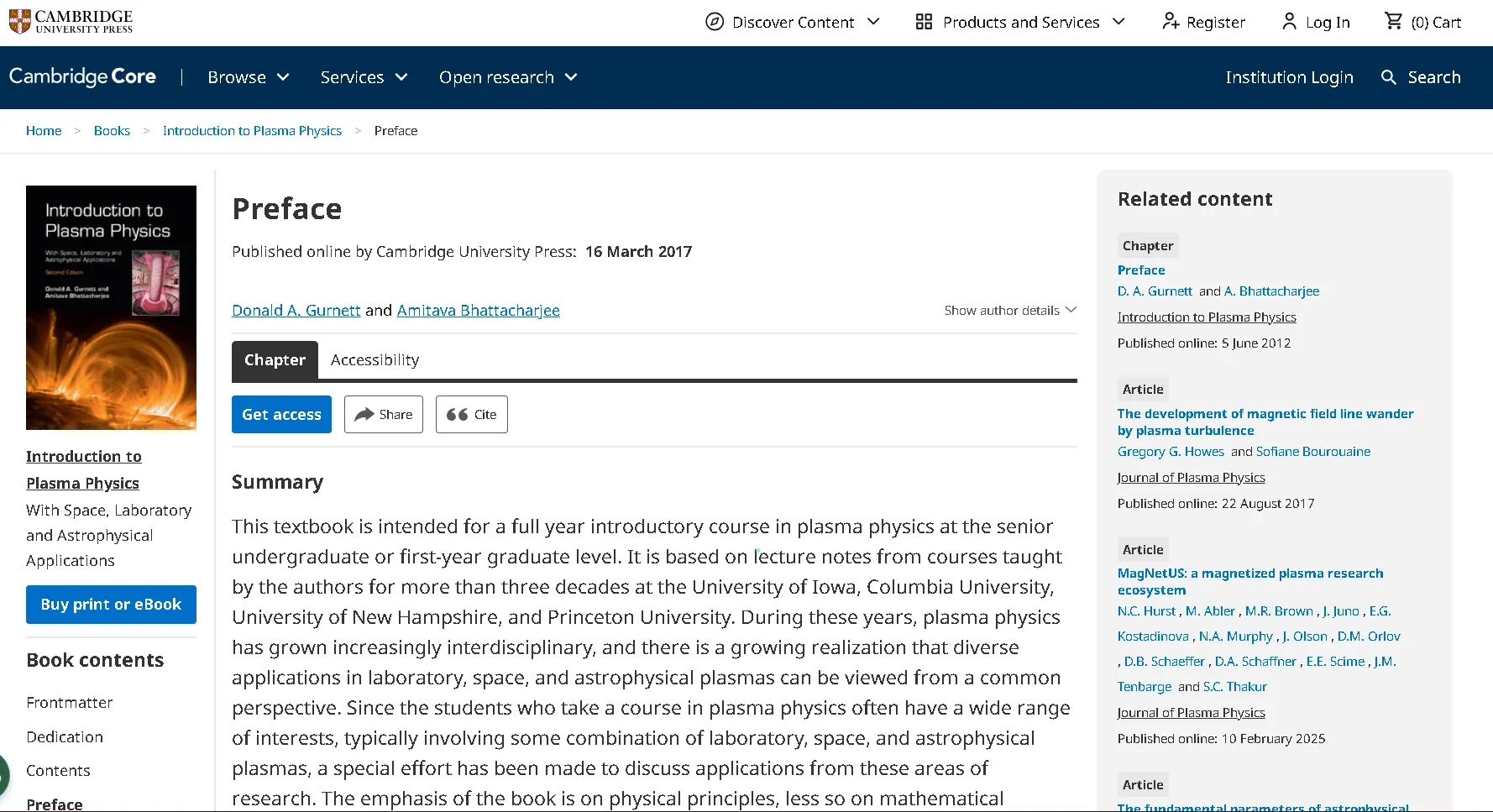
Explore the preface of Introduction to Plasma Physics, outlining course structure, key topics, and applications in space and laboratory physics.
Plasma Fundamentals
- Definition and criteria for a plasma: Debye shielding, Debye length, quasi-neutrality
- Plasma frequency and the distinction between plasma and neutral gas behaviour
- Collisionality: mean free path, collision frequencies, Coulomb logarithm
- Plasma parameters: density, temperature (in eV), beta, magnetic field strength
- Natural and laboratory plasma environments: solar wind, ionosphere, fusion reactors, industrial plasmas
Single-Particle Motion
- Charged particle motion in uniform electric and magnetic fields: gyration, Larmor radius, cyclotron frequency
- Particle drifts: ExB drift, gradient drift, curvature drift, polarisation drift
- Magnetic mirrors: mirror ratio, loss cone, adiabatic invariants
- Guiding centre approximation and its range of validity
- Motion in time-varying and spatially varying fields
Kinetic Theory of Plasmas
- Distribution functions: Maxwellian, bi-Maxwellian, non-equilibrium distributions
- The Boltzmann equation and its collisionless limit: the Vlasov equation
- Moments of the distribution function: continuity, momentum, and energy equations
- Landau damping: physical mechanism, mathematical derivation, and implications
- Plasma echoes and non-linear kinetic effects at an introductory level
Fluid Description and MHD
- Two-fluid model: separate electron and ion fluid equations, closure approximations
- Single-fluid MHD: derivation, ideal MHD equations, frozen-in flux theorem
- MHD equilibrium: pressure balance, force-free fields, Grad-Shafranov equation
- MHD waves: Alfvén waves, magnetosonic waves — dispersion relations and physical interpretation
- Magnetic reconnection: basics, Sweet-Parker model, physical consequences
- Resistive MHD and the role of finite resistivity: diffusion timescale, Lundquist number
Plasma Waves and Instabilities
- Electrostatic waves: plasma oscillations, Langmuir waves, ion acoustic waves
- Electromagnetic waves in plasmas: O-mode, X-mode, R-wave, L-wave — cutoffs and resonances
- Lower hybrid, upper hybrid, and whistler waves
- Plasma instabilities: classification (absolute vs convective, micro vs macro)
- Fluid instabilities: Rayleigh-Taylor, Kelvin-Helmholtz
- Kinetic instabilities: beam-plasma instability, bump-on-tail, drift wave instabilities
- Quasilinear theory and saturation of instabilities
Plasma Heating and Confinement
- Ohmic heating, neutral beam injection, RF heating methods (ICRF, ECRH, LH)
- Magnetic confinement: tokamaks, stellarators, magnetic mirrors — basic operating principles
- Inertial confinement: basic principles, ignition conditions
- Lawson criterion: derivation and physical interpretation
- Plasma diagnostics: Langmuir probes, Thomson scattering, spectroscopy basics
Applied and Astrophysical Plasmas
- Solar wind: structure, Parker spiral, interaction with planetary magnetospheres
- Ionospheric plasma: structure, waves, and coupling to the magnetosphere
- Astrophysical jets and accretion disks: basic MHD models
- Industrial plasma applications: plasma etching, plasma-assisted deposition, arc discharges
Students working on adjacent topics can also explore related MPB pages including Electrodynamics, Statistical Mechanics, and Fluid Mechanics & Dynamics — all of which underpin plasma physics at the graduate level.
How My Physics Buddy Tutors Help You with Plasma Physics (The Learning Loop)
Diagnose: Every engagement begins with a diagnostic. The tutor identifies where your mathematical fluency breaks down, which physical concepts are unclear, and which areas of your specific university course are causing the most difficulty. Plasma Physics spans a wide landscape — the diagnostic ensures sessions address your actual gaps, not a generic syllabus.
Explain: Plasma Physics is full of moments where the formalism runs ahead of the intuition. Your tutor works to close that gap — explaining what Landau damping is physically doing before writing down the Laplace transform, or why the frozen-in flux theorem is a consequence of ideal MHD before deriving it. The explanation adapts until the concept is genuinely clear, not just symbolically familiar.
Practice: You work through graduate-level problem set questions live during sessions — deriving dispersion relations, solving single-particle motion problems, applying MHD stability criteria, and interpreting plasma diagnostics. The tutor watches your approach at every step, not just your final expression.
Feedback: After each derivation or problem, you receive specific, actionable feedback. “Your Vlasov equation setup was correct but you did not close the contour correctly in the complex plane for the Landau damping integral” or “your MHD equilibrium equation is right but you have not applied the boundary condition at the plasma edge” — targeted, mathematically specific, and tied to what your course actually requires.
Retest / Reinforce: Key concepts return in new problem contexts across sessions. Single-particle drifts, for example, reappear in MHD derivations and in wave propagation analysis — each encounter reinforces the underlying physics from a different mathematical angle.
Plan: The tutor updates the session plan based on your course progression, upcoming problem sets or exams, and your growing fluency across topics. You always know what the next session targets and why.
Accountability: For students on weekly plans — particularly PhD students managing coursework alongside research — tutors help maintain a steady rhythm of conceptual review alongside problem-set work.
Sessions run live on Google Meet with a digital pen-pad or iPad + Apple Pencil — essential for a subject where derivations regularly span multiple lines and diagram annotation (sketching dispersion diagrams, field geometries, and particle orbits) is central to understanding. Before your first session, share your university course name and level, your current syllabus chapter or topic, any problem sets you are working on, your target text, and any upcoming deadlines. The first session typically includes a short diagnostic on two or three topic areas, a live working-through of your most pressing problem or concept, and a clear plan for the next two to four sessions.
Plasma Physics is the physics of the fourth state of matter — and it is the physics of over 99% of the visible universe. From stellar interiors and solar wind to fusion reactors and semiconductor manufacturing, plasma physics underpins some of the most consequential scientific and engineering challenges of our time. According to the U.S. Department of Energy Office of Fusion Energy Sciences, fusion energy research — which is fundamentally plasma physics at scale — is one of the highest-priority long-term energy research programs globally. Students who develop genuine fluency in this subject position themselves at the frontier of both basic physics and applied energy research.
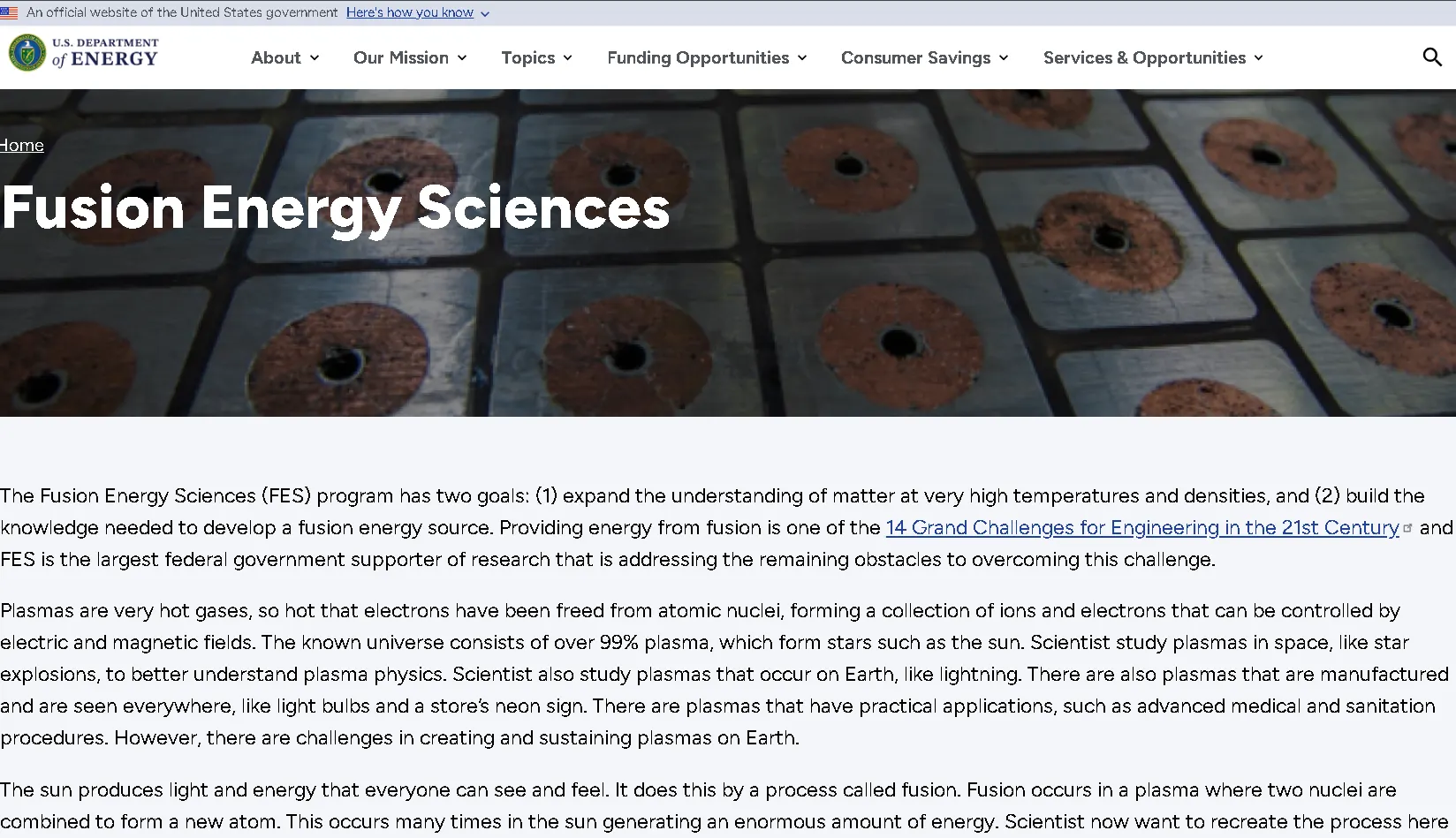
Learn how the DOE’s Fusion Energy Sciences program advances plasma physics and develops fusion as a clean, sustainable energy source.
Tutor Match Criteria (How We Pick Your Tutor)
MPB matches you to a tutor based on several specific factors. Here is what goes into the decision for Plasma Physics:
Level and course fit: Your tutor will have direct experience with plasma physics at your specific academic level — undergraduate module, graduate course, or PhD-level study. They will be familiar with the mathematical rigour expected at each stage and the standard texts used at your institution.
Topic strengths: If your difficulty is in kinetic theory and the Vlasov equation, MHD stability, wave propagation, or a specific application area like fusion or astrophysical plasmas, we match you with a tutor whose demonstrated expertise covers that domain at the appropriate depth.
Tools and setup: All MPB tutors use Google Meet for live sessions and a digital pen-pad or iPad + Apple Pencil for real-time derivation work — essential for a subject where complex multi-line calculations and field geometry sketches are part of every session.
Time zone and availability: Tutors are available across US, UK, Canada, Australia, and Gulf time zones, fitting around your university schedule, research lab hours, and problem-set deadlines.
Learning style and pace: Some students need systematic first-principles rebuilding of the theoretical framework. Others want focused, fast-paced work through specific problem types ahead of an exam or assignment deadline. Your tutor adjusts the mode accordingly.
Language and communication preferences: Clear, technically precise English-language instruction is the default, with communication style adapted to your academic background and comfort level.
Goals: A PhD student needing to pass a qualifying exam in plasma physics has different session needs than an undergraduate working through a single module or a postdoc filling a specific knowledge gap. We align on your goal before sessions begin.
Urgency and timeline: A student with a problem set due in three days gets a different plan than one building foundations over a semester. Tutor selection accounts for your timeline and the nature of your immediate deliverables.
Study Plans (Pick One That Matches Your Goal)
MPB offers three broad plan types for Plasma Physics: a short catch-up plan (typically one to two weeks) for students who need to close specific topic gaps quickly before an exam or assignment deadline, a course support plan (typically four to eight weeks) for structured assistance across a semester-long plasma physics course, and an ongoing weekly support plan for PhD students or researchers who want consistent expert guidance across a longer period. The tutor builds the specific session-by-session plan after the diagnostic — no fixed schedule is set until your starting point, course level, and immediate goals are clearly understood.
Pricing Guide
Plasma Physics tutoring at MPB starts at USD 20 per hour. Given the advanced and highly specialised nature of this subject, most graduate and PhD-level sessions fall in the USD 50–USD 80 per hour range. For very advanced topics — kinetic theory, non-linear plasma physics, fusion reactor physics — or highly compressed timelines, rates may go up to USD 100 per hour.
Pricing depends on the tutor’s specialisation and academic level, the depth and complexity of the topics covered, your timeline and session frequency, and whether sessions are focused on course content, research-level concepts, or exam preparation. All rates are discussed transparently before you commit to any plan.
Graduate-level Plasma Physics is a subject where even small conceptual gaps — a shaky understanding of the guiding centre approximation, or uncertainty about when the MHD description breaks down — compound quickly as the course progresses. Students who address these gaps early, with expert one-on-one guidance, consistently find subsequent topics more tractable than those who let ambiguities accumulate. In a subject this technically dense, timely clarification is one of the highest-return investments a student can make in their own performance.
FAQ
Is Plasma Physics hard?
Plasma Physics is widely regarded as one of the more mathematically and conceptually demanding areas of graduate physics. It requires simultaneous fluency in electromagnetism, classical mechanics, fluid dynamics, and statistical mechanics. Most students find it manageable with methodical study and expert guidance — the challenge is the breadth of prerequisite knowledge required, not any single impenetrable concept.
How many sessions are needed?
This depends heavily on your level, your specific weak areas, and your timeline. A student needing help with a single topic — Landau damping, say, or MHD equilibrium — may need two to five sessions. A graduate student seeking support across a full semester course typically benefits from regular weekly sessions throughout the term. Your tutor will give a specific estimate after the diagnostic.
Can you help with Plasma Physics homework and problem sets?
Yes — as guided support, not submission. Your tutor will work through the physics and mathematics of your problem set questions with you, explain the approach, and help you understand where your derivation went wrong. MPB does not complete or submit assignments for students. All guidance is for learning and reference purposes only. Academic integrity applies at every level, including graduate coursework, and students are expected to submit their own work at all times.
Can you help with lab report and research paper writing in Plasma Physics?
Yes, as structural and conceptual guidance. Your tutor can help you understand how to present experimental data from plasma diagnostics, structure a scientific argument in a lab report, or outline a research paper clearly. MPB does not write reports or papers for students. Guidance is focused on helping you communicate your own analysis and findings more effectively.
Does the tutoring match my university’s specific Plasma Physics syllabus?
MPB tutors are familiar with plasma physics curricula from a range of universities in the US, UK, Canada, and Australia, and with the standard graduate texts in the field. Since syllabi vary significantly by institution and instructor, share your course outline, current chapter, and any assigned texts before your first session. The tutor will align sessions to your specific course rather than a generic plasma physics sequence.
What happens in the first session?
The first session includes a short diagnostic on two or three topic areas from your course, a live working-through of your most pressing concept or problem, and a clear plan for the next two to four sessions. Come prepared with your course syllabus or current chapter, any problem sets in progress, your assigned text, and any upcoming exam or submission dates. Sessions run on Google Meet with digital pen-pad support.
Is online tutoring effective for graduate-level Plasma Physics?
Yes. For a derivation-heavy subject like Plasma Physics, live online sessions with digital pen-pad tools are highly effective. Your tutor can work through multi-line derivations, sketch dispersion diagrams, draw field geometries, and annotate equations in real time while you follow and interact. The format is close to a one-on-one whiteboard session with a research supervisor, without the scheduling constraints of in-person availability.
What are the key prerequisites for Plasma Physics?
A strong foundation in classical electrodynamics (at the level of Griffiths or Jackson), classical mechanics, and statistical mechanics is essential. Familiarity with partial differential equations and complex analysis is also important, particularly for wave theory and kinetic topics. If your prerequisites are incomplete, your tutor can identify and address specific gaps alongside the plasma physics content. Students who want to strengthen their electrodynamics foundation first can explore Electrodynamics tutoring on MPB.
Can MPB help with PhD qualifying exams that include Plasma Physics?
Yes. PhD qualifying exams in Physics programs that include plasma physics typically test a range of topics — single-particle motion, MHD, waves, and kinetic theory — at a depth that requires both derivation fluency and physical intuition. MPB tutors are experienced in helping PhD students prepare for qualifying exams through targeted problem-solving and conceptual review sessions. Share your qualifying exam syllabus and past papers (where available) and the tutor will build a preparation plan around them.
Can MPB help with thesis or dissertation work in Plasma Physics?
At a guidance level, yes. MPB tutors can help PhD students understand theoretical frameworks relevant to their research, work through derivations that arise in their thesis work, and clarify conceptual questions in their specific area of plasma physics. MPB does not write or contribute original research content to theses or dissertations. All support is framed as conceptual guidance and explanation to help the student develop their own understanding and analysis.
What related physics subjects does MPB cover that connect to Plasma Physics?
Plasma Physics draws on several adjacent disciplines, all of which MPB supports. Students who need to strengthen foundations in Statistical Mechanics, Fluid Mechanics & Dynamics, Nuclear Physics, or Computational Physics (for numerical plasma simulation) can find specialist tutoring in all of these areas on MPB. Students with interests in space and astrophysical plasma contexts can also explore Astronomy & Astrophysics on MPB.
Trust & Quality at My Physics Buddy
Tutor selection: MPB tutors for Plasma Physics hold postgraduate degrees — typically at Masters or PhD level — in Physics, Applied Physics, Nuclear Engineering, or closely related fields, with specific coursework or research experience in plasma physics. Every tutor goes through a subject screening that includes a live demo session and an ongoing student feedback loop. Plasma Physics is a rare specialisation in the tutoring market; MPB’s matching process prioritises demonstrated subject depth over generalist coverage.
Academic integrity: MPB’s position is clear — we guide, you submit your own work. Tutors explain concepts, work through similar problems, and provide feedback on your derivations and reasoning. They do not complete assignments, problem sets, or any assessed work for students. This applies equally at the undergraduate, graduate, and PhD level. All guidance is framed as explanation, structured feedback, and conceptual clarification — consistent with your university’s academic integrity policies.
About MPB: My Physics Buddy is a Physics-focused online tutoring platform serving students from undergraduate through to postgraduate and research level, across the US, UK, Canada, Australia, and Gulf regions. Our core is Physics and closely related quantitative subjects. Students working on related advanced topics can explore MPB pages including Quantum Mechanics, Particle Physics, and Condensed Matter (Solid State) Physics — all of which share mathematical tools and physical frameworks with plasma physics at the graduate level.
Research on graduate STEM education consistently shows that the students who perform best in advanced, mathematically intensive courses are those who actively engage with the material through problem-solving and receive regular expert feedback on their work — rather than those who attend lectures and re-read notes passively. A study cited in the Physical Review Physics Education Research journal found that deliberate, feedback-driven practice in physics problem-solving produces significantly stronger conceptual retention and transfer than passive study methods. MPB’s learning loop is designed around this evidence.
APS Journals page featuring Physical Review Physics Education Research, a leading journal publishing research on physics teaching and learning.
“Plasma physics and fusion research represent one of the greatest scientific and engineering challenges of our time — and one of the most promising long-term solutions to humanity’s energy needs. The scientists and engineers who will solve these problems are being trained in universities today.”
— Adapted from the U.S. Department of Energy, Office of Fusion Energy Sciences
Students building expertise in Plasma Physics often find natural research and academic connections to Electrodynamics, Nuclear Physics, and Computational Physics — all subjects where MPB provides specialist tutoring at the graduate level.
“In a subject as demanding as plasma physics, the difference between a student who struggles and one who thrives is rarely raw intelligence — it is almost always the quality and timeliness of the expert feedback they receive on their problem-solving.”
— Based on findings in Bloom’s 2-Sigma Study, Educational Researcher (1984)
Content reviewed by a Plasma Physics tutor at My Physics Buddy.
Next Steps
Tell us your academic level (undergraduate, Masters, or PhD), your university course name, your current topic or chapter in Plasma Physics, any upcoming deadlines or exams, and your main challenge areas — whether that is single-particle motion, kinetic theory, MHD, plasma waves, or instabilities. We will match you with a tutor whose expertise fits your course depth and timeline. Most students are matched and into their first session within a few days of reaching out. Scheduling is flexible across all primary time zones.

