Quantum Field Theory (QFT) Tutor Online
My Physics Buddy (MPB) provides 1:1 online tutoring & homework help in Physics and related subjects, including Quantum Field Theory at the advanced undergraduate, Masters, and PhD level. QFT is widely regarded as one of the most mathematically and conceptually demanding courses in theoretical physics — a subject where even strong students regularly find that lectures and textbooks alone are not enough. Whether you are working through canonical quantisation and the free scalar field for the first time, navigating the path integral formalism, wrestling with renormalisation, or building toward gauge theories and the Standard Model, MPB connects you with a QFT tutor matched to your exact course level and content. If you have been searching for a “Quantum Field Theory tutor near me” who can work at genuine graduate depth, live online sessions with MPB give you that access wherever you are.
Our sessions are designed to help you aim for real conceptual clarity and problem-solving fluency in QFT — not surface familiarity that collapses under exam or research pressure.
- 1:1 live online sessions — no group classes, no pre-recorded content
- Tutors matched specifically to QFT course content and your academic level
- Covers advanced undergraduate through to PhD-level Quantum Field Theory
- Flexible scheduling across US, UK, Canada, Australia, and Gulf time zones
- Structured learning plan built after your diagnostic session
- Ethical assignment, problem set, and dissertation guidance — we work through the physics with you, you produce the work
Who This Quantum Field Theory Tutoring Is For
QFT is primarily a graduate-level subject, though strong final-year undergraduates at some institutions encounter introductory versions. This tutoring is built for students operating at genuine theoretical depth:
- Final-year undergraduate students taking an introductory QFT or relativistic quantum mechanics course as part of a theoretical physics degree
- Masters-level students in theoretical or mathematical physics working through QFT as a core or elective module
- PhD students in high energy physics, particle physics, condensed matter theory, or mathematical physics for whom QFT is a foundational tool — whether for coursework, qualifying exams, or direct research application
- Students in the US, UK, Canada, Australia, and Gulf whose graduate programmes include QFT as part of a broader theoretical physics curriculum
- Students needing structured support for QFT problem sets, qualifying exam preparation, or dissertation-level conceptual clarity
- Students returning to QFT after a gap and needing to rebuild their working knowledge systematically before applying it in research
Outcomes: What You’ll Be Able to Do in Quantum Field Theory
QFT requires you to develop a genuinely new way of thinking about physical systems — one where particles are excitations of underlying fields, where infinities arise naturally and must be handled systematically, and where the connection between symmetry and physical law becomes precise and calculable. The capabilities you build through structured tutoring are observable and tied directly to what graduate courses and research both demand.
Solve QFT problem sets involving canonical quantisation, propagators, interaction vertices, and scattering amplitudes — with the mathematical rigour expected at graduate level. Analyze the structure of a quantum field theory from its Lagrangian: identify symmetries, derive equations of motion via the Euler-Lagrange procedure, classify field content, and determine conservation laws through Noether’s theorem. Model physical processes using Feynman diagrams — not as mnemonic devices but as systematic tools grounded in the underlying perturbation theory, with correct combinatorial factors and momentum-space rules. Explain renormalisation conceptually and technically: why divergences appear, how regularisation schemes handle them, what renormalisation group flow means physically, and how running couplings connect theory to experiment. Apply the path integral formalism to scalar, spinor, and gauge fields — deriving propagators, understanding functional methods, and connecting the path integral to the canonical approach. Write rigorous, well-structured derivations and physical arguments that meet the standard expected in graduate examinations, qualifying exams, and research papers.
What We Cover in Quantum Field Theory (Syllabus / Topics)
QFT curricula vary between institutions — some courses follow canonical quantisation first (Peskin and Schroeder style), others lead with the path integral (Zee or Srednicki style), and content coverage differs between programmes in high energy physics, condensed matter theory, and mathematical physics. MPB tutors align directly to your specific course and textbook. The following tracks reflect what is typically covered at each stage — always confirm your current syllabus with your institution.
Introductory QFT (Advanced Undergraduate / Early Graduate)
- Review of classical field theory: Lagrangian density, Euler-Lagrange equations, Noether’s theorem, energy-momentum tensor
- Canonical quantisation of the free scalar field: mode expansion, creation and annihilation operators, Fock space, vacuum energy
- Propagators and Green’s functions: Feynman propagator, causal structure, Klein-Gordon propagator in momentum space
- Canonical quantisation of the Dirac field: spinors, Clifford algebra, plane wave solutions, anti-commutation relations
- Canonical quantisation of the electromagnetic field: gauge fixing, photon propagator, polarisation states
- Interacting field theories: phi-4 theory, perturbation theory in the interaction picture, Dyson series
- Wick’s theorem and its application to time-ordered products
- Feynman diagrams: position-space and momentum-space Feynman rules for scalar theories
- Introduction to QED Feynman rules: electron-photon vertex, tree-level scattering amplitudes
- Cross-sections and decay rates: S-matrix, LSZ reduction formula (conceptual introduction)
Intermediate QFT (Core Graduate)
- Path integral quantisation: functional integral for scalar fields, generating functionals, sources, connected and 1PI diagrams
- Path integral for fermions: Grassmann variables, fermionic generating functional
- Regularisation methods: dimensional regularisation, Pauli-Villars, cutoff regularisation — comparison and use
- Renormalisation: divergence classification, counterterm approach, renormalised perturbation theory in phi-4 and QED
- Renormalisation group: Callan-Symanzik equation, beta function, running coupling, fixed points, asymptotic freedom
- One-loop calculations in QED: electron self-energy, photon self-energy (vacuum polarisation), vertex correction
- Ward-Takahashi identities and their physical content
- Non-Abelian gauge theories: Yang-Mills Lagrangian, covariant derivative, field strength tensor, gauge invariance
- Faddeev-Popov procedure and ghost fields in non-Abelian gauge theories
- BRST symmetry (conceptual)
Advanced QFT (Late Graduate / Research Preparation)
- Spontaneous symmetry breaking: Goldstone theorem, Mexican hat potential, massless Goldstone bosons
- Higgs mechanism: gauge boson mass generation, Higgs field, unitary gauge
- The Standard Model: electroweak unification, SU(3)×SU(2)×U(1) structure, fermion content, CKM mixing (overview level)
- Effective field theory: decoupling, Wilsonian renormalisation group, operator matching
- Introduction to Quantum Chromodynamics (QCD): quark and gluon fields, colour factors, asymptotic freedom, confinement overview
- Advanced path integral methods: instantons, tunnelling in field theory (conceptual)
- Introduction to supersymmetry: motivation, superspace, supermultiplets (conceptual overview)
- Connections to condensed matter: QFT methods in many-body physics, Green’s functions, and field-theoretic bosonisation (programme-dependent)
- Research-level problem solving and qualifying exam preparation
- Thesis and dissertation guidance: structuring theoretical derivations in research writing
QFT courses at different institutions follow different paths — some lead with canonical quantisation, others with the path integral. Some programmes cover condensed matter applications alongside particle physics. Share your course syllabus, prescribed textbook, and upcoming assessments with your tutor before the first session so the content is precisely aligned from the start.
How My Physics Buddy Tutors Help You with Quantum Field Theory (The Learning Loop)
Diagnose: The first session begins with a diagnostic conversation. The tutor asks you to work through a representative problem — a canonical quantisation exercise, a Feynman diagram calculation, a renormalisation group argument — and explain your reasoning as you go. This reveals whether your gaps are in the underlying quantum mechanics and special relativity, in the formalism of QFT itself, or in the mathematical techniques (complex analysis, group theory, functional methods) the subject demands.
Explain: The tutor does not re-derive what your lecturer already derived. They explain why the formalism is structured the way it is — why normal ordering removes the vacuum divergence but does not make it disappear physically, what the Feynman propagator is actually computing, why dimensional regularisation preserves gauge invariance when cutoff regularisation does not, what the beta function is physically telling you about a theory. The “why” is what makes QFT coherent rather than a disconnected sequence of techniques.
Practice: You work through problems live. In QFT this means computing propagators, drawing and evaluating Feynman diagrams, deriving Feynman rules from Lagrangians, applying Wick’s theorem, working through one-loop integrals, and constructing renormalisation group arguments. The tutor observes your process and intervenes where the physical reasoning or the mathematical execution breaks down.
Feedback: Feedback is precise. Not “your diagram is missing a term” but “you have the right topology but you forgot the symmetry factor for this diagram — here is a systematic way to read off symmetry factors that works for any diagram in this theory.” At PhD level, feedback extends to the rigour and clarity of written derivations in the style expected for research papers and qualifying exams.
Retest/Reinforce: Concepts return in harder contexts across sessions. Free field quantisation reappears inside interaction picture calculations. The Feynman propagator reappears inside loop integrals. Noether’s theorem reappears in Ward identities. The tutor tracks this structure and builds on it deliberately, so each new topic reinforces rather than displaces what came before.
Plan: After each session the tutor updates your learning plan — more time on areas still unclear, advancement to harder problem types in areas now solid. No session covers already-mastered ground unless you specifically want to consolidate it.
Accountability: Between sessions the tutor may assign specific problems from your problem set or textbook, ask you to write out a derivation in full, or suggest a specific section of a reference to work through. This between-session structure is what makes the learning compound.
All sessions run via Google Meet with a digital pen-pad or iPad+Pencil setup, so Lagrangians, Feynman diagrams, loop integral calculations, and renormalisation group flows are all visible, legible, and editable in real time. Before your first session, share your course syllabus, your prescribed textbook, any problem sets or exam papers you are working toward, and your specific areas of difficulty. The tutor uses this to make the diagnostic session immediately targeted.
“The career of a young theoretical physicist consists of treating the harmonic oscillator in ever-increasing levels of abstraction.”
Sidney Coleman, Harvard University — widely cited in graduate physics education literature, referenced in Harvard Physics faculty historical records
Explore Harvard University’s Physics faculty, featuring leading professors, researchers, and experts across diverse physics fields.
Tutor Match Criteria (How We Pick Your Tutor)
QFT is among the most technically demanding subjects in all of physics. Matching you to the right tutor requires precision.
Level and course fit: A tutor supporting a final-year undergraduate working through phi-4 theory and basic Feynman rules needs different depth and emphasis than one supporting a PhD student preparing for a qualifying exam on non-Abelian gauge theories and the renormalisation group. MPB matches by level and specific content area, not by subject label alone.
Topic strengths and tools: QFT tutors at MPB are assessed on their specific competencies — canonical and path integral quantisation, perturbation theory, renormalisation, gauge theories — before being recommended. Sessions use Google Meet with a digital pen-pad or iPad+Pencil so Feynman diagrams, tensor index calculations, and extended derivations are all fully visible in real time.
Time zone and availability: MPB serves students across the US, UK, Canada, Australia, and Gulf. Sessions are available across all major time zones, including evenings and weekends to accommodate demanding graduate schedules.
Learning style and pace: Some students need slow, careful reconstruction of the formalism from its foundations — especially if their quantum mechanics or special relativity background has gaps. Others need fast, targeted problem-solving for an imminent exam or qualifying assessment. The tutor adapts to what you need.
Language and communication preferences: Tutors communicate clearly in English. Students who prefer a more visual approach, more explicit step-by-step working, or particular emphasis on physical interpretation over pure formalism can specify this at the matching stage.
Goals: Coursework problem sets, qualifying exam preparation, research-level conceptual clarity, or dissertation chapter guidance — the tutor shapes each session to the goal that matters most right now.
Urgency and timeline: Qualifying exam in three weeks or building QFT understanding across an academic year — the tutor builds a realistic plan that fits both the time available and the depth required.
Study Plans (Pick One That Matches Your Goal)
MPB offers three broad plan types: a catch-up plan (typically 1–2 weeks) for students behind on specific topics or units — for example, needing to consolidate path integrals before the course moves to gauge theories — an exam prep plan (typically 4–8 weeks) for structured preparation covering all assessed material ahead of a final exam or qualifying exam, and a weekly support plan for consistent help throughout a graduate semester or research period. After the first diagnostic session, your tutor builds the specific session-by-session plan based on your actual gaps, your timeline, and your available weekly commitment.
Pricing Guide
Quantum Field Theory tutoring at MPB starts at USD 40 per hour given the advanced graduate level at which QFT is taught, and typically ranges up to USD 100 per hour for highly specialised content — advanced gauge theories, renormalisation group methods, Standard Model structure, or research-level QFT applications. Pricing reflects the specialist expertise required, tutor experience and availability, your timeline urgency, and the depth of content involved.
All pricing is confirmed before any session begins — no hidden fees. Every quote is specific to your level and content area.
WhatsApp for a quick quote — share your programme level, the specific QFT topics you need support with, and your timeline.
FAQ
Is Quantum Field Theory hard?
QFT is broadly considered the most technically demanding course in a standard physics graduate curriculum. It requires simultaneous fluency in quantum mechanics, special relativity, classical field theory, complex analysis, and group theory — and it introduces entirely new conceptual structures that have no undergraduate analogue. Most students who struggle do so because one or more of these foundations has gaps, or because the formalism was introduced without enough physical motivation. Targeted 1:1 tutoring identifies and addresses both.
How many sessions are needed?
It depends on your level, your goals, and your starting point. A final-year undergraduate working through an introductory QFT module before exams might need 8–12 focused sessions. A graduate student building systematic understanding across a full-year QFT course might work with a tutor for 20–40 sessions over the academic year. A PhD student preparing for a qualifying exam with 4–6 weeks to go typically needs an intensive 10–15 session plan. After the diagnostic your tutor will give a realistic, honest estimate.
Can MPB help with QFT problem sets?
Yes — as guided explanation and worked examples. QFT problem sets are among the most technically demanding in graduate physics, and the tutor will work through the relevant formalism, demonstrate similar calculations, and give feedback on your attempts. The solutions you submit are your own work. MPB does not complete or write problem set solutions for students. This approach is consistent with the academic integrity standards of every graduate programme we support.
Will the tutor cover my exact course textbook and syllabus?
Yes. Tutors are familiar with the standard QFT texts — Peskin and Schroeder, Srednicki, Zee’s QFT in a Nutshell, Weinberg’s The Quantum Theory of Fields, Tong’s lecture notes, and others — and will align directly to whatever your institution prescribes. Share your syllabus and textbook before the first session.
What mathematical background is needed before starting QFT tutoring?
Solid graduate-level quantum mechanics, special relativity, and classical mechanics (Lagrangian formulation) are the minimum prerequisites. Comfort with complex analysis, linear algebra, and basic group theory is also important. If your background in any of these areas has gaps, your tutor will identify this in the diagnostic and address it directly before progressing into QFT proper. MPB also offers dedicated support through pages like Quantum Mechanics, Special Relativity, and Mathematical Physics.
What happens in the first session?
The first session starts with a diagnostic — a few representative problems and a conversation about which parts of your course feel clear and which do not. The tutor then teaches a focused concept live, so you leave the first session with something concrete. Before attending, share your syllabus, your prescribed textbook, your known weak areas, and any upcoming deadlines so the tutor can make the session immediately relevant and targeted.
Is online QFT tutoring as effective as in-person?
For QFT, online sessions via Google Meet with a digital pen-pad or iPad+Pencil are fully effective. Extended Lagrangian derivations, Feynman diagram drawing, tensor index manipulation, loop integral calculations, and renormalisation group flows can all be written, annotated, and worked through in real time on a shared digital whiteboard. Students in the US, UK, Canada, Australia, and Gulf consistently find live online sessions as productive as in-person, with the additional benefit of flexible scheduling across demanding graduate timetables.
Can MPB help with qualifying exam preparation in QFT?
Yes. Qualifying exam preparation is one of the most common reasons graduate students seek QFT tutoring. MPB tutors can work through past exam-style problems, identify and fill conceptual gaps across all tested areas, and help you develop the speed and rigour of written derivation that qualifying exams require. The structure of qualifying exams varies by institution — share your programme’s exam format and past papers if available so the tutor can align preparation accordingly.
Can a tutor help if I need QFT as a tool for my research rather than as a standalone course?
Yes. Some PhD students in condensed matter, mathematical physics, or related fields encounter QFT methods — path integrals, Green’s functions, effective field theory, bosonisation — as tools for their research rather than through a formal QFT course. MPB tutors can work with you on the specific QFT techniques your research demands, starting from wherever your current understanding sits and building toward the depth your work requires.
How does QFT connect to other subjects at MPB?
QFT builds directly on Quantum Mechanics, Special Relativity, and Classical (Newtonian) Mechanics (particularly the Lagrangian formulation). Students in particle physics will also find dedicated support through Particle Physics. Those working at the intersection of QFT and condensed matter can explore Condensed Matter (Solid State) Physics. For the mathematical tools QFT demands, Mathematical Physics is also available.
Can MPB support dissertation or research paper writing in QFT?
Yes — at a guidance level. Tutors can help you structure theoretical arguments in your writing, work through the logic of a derivation for a methods or results section, and give feedback on how clearly your physical reasoning and mathematics are expressed. They do not write your dissertation or research papers. The goal is to deepen your understanding so your written work reflects it with precision and clarity.
Our services aim to provide personalised academic guidance, helping students understand concepts and improve skills. Materials and guidance provided are for reference and learning purposes only. Misusing them for academic dishonesty or violations of integrity policies is strongly discouraged.
Trust & Quality at My Physics Buddy
QFT tutors at MPB are vetted specifically for this subject at graduate level — not assigned from a generalist tutor pool. Every tutor completes a subject-specific assessment demonstrating competency in the areas they claim to teach before being listed. They are evaluated on technical depth, ability to explain abstract formalism clearly and physically, and familiarity with the assessment styles relevant to graduate QFT courses. Student feedback after each session feeds into ongoing quality reviews.
MPB operates on one principle: we guide, you produce the work. In a graduate context this means the tutor works through the physics with you — explaining, demonstrating, giving feedback on your derivations — but the problem set solutions, qualifying exam answers, and dissertation chapters are always your own. This approach aligns with academic integrity standards across every graduate institution in the US, UK, Canada, Australia, and Gulf. Research on expert tutoring outcomes in advanced physics — including work cited by the National Academies of Sciences — consistently shows that active, expert-guided problem solving is what builds the kind of robust understanding graduate QFT demands.
MPB is a Physics-focused online tutoring platform serving students from advanced undergraduate through PhD level across the US, UK, Canada, Australia, and Gulf. QFT is one of MPB’s most specialist subject areas. Students working across related advanced theory subjects can explore dedicated pages for Quantum Mechanics, Quantum Optics, Particle Physics, General Relativity, and Special Relativity. Students whose research sits at the boundary of QFT and quantum information can also explore Quantum Computing.
“Quantum field theory is our best description of nature at the most fundamental level we have yet reached — and learning it properly is one of the most intellectually rewarding things a physicist can do.”
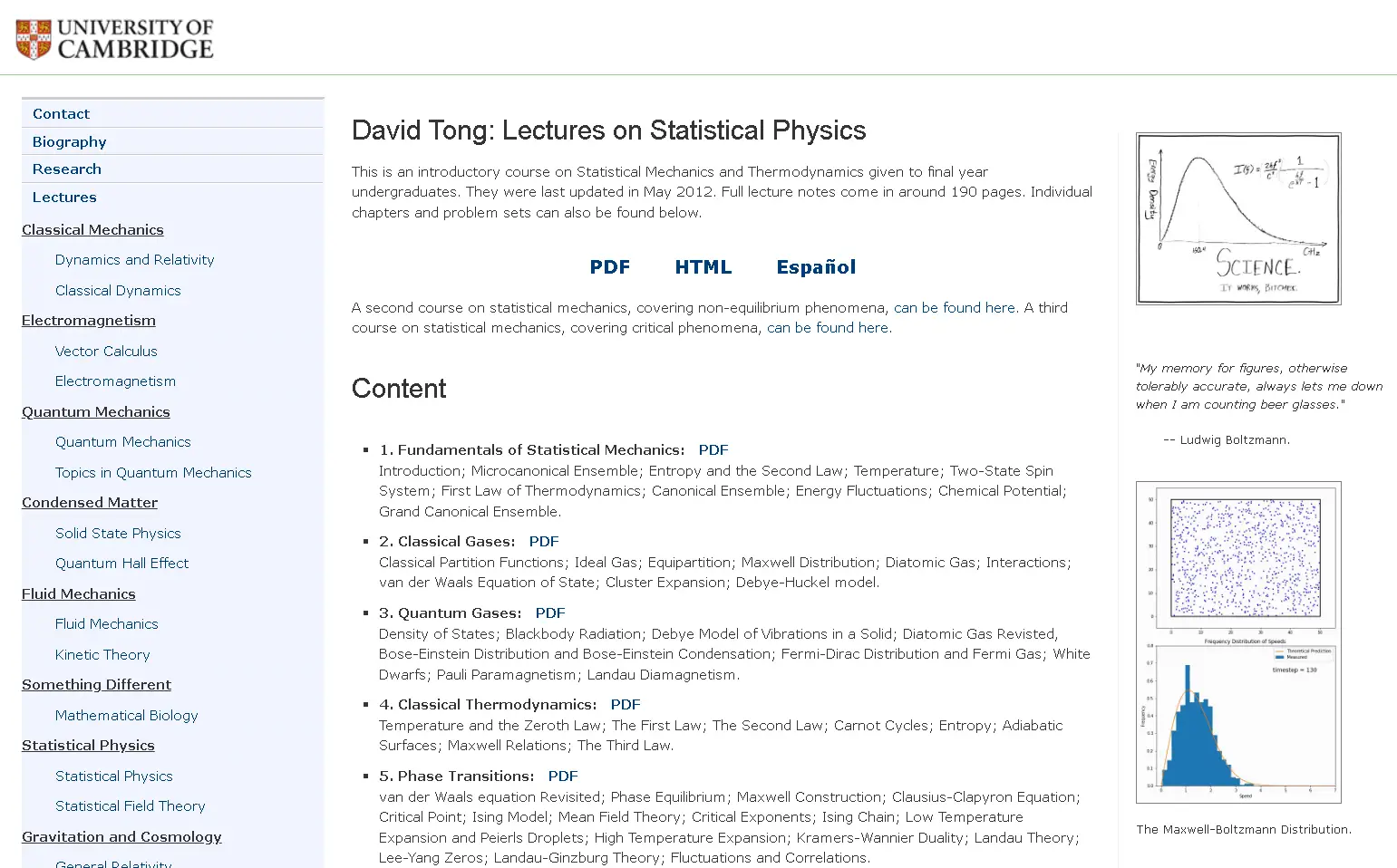
Access Cambridge DAMTP statistical physics lecture notes, reading materials, and academic resources for undergraduate physics study.
Content reviewed by a Quantum Field Theory tutor at My Physics Buddy.
Additional References and Resources
The following credible external resources are useful for students and parents exploring QFT education at graduate level:
- David Tong, University of Cambridge — QFT Lecture Notes: Freely available, widely used graduate lecture notes considered among the clearest introductions to QFT available. Referenced in graduate programmes globally.
- Cambridge University Press — Peskin and Schroeder, An Introduction to Quantum Field Theory: The standard graduate QFT textbook used across the US, UK, and internationally.
- SLAC/Stanford — TASI Lectures on Introduction to Supersymmetry: Authoritative graduate-level lecture notes from the US national particle physics laboratory, covering advanced QFT extensions relevant to research-level study.
- American Physical Society — Division of Particles and Fields (DPF): The primary professional organisation for particle physicists in the US, whose research is built on QFT as its foundational language.
- National Academies of Sciences — Science Learning Report: Research on expert-guided learning in demanding technical subjects, relevant for understanding why 1:1 tutoring is particularly effective at graduate level.
- Symmetry Magazine (Fermilab/SLAC) — The Basics of Quantum Field Theory: A clear, authoritative conceptual introduction from the US national particle physics laboratories — useful for students wanting to orient themselves before diving into the formalism.
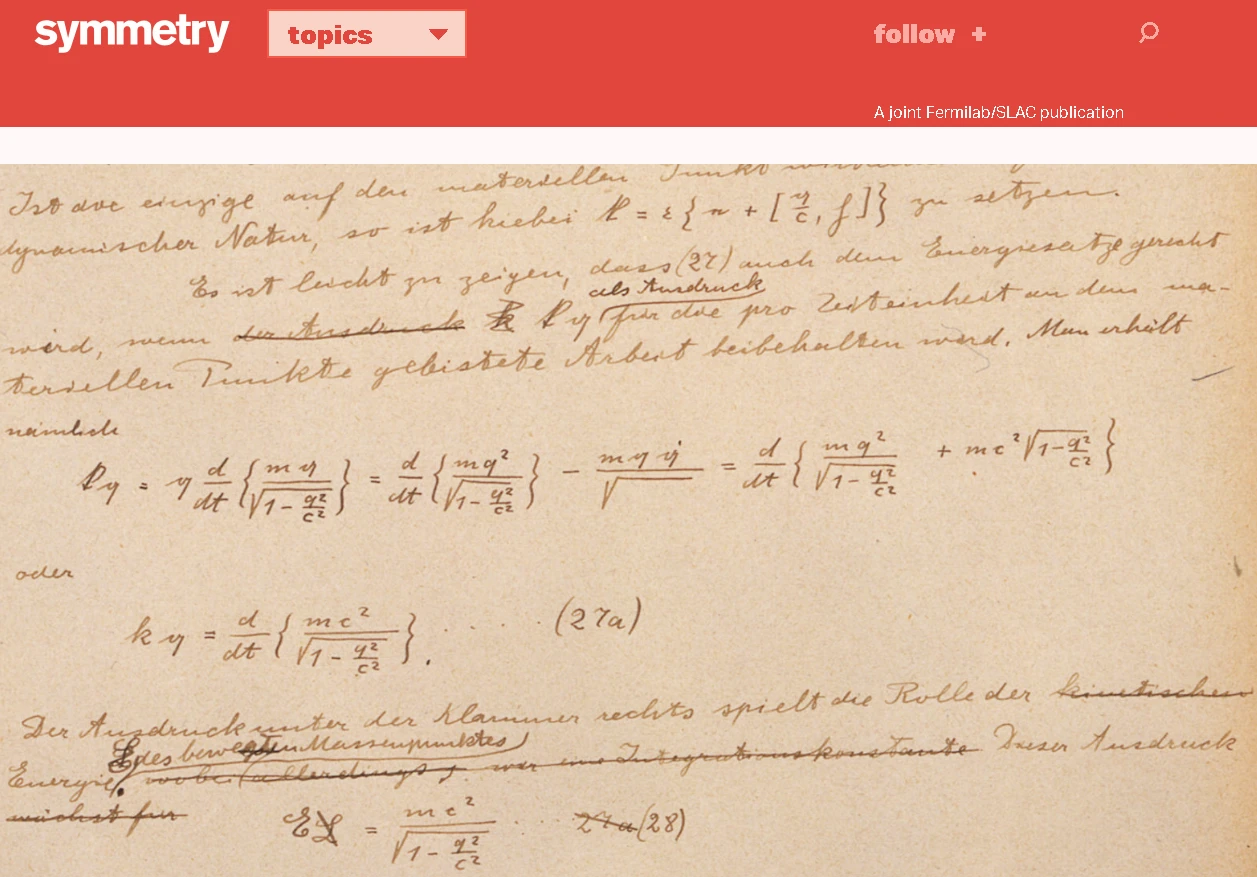
Explore special relativity concepts, including Einstein’s equations, energy-mass relationship, and the limits of the speed of light.
Next Steps
Tell us your current level in QFT — final-year undergraduate, Masters, or PhD — along with the specific topics you need to work through, your prescribed textbook or lecture notes, and any upcoming exam, problem set, or qualifying exam dates. Share your availability and time zone. MPB will match you to a tutor with genuine QFT depth at your level, confirm the fit, and you can begin as soon as the next available slot. Most students are matched and have their first session booked within 24–48 hours.

