Hire Best Special Relativity Tutors Online



Testimonials



Special Relativity Tutor Online
My Physics Buddy (MPB) provides 1:1 online tutoring & homework help in Physics and related subjects, including Special Relativity at every academic level. Special Relativity sits at the boundary where Newtonian mechanics breaks down and a more fundamental description of space, time, and energy takes over. If you are searching for a “Special Relativity tutor near me” who can make the formalism genuinely clear, MPB connects you with subject-matched tutors across the US, UK, Canada, Australia, and Gulf — designed to help you aim for stronger performance and real conceptual understanding.
- 1:1 live online sessions — no group classes, no pre-recorded content
- Tutors matched to Special Relativity syllabi and your exact academic level
- Covers late undergraduate through to graduate and research-level Special Relativity
- Flexible scheduling across all major time zones
- Structured learning plan built after your diagnostic session
- Ethical assignment and dissertation guidance — we explain the physics, you produce the work
Who This Special Relativity Tutoring Is For
Special Relativity appears across several stages of a physics education — from its first introduction in modern physics modules, through to its role as a prerequisite for electrodynamics, particle physics, and quantum field theory at graduate level. This tutoring is designed for:
- Undergraduate students encountering Special Relativity for the first time in a modern physics or classical mechanics course
- Intermediate undergraduates for whom Special Relativity is covered more rigorously in a dedicated module or as part of electrodynamics
- Masters-level students using relativistic kinematics and four-vector formalism as tools for particle physics, field theory, or cosmology courses
- PhD students who need to consolidate their Special Relativity foundations before engaging with General Relativity or Quantum Field Theory at research level
- Students in the US, UK, Canada, Australia, and Gulf whose degree programmes include Special Relativity as part of a theoretical, mathematical, or applied physics track
- Students needing ethical assignment guidance or structured problem-set support without academic shortcuts
Outcomes: What You’ll Be Able to Do in Special Relativity
The capabilities built through structured 1:1 Special Relativity tutoring are directly tied to what exams and graduate courses both demand — not just familiarity with the results, but the ability to derive and apply them with confidence.
Solve problems in relativistic kinematics and dynamics — time dilation, length contraction, relativistic momentum, energy, and the energy-momentum relation — without needing to look up which formula applies. Analyze physical scenarios using Lorentz transformations, correctly identifying which frame is relevant, what is invariant, and why simultaneity is frame-dependent in a way that is precise rather than vague. Model relativistic systems using four-vectors — four-velocity, four-momentum, four-force — and apply covariant notation with the confidence expected at advanced undergraduate and graduate level. Explain the logical structure of Special Relativity from its two postulates, deriving the Lorentz transformation, time dilation, and length contraction without circular reasoning. Apply relativistic mechanics to particle physics contexts — threshold energies, invariant mass, centre-of-momentum frame calculations — which is where Special Relativity is most practically used at graduate level.
Special Relativity is one of the few topics in physics where conceptual confusion and mathematical errors are equally common — and where fixing the conceptual picture almost always resolves the mathematical errors too. The diagnostic session is specifically designed to identify which type of gap is driving your difficulty.
What We Cover in Special Relativity (Syllabus / Topics)
Special Relativity syllabi vary between institutions and between the level at which the subject is taught. Tutors align directly to your specific course materials. The following tracks reflect what is typically covered at each stage — always confirm your current syllabus with your institution.
Introductory Level (First Encounter — Modern Physics or Classical Mechanics Module)
- Historical motivation: Michelson-Morley experiment, failure of the aether hypothesis, problems with Galilean relativity
- Einstein’s two postulates: the principle of relativity and the constancy of the speed of light
- Simultaneity: the train-and-lightning thought experiment, relativity of simultaneity
- Time dilation: derivation from light clock, proper time, the twin paradox
- Length contraction: derivation, proper length, muon decay as experimental evidence
- Lorentz transformation: derivation and application to coordinate and velocity transformations
- Relativistic velocity addition: derivation and application
- Relativistic momentum and energy: rest energy, kinetic energy, E²=p²c²+m²c⁴
- Mass-energy equivalence: E=mc², physical interpretation and applications
- Basic relativistic kinematics problems: decay, collision, threshold energy at an introductory level
Intermediate Level (Dedicated Module or Electrodynamics Context)
- Minkowski spacetime: spacetime diagrams, events, worldlines, light cones
- Spacetime interval: timelike, spacelike, and lightlike separations — invariance and physical meaning
- Four-vectors: covariant and contravariant components, index notation, the metric tensor
- Four-velocity and four-momentum: derivation, physical interpretation, invariant mass
- Relativistic dynamics: four-force, relativistic Newton’s second law, equations of motion
- Doppler effect in Special Relativity: longitudinal and transverse Doppler, relativistic beaming
- Relativistic kinematics in particle physics: threshold calculations, centre-of-momentum frame, invariant mass calculations
- Transformation of electromagnetic fields: how E and B fields transform under Lorentz boosts
- Electromagnetism as a relativistic theory: the four-potential, covariant form of Maxwell’s equations (overview)
- Causality and the light cone structure of spacetime
Advanced Level (Graduate — Prerequisite for GR, QFT, or Particle Physics)
- Lorentz group and its representations: proper orthochronous Lorentz group, spinors (introductory)
- Tensors in Special Relativity: rank-2 tensors, tensor transformation law, the stress-energy tensor
- Covariant formulation of electrodynamics: field strength tensor, Maxwell’s equations in covariant form
- Action principle in Special Relativity: relativistic action for a free particle, coupling to electromagnetic field
- Connection to General Relativity: equivalence principle as motivation, local flatness, transition to curved spacetime
- Connection to Quantum Field Theory: why relativistic quantum mechanics requires field theory, Klein-Gordon and Dirac equations as motivation
- Advanced particle physics kinematics: deep inelastic scattering variables, Mandelstam variables s, t, u
How My Physics Buddy Tutors Help You with Special Relativity (The Learning Loop)
Diagnose: The first session begins with a diagnostic. The tutor gives you a few representative problems — a Lorentz transformation problem, a relativistic kinematics calculation, a spacetime interval question — and asks you to explain your reasoning as you work. This immediately reveals whether your difficulty is conceptual (the physical picture is unclear), formal (the four-vector notation is uncomfortable), or mathematical (algebraic or sign errors in the calculations).
Explain: The tutor does not re-read your lecture notes. They explain what a Lorentz transformation physically means, why simultaneity is relative in a logically necessary way given the postulates, what the spacetime interval is actually measuring, and why the four-momentum formalism is not just convenient notation but a reflection of the geometric structure of spacetime. The physical picture and the formalism are built together, not separately.
Practice: You work through problems live. In Special Relativity this means Lorentz transformation exercises, spacetime diagram construction, four-vector calculations, relativistic kinematics problems in particle physics contexts, and written explanations connecting physical reasoning to mathematical results. The tutor observes your process and intervenes precisely where it breaks down.
Feedback: Feedback is specific. Not “you have the wrong answer” but “you applied the Lorentz transformation in the wrong direction — you boosted from the lab frame to the particle frame when the problem asks for the opposite, and here is a systematic way to keep the direction of the boost straight.” At graduate level, feedback extends to the precision and logical structure of written derivations.
Retest/Reinforce: Concepts return in harder contexts across sessions. Time dilation at introductory level reappears inside proper time calculations along worldlines at intermediate level, which connects to geodesic motion in General Relativity at graduate level. The tutor tracks this progression and builds on it deliberately.
Plan: After each session the tutor updates your learning plan. Weak areas get more time. Areas now solid are pushed to harder problem types. No session wastes time on already-mastered ground.
Accountability: Between sessions the tutor may assign specific problems, ask you to write out a derivation in full, or suggest a section of your textbook to work through. This structured between-session work is what makes each live session build on the last rather than repeat it.
All sessions run via Google Meet with a digital pen-pad or iPad+Pencil setup, so spacetime diagrams, Minkowski diagrams, four-vector calculations, and tensor index manipulations are all visible and editable in real time. Before your first session, share your syllabus, prescribed textbook, known weak areas, and any upcoming deadlines.
“The special theory of relativity grew out of Maxwell’s equations of the electromagnetic field. It is in this sense a child of the electromagnetic field theory.”
Albert Einstein — as cited in American Physical Society historical records on the centenary of Special Relativity
Explore APS News historical articles showcasing key moments, developments, and insights from the physics community.
Tutor Match Criteria (How We Pick Your Tutor)
Special Relativity is taught at very different levels of depth and formalism depending on the programme and year — matching you to the right tutor requires knowing exactly where you are.
Level and course fit: A tutor supporting an undergraduate in a first modern physics encounter with time dilation and E=mc² needs different emphasis than one supporting a PhD student consolidating four-vector formalism before starting QFT. MPB matches by level and specific content, not subject label alone.
Topic strengths and tools: Tutors are assessed on their competency across the full range of Special Relativity content — from the two postulates through to covariant electrodynamics and Lorentz group representations — before being recommended. Sessions use Google Meet with a digital pen-pad or iPad+Pencil so all diagrams, derivations, and index calculations are fully visible in real time.
Time zone and availability: MPB serves students across the US, UK, Canada, Australia, and Gulf. Sessions are available across all major time zones including evenings and weekends.
Learning style and pace: Some students need the logical structure of Special Relativity rebuilt carefully from the two postulates. Others need fast, targeted problem-solving for an imminent exam. The tutor adapts to what you need.
Goals: Exam preparation, problem-set support, conceptual clarity before advancing to General Relativity or QFT, or dissertation-level support — the tutor shapes each session to the goal that matters most right now.
Urgency and timeline: Exam in two weeks or building foundations across a semester — the tutor builds a realistic plan that fits.
Study Plans (Pick One That Matches Your Goal)
MPB offers three broad plan types: a catch-up plan (typically 1–2 weeks) for students behind on specific topics, an exam prep plan (typically 4–8 weeks) for structured coverage of all assessed material, and a weekly support plan for consistent help throughout a semester or research period. After the first diagnostic session, your tutor builds the specific session-by-session plan based on your actual gaps, your timeline, and your available weekly commitment.
Pricing Guide
Special Relativity tutoring at MPB starts at USD 20 per hour and typically ranges up to USD 40 per hour for undergraduate-level sessions. Graduate-level tutoring covering four-vector formalism, covariant electrodynamics, or Lorentz group theory can go up to USD 100 per hour depending on depth and tutor profile. All pricing is confirmed before any session begins — no hidden fees.
WhatsApp for a quick quote — share your level, the specific topics you need, and your timeline.
FAQ
Is Special Relativity hard?
Special Relativity is conceptually unfamiliar but mathematically accessible at the introductory level — the algebra is not advanced. Most students struggle because the physical picture (what it means for simultaneity to be relative, what a spacetime interval actually measures) is never made precise enough. Once the conceptual foundations are solid, the problem-solving follows naturally. At graduate level, the formalism becomes more demanding, but the conceptual core remains the same.
How many sessions are needed?
An undergraduate student catching up on time dilation, Lorentz transformations, and relativistic energy-momentum before an exam typically needs 4–8 sessions. A student working through a full semester module covering spacetime geometry and four-vector formalism might need 10–15 sessions. A PhD student consolidating Special Relativity as a foundation for QFT or General Relativity may need 6–12 targeted sessions. Your tutor will estimate accurately after the diagnostic.
Can MPB help with Special Relativity problem sets and assignments?
Yes — as guided explanation and worked examples. The tutor works through the relevant formalism, demonstrates similar problems, and gives feedback on your attempts. Solutions you submit are always your own work. MPB does not complete or write problem sets for students. This approach is consistent with academic integrity standards across every institution and region MPB serves.
What background is needed before starting?
For introductory Special Relativity, solid Newtonian mechanics and basic electromagnetic theory are sufficient. For the intermediate level covering four-vectors and covariant notation, comfort with vector calculus and index notation helps significantly. For the graduate level covering the Lorentz group and tensor formalism, prior exposure to linear algebra and classical mechanics at the Lagrangian level is important. Your tutor will identify any gaps in the diagnostic and address them directly. The Classical (Newtonian) Mechanics and Mathematical Physics pages offer dedicated support if needed.
What happens in the first session?
The first session starts with a diagnostic — a few representative problems and a conversation about where you feel clear and where you do not. The tutor then teaches a focused concept live, so you leave with something concrete from the first session. Before attending, share your syllabus, your prescribed textbook or lecture notes, known weak areas, and any upcoming deadlines.
Is online Special Relativity tutoring as effective as in-person?
For Special Relativity, online sessions via Google Meet with a digital pen-pad or iPad+Pencil are fully effective. Spacetime diagrams, Minkowski diagrams, four-vector calculations, and tensor index manipulations can all be drawn and worked through in real time on a shared digital whiteboard. Students in the US, UK, Canada, Australia, and Gulf consistently find live online sessions as productive as in-person, with the added benefit of flexible scheduling across time zones.
What textbooks do Special Relativity tutors work with?
Tutors are familiar with standard texts including Taylor and Wheeler’s Spacetime Physics, Griffiths’ Introduction to Electrodynamics (Chapter 12), Helliwell’s Special Relativity, French’s Special Relativity, and at the graduate level, Carroll’s Spacetime and Geometry (introductory chapters) and Jackson’s Classical Electrodynamics. Share your prescribed text before the first session and the tutor aligns directly to it.
Can Special Relativity tutoring help me prepare for General Relativity or QFT?
Yes — this is one of the most common reasons graduate students seek Special Relativity support. Gaps in Special Relativity foundations create persistent difficulties in both General Relativity and Quantum Field Theory (QFT), because both subjects use the language of four-vectors, tensors, and covariant notation as their working tools. The tutor will specifically target the formalism and conceptual understanding needed for your next course.
Does MPB cover the connection between Special Relativity and electromagnetism?
Yes. One of the most illuminating results in physics is that magnetism can be understood as a relativistic consequence of electrostatics. Tutors cover the transformation of electromagnetic fields under Lorentz boosts and the covariant formulation of Maxwell’s equations — content that sits at the intersection of Special Relativity and Electrodynamics, and is assessed in many intermediate and advanced courses.
How does Special Relativity connect to other subjects at MPB?
Special Relativity is a direct prerequisite for General Relativity, Quantum Field Theory (QFT), and Particle Physics. It also connects closely to Electrodynamics at the intermediate level and to Modern Physics at the introductory level. Students building toward cosmology will also find it foundational for Cosmology.
Our services aim to provide personalised academic guidance, helping students understand concepts and improve skills. Materials and guidance provided are for reference and learning purposes only. Misusing them for academic dishonesty or violations of integrity policies is strongly discouraged.
Trust & Quality at My Physics Buddy
Special Relativity tutors at MPB are vetted specifically for this subject across all levels at which it is taught — introductory, intermediate, and graduate. Every tutor completes a subject-specific assessment before being listed, demonstrating both conceptual depth and the ability to explain relativistic reasoning clearly to students at different stages. Student feedback after each session feeds into ongoing quality reviews.
MPB operates on one clear principle: we guide, you produce the work. Whether you are an undergraduate working through a Lorentz transformation problem set or a PhD student consolidating tensor formalism, the tutor explains, demonstrates, and gives feedback on your work — they do not write it. Research from the National Academies of Sciences, How People Learn, confirms that active expert-guided problem solving is what builds durable understanding in technically demanding subjects — exactly the model MPB uses.
MPB is a Physics-focused online tutoring platform serving students from undergraduate through PhD level across the US, UK, Canada, Australia, and Gulf. Students working across related theory subjects can explore dedicated pages for General Relativity, Quantum Field Theory (QFT), Electrodynamics, and Particle Physics. Students building foundational knowledge can find support through Classical (Newtonian) Mechanics and the main Physics page.
“The principle of relativity is not an assumption to be added to mechanics — it is a consequence of the deepest properties of space and time that experiment has repeatedly confirmed over more than a century.”
Content reviewed by a Special Relativity tutor at My Physics Buddy.
Learn how the SI redefinition transformed the metric system by basing all units on universal constants of nature.
Additional References and Resources
The following credible external resources are useful for students exploring Special Relativity at different levels:
- American Physical Society — Centenary of Special Relativity: Historical and scientific context for Einstein’s 1905 paper, from the APS physics history programme.
- The Feynman Lectures on Physics, Chapter 15 — The Special Theory of Relativity (Caltech): Feynman’s classic treatment of Special Relativity, freely available from Caltech and widely regarded as one of the clearest physical introductions.
- David Tong, University of Cambridge — Lectures on Dynamics and Relativity: Freely available undergraduate lecture notes on Special Relativity, widely used in UK and international physics programmes.
- National Institute of Standards and Technology (NIST) — Fundamental Constants: How Special Relativity underpins the definitions of fundamental physical constants including the speed of light.
- Nobel Prize — Albert Einstein Nobel Lecture (1921): Einstein’s own description of the theory of relativity in his Nobel lecture, a primary historical source.
- Symmetry Magazine (Fermilab/SLAC) — The Basics of Special Relativity: A clear, authoritative conceptual introduction from the US national particle physics laboratories, useful for students orienting themselves before the formalism.
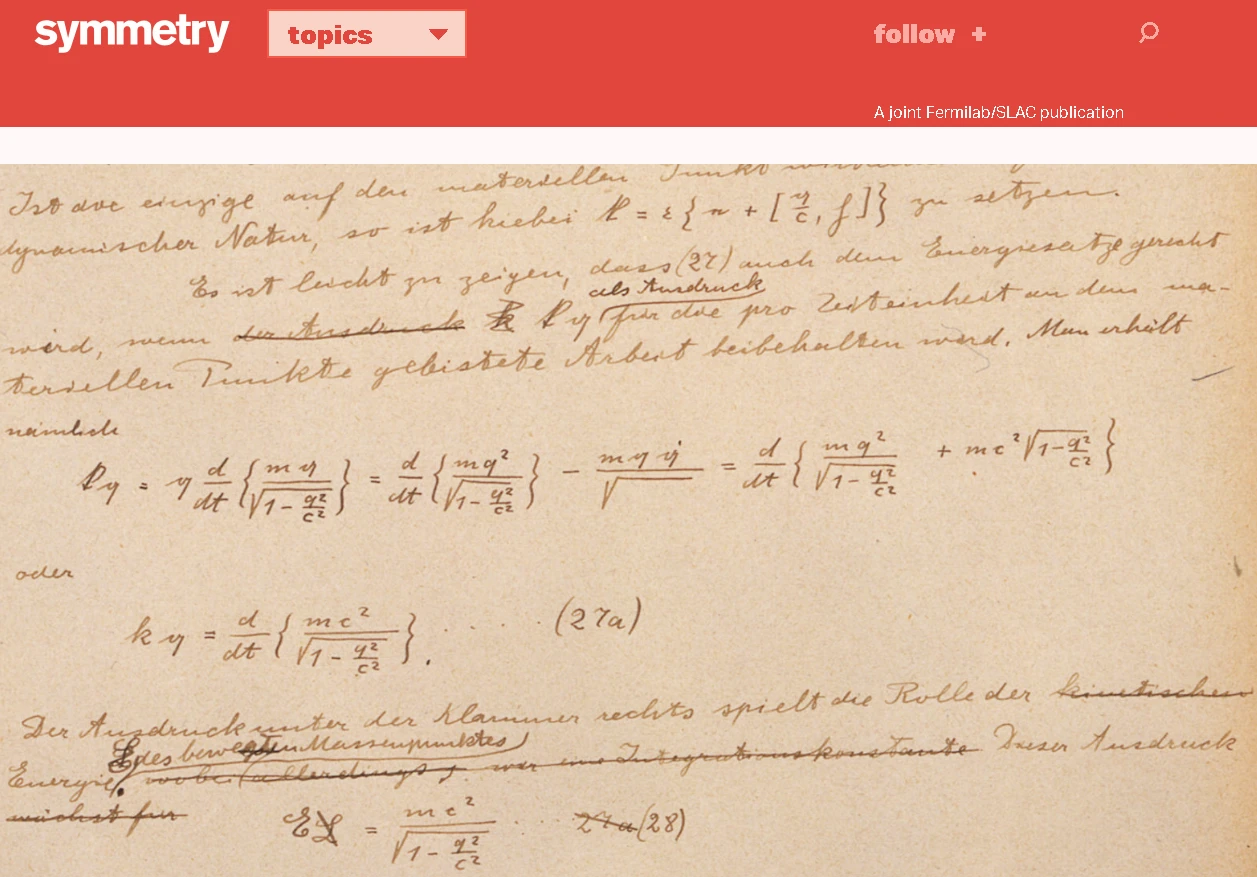
Explore special relativity concepts, including Einstein’s equations, energy-mass relationship, and the limits of the speed of light.
Next Steps
Tell us your current level in Special Relativity — first encounter in a modern physics module, a dedicated intermediate course, or graduate-level preparation for GR or QFT — along with the specific topics you need to focus on and any upcoming exam or submission dates. Share your availability and time zone. MPB will match you to the right tutor, confirm the fit, and most students have their first session booked within 24–48 hours.

