Hire Best Thermodynamics Tutors Online



Testimonials



Thermodynamics Tutor Online
My Physics Buddy (MPB) offers 1:1 online tutoring & homework help in Physics and related subjects, including Engineering Thermodynamics at undergraduate and graduate level. Whether you are an engineering student struggling with entropy, a postgraduate working through advanced cycles, or a parent looking for structured support for your child, MPB connects you with specialist tutors who know the subject in depth. If you have searched for a Thermodynamics tutor near me but want the flexibility and quality of an online session, MPB is designed to help you aim for clearer understanding, stronger problem-solving, and better course performance.
- 1:1 online sessions focused on Engineering Thermodynamics — no group dilution
- Tutors matched to your course level, textbook, and university syllabus
- Flexible time zones — available across the US, UK, Canada, Australia, and the Gulf
- Structured learning plan built after a diagnostic session
- Ethical homework and assignment guidance — we explain so you can solve independently
Who This Thermodynamics Tutoring Is For
MPB’s Thermodynamics tutoring is tailored primarily for engineering students who need rigorous, quantitative support — not just conceptual overviews.
- Undergraduate engineering students (Mechanical, Chemical, Aerospace, Civil) taking introductory or intermediate Thermodynamics courses
- Graduate and Master’s level engineering students tackling advanced topics such as irreversibility, exergy, or combustion thermodynamics
- PhD students who need a refresher or deeper treatment of specific thermodynamic concepts for their research
- Students following programmes at universities in the US, UK, Canada, Australia, or the Gulf who need syllabus-aligned support
- Students who need structured homework and assignment guidance to consolidate lecture material
- Parents of engineering undergraduates who want to ensure their child gets the targeted help a large university lecture hall cannot provide
- University faculty or department heads exploring tutoring partnerships for student support programmes
Outcomes: What You’ll Be Able To Do in Thermodynamics
The aim of every session is to build real capability — the kind that shows up in problem sets, exams, and engineering practice.
Solve multi-step thermodynamic problems involving energy balances, entropy generation, and cycle efficiency using correct sign conventions and unit analysis. Analyse open and closed systems by applying the First and Second Laws rigorously, distinguishing clearly between heat, work, and internal energy changes. Model real engineering cycles — Rankine, Brayton, Otto, Diesel, and refrigeration — and calculate performance metrics such as thermal efficiency, COP, and back-work ratio. Explain the physical meaning behind abstract concepts such as entropy, availability, and irreversibility in language that connects mathematics to engineering reality. Apply equations of state and thermodynamic property tables (steam tables, refrigerant tables, ideal gas relations) accurately and efficiently. Present solutions in a structured, exam-ready format that earns full marks on worked problems — not just a correct final answer.
“Thermodynamics is the only physical theory of universal content which I am convinced will never be overthrown.”
— Albert Einstein, as cited in Nature’s history of thermodynamics
What We Cover in Thermodynamics (Syllabus / Topics)
MPB tutors align sessions to your university course structure. The topics below reflect the standard Engineering Thermodynamics curriculum at undergraduate and graduate level, drawing on widely used texts such as Moran, Shapiro et al. — Fundamentals of Engineering Thermodynamics and Çengel & Boles. Always share your course syllabus so the tutor can align precisely.
Track 1: Foundational Engineering Thermodynamics (Introductory Undergraduate)
- Basic concepts: system, surroundings, state, process, equilibrium, and thermodynamic properties
- Pure substances and phases: phase diagrams, quality, and use of steam tables and refrigerant tables
- First Law for closed systems: heat, work, and internal energy; boundary work calculations
- First Law for open (control volume) systems: steady-state flow, nozzles, diffusers, turbines, compressors, and heat exchangers
- Second Law: Kelvin–Planck and Clausius statements, heat engines, refrigerators, heat pumps, and COP
- Entropy: Clausius inequality, entropy generation, isentropic processes, and the T–s diagram
- Ideal gas mixtures and psychrometrics (where included in course)
- Common problem types: energy balance equations, efficiency calculations, property lookups, and cycle diagrams
Track 2: Power and Refrigeration Cycles (Intermediate Undergraduate)
- Vapour power cycles: ideal and actual Rankine cycle, reheat, regenerative feedwater heaters
- Gas power cycles: Otto, Diesel, Dual, and Stirling cycles — air-standard analysis
- Gas turbine cycles: Brayton cycle, intercooling, reheating, and regeneration
- Refrigeration and heat pump cycles: vapour-compression cycle, cascade systems, gas refrigeration
- Cogeneration and combined cycles: concept and basic efficiency analysis
- Performance metrics: thermal efficiency, back-work ratio, mean effective pressure, and COP
- Common problem types: T–s and p–h diagrams, cycle analysis with property tables, efficiency improvement strategies
Track 3: Advanced Thermodynamics (Upper Undergraduate / Graduate)
- Exergy (availability) analysis: exergy of a closed system, flow exergy, exergy destruction, and second-law efficiency
- Thermodynamic property relations: Maxwell relations, Clapeyron equation, and departure functions
- Real gas behaviour: equations of state (van der Waals, Redlich–Kwong, Peng–Robinson), compressibility charts
- Chemical thermodynamics: reaction stoichiometry, enthalpy of combustion, adiabatic flame temperature, and equilibrium constants
- Irreversibility and entropy generation in engineering systems
- Statistical thermodynamics: Boltzmann distribution, partition functions, and connections to macroscopic properties (graduate focus)
- Common problem types: exergy destruction calculations, equilibrium reaction problems, departure function calculations
Track 4: Homework, Assignment, and Lab Report Guidance
- Worked examples of problem-solving methodology using systematic energy and entropy balance frameworks
- Guidance on interpreting assignment questions and choosing the correct approach
- Lab report structure: objective, theory, data analysis, results, and discussion — MPB does not write reports for students
- Checking unit consistency, sign conventions, and boundary condition assumptions
- Exam preparation: past paper walkthroughs, timed problem practice, and formula sheet strategy
How My Physics Buddy Tutors Help You with Thermodynamics (The Learning Loop)
Diagnose: The first session opens with a focused diagnostic. The tutor asks about your current course unit, recent assignment results, and specific topics where you feel stuck — whether that is entropy, cycle analysis, or property table lookups. This shapes every session that follows.
Explain: Concepts are built from first principles. Tutors use digital pen-pads or iPad with Apple Pencil so derivations, diagrams, and worked solutions appear on screen in real time — not just a slide deck you could have downloaded yourself.
Practice: You attempt problems during the session with the tutor present. Questions are selected from your textbook, past papers, or the tutor’s own library — matched to your course level and the exact topic being covered.
Feedback: The tutor reviews your method step by step. Engineering Thermodynamics errors are often subtle — wrong system boundary, incorrect sign convention, using the wrong table column — and catching these live is far more effective than marking alone.
Retest / Reinforce: The next session begins with a short check on the previous topic. If retention is solid, the tutor moves forward. If gaps remain, they are addressed before new material is introduced.
Plan: After each session, the tutor shares a brief summary — what was covered, what to review before next time, and what is coming up. For students with exams approaching, this includes a topic priority list.
Accountability: For students on ongoing weekly plans, the tutor stays in light contact between sessions — answering a quick query or confirming the next topic — so momentum is maintained throughout the semester.
All sessions run via Google Meet, which requires no installation and works on any device. Before your first session, it helps to share your course syllabus or textbook name, a recent assignment or test result, and your exam dates. The tutor will use this to run a focused diagnostic, teach one live topic, and outline a clear plan by the end of the session.
“Students who receive targeted one-to-one instruction in STEM subjects consistently outperform peers receiving only standard classroom teaching, particularly in quantitative reasoning and problem application.”
— Education Endowment Foundation, One-to-One Tuition Toolkit
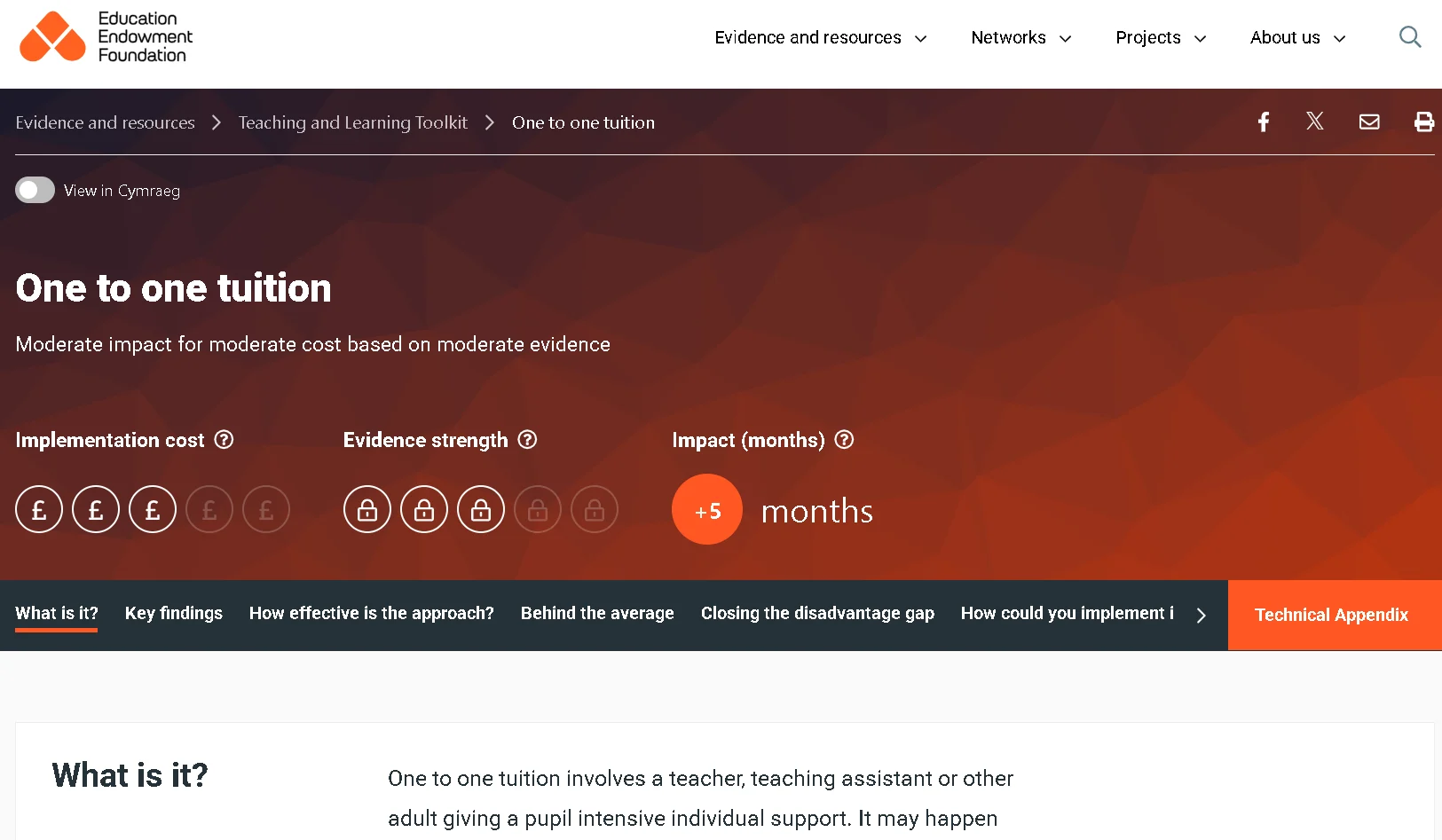
Discover the impact, cost, and evidence behind one-to-one tuition in the Education Endowment Foundation teaching and learning toolkit.
Tutor Match Criteria (How We Pick Your Tutor)
Every student is matched with a tutor who fits their specific course, level, and schedule. Matching is deliberate — not random.
Level and syllabus fit: The tutor must be comfortable with your specific course level — introductory undergraduate, intermediate cycle analysis, or advanced graduate thermodynamics. They will have reviewed similar textbooks and course structures before.
Topic strengths: If your difficulty is in exergy analysis or combustion, your tutor has direct expertise in that area — not just general thermodynamics familiarity.
Tools and setup: Tutors use Google Meet with a digital pen-pad or iPad and Apple Pencil. Thermodynamics requires live working of derivations and diagrams — a tutor who cannot show working on screen is not suitable for this subject.
Time zone and availability: Sessions are scheduled to fit students in the US, UK, Canada, Australia, and the Gulf. Early mornings, evenings, and weekends are available.
Learning style and pace: Some engineering students want derivations from scratch; others want to jump into problem-solving. The tutor adjusts from session one.
Language and communication: Clear, precise technical communication in English — calibrated to the student’s level, whether that is a first-year undergraduate or a PhD candidate.
Goals: Whether the goal is to pass a mid-term, improve a final grade, complete an assignment correctly, or build deep conceptual understanding for research — the tutor aligns entirely to that goal.
Urgency and timelines: Students with exams or assignment deadlines approaching are matched with tutors who have immediate availability.
Study Plans (Pick One That Matches Your Goal)
MPB offers three main plan types for Thermodynamics: a short catch-up plan (typically 1–2 weeks) for students who have fallen behind on a specific unit or topic before an assessment; an exam preparation plan (typically 4–8 weeks) for students working systematically through their full course before finals or a qualifying exam; and ongoing weekly support for consistent reinforcement throughout an engineering semester. The tutor designs the exact session plan — topics, resources, problem sets, and pacing — after the diagnostic, not before.
Engineering Thermodynamics is one of the most mathematically intensive core courses in any mechanical or chemical engineering degree. Students often struggle not because they cannot do the maths, but because they do not yet understand which principles apply to which system and why. MPB tutors are trained to bridge exactly this gap — using structured problem-solving frameworks that connect physical reasoning to mathematical execution, so students can approach any unseen problem with a clear method rather than guesswork.
Pricing Guide
MPB tutoring fees for Thermodynamics start at USD 20 per hour and typically range up to USD 40 per hour for standard undergraduate-level sessions. Advanced graduate-level topics — such as exergy analysis, chemical equilibrium thermodynamics, or statistical thermodynamics — may be priced higher depending on tutor expertise and topic complexity. Shorter timelines, urgent exam preparation, and limited tutor availability for highly specialised content may also affect the rate.
FAQ
Is Thermodynamics hard for engineering students?
Engineering Thermodynamics is consistently rated among the most challenging core courses in mechanical and chemical engineering. The difficulty comes from combining abstract concepts like entropy with rigorous numerical problem-solving. Most students find the subject significantly more approachable with targeted one-to-one support.
How many sessions are needed?
This depends on your starting level and goal. A student who needs help with one unit before an assessment may need 4–6 sessions. A student preparing for a full-semester final exam over 6–8 weeks might need 12–20 sessions. The tutor will give a specific estimate after the diagnostic.
Can tutors help with homework and assignments?
Yes, but through guidance rather than doing the work. Tutors explain the relevant concept, work through a similar example, and help you identify where your own approach went wrong. You complete and submit your own work. MPB does not solve or submit assignments on behalf of students. Academic integrity is a firm and non-negotiable principle at MPB.
Will the tutor match my exact university syllabus?
Tutors work from your course syllabus and textbook. It helps to share these before the first session so the tutor can align topics, notation, and problem types precisely. Small variations in coverage exist across universities, and the tutor will confirm these in the diagnostic session.
What happens in the first session?
The first session includes a focused diagnostic to identify your current level and specific weak areas, followed by live teaching on the most urgent topic. By the end, the tutor will outline a recommended plan covering which topics to address, in what order, and over what timeframe.
Is online Thermodynamics tutoring effective for engineering?
Yes. Physics and engineering tutoring online with a digital pen-pad replicates the whiteboard experience effectively. The American Society for Engineering Education has documented positive outcomes for online engineering tutoring, particularly for quantitative subjects. Many students find online sessions easier to schedule around their academic timetable.
Search ASEE conference proceedings and access engineering education research, papers, and academic resources.
Can the tutor help with my Thermodynamics lab report?
Yes. Tutors can help you understand the underlying theory behind your experiment, structure your report correctly (objective, theory, data analysis, results, discussion), and improve the clarity of your conclusions. MPB does not write lab reports for students. All written content must be the student’s own work.
Which textbooks does MPB support?
Tutors are familiar with the most widely used Engineering Thermodynamics texts including Çengel & Boles, Moran & Shapiro, Smith, Van Ness & Abbott, Borgnakke & Sonntag, and Wark & Richards. Share your textbook name and edition at booking and the tutor will prepare accordingly.
Can tutors help with graduate-level or PhD Thermodynamics?
Yes. MPB has tutors with graduate-level expertise who can cover advanced topics including exergy analysis, thermodynamic property relations, equations of state, chemical thermodynamics, and statistical thermodynamics. Graduate students should specify their research area and course level at booking so the right tutor can be matched.
What if I need help with both Thermodynamics and a related subject like Fluid Mechanics?
MPB covers a wide range of engineering and physics subjects. Students who need support across both Thermodynamics and related engineering subjects can explore Fluid Mechanics & Dynamics or Engineering Dynamics tutoring pages. Tutors can sometimes cover related subjects in the same session if requested.
The Second Law of Thermodynamics — and the concept of entropy that follows from it — is one of the most misunderstood ideas in all of engineering science. Students often memorise the Clausius inequality or the entropy balance equation without grasping what entropy physically represents. MPB tutors invest time in building this physical intuition first, because students who understand entropy conceptually make far fewer errors in entropy balance calculations and cycle analysis than those who treat it as just another formula to plug into.
Trust & Quality at My Physics Buddy
Tutor selection: MPB tutors hold degrees in Physics, Mechanical Engineering, Chemical Engineering, or closely related disciplines. Every tutor is vetted through subject knowledge assessments, a live demonstration session, and ongoing student feedback review. Tutors who receive consistently poor feedback are not retained. For Engineering Thermodynamics specifically, tutors are expected to demonstrate competence in both the conceptual foundations and the problem-solving frameworks used in engineering courses.
Academic integrity: MPB’s role is to teach and guide — not to complete work for students. Every homework walkthrough, assignment discussion, and exam preparation session is structured so the student builds understanding and solves independently. We guide — you submit your own work. This is a non-negotiable principle across every subject and every level on the platform. Students are encouraged to read their institution’s academic integrity policy, such as those published by the Massachusetts Institute of Technology.
About MPB: My Physics Buddy is a Physics-focused online tutoring platform serving undergraduate students, graduate students, Masters and PhD candidates, and their parents across the US, UK, Canada, Australia, and the Gulf. The platform covers Physics and closely related quantitative subjects in depth — from school-level to advanced research level. Students working across related engineering subjects may also find the following pages useful: Engineering Statics, Engineering Physics, Statistical Mechanics, and Fluid Mechanics & Dynamics. Students who are also studying advanced physics topics that connect to thermodynamics can explore Condensed Matter (Solid State) Physics, Plasma Physics, and Computational Physics. For context on how thermodynamics fits into modern engineering education, the ABET Engineering Accreditation criteria outline the role of thermodynamics within accredited engineering curricula in the US and internationally.
Explore ABET’s accreditation criteria for engineering programs, outlining standards and quality benchmarks for 2025–2026.
“Engineering education research consistently shows that students benefit most from expert-guided problem-solving practice — working through realistic, challenging problems with immediate expert feedback — rather than re-reading notes or watching passive video content alone.”
— American Society for Engineering Education, Engineering Education Research Review
Content reviewed by a Thermodynamics tutor at My Physics Buddy.
Next Steps
Tell us your current course level (undergraduate, graduate, PhD), your university, the textbook or syllabus you are following, and the topics giving you the most difficulty. Share your availability and upcoming exam or assignment dates. MPB will match you with a Thermodynamics tutor who fits your syllabus, time zone, and goals — and you can get started within days.

