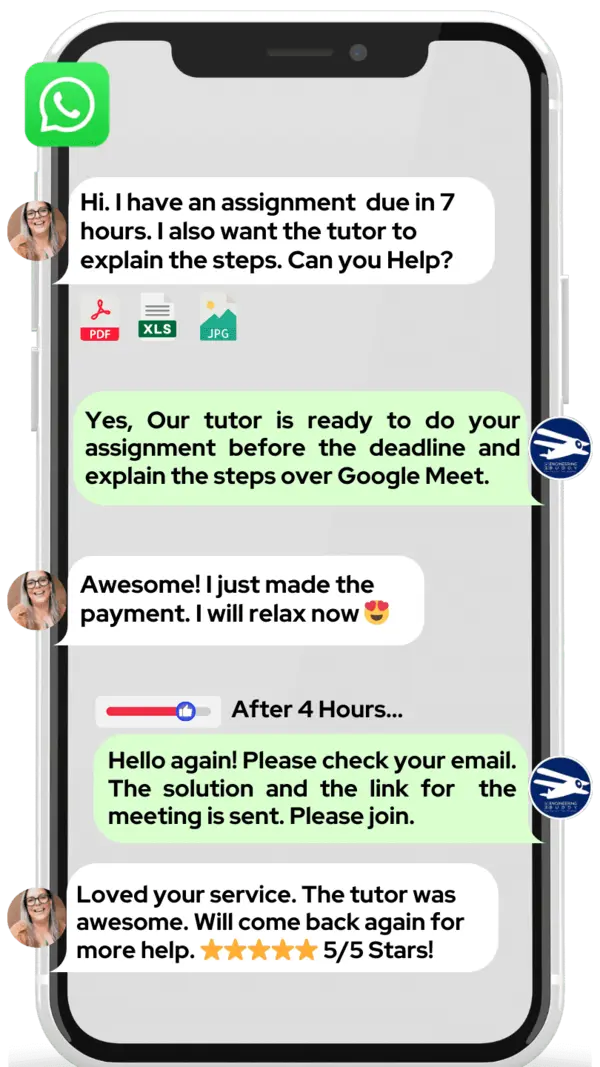
Hire Best Fluid Mechanics & Dynamics Tutors Online


Testimonials



Fluid Mechanics & Dynamics Tutor Online
My Physics Buddy (MPB) provides 1:1 online tutoring & homework help in Physics and related subjects, including dedicated support for Fluid Mechanics & Dynamics. This subject sits at the intersection of physics, mathematics, and engineering — covering how liquids and gases behave under forces, flow conditions, and pressure gradients. Whether you are an undergraduate engineering or physics student struggling with viscous flow, or a graduate student working through Navier-Stokes equations, MPB matches you with a specialist tutor. If you have been searching for a Fluid Mechanics & Dynamics tutor near me, our fully online model means expert help is available regardless of your location, timed to your schedule. Sessions are designed to improve conceptual understanding, mathematical problem-solving, and performance in assessments.
- 1:1 live sessions matched to your course level and university syllabus
- Expert tutors with strong backgrounds in engineering mechanics and applied physics
- Flexible scheduling across US, UK, Canada, Australia, and Gulf time zones
- Structured learning plan built around your coursework deadlines and exam dates
- Ethical guidance on homework, assignments, and lab report structure
Who This Fluid Mechanics & Dynamics Tutoring Is For
Fluid Mechanics & Dynamics tutoring at MPB is relevant across a wide range of student profiles. It is particularly well suited to the following.
- Undergraduate students in Mechanical, Civil, Chemical, or Aerospace Engineering taking fluid mechanics as a core or elective course at universities in the US, UK, Canada, Australia, or Gulf region
- Physics undergraduate students encountering continuum mechanics, hydrodynamics, or fluid dynamics as part of their programme
- Graduate students working on research or coursework that requires advanced fluids knowledge — including turbulence, computational fluid dynamics (CFD), or multiphase flow
- Masters and PhD students needing targeted support for specific chapters or thesis-related fluid mechanics concepts
- Parents of undergraduate students who want their child to have a reliable expert to turn to when lecture material is unclear or deadlines are approaching
- Students who need ethical guidance on understanding and structuring homework problems, lab reports, and assignment questions in fluid mechanics
Outcomes: What You’ll Be Able To Do in Fluid Mechanics & Dynamics
Effective tutoring in Fluid Mechanics & Dynamics produces observable, testable improvements. After working with an MPB tutor, students are equipped to do the following.
Solve problems involving fluid statics, Bernoulli’s equation, pipe flow, and open-channel flow with a clear, methodical approach. Analyse flow conditions — laminar versus turbulent, internal versus external, compressible versus incompressible — and select the correct governing equations accordingly. Model real-world fluid systems by applying control volume analysis, continuity, momentum, and energy equations correctly. Explain physical phenomena such as boundary layer development, pressure drag, viscosity effects, and flow separation in terms that connect mathematics to observable behaviour. Apply dimensional analysis and the Buckingham Pi theorem to simplify complex fluid problems. Write clearly structured lab reports and assignment solutions that show your physical reasoning, not just algebraic steps. Present derivations and problem solutions in a logical sequence that earns method marks even under exam conditions.
“Fluid mechanics is notoriously difficult for students because it demands simultaneous physical intuition and mathematical rigour. Students who succeed are those who learn to visualise the flow first, then build the equations from that picture — not the other way around. That shift in approach is what good tutoring can accelerate.”
— Perspective consistent with pedagogy discussed in American Society for Engineering Education (ASEE) research on fluid mechanics instruction

Search ASEE conference proceedings and access engineering education research, papers, and academic resources.
What We Cover in Fluid Mechanics & Dynamics (Syllabus / Topics)
MPB tutors work through the syllabus as taught at your institution. Below are the main topic tracks, covering content from introductory undergraduate through to advanced graduate level. Exact coverage depends on your course and institution.
Fluid Statics
- Pressure distribution in static fluids, Pascal’s law
- Manometry and pressure measurement
- Hydrostatic forces on submerged surfaces — plane and curved
- Buoyancy, Archimedes’ principle, and stability of floating bodies
- Pressure variation in rigid-body motion
Fluid Kinematics and Flow Analysis
- Eulerian vs Lagrangian descriptions of flow
- Streamlines, streaklines, and pathlines
- Continuity equation — integral and differential forms
- Velocity fields, acceleration, and material derivative
- Vorticity, circulation, and irrotational flow
Conservation Laws and Control Volume Analysis
- Reynolds Transport Theorem
- Linear and angular momentum equations for control volumes
- Energy equation: Bernoulli’s equation derivation and application limits
- Extended Bernoulli with head losses and pump/turbine work
- Common problem types: pipe junctions, nozzles, turbines, and reaction forces
Internal and Pipe Flow
- Laminar and turbulent pipe flow; Reynolds number criterion
- Hagen-Poiseuille flow; velocity profiles
- Moody chart, Darcy-Weisbach equation, friction factor
- Minor losses: bends, valves, contractions, expansions
- Pipe network analysis; series and parallel systems
External Flow and Boundary Layer Theory
- Boundary layer development over flat plates and curved surfaces
- Laminar and turbulent boundary layers; transition
- Drag and lift: pressure drag, skin friction drag, lift coefficients
- Flow over cylinders, spheres, and aerofoils — qualitative and quantitative
- Separation, wakes, and von Kármán vortex streets
Dimensional Analysis and Similitude
- Buckingham Pi theorem — method and worked problems
- Key dimensionless numbers: Reynolds, Froude, Mach, Weber, Euler
- Dynamic similarity and model testing principles
Compressible Flow (where included in course)
- Speed of sound, Mach number, and flow regimes
- Isentropic flow relations
- Normal shocks: Rankine-Hugoniot conditions
- Nozzle flow: converging, converging-diverging, choked flow
Advanced Topics (Graduate Level)
- Navier-Stokes equations: derivation, exact solutions, and simplifications
- Turbulence: Reynolds-averaged equations (RANS), turbulence models at conceptual level
- Potential flow theory: stream functions, velocity potential, flow superposition
- Computational Fluid Dynamics (CFD): conceptual foundations, meshing, boundary conditions
- Multiphase flow and non-Newtonian fluid behaviour at introductory graduate level
Fluid Mechanics & Dynamics is one of the highest-failure-rate courses in undergraduate engineering programmes worldwide. The subject demands fluency in calculus, vector mathematics, and physical intuition simultaneously. MPB tutors approach this by working through each topic in sequence — building the physical picture before the equations — and then applying that understanding directly to the types of problems your course assignments and exams actually test. Homework guidance, problem-set walkthroughs, and lab report structure support are all part of what tutors can offer.
How My Physics Buddy Tutors Help You with Fluid Mechanics & Dynamics (The Learning Loop)
Diagnose: The first session includes a diagnostic conversation and a few targeted problems to identify where your understanding is solid and where it breaks down. Common gaps include control volume setup, applying Bernoulli correctly with its assumptions, or Navier-Stokes manipulation at graduate level. The diagnostic shapes every session that follows.
Explain: Tutors do not just rework textbook derivations. They explain the physical reasoning behind each governing equation — why the continuity equation takes the form it does, what boundary layer assumptions actually mean, and how to read a Moody chart confidently. Explanation is connected directly to the types of questions your specific course asks.
Practice: You work through problems drawn from your own course materials, past exams, and standard textbooks such as those by Munson, White, or Cengel — depending on what your programme uses. Tutors observe your approach and identify where reasoning diverges from correct method.
Feedback: After each problem, your tutor provides specific feedback on method, not just the answer. Where you set up a control volume incorrectly, or applied Bernoulli outside its valid conditions, the tutor identifies the exact point of error and explains how to correct it.
Retest and Reinforce: Topics are revisited with fresh problems in later sessions to confirm that corrections have been properly understood and can be applied independently.
Plan: Between sessions, the tutor sets targeted work — specific problem types, textbook exercises, or practice derivations — matched to your weaker areas and upcoming deadlines.
Accountability: For students with multiple assignments and lab deadlines, regular sessions help maintain forward momentum through the course rather than falling behind and cramming.
All sessions run live via Google Meet. Tutors use a digital pen-pad or iPad with Apple Pencil, so all working — diagrams, control volume sketches, vector notation — is fully visible and interactive. Before your first session, share your course syllabus or textbook name, topics currently being covered, any homework or assignment questions you are stuck on, and your upcoming exam or submission dates. This allows the tutor to arrive prepared for a focused, immediately useful first session.
Tutor Match Criteria (How We Pick Your Tutor)
MPB matches students to tutors on specific criteria relevant to fluid mechanics — not just the subject name.
Level and syllabus fit: Undergraduate and graduate fluid mechanics are very different in depth and mathematical demand. Tutors are matched to the correct level — from introductory engineering fluids through to Navier-Stokes and CFD at graduate level.
Topic strengths: If your course is heavily focused on external aerodynamics, compressible flow, or turbulence modelling, the tutor match reflects that specialisation.
Tools and setup: All tutors use Google Meet with a digital pen-pad or iPad and Apple Pencil. This is essential for fluid mechanics, where free-body diagrams, control volume sketches, and velocity profile drawings need to be done live.
Time zone and availability: Tutors are matched for your region — US, UK, Canada, Australia, or Gulf — with session slots available across morning, afternoon, and evening hours local to you.
Learning style and pace: Some students need a methodical, conceptual approach before touching equations. Others are confident mathematically but need help building physical intuition. Tutor matching accounts for this.
Language and communication: Clear English-medium instruction is standard. Additional language preferences are accommodated where tutor availability allows.
Goals and urgency: Whether you are trying to pass an upcoming exam, improve on a graded assignment, or build a stronger foundation for thesis research, the tutor match and session plan are calibrated accordingly.
“Studies on undergraduate STEM outcomes consistently show that students who receive targeted, personalised instruction during high-difficulty courses perform significantly better than those relying solely on lectures and self-study. For courses like fluid mechanics, where conceptual misunderstandings compound quickly, early intervention through 1:1 support tends to have the most measurable impact.”
— Consistent with findings cited by the Education Endowment Foundation on one-to-one tuition effectiveness
The Education Endowment Foundation provides evidence-based resources and research to support schools, colleges, and early years education.
Study Plans (Pick One That Matches Your Goal)
MPB offers three plan types for Fluid Mechanics & Dynamics: a short catch-up plan (1–2 weeks) for students close to an exam or submission deadline who need rapid, focused help on specific topics; a structured semester support plan (4–8 weeks) for students who want consistent coverage aligned with their course schedule; and ongoing weekly support for students who prefer a reliable tutor throughout the entire term. After the diagnostic session, your tutor builds the specific session plan based on your actual syllabus, weak areas, and deadlines — the above are frameworks, not fixed schedules.
Pricing Guide
Fluid Mechanics & Dynamics tutoring at MPB is priced based on the level of expertise required, the complexity of the course content, and tutor availability. Hourly rates generally start at USD 20 and range up to USD 40 for most undergraduate-level sessions. For highly advanced graduate-level content — such as turbulence theory, CFD foundations, or Navier-Stokes analytical solutions — rates may go higher, up to USD 100 per hour in some cases.
Factors that influence pricing include the academic level of your course (undergraduate vs. Masters vs. PhD), how close your deadline is, and whether you need intensive daily sessions or standard weekly support. A very short timeline with frequent sessions typically sits toward the upper end of the range.
FAQ
Is Fluid Mechanics & Dynamics hard?
It is consistently rated among the most challenging undergraduate engineering and physics courses. The difficulty comes from combining vector calculus, physical reasoning, and multiple governing equations simultaneously. Most students find it manageable with structured, concept-first tutoring rather than formula memorisation.
How many sessions are needed?
This depends on your current level and goals. Students targeting a specific exam or assignment typically benefit from 4–8 focused sessions. Those wanting full-semester support may work with a tutor weekly throughout the term. Your tutor will recommend a session frequency after the diagnostic.
Can you help with homework, assignments, and lab reports?
Yes — within clear academic integrity limits. Tutors explain concepts, walk through the method for similar problems, help you understand where your approach goes wrong, and provide feedback on the structure of your lab reports and written assignments. MPB provides guidance and explanation; you complete and submit your own work. We do not submit assignments on your behalf, and we strongly discourage any misuse of our support that would violate your institution’s academic integrity policies.
Do your tutors match my exact university syllabus?
Tutors work from your actual course materials — your textbook, lecture slides, and past exam papers — wherever possible. Core fluid mechanics content is consistent across most programmes, though the depth and topic sequence vary. Sharing your syllabus before the first session helps ensure the tutor covers exactly what your course requires.
What happens in the first session?
The first session includes a diagnostic — a short conversation and a few problems to assess your current level. The tutor then covers one or two topics you are currently struggling with and outlines a recommended session plan. Come prepared with your syllabus, current lecture notes, and any specific questions or problems you are stuck on.
Is online tutoring as effective as in-person for fluid mechanics?
For most students, yes. All working — including control volume diagrams, velocity profiles, and free-body sketches — is done live on a shared digital board via Google Meet. The ability to work with a specialist tutor regardless of your location, at flexible hours, is a significant practical advantage over trying to find in-person help locally.
Which textbook does MPB use?
Tutors are flexible. Common textbooks include Munson’s Fundamentals of Fluid Mechanics, White’s Fluid Mechanics, and Cengel & Cimbala’s Fluid Mechanics: Fundamentals and Applications. Share your course textbook when booking and the tutor will align sessions to it. At graduate level, texts such as Batchelor’s An Introduction to Fluid Dynamics are also commonly used.
Can you help with Computational Fluid Dynamics (CFD)?
MPB tutors can help with the conceptual foundations of CFD — governing equations, discretisation principles, boundary condition setup, and understanding simulation outputs — at a level consistent with graduate coursework. For deep software-specific CFD training in tools like ANSYS Fluent or OpenFOAM, availability depends on the tutor matched to you; please mention this requirement when enquiring.
Do you help with thesis or dissertation work related to fluid mechanics?
MPB can provide high-level guidance on fluid mechanics concepts relevant to your thesis — helping you understand the theory, discuss methodologies, and strengthen your grasp of the governing physics. We do not write, draft, or submit thesis content on your behalf. The support is educational and conceptual, designed to help you work more effectively on your own research.
What related subjects does MPB also support?
Students in fluid-heavy programmes often work across related quantitative subjects. MPB also offers tutoring in Thermodynamics, Engineering Dynamics, Engineering Statics, and Mathematical Physics, all of which frequently overlap with fluid mechanics coursework.
Academic integrity is central to how MPB operates. In Fluid Mechanics & Dynamics — a subject where problem-solving method matters as much as the final answer — the goal of tutoring is to make you genuinely capable of working through problems independently. Tutors explain, demonstrate, and guide. Students do the work, form the reasoning, and submit their own solutions. This approach builds the durable understanding that actually shows up in exams and in professional practice — which is the whole point.
Trust & Quality at My Physics Buddy
Tutor selection: Every MPB tutor is screened on subject knowledge through a live demonstration session before being placed with students. For Fluid Mechanics & Dynamics, this means working through representative problems — from control volume analysis to Navier-Stokes simplifications — and demonstrating the ability to explain physical reasoning clearly, not just reach the correct answer. Tutors typically hold undergraduate or postgraduate degrees in Mechanical Engineering, Aerospace Engineering, Civil Engineering, Applied Physics, or related fields from recognised universities. Student feedback is reviewed regularly and informs ongoing tutor quality management.
Academic integrity: MPB’s approach to homework and assignment guidance is grounded in a clear principle: we guide, you submit your own work. Tutors explain methods, identify errors in your reasoning, and help you understand the physics behind each problem. They do not complete assignments or produce solutions for submission. This is stated clearly to every student, and it is consistent with the academic integrity policies of institutions across the US, UK, Canada, Australia, and the Gulf. Learning is the goal — not shortcut access to answers.
About MPB: My Physics Buddy is a Physics-focused online tutoring platform serving undergraduate students, graduate students, and advanced learners in the US, UK, Canada, Australia, and Gulf region. Our core strength is Physics and closely related quantitative subjects — including engineering mechanics, applied mathematics, and subject-specific exam preparation. Students working across multiple engineering subjects often find it useful to explore related MPB pages: those covering Classical (Newtonian) Mechanics, Electromagnetism, and Waves and Optics may find overlap with their programme. Students preparing for specific physics qualifications can also explore AP Physics C: Mechanics, A/AS Level Physics (9702), and Engineering Physics tutoring pages for related support.
For further context on fluid mechanics as a discipline, the American Physical Society Division of Fluid Dynamics provides research-level context on the subject’s scope, and the National Academy of Engineering has documented the centrality of fluid mechanics knowledge to engineering practice. Students wanting to understand the career relevance of fluid dynamics may also find resources from the American Institute of Aeronautics and Astronautics (AIAA) informative, particularly for aerospace and propulsion applications.

Explore aerospace engineering, satellite technology, and global space innovation with AIAA’s events, courses, and community.
Content reviewed by a Fluid Mechanics & Dynamics tutor at My Physics Buddy.
Next Steps
Share your course level, university, the topics you are currently covering, and any upcoming deadlines or exam dates. MPB will identify a matched tutor available in your time zone and get you into a first session quickly — typically within a few days of your initial enquiry. The first session includes a diagnostic and begins working on your most urgent topics immediately. Most students leave the first session with a clearer approach to at least one problem type they were previously stuck on.

