Medical Physics Tutor Online
My Physics Buddy (MPB) provides 1:1 online tutoring & homework help in Physics and related subjects, including Medical Physics at every academic level. Medical Physics is a rigorous, highly specialised discipline that bridges the physical sciences with clinical medicine — and it demands precision in both. Whether you are an undergraduate encountering radiation physics for the first time, a Masters student working through imaging systems and dosimetry, or a PhD candidate developing research in radiotherapy or nuclear medicine, MPB connects you with a Medical Physics tutor matched to your exact course and level. If you have been looking for a “Medical Physics tutor near me” with genuine subject-area depth, live online sessions with MPB give you that access regardless of where you are.
Our sessions are designed to help you aim for stronger grades, clearer conceptual understanding, and the rigour your programme demands — without shortcuts.
- 1:1 live online sessions — no group classes, no pre-recorded video content
- Tutors matched specifically to Medical Physics curricula and your level
- Covers undergraduate through to PhD-level Medical Physics
- Flexible scheduling across US, UK, Canada, Australia, and Gulf time zones
- Structured learning plan built after your diagnostic session
- Ethical homework, assignment, and lab report guidance — we explain, you produce the work
Who This Medical Physics Tutoring Is For
Medical Physics is studied across a range of programmes — from undergraduate physics degrees with a medical or biomedical track, to specialist Masters and PhD programmes in clinical medical physics, radiation oncology physics, nuclear medicine, and imaging science. This tutoring is designed for:
- Undergraduate students taking Medical Physics as a module within a Physics, Biomedical Science, or Engineering degree (US, UK, Canada, Australia, Gulf)
- Students in pre-medical or health sciences programmes where Medical Physics or Radiation Physics is a required or elective course
- Masters-level students in Medical Physics, Clinical Physics, Radiation Oncology Physics, or Health Physics programmes
- PhD students in Medical Physics or related research areas needing conceptual clarity, coursework support, or research problem-solving guidance
- Students preparing for professional certification examinations in Medical Physics (format and requirements vary by country and certifying body)
- Students needing ethical assignment, lab report, or dissertation guidance without academic shortcuts
- Parents of undergraduate students in the US, UK, Canada, Australia, and Gulf seeking structured, expert academic support
Outcomes: What You’ll Be Able to Do in Medical Physics
Medical Physics requires you to operate fluently at the intersection of physics, biology, and clinical application. The capabilities you build through structured 1:1 tutoring are observable and directly tied to what your programme assesses.
Solve quantitative problems in radiation dosimetry, radioactive decay, imaging physics, and electromagnetic field interactions — with the mathematical rigour your course or exam requires. Analyze physical processes underlying clinical technologies — from how an X-ray beam is produced and attenuated, to how MRI signal is generated and encoded, to how a linear accelerator delivers a dose distribution. Model the physical behaviour of ionising radiation in tissue, accounting for interaction mechanisms, energy transfer, and biological effect at a conceptual and mathematical level. Explain the physics behind diagnostic imaging modalities — X-ray, CT, MRI, PET, ultrasound — with the precision required for written assessments, viva examinations, and research writing. Apply radiation protection and safety principles correctly, connecting regulatory frameworks to the underlying physical rationale. Write well-structured lab reports, data analyses, and research sections that demonstrate physical reasoning clearly and meet academic standards.
What We Cover in Medical Physics (Syllabus / Topics)
Medical Physics curricula differ significantly between institutions, countries, and qualification levels. Tutors at MPB align to your specific course materials. The following tracks give an overview of what is typically covered at each stage. Always confirm your current syllabus with your institution.
Track 1 — Undergraduate Medical Physics (Introductory and Intermediate)
- Atomic and nuclear structure: review of atomic models, nuclear stability, radioactive decay modes
- Radiation interactions with matter: photoelectric effect, Compton scattering, pair production, attenuation coefficients
- X-ray production: bremsstrahlung, characteristic radiation, X-ray tube physics
- Radiation dosimetry fundamentals: absorbed dose, kerma, exposure, effective dose, dose units
- Radiation detection and instrumentation: ionisation chambers, Geiger-Müller counters, scintillation detectors, semiconductor detectors
- Diagnostic imaging: X-ray radiography, fluoroscopy, image quality parameters (contrast, resolution, noise, SNR)
- Introduction to CT imaging: Hounsfield units, reconstruction principles, scanner geometry
- Introduction to MRI: spin physics, RF excitation, relaxation times T1 and T2, pulse sequences at a conceptual level
- Introduction to nuclear medicine: radiopharmaceuticals, gamma cameras, SPECT and PET principles
- Radiation protection and safety: ALARA principle, dose limits, shielding basics, regulatory frameworks (varies by country)
- Ultrasound physics: acoustic waves, impedance, transducers, Doppler effect in clinical context
Track 2 — Advanced Undergraduate and Masters Level
- Advanced radiation dosimetry: cavity theory (Bragg-Gray), TLD and film dosimetry, Monte Carlo principles
- Radiotherapy physics: external beam treatment planning, depth dose curves, beam modifiers, isodose distributions
- Linear accelerator physics: electron gun, accelerating waveguide, bending magnets, beam delivery systems
- Brachytherapy: source types, dose rate regimes, TG-43 formalism (high level)
- Advanced MRI physics: k-space, imaging sequences, artefacts, MR spectroscopy introduction
- Advanced CT and dual-energy CT: iterative reconstruction, image quality metrics, clinical applications
- Advanced nuclear medicine: quantitative SPECT/PET, attenuation correction, dosimetry in radionuclide therapy
- Radiation biology: cell survival curves, LET, RBE, fractionation, radiobiological models (LQ model)
- Health physics and radiation protection in depth: external and internal dosimetry, occupational exposure management
- Medical imaging informatics: DICOM standards, PACS, image processing fundamentals
Track 3 — PhD and Research Level
- Conceptual deep-dives into specialised research areas: adaptive radiotherapy, proton therapy, MR-Linac, theranostics
- Quantitative imaging and biomarker extraction
- Advanced Monte Carlo simulation in Medical Physics (conceptual and application-level)
- Research methodology discussion: experimental design, uncertainty analysis, clinical translation
- Thesis and dissertation guidance: structuring physical reasoning in research writing, methodology sections, results interpretation
- Broad academic and career guidance for clinical medical physicist pathways
Syllabus and certification note: Medical Physics programmes, course structures, and professional certification requirements vary substantially between countries and institutions. In the US, the American Association of Physicists in Medicine (AAPM) sets widely referenced standards for the profession. In the UK, training pathways are governed by the Institute of Physics and Engineering in Medicine (IPEM). MPB tutors align to your specific course materials — always confirm your programme requirements with your institution or certifying body.

Explore IPEM, a leading professional body advancing physics and engineering in medicine to improve healthcare outcomes.
How My Physics Buddy Tutors Help You with Medical Physics (The Learning Loop)
Diagnose: The first session begins with a diagnostic conversation. The tutor asks you to work through a few representative problems — radiation interaction calculations, dosimetry questions, imaging physics concepts — and explain your reasoning aloud. This quickly identifies whether gaps are in the underlying physics, the mathematical application, or the clinical context layer that Medical Physics adds on top.
Explain: The tutor does not re-read your lecture slides back to you. They explain the physical mechanism — why Compton scattering dominates at diagnostic energies, what T1 relaxation physically represents, why the linear-quadratic model describes cell survival curves the way it does. Understanding the physical basis is what separates students who can answer novel questions from those who can only answer familiar ones.
Practice: You attempt problems live, with the tutor observing. In Medical Physics, this means quantitative dosimetry calculations, decay chain problems, dose distribution questions, and extended written responses that connect physics to clinical context. The tutor watches the process — not just the answer — and intervenes at the point where reasoning breaks down.
Feedback: Feedback is specific. Not “check your units” but “you applied the inverse square law without accounting for scatter, which is why your calculated dose is significantly off the expected value.” At Masters and PhD level, feedback extends to the rigour of your written physical argument and the precision of your mathematical notation.
Retest/Reinforce: Concepts return in harder forms in subsequent sessions. Radioactive decay at the introductory level becomes multi-component decay chains and activity calculations at the advanced level. The tutor tracks what has been covered and deliberately revisits it at increasing difficulty.
Plan: After each session the tutor updates your learning plan — more time on dosimetry concepts that remain weak, advancement to harder problem types in areas now solid. No session is filler.
Accountability: Between sessions, the tutor may assign specific practice problems, suggest sections of a key textbook to review, or ask you to draft part of a lab report for feedback. This structured between-session work is what makes the learning compound rather than reset each time.
All sessions run via Google Meet with a digital pen-pad or iPad+Pencil setup, so equations, diagrams, dose distributions, and decay schemes are all visible and editable in real time. Before your first session, share your course syllabus or module guide, any specific topics you know are weak, upcoming exam or assignment deadlines, and your current level. The tutor will use this to shape the diagnostic and the first live teaching block.
Tutor Match Criteria (How We Pick Your Tutor)
Medical Physics is a specialist discipline. Finding the right tutor requires more than matching on “Physics” generally.
Level and course fit: A tutor supporting an undergraduate taking a single Medical Physics module needs different depth and emphasis than one supporting a Masters student in clinical radiation dosimetry. MPB matches by level and specific sub-area, not just by subject label.
Topic strengths and tools: Tutors are assessed on their specific Medical Physics competencies — radiation physics, imaging, dosimetry, radiation biology — before being recommended. They use Google Meet with a digital pen-pad or iPad+Pencil so all working, diagrams, and dose calculations are visible in real time.
Time zone and availability: MPB serves students across the US, UK, Canada, Australia, and Gulf. Sessions can be scheduled across all major time zones including evenings and weekends.
Learning style and pace: Some students need slow conceptual build-up from the physics fundamentals. Others need fast, targeted problem-solving drill ahead of an exam. The tutor adapts to what you need, not a preset pace.
Language and communication preferences: Tutors communicate clearly in English. Students who prefer more visual explanations, simpler phrasing, or a particular explanation approach can specify this at the matching stage.
Goals: Exam preparation, coursework understanding, lab report guidance, dissertation support, professional exam readiness, or broad conceptual clarity — the tutor shapes each session to the goal that matters most right now.
Urgency and timeline: Deadline in one week or building understanding across a full semester — the tutor builds a plan that fits the time available and the depth needed.
Study Plans (Pick One That Matches Your Goal)
MPB offers three broad plan types: a catch-up plan (typically 1–2 weeks) for students behind on specific modules or topic areas, an exam prep plan (typically 4–8 weeks) for structured pre-exam coverage across all assessed material, and a weekly support plan for consistent help throughout a semester, academic year, or research period. After the first diagnostic session, your tutor builds the specific session-by-session plan based on your actual gaps, your timeline, and how much time you can commit each week.
Pricing Guide
Medical Physics tutoring at MPB starts at USD 20 per hour and typically ranges up to USD 40 per hour for standard undergraduate sessions. Advanced Masters and PhD-level tutoring — which requires specialist expertise in clinical dosimetry, advanced imaging physics, or research-level topics — can go up to USD 100 per hour depending on topic complexity and tutor profile.
Pricing reflects the level and complexity of the subject, the tutor’s experience and availability, your timeline urgency, and whether sessions involve standard coursework or highly specialised research-area topics. All pricing is confirmed before any session begins — no hidden fees.
WhatsApp for a quick quote — share your level, the specific Medical Physics topics you need help with, and your timeline, and we will give you a specific number.
FAQ
Is Medical Physics hard?
Medical Physics is widely regarded as one of the more demanding applied physics disciplines because it requires simultaneous fluency in physics, mathematics, and clinical or biological context. Most students find it hard not because the physics is inaccessible but because the interdisciplinary nature means gaps in one area cascade into others. Targeted 1:1 tutoring specifically addresses this by identifying and filling the right gaps in the right order.
How many sessions are needed?
It depends on your level, your goals, and your current state. An undergraduate student catching up on a specific module before an exam typically needs 6–10 focused sessions. A Masters student working through a full semester of radiotherapy physics and dosimetry might need 15–25 sessions over the term. After the diagnostic, your tutor will give you a realistic estimate based on what they observe, not a generic package.
Can MPB help with Medical Physics homework, assignments, and lab reports?
Yes — as guidance and explanation. Tutors work through the physics concepts underlying your assignment, demonstrate similar example problems, and give feedback on your attempts and drafts. For lab reports, guidance covers structure, data analysis approach, uncertainty treatment, and how to frame physical interpretation correctly. The work you submit is always your own. MPB does not complete or write assignments for students. This approach is consistent with academic integrity standards across every institution and region we serve.
Will the tutor cover my exact course syllabus?
Tutors align directly to your specific course materials — your module guide, prescribed textbook, and institution’s learning outcomes. Share these at the start and the tutor will work from them. Exact exam questions are not known in advance, but building genuine understanding across the full syllabus is precisely what the sessions aim to achieve.
What happens in the first session?
The first session starts with a short diagnostic — a few representative problems and a conversation about where you feel confident and where you do not. The tutor then teaches a focused concept live, so you leave with something concrete from the first session. Before you attend, share your current syllabus, your known weak areas, and any upcoming exam or submission dates so the tutor can make the diagnostic session immediately relevant.
Is online Medical Physics tutoring as effective as in-person?
For Medical Physics, online sessions via Google Meet with a digital pen-pad or iPad+Pencil are fully effective. Radiation interaction diagrams, dose distribution plots, decay schemes, imaging system schematics — all can be drawn and annotated in real time on a shared digital whiteboard. Students in the US, UK, Canada, Australia, and Gulf consistently find live online sessions as productive as in-person ones, with the added benefit of flexible scheduling across time zones.
Can MPB support PhD students in Medical Physics research?
Yes. MPB works with PhD students on conceptual clarity in specialist research areas, coursework and qualifying exam support, and structured problem-solving in areas like Monte Carlo dosimetry, advanced imaging, or radiobiological modelling. Tutors provide guidance on structuring physical arguments in research writing and can discuss dissertation chapters at a conceptual level. MPB tutors complement your research supervision — they do not replace it, and they do not write your research for you.
Does MPB cover radiation protection and health physics topics?
Yes. Radiation protection, ALARA principles, dose limits, and shielding calculations are covered as part of the Medical Physics curriculum. Regulatory frameworks and specific dose limits vary by country and certifying body — tutors keep coverage high-level and accurate, and will direct you to the relevant national guidelines where specifics matter. For context, the US Nuclear Regulatory Commission and the International Commission on Radiological Protection (ICRP) are the authoritative sources for radiation protection standards internationally.
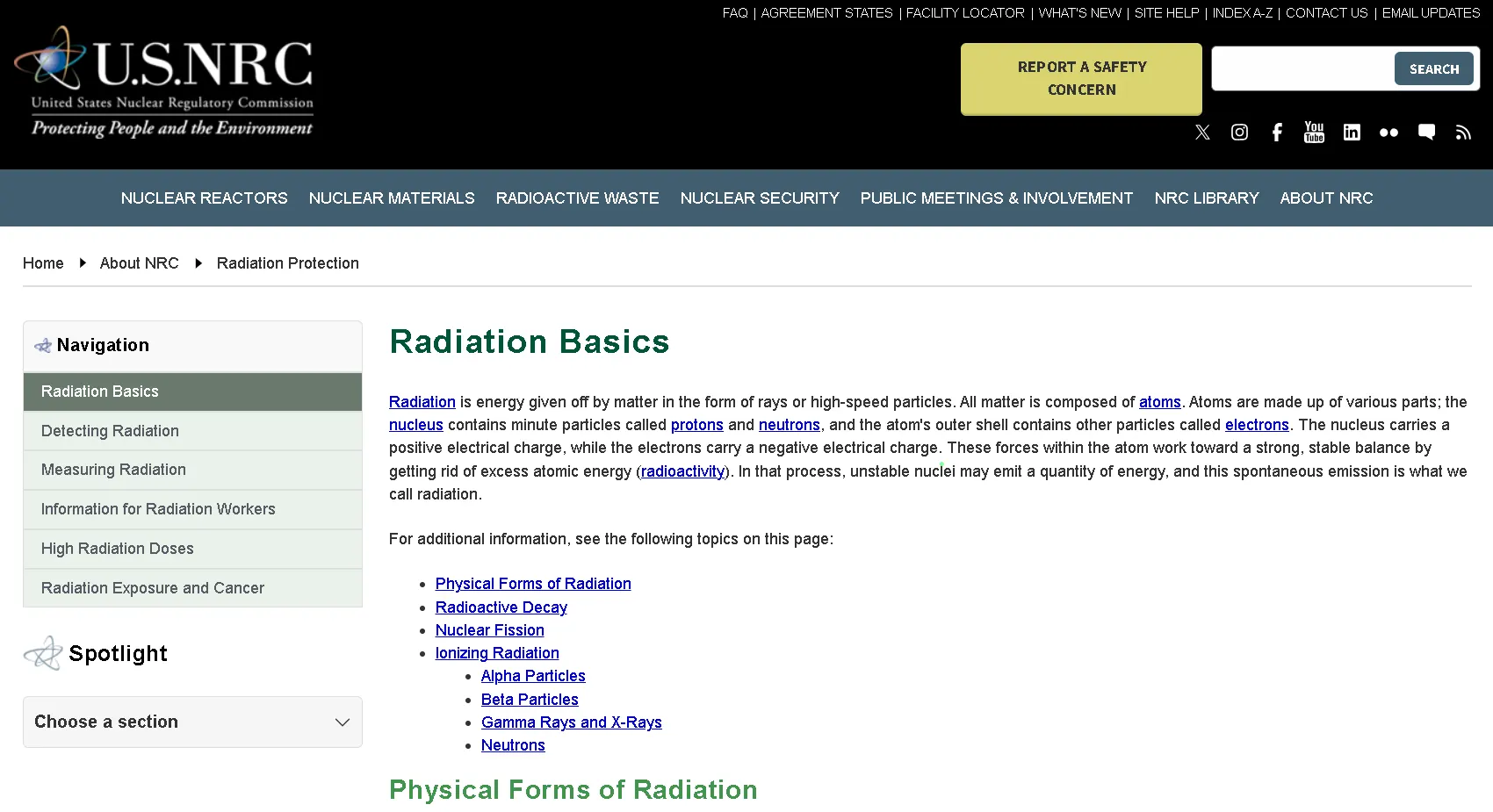
Learn the fundamentals of radiation, including types, sources, and health effects, with NRC educational resources.
What textbooks do Medical Physics tutors work with?
Tutors are familiar with commonly used Medical Physics textbooks including Khan’s The Physics of Radiation Therapy, Bushberg et al.’s The Essential Physics of Medical Imaging, and Cherry, Sorenson & Phelps’ Physics in Nuclear Medicine, among others. Tutors work from whatever prescribed text or course material your institution uses — share it before the first session and the tutor will align to it directly.
How does Medical Physics relate to other Physics subjects at MPB?
Medical Physics draws heavily on several foundational physics disciplines. Students who find they need to strengthen underlying knowledge can also find support through MPB’s dedicated pages for Radiation Physics, Nuclear Physics, Atomic Physics, and Waves and Optics. Students in imaging-focused programmes may also benefit from Electromagnetism support.
Can I get help preparing for Medical Physics professional certification exams?
MPB can support your preparation for Medical Physics certification examinations through structured concept review, problem-solving sessions, and targeted work on areas commonly assessed. Certification formats, eligibility requirements, and examination structures vary significantly by country and certifying body — always confirm the current requirements with the relevant organisation (such as the AAPM for ABR board certification in the US, or IPEM in the UK). MPB’s role is to build your conceptual and problem-solving depth, not to provide examination-specific materials from certifying bodies.
“Medical physicists are uniquely positioned at the interface of physical science and clinical medicine, requiring both deep technical knowledge and the ability to translate that knowledge into safe, effective patient care.”
American Association of Physicists in Medicine (AAPM) — What Is a Medical Physicist?
Trust & Quality at My Physics Buddy
How We Select Tutors
Medical Physics tutors at MPB are vetted specifically for this discipline — not hired as generalist physics tutors and reassigned. Every tutor completes a subject-specific assessment covering the areas they claim to teach before being listed. They demonstrate conceptual depth, ability to explain interdisciplinary content clearly, and familiarity with the exam or course formats relevant to their level. Student feedback after each session feeds into ongoing tutor quality reviews, and tutors with poor feedback are reviewed before being recommended again.
Academic Integrity
MPB operates on one clear principle: we guide, you submit your own work. Whether you are an undergraduate asking for help understanding a dosimetry assignment, a Masters student working through a lab report structure, or a PhD student drafting a methods section, the tutor explains, demonstrates, and gives feedback — they do not write or complete your work. This approach aligns with the academic integrity standards of every university and examination body across the US, UK, Canada, Australia, and Gulf. Medical Physics as a profession is built on precision and intellectual honesty — those values apply equally to how students learn it.
Why Physics-Focused Expertise Matters in Medical Physics
Medical Physics is not a subject that benefits from generalist tutoring. The physics foundations — radiation interactions, electromagnetic fields, wave physics, quantum mechanics of atomic transitions — must be understood at a level of rigour that supports clinical application. The Institute of Physics and Engineering in Medicine (IPEM) emphasises that professional Medical Physicists require training that goes well beyond surface familiarity with imaging modalities. MPB’s tutor vetting process reflects that standard.
Research on STEM tutoring outcomes — including data from the National Center for Education Statistics — consistently shows that students receiving targeted individual instruction perform significantly better in quantitative, reasoning-intensive subjects than those relying on group instruction alone. Medical Physics, which demands both mathematical precision and physical reasoning, is precisely the type of subject where 1:1 tutoring delivers its greatest advantage.
About My Physics Buddy
MPB is a Physics-focused online tutoring platform serving students from pre-university through PhD level across the US, UK, Canada, Australia, and Gulf. Medical Physics is one of MPB’s specialist subject areas, supported by tutors with direct academic and research-level experience in the discipline. Students working across related Physics subjects or exam-based courses can explore dedicated MPB pages for Ultrasound Physics, Radiographic Physics, and Biophysics. Students building foundational knowledge can find support through Physics and Modern Physics pages, while those exploring advanced theory can look at Quantum Mechanics and Electrodynamics.
“The application of physics to medicine has been one of the most transformative developments in modern healthcare — from diagnostic imaging to radiation therapy, physics underpins nearly every major advance in clinical technology.”
Content reviewed by a Medical Physics tutor at My Physics Buddy.
Additional References and Resources
The following credible external resources are useful for students and parents seeking authoritative information on Medical Physics education, professional standards, and career pathways:
- American Association of Physicists in Medicine (AAPM): The primary professional organisation for Medical Physicists in the US. Publishes widely referenced reports, task group documents, and training guidelines.
- Institute of Physics and Engineering in Medicine (IPEM): The leading professional body for Medical Physicists in the UK. Sets training and competency standards for the profession.
- International Commission on Radiological Protection (ICRP): The international authority on radiation protection principles. Essential background for radiation dosimetry and health physics components of any Medical Physics curriculum.
- US Nuclear Regulatory Commission — Radiation Basics: Clear, authoritative introductory resource on types of radiation, interaction mechanisms, and safety principles.
- International Atomic Energy Agency (IAEA) — Medical Physics Educational Resources: Freely available educational materials on medical radiation physics from the UN’s nuclear energy agency, used widely in academic programmes globally.
- National Library of Medicine — Radiation Dosimetry (StatPearls): A peer-reviewed clinical reference for dosimetry concepts, relevant to both undergraduate study and professional exam preparation.
A surreal distorted reflection blending a human face with natural and urban elements, symbolizing perception and visual distortion.
Next Steps
Tell us your current level in Medical Physics — undergraduate module, Masters programme, or PhD research area — along with the specific topics you need to focus on and any upcoming exam, assignment, or submission dates. Share your availability and time zone. MPB will match you to a tutor with the right subject-area depth, confirm the fit with you, and you can begin as soon as the next available slot. Most students are matched and have their first session booked within 24–48 hours.

