Hire Best IGCSE Physics (0625) Tutors Online

Testimonials



IGCSE Physics (0625) Tutor Online
My Physics Buddy (MPB) offers 1:1 online tutoring & homework help in Physics and related subjects. Cambridge IGCSE Physics (syllabus code 0625) is one of the most widely taken international science qualifications in the world — recognised by schools and universities across the UK, UAE, Saudi Arabia, Qatar, Australia, Canada, the US, and beyond. It is the foundation on which A Level, IB, and university physics are built. MPB connects students with specialist tutors for live, personalised sessions aligned to the Cambridge 0625 syllabus, your specific paper targets, and your exam series. Whether you are a student searching for an IGCSE Physics tutor near me, a parent looking for structured Cambridge Physics support, or a school coordinator seeking vetted online tutor coverage, MPB is built for this qualification. Sessions are designed to help you aim for strong grades at Core or Extended level and develop the physical reasoning that makes A Level and beyond genuinely accessible.
- 1:1 live sessions — fully aligned to the Cambridge IGCSE Physics (0625) syllabus
- Covers both Core and Extended tiers, and all paper formats including the Alternative to Practical
- Covers both the academic course content and standardised exam technique for Papers 1, 2, 3, 4, 5, and 6
- Tutors matched by tier, topic strengths, and your learning pace
- Flexible scheduling across UK, UAE, Saudi Arabia, Qatar, Australia, Canada, and US time zones
- Structured learning plan built after a diagnostic session
- Ethical homework and assignment guidance — we explain concepts, you submit your own work
Who This IGCSE Physics (0625) Tutoring Is For
Cambridge IGCSE Physics (0625) is taken by a wide range of students across many school systems and regions. MPB’s tutoring program is built to serve all of them.
- Year 10 and Year 11 students (or equivalent) in UK, Australian, or international schools following the Cambridge curriculum and preparing for May/June or October/November exam sessions
- Students in UAE, Saudi Arabia, Qatar, Bahrain, and other Gulf countries attending British-curriculum or Cambridge-accredited international schools
- Students in Canada, Australia, or the US taking Cambridge IGCSE as part of an international school program
- Students sitting the Extended tier and targeting grades A* to C, or Core tier students aiming for grades C to G
- Parents of IGCSE Physics students who want reliable, weekly expert support for their child ahead of a high-stakes exam
- Students who need guided help with homework problems, revision notes, practical paper technique, or understanding tricky concepts like electromagnetic induction or nuclear physics
- School coordinators at international schools looking for vetted online tutor support across a cohort of IGCSE students
Outcomes: What You’ll Be Able To Do in IGCSE Physics (0625)
Cambridge IGCSE Physics tests both factual recall and the ability to apply concepts to unfamiliar situations. Strong tutoring builds both. These are the kinds of capabilities that well-targeted preparation develops — they are observable outcomes, not guarantees.
Solve structured exam questions across all major 0625 topic areas — forces and motion, energy, waves, electricity, magnetism, and atomic physics — with the clarity and precision Cambridge mark schemes reward. Explain physical phenomena in the specific language the syllabus uses, matching assessment objective expectations for describe, explain, and calculate questions. Analyse unfamiliar scenarios and data in the way Cambridge’s higher-mark questions consistently demand, rather than relying on memorised responses. Handle practical and data-based questions in Paper 5 and Paper 6 (Alternative to Practical) with confidence — including drawing and interpreting graphs, estimating errors, and suggesting improvements. Apply mathematical skills at the IGCSE level — rearranging equations, working with units, and reading values from graphs — accurately and consistently across all paper types.
What We Cover in IGCSE Physics (0625) (Syllabus / Topics)
MPB’s coverage follows the Cambridge IGCSE Physics syllabus (0625), as published by Cambridge Assessment International Education (CAIE). Topic weightings and exact paper structures may vary by exam series — always verify current details with CAIE directly.
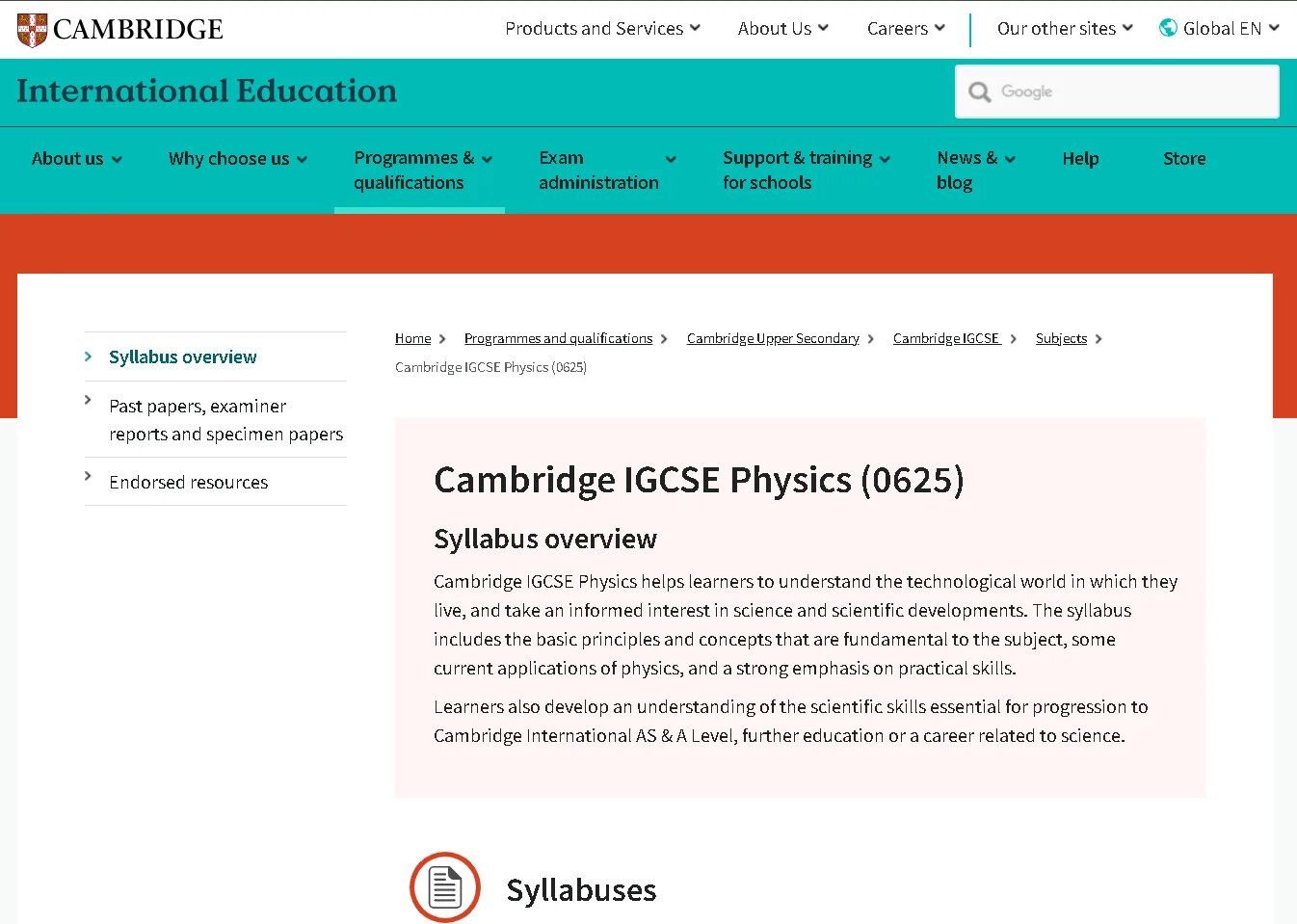
Explore the Cambridge IGCSE Physics course, covering core concepts, practical skills, and exam preparation for secondary students.
General Physics
- Measurements and units: length, mass, time, significant figures, SI units
- Motion: speed, velocity, acceleration, distance-time and velocity-time graphs
- Forces: Newton’s laws, weight, friction, resultant forces, terminal velocity
- Momentum: impulse, conservation of momentum (Extended)
- Energy, work, and power: energy stores and transfers, efficiency, conservation of energy
- Pressure: definition, pressure in fluids and gases, Boyle’s law (Extended)
Thermal Physics
- States of matter: particle model, changes of state, kinetic theory
- Thermal properties: specific heat capacity, specific latent heat, thermal expansion
- Transfer of thermal energy: conduction, convection, radiation — mechanisms and applications
Properties of Waves, Including Light and Sound
- General wave properties: amplitude, wavelength, frequency, wave speed, transverse and longitudinal waves
- Light: reflection, refraction, total internal reflection, lenses (converging and diverging), dispersion
- Electromagnetic spectrum: properties and uses of all regions
- Sound: production, transmission, speed in different media, ultrasound applications
Electricity and Magnetism
- Simple phenomena of magnetism: magnetic fields, magnetic materials, permanent and induced magnetism
- Electrical quantities: charge, current, voltage, resistance, Ohm’s law, I-V characteristics
- Electric circuits: series and parallel circuits, Kirchhoff’s laws at IGCSE level, potential dividers (Extended)
- Electrical energy and power: calculations, energy transfers in circuits
- Electromagnetic effects: electromagnetic induction, the generator effect, transformers, the motor effect
Atomic Physics
- The nuclear atom: protons, neutrons, electrons, isotopes, atomic number, mass number
- Radioactivity: alpha, beta, and gamma radiation — properties, penetration, detection
- Nuclear reactions: radioactive decay equations, half-life, background radiation, uses and hazards of radiation
- Nuclear fission and fusion: basic principles and energy release (Extended)
Practical Skills (Papers 3, 5, and 6)
- Planning experiments: identifying variables, designing fair tests, predicting outcomes
- Collecting and recording data: tables, units, significant figures, repeats
- Processing data: calculating derived quantities, plotting graphs, drawing best-fit lines
- Evaluating results: identifying sources of error, suggesting improvements, assessing reliability
- Alternative to Practical (Paper 6): interpreting experimental data and descriptions without live lab access
Exam Technique (Papers 1, 2, 4, 5, and 6)
- Multiple-choice strategy for Paper 1: managing time, eliminating distractors, checking units
- Structured question technique for Papers 2 and 4: interpreting command words (state, describe, explain, calculate, sketch)
- Mark scheme language: matching Cambridge’s expected phrasing without rote memorisation
- Extended tier preparation: tackling the harder calculation and explanation questions in Paper 4
- Past paper practice and examiner report analysis for common error patterns
Students who want to explore specific IGCSE Physics topic areas in greater depth, or who are looking ahead to post-IGCSE qualifications, can also visit related MPB pages including Waves and Optics, Electromagnetism, and Nuclear Physics.
How My Physics Buddy Tutors Help You with IGCSE Physics (0625) (The Learning Loop)
Diagnose: Every engagement starts with a diagnostic. The tutor identifies which 0625 topic areas are secure, which are unclear, and where your exam technique breaks down — whether that is explaining phenomena in the right language, handling graph work, or structuring multi-mark answers. This shapes every session that follows.
Explain: Cambridge IGCSE questions regularly reward students who can explain the physics clearly, not just recall a fact. Your tutor goes to first principles when needed — explaining why a transformer works, not just that it does — and adapts the explanation until the concept is genuinely understood, not just familiar-sounding.
Practice: You work through Cambridge-style questions live during sessions: Paper 1 multiple-choice with distractor analysis, structured Paper 2 and 4 questions with mark scheme comparison, and practical Paper 5 and 6 scenarios. The tutor watches your reasoning process, not just your final answer.
Feedback: After each question or question set, you receive specific, actionable feedback tied to Cambridge assessment expectations. “You described what happened but the mark scheme wants you to explain the mechanism — say why the current increases, not just that it does” is more useful than general praise or vague correction.
Retest / Reinforce: Topics from earlier sessions return in new question contexts. Electromagnetic induction, for example, appears across multiple question formats — motors, generators, transformers — and each encounter reinforces the core principle from a different angle.
Plan: The tutor updates the session plan based on your performance across topics, your exam series, and your growing confidence. You always know what the next session targets and why.
Accountability: For students on weekly plans, tutors monitor progress between sessions and help students stay on track with their school’s revision schedule and exam timeline.
Sessions run live on Google Meet with a digital pen-pad or iPad + Apple Pencil — useful for drawing circuit diagrams, ray diagrams, wave sketches, and graph annotations in real time. Before your first session, share your current syllabus unit, any recent test or past paper results, your tier (Core or Extended), and your exam series. The first session typically includes a short diagnostic covering two or three topic areas, a live teaching segment on your most urgent weak point, and a clear plan for the next two to four sessions.
Cambridge IGCSE is taken by over a million students each year across more than 160 countries, making it one of the most internationally recognised pre-16 qualifications in the world. According to Cambridge Assessment International Education, IGCSE results are used by schools and universities worldwide as a benchmark for academic readiness. Performing strongly at IGCSE Physics — particularly at the Extended tier — is one of the clearest indicators of readiness for Cambridge A Level, IB Physics, or equivalent advanced qualifications.
Tutor Match Criteria (How We Pick Your Tutor)
MPB matches you to a tutor based on several specific factors. Here is what goes into the decision for Cambridge IGCSE Physics (0625):
Level and tier fit: Your tutor will have direct experience with the Cambridge 0625 syllabus — including both Core and Extended tier content, the paper formats, and the mark scheme conventions that Cambridge uses at this level. Tutors understand the difference between what Core and Extended students are expected to produce and teach accordingly.
Topic strengths: If your weak area is electromagnetic induction, radioactivity, or wave properties, we match you with a tutor whose demonstrated strength covers that domain clearly and at the right level for IGCSE.
Tools and setup: All MPB tutors use Google Meet for live sessions and a digital pen-pad or iPad + Apple Pencil for real-time diagram work — drawing ray diagrams, circuit schematics, wave sketches, and field line diagrams as part of the explanation.
Time zone and availability: Tutors are available across UK, UAE, Saudi Arabia, Qatar, Australia, Canada, and US time zones — covering the full spread of regions where Cambridge IGCSE is taken. Sessions fit around your school timetable and revision schedule.
Learning style and pace: Some students need careful, step-by-step concept building. Others want rapid-fire past paper practice. Your tutor adjusts the approach to match what actually works for you.
Language and communication preferences: Clear, accessible English-language instruction is the default, with communication style adapted to your age, background, and comfort level.
Goals: A student targeting A* at Extended tier has different session needs than one aiming to pass Core, catch up on missed content, or prepare for a specific paper. We align on your goal before sessions begin.
Urgency and timeline: A student with four weeks to the May/June exam gets a focused, targeted plan. A student starting at the beginning of Year 10 gets a paced, full-course structure. Tutor selection accounts for your remaining time and exam series.
Study Plans (Pick One That Matches Your Goal)
MPB offers three broad plan types for Cambridge IGCSE Physics (0625): a short catch-up plan (typically one to two weeks) for students who need to close specific topic gaps quickly before an exam, an exam prep plan (typically four to eight weeks) for structured revision across the full paper set, and an ongoing weekly support plan for students who want consistent expert guidance across Year 10 and Year 11. The tutor builds the specific session-by-session plan after the diagnostic — no fixed schedule is set until your starting point, target grade, tier, and exam series are clearly understood.
Pricing Guide
IGCSE Physics (0625) tutoring at MPB starts at USD 20 per hour and typically ranges up to USD 40 per hour for most IGCSE-level sessions. Pricing depends on the tutor’s experience and qualification level, whether you are on the Core or Extended tier, your exam timeline and session frequency, and the depth of topic coverage required. All rates are discussed transparently before you commit to any plan.
IGCSE Physics is both a rigorous academic course and a standardised international exam. Students who treat preparation as only one of these — pure content learning without exam technique, or only past paper drilling without conceptual depth — tend to leave marks on the table. The highest-scoring students combine both: they understand the physics and they know exactly how Cambridge expects them to express it.
FAQ
Is IGCSE Physics (0625) hard?
IGCSE Physics is considered one of the more demanding IGCSE sciences, especially at the Extended tier. It requires both factual understanding and the ability to apply concepts to unfamiliar situations. Most students find it very manageable with consistent study and clear concept-building — the challenge is more about depth of understanding than volume of content.
How many sessions are needed?
This depends on your current level, tier, exam date, and target grade. Students doing targeted gap-filling before an exam may need four to eight sessions. Students on a full-year weekly support plan across Year 10 and Year 11 typically benefit from regular sessions throughout both years. Your tutor will give a more specific estimate after the diagnostic session.
Can you help with IGCSE Physics homework or assignments?
Yes — as guided support, not submission. Your tutor will walk through problem-solving strategies, explain the physics behind confusing questions, and help you understand why an answer did or did not match the mark scheme. MPB does not complete or submit work for students. All guidance is for learning and reference purposes only, and students are expected to submit their own work at all times.
Does the tutoring exactly match my school’s 0625 syllabus sequence?
MPB follows the official Cambridge IGCSE Physics (0625) syllabus. Since schools sequence topics differently across Year 10 and Year 11, it helps to share your school’s current chapter or unit before the first session. The tutor will align sessions to wherever you are in your school’s teaching order rather than imposing a separate sequence.
What happens in the first session?
The first session includes a short diagnostic covering two or three 0625 topic areas, a live teaching segment on your most urgent weak point, and a clear plan for the next two to four sessions. Come prepared with your current syllabus unit, any recent test or past paper results, your tier (Core or Extended), and your exam series. The session runs on Google Meet with digital pen-pad support.
Is online tutoring as effective as in-person for IGCSE Physics?
For a structured, content-driven qualification like Cambridge 0625, online tutoring with digital pen-pad tools is highly effective. Your tutor can draw circuit diagrams, ray diagrams, field sketches, and velocity-time graphs in real time while you interact with the explanation. Research on online STEM learning published by EDUCAUSE suggests that one-on-one online instruction compares favourably to in-person formats when the tools and tutor quality are strong.
What is the difference between Core and Extended tier in IGCSE Physics?
Core tier (Papers 1 and 3) covers a subset of the syllabus and targets grades C to G. Extended tier (Papers 2 and 4, plus practical papers) covers the full syllabus including additional content on momentum, Boyle’s law, nuclear fission and fusion, and more complex circuit analysis — targeting grades A* to G. Most students aiming for A Level Physics are advised to take the Extended tier. Your tutor will work with whichever tier is relevant to you.
Can you help with Paper 5 and the Alternative to Practical (Paper 6)?
Yes. Practical skills are a significant assessed component of Cambridge 0625. Your tutor can walk through planning experiments, drawing and interpreting graphs with best-fit lines, estimating errors, and structuring evaluation answers. Paper 6 (Alternative to Practical) requires students to answer questions based on experimental data and descriptions without live lab access — your tutor can provide targeted practice specifically for this format.
Does IGCSE Physics prepare students for A Level or IB Physics?
Yes — Cambridge IGCSE Physics (0625) is specifically designed as preparation for Cambridge A/AS Level and equivalent advanced qualifications. Students who complete IGCSE Physics with a strong Extended tier foundation find the transition to A/AS Level Physics (9702) significantly more manageable. Students considering the International Baccalaureate can also explore IB Physics HL/SL on MPB.
What resources does MPB use alongside the 0625 syllabus?
Tutors work from the official Cambridge IGCSE Physics (0625) syllabus document and Cambridge past papers and mark schemes, available via the Cambridge International past papers portal. Examiner reports are also used to identify common student errors. If your school uses a specific textbook — such as the Cambridge IGCSE Physics coursebook by Sang and Jones — share it beforehand and the tutor will incorporate it.
Can MPB help with other Cambridge Physics qualifications beyond IGCSE?
Yes. MPB supports the full Cambridge Physics pathway. Students who have completed IGCSE and are moving on to advanced study can explore A/AS Level Physics (9702) or GCSE Physics tutoring on MPB. For students in the Gulf region also sitting local assessments, MPB’s EmSAT Physics page may also be relevant.
What common mistakes do IGCSE Physics students make in exams?
Based on Cambridge examiner reports, common errors include: giving incomplete explanations (describing what happens without explaining why), dropping units in calculations, misreading graph scales, confusing speed with velocity or energy with power, and not using the correct scientific terminology in describe and explain questions. Your tutor actively targets these patterns based on your past paper performance and the specific examiner reports for your topic areas.
Trust & Quality at My Physics Buddy
Tutor selection: MPB tutors for IGCSE Physics (0625) hold degrees in Physics, Engineering Physics, or closely related quantitative fields. Every tutor goes through a subject screening that includes a live demo session and an ongoing student feedback loop. Tutors are familiar with the Cambridge 0625 assessment structure, mark scheme conventions, and the specific language Cambridge rewards at IGCSE level. They are not generalists — they are matched to the qualification, tier, and topic areas you are preparing for.
Academic integrity: MPB’s position is clear — we guide, you submit your own work. Tutors explain physics concepts, work through similar practice questions, and provide feedback on your reasoning and exam technique. They do not write answers for students to copy or submit. This protects your academic record and ensures genuine learning occurs. All guidance is framed as explanation, structured feedback, and conceptual clarification — consistent with Cambridge’s academic honesty policies and your school’s integrity requirements.
About MPB: My Physics Buddy is a Physics-focused online tutoring platform serving students from secondary school through to postgraduate level, across the US, UK, Canada, Australia, and Gulf regions. Our core is Physics and closely related quantitative subjects. Students working across related physics topics or adjacent qualifications can also explore Physics (general overview), Kinematics, and Thermodynamics on MPB — all areas that build directly on IGCSE foundations.
Physics education research consistently shows that students who receive targeted, formative feedback during structured problem-solving develop significantly stronger ability to handle unfamiliar question types — exactly the kind of questions Cambridge places at the top end of its mark scheme. A study published in the Physical Review Physics Education Research journal found this effect was particularly pronounced in students who had previously relied on passive re-reading and memorisation rather than active problem-solving practice. MPB’s learning loop is built to address this directly.
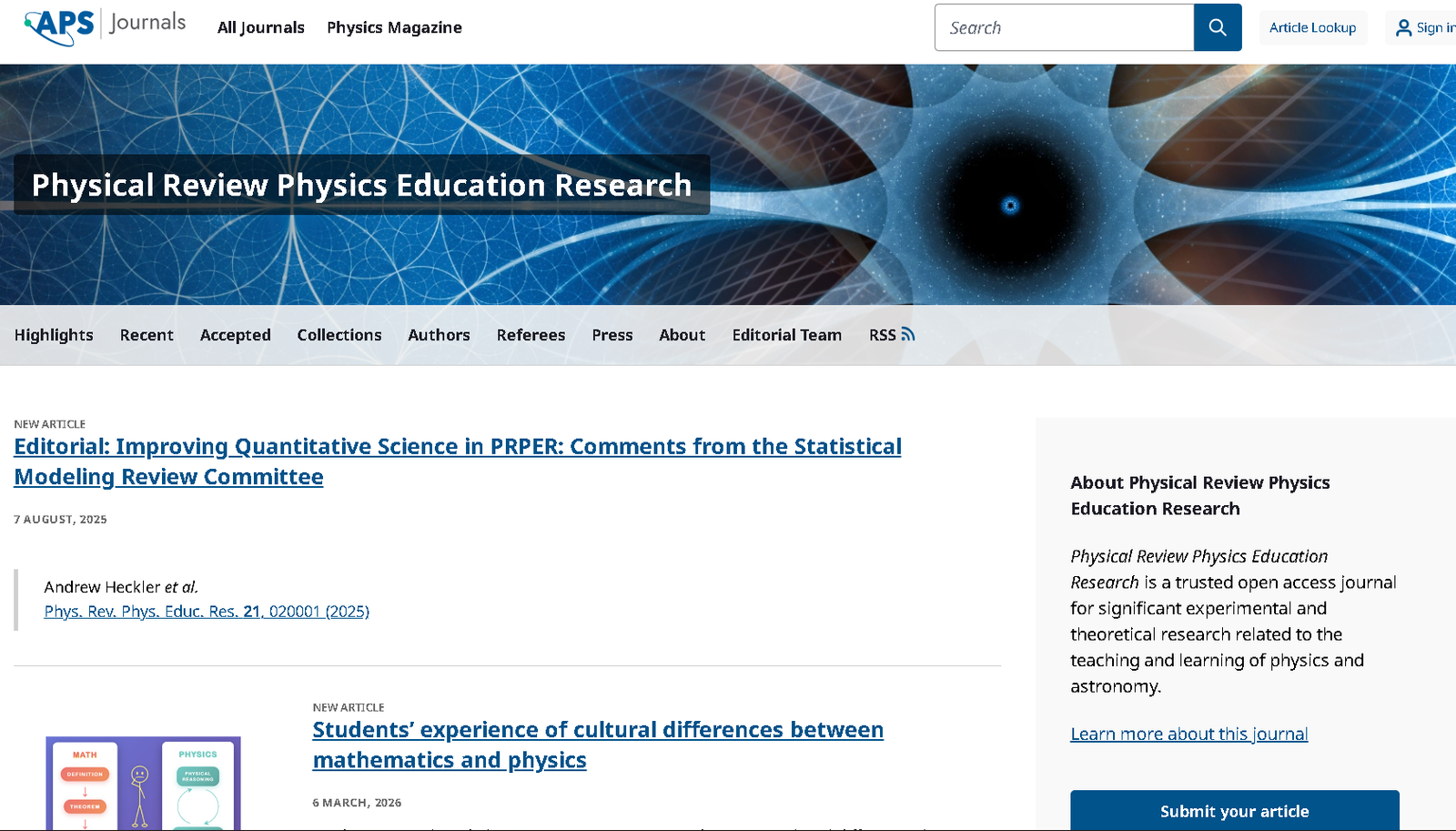
APS Journals page featuring Physical Review Physics Education Research, a leading journal publishing research on physics teaching and learning.
“Cambridge IGCSE develops learners who are confident, responsible, reflective, innovative and engaged — and who demonstrate a thorough knowledge of the subject matter as well as the skills to apply that knowledge in new contexts.”
— Cambridge Assessment International Education, Benefits of a Cambridge Education
Students who build a strong IGCSE Physics foundation often find the transition to more advanced study — including Electrostatics, Waves and Optics, and Modern Physics at A Level or university level — considerably smoother. MPB supports students through this progression, not just at the IGCSE stage.
“The single most effective intervention in student learning is not more content — it is timely, specific, individualised feedback that tells a student exactly what to do differently and why.”
— Based on findings in Bloom’s 2-Sigma Study, Educational Researcher (1984)
Content reviewed by an IGCSE Physics (0625) tutor at My Physics Buddy.
Next Steps
Tell us your tier (Core or Extended), your current unit or topic in the 0625 syllabus, your exam series (May/June or October/November), your target grade, and your main challenge areas — whether that is electromagnetic induction, radioactivity, wave properties, practical paper technique, or exam question structure. We will match you with a tutor whose background fits your level and timeline. Most students are matched and into their first session within a few days of reaching out. Scheduling is flexible across all primary time zones.

