GRE Physics Tutor Online
My Physics Buddy (MPB) offers 1:1 online tutoring & homework help in Physics and related subjects — and GRE Physics Subject Test preparation is one of our most specialized and high-stakes tutoring areas. The GRE Physics Subject Test is both a rigorous academic subject review and a standardized exam administered by Educational Testing Service (ETS), required or recommended by many graduate physics programs in the US and internationally. It tests the equivalent of a full undergraduate physics degree across multiple domains in a single, time-pressured sitting. Whether you are a final-year undergraduate, a recent graduate, or a student returning to physics after a gap, MPB connects you with tutors who understand the breadth and depth this exam demands. If you’ve been searching for a GRE Physics tutor near me and want the depth and flexibility of personalized online preparation, you are in the right place. Our sessions are designed to improve conceptual recall, problem-solving speed, and multi-topic reasoning — with honest, structured guidance and no over-promises.
- 1:1 live sessions — fully personalized to your undergraduate background and target program level
- Expert tutors with strong knowledge across all GRE Physics Subject Test domains
- Flexible time zones — sessions available for students in the US, UK, Canada, Australia, and Gulf regions
- Structured learning plan built around your diagnostic performance, weakest domains, and test date
- Ethical guidance on practice and review — we explain, walk through, and reinforce; you develop and own the understanding
Who This GRE Physics Tutoring Is For
GRE Physics Subject Test preparation is for students applying to graduate physics programs who need a rigorous, expert-guided review of their entire undergraduate physics curriculum under exam conditions.
- Final-year undergraduate physics students in the US, UK, Canada, Australia, and Gulf who are applying to PhD or Masters programs requiring the GRE Physics Subject Test
- Recent physics graduates who studied the content but need to consolidate, recall, and apply it quickly under timed conditions
- Students from adjacent majors — engineering physics, applied physics, astrophysics — who have most of the content but have gaps in specific domains like quantum mechanics or statistical mechanics
- International students applying to US graduate programs where a competitive GRE Physics score strengthens an application
- Students retaking the GRE Physics Subject Test who need targeted work on the specific domains where their previous score was weakest
- Graduate students and PhD candidates whose programs recommend or require strong GRE Physics performance for fellowship applications or qualifying exam preparation
Outcomes: What You’ll Be Able To Do in GRE Physics
Structured, consistent preparation with an MPB GRE Physics tutor is designed to build the specific, observable skills that the exam rewards — speed, breadth, and multi-domain reasoning all at once.
Solve classical mechanics problems — from Lagrangian and Hamiltonian formulations to oscillations, central force motion, and rigid body dynamics — at the speed and accuracy the GRE Physics format demands. Analyze electromagnetism problems spanning electrostatics, magnetostatics, electromagnetic waves, and circuit analysis, applying Maxwell’s equations at the level expected of a strong undergraduate physics graduate. Apply quantum mechanics concepts — wavefunctions, operators, perturbation theory, angular momentum, and identical particles — to the variety of question types that regularly appear across the quantum mechanics domain of the exam. Recall and deploy thermodynamics and statistical mechanics results — partition functions, entropy, ensembles, and phase transitions — quickly and accurately, which is where many students lose significant marks due to under-preparation of this domain. Identify the fastest solution path for each question type, which is a distinct, trainable skill in the GRE Physics context given the exam’s pace requirements — approximately 100 seconds per question across 100 questions.
What We Cover in GRE Physics (Syllabus / Topics)
The GRE Physics Subject Test is developed and administered by ETS. The approximate content weightings below are based on publicly available ETS guidance and are high-level; exact proportions may vary by test form. Always verify current details directly with ETS. Your tutor will align your preparation precisely to the current published content outline and your own diagnostic performance.
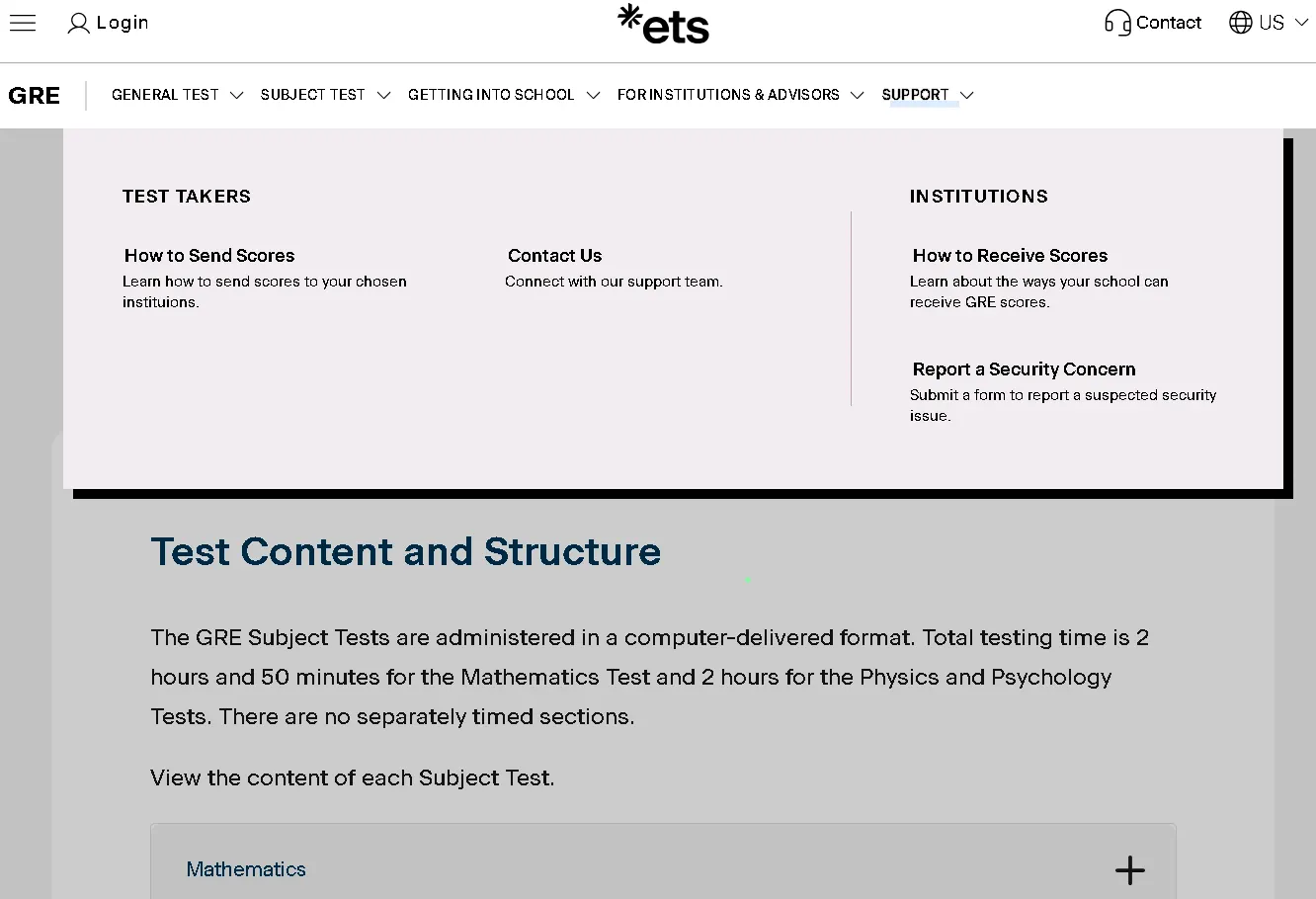
Understand the GRE Physics Subject Test structure, including key topics, question types, and exam format.
Track 1: Classical Mechanics (approx. 20% of exam)
- Kinematics and Newton’s laws; conservation of energy and momentum
- Oscillations: simple harmonic motion, damped and driven oscillators
- Central force motion and orbital mechanics
- Rigid body motion: moment of inertia, angular momentum, torque
- Lagrangian and Hamiltonian mechanics: generalized coordinates, equations of motion
- Non-inertial reference frames and fictitious forces
- Problem types: multi-step calculation, conceptual reasoning, Lagrangian setup and solution
Track 2: Electromagnetism (approx. 18% of exam)
- Electrostatics: Coulomb’s Law, Gauss’s Law, electric potential, capacitance
- Magnetostatics: Biot-Savart Law, Ampere’s Law, magnetic vector potential
- Maxwell’s equations in integral and differential form
- Electromagnetic waves: propagation, polarization, boundary conditions
- DC and AC circuits: Kirchhoff’s rules, impedance, resonance
- Electromagnetic induction; Faraday’s and Lenz’s laws
- Problem types: field calculations, boundary value setups, circuit analysis, wave propagation
Track 3: Quantum Mechanics (approx. 12% of exam)
- Wave functions, the Schrödinger equation (time-dependent and time-independent)
- Operators, eigenvalues, expectation values, and commutation relations
- Infinite square well, harmonic oscillator, hydrogen atom solutions
- Angular momentum and spin; Clebsch-Gordan decomposition
- Time-independent perturbation theory: first and second order corrections
- Identical particles: bosons, fermions, exchange symmetry
- Problem types: eigenvalue calculation, perturbation correction, selection rule application
Track 4: Thermodynamics and Statistical Mechanics (approx. 10% of exam)
- Laws of thermodynamics; thermodynamic potentials
- Carnot cycle, entropy, and the second law
- Kinetic theory and the Maxwell-Boltzmann distribution
- Classical statistical mechanics: partition functions and ensemble theory
- Quantum statistical mechanics: Fermi-Dirac and Bose-Einstein distributions
- Phase transitions and the equipartition theorem
- Problem types: partition function evaluation, entropy change calculations, distribution function application
Track 5: Atomic Physics (approx. 10% of exam)
- Hydrogen atom: energy levels, quantum numbers, spectral series
- Multi-electron atoms: electron configurations, Hund’s rules, the periodic table
- The Zeeman effect and the Stark effect
- Atomic transitions, selection rules, and spectroscopy
- Lasers: stimulated emission, population inversion, laser operation principles
- Problem types: energy level identification, transition probability, spectroscopic line analysis
Track 6: Special Relativity (approx. 6% of exam)
- Lorentz transformations and their consequences
- Time dilation, length contraction, and relativistic velocity addition
- Relativistic energy and momentum; four-vectors
- Invariant mass and relativistic kinematics of particle collisions
- Problem types: Lorentz transformation calculation, invariant mass problems, relativistic energy scenarios
Track 7: Laboratory Methods (approx. 6% of exam)
- Data analysis: error propagation, statistical and systematic uncertainty
- Electronics: op-amps, filters, digital logic basics
- Radiation detection: Geiger counters, scintillators, photodetectors
- Experimental design and measurement principles
- Problem types: error analysis, circuit identification, detector physics scenarios
Track 8: Specialized Topics (approx. 18% combined — varies by test form)
- Nuclear and particle physics: nuclear structure, decay modes, conservation laws, Standard Model basics
- Condensed matter physics: crystal structure, band theory, semiconductors, superconductivity basics
- Waves and optics: interference, diffraction, polarization, geometric optics
- Mathematical methods: differential equations, linear algebra, complex analysis, Green’s functions
- Problem types: nuclear decay calculation, band gap reasoning, optical path difference, mathematical physics application
Students preparing for GRE Physics who also want deeper subject-level support in specific domains can explore MPB’s dedicated pages for Quantum Mechanics, Statistical Mechanics, and Electromagnetism.
How My Physics Buddy Tutors Help You with GRE Physics (The Learning Loop)
Diagnose: Every engagement starts with a thorough diagnostic. The tutor reviews your undergraduate curriculum, which domains you covered most recently and most deeply, which areas feel rustiest, and your target test date and score goal. A diagnostic problem set across multiple domains is often used in the first session to map your actual starting performance — not just your self-assessment of it.
Explain: The tutor rebuilds and sharpens each domain using clear, graduate-appropriate explanations that connect physical intuition to mathematical formalism. For GRE Physics, the goal is rapid, accurate recall under pressure — so explanations are structured for retention and quick deployment, not just passive understanding.
Practice: You work through official ETS practice problems and high-quality supplemental problems across all domains, with increasing emphasis on timed conditions as the test date approaches. Problem selection is strategic — covering the question types and difficulty levels that appear most consistently in the GRE Physics Subject Test.
Feedback: After each practice block, your tutor reviews your reasoning process in detail — where you lost time, where your setup was wrong, where you applied an approximation that wasn’t valid, and which domain areas are costing you the most marks. Feedback is specific, actionable, and anchored to the actual GRE Physics content distribution.
Retest/Reinforce: Domains where errors cluster are revisited with progressively harder problems and varied question types. Reinforcement is spaced deliberatly so that recall under timed conditions improves consistently, not just in the session where a topic was reviewed.
Plan: Your tutor maintains a domain-by-domain roadmap anchored to your test date and diagnostic performance. The plan is adjusted based on your weekly practice performance, shifting emphasis to wherever the return on session time is greatest as the exam approaches.
Accountability: For GRE Physics preparation, structured self-study between sessions is critical. Tutors assign specific timed practice sets, topic reviews, and formula consolidation tasks, and track completion and performance data across sessions to build cumulative momentum.
All sessions run on Google Meet, with a digital pen-pad or iPad + Pencil for live derivations, problem-solving walkthroughs, and domain-by-domain review. Teaching depth is calibrated to graduate program readiness — explanations assume undergraduate physics background and build from there, not from scratch.
First session flow: Your first session starts with a diagnostic discussion covering your undergraduate program, which courses you took and how recently, your test date, and your target programs. The tutor then works through a short diagnostic problem set across 3–4 key domains and delivers immediate feedback. The session closes with a clear preparation roadmap. Before the session, it helps to share your undergraduate transcript or course list, any previous GRE Physics attempt scores, and your application timeline.
Tutor Match Criteria (How We Pick Your Tutor)
MPB selects your GRE Physics tutor based on several overlapping criteria — at this level, depth across the full undergraduate curriculum is non-negotiable.
Level and exam fit: Your tutor will have strong command across all GRE Physics Subject Test domains — classical mechanics, electromagnetism, quantum mechanics, statistical mechanics, atomic physics, and beyond. We specifically look for tutors with graduate-level physics backgrounds who have direct experience with the breadth the exam demands.
Topic strengths and tools: For GRE Physics, we prioritize tutors who are equally confident in both calculation-heavy domains like classical mechanics and electromagnetism and conceptually demanding areas like quantum mechanics and statistical mechanics. Tools used include Google Meet and digital pen-pad or iPad + Pencil for live derivations and problem walkthroughs.
Time zone and availability: Tutors are matched for availability across US (ET, CT, PT), UK (GMT/BST), Canada, Australia (AEST/AEDT), and Gulf (GST/AST) time zones. Flexible scheduling is available for students managing applications and coursework simultaneously.
Learning style and pace: Some students need a systematic domain-by-domain curriculum rebuild; others prefer targeted drilling on identified weak areas. Your tutor adapts to the preparation strategy that maximizes your score improvement given your specific background and timeline.
Language and communication preferences: All MPB tutors communicate in clear English and adjust explanation depth between conceptual overview and full mathematical rigour based on what the session demands.
Goals: Whether you are aiming to cross a minimum threshold for program admission, trying to reach a highly competitive percentile for top PhD programs, or retaking to improve a previous score, the tutor’s structure is calibrated to that specific goal.
Urgency and timelines: Students with a test date weeks away get an intensive, domain-triage structure focused on highest-yield areas. Students preparing months out get a full, systematic curriculum review. Both are planned explicitly after the diagnostic session.
Study Plans (Pick One That Matches Your Goal)
MPB offers three broad plan types for GRE Physics preparation: an intensive catch-up plan (typically 1–2 weeks) for students with an imminent test date who need rapid domain triage and high-yield problem drilling, a full exam prep plan (typically 4–8 weeks) that works systematically through every GRE Physics domain with diagnostic-driven prioritization and progressive timed practice, and ongoing weekly support for students preparing well in advance who want consistent expert guidance across a full semester before their test date. The specific session plan — domain sequence, timed practice schedule, and review strategy — is built by your tutor after the diagnostic session, ensuring it reflects your actual undergraduate background, current gaps, and test timeline.
Pricing Guide
GRE Physics tutoring at MPB starts at USD 20 per hour and typically ranges up to USD 40 per hour for standard exam preparation sessions. Given the graduate-level breadth and depth of the GRE Physics Subject Test, sessions requiring specialist tutor expertise across advanced domains — quantum mechanics, statistical mechanics, classical field theory — may be priced higher, in some cases up to USD 100 per hour. Pricing varies based on the tutor’s background, the complexity and depth of content required, and timeline urgency. Supply and demand also affects rates — availability of specialist tutors and session frequency can influence the final quote.
For a specific quote based on your background, preparation timeline, and test date, WhatsApp for quick quote.
FAQ
Is the GRE Physics Subject Test hard?
The GRE Physics Subject Test is widely considered one of the most demanding subject tests administered by ETS. It covers the full scope of an undergraduate physics degree — across mechanics, electromagnetism, quantum mechanics, statistical mechanics, atomic physics, and more — in 100 questions over 170 minutes. The difficulty comes as much from breadth and speed as from individual question complexity. Targeted, structured preparation makes a measurable difference in performance.
How many sessions are needed?
It depends heavily on your undergraduate background, how recently you studied each domain, and your test date. Students with 8–12 weeks of preparation time typically benefit from 2–3 sessions per week. Students with a shorter timeline do intensive daily or near-daily sessions on the highest-yield domains. Your tutor will give a specific estimate after the first diagnostic session once your domain-by-domain starting point is mapped.
Can you help with GRE Physics practice problems and review sets?
Yes — MPB provides guided problem review and practice set walkthroughs throughout your preparation. Tutors work through official ETS practice problems and supplementary materials with you, explaining the reasoning, identifying faster solution paths, and reviewing errors in detail. Our services aim to provide personalized academic guidance to help you understand concepts and improve your skills. All practice work is your own — tutors guide the learning, not the submission.
Does MPB cover all GRE Physics domains or only specific ones?
MPB covers all GRE Physics Subject Test domains — classical mechanics, electromagnetism, quantum mechanics, thermodynamics and statistical mechanics, atomic physics, special relativity, laboratory methods, nuclear physics, condensed matter, waves and optics, and mathematical methods. Domain emphasis in sessions is determined by your diagnostic performance, not by a fixed curriculum, so your preparation time is always focused where it matters most for your specific score profile.
What happens in the first session?
The first session begins with a diagnostic discussion — your undergraduate program, courses taken, time since graduation, previous GRE Physics attempt if applicable, and your target test date and programs. The tutor then works through a short diagnostic problem set across several key domains to map your actual starting performance. The session closes with a prioritized preparation roadmap. Bring your undergraduate course list, any previous practice test scores, and your application and test date timeline.
Is online tutoring effective for GRE Physics preparation?
Yes — for GRE Physics preparation specifically, online 1:1 sessions are highly effective. The format allows the tutor to move fluidly across domains within a single session, work through derivations and calculations live on a digital whiteboard, and share and annotate practice problems in real time. Students across the US, UK, and internationally find the flexibility of online scheduling essential when balancing GRE prep with final-year coursework and graduate applications simultaneously.
What score do I need on the GRE Physics Subject Test?
Score requirements vary significantly by program and institution. Top PhD programs in physics at research universities in the US often see applicants with scores in the 90th percentile or higher, though this varies by program and year. Some programs list no minimum and evaluate scores holistically. Always verify requirements directly with each program you are applying to. The ETS GRE Subject Test score interpretation page provides useful context on percentile distributions.
How is the GRE Physics Subject Test different from general GRE preparation?
The GRE Physics Subject Test is a completely separate exam from the GRE General Test. It tests deep subject knowledge across the full undergraduate physics curriculum — not verbal reasoning, quantitative aptitude, or analytical writing. Preparation for it is essentially a comprehensive undergraduate physics review conducted under timed, exam-strategy conditions. Students preparing for the general GRE and the Physics Subject Test simultaneously need separate, distinct preparation tracks for each. MPB supports the Physics Subject Test specifically.
Can tutoring help if I studied engineering physics rather than pure physics?
Yes — engineering physics and applied physics students often have strong coverage in classical mechanics, electromagnetism, and some modern physics, but may have gaps in quantum mechanics, statistical mechanics, or atomic physics as taught in a pure physics curriculum. Your tutor will identify those gaps in the diagnostic session and build a plan that fills them efficiently without wasting time on domains you already cover well. MPB also offers dedicated support in Engineering Physics for students whose background sits at that intersection.
Does strong GRE Physics preparation help with graduate qualifying exams?
Yes — significantly. The GRE Physics Subject Test and most physics graduate qualifying exams draw on the same broad undergraduate curriculum. Students who prepare rigorously for the GRE Physics Subject Test often find that their qualifying exam readiness improves in parallel, particularly in classical mechanics, electromagnetism, and quantum mechanics. Students looking ahead to graduate-level coursework can also explore MPB’s pages for Quantum Mechanics, Statistical Mechanics, and Classical (Newtonian) Mechanics.
Academic Integrity Note: Our services aim to provide personalized academic guidance, helping students understand concepts and improve skills. Materials provided are for reference and learning purposes only. Misusing them for academic dishonesty or violations of academic integrity policies is strongly discouraged.
Trust & Quality at My Physics Buddy
Tutor selection: Every MPB tutor goes through a subject knowledge screening, a live demo session evaluation, and an ongoing student feedback review process. For GRE Physics, we specifically look for tutors with graduate-level physics backgrounds who are strong across the full breadth of the undergraduate curriculum — not just one or two domains. The ability to move fluidly between classical mechanics, quantum mechanics, electromagnetism, and statistical mechanics within a single session is essential at this level, and tutors are evaluated accordingly.
Academic integrity: MPB’s role is to guide, explain, and build understanding — not to complete work for students. In all practice review, problem set walkthroughs, and preparation sessions, tutors explain concepts, work through analogous examples, and provide feedback on the student’s own reasoning. All work is the student’s own. This approach builds the genuine, rapid-recall understanding that the GRE Physics Subject Test — and graduate school itself — actually requires.
About My Physics Buddy: MPB is a Physics-focused online tutoring platform serving undergraduate students, graduate students, PhD candidates, and their families across the US, UK, Canada, Australia, and Gulf regions. Our core is Physics and closely related quantitative subjects. Students preparing for GRE Physics can also explore subject-specific depth through MPB’s dedicated pages for Special Relativity, Atomic Physics, Nuclear Physics, Waves and Optics, and Thermodynamics — all domains directly tested in the GRE Physics Subject Test and available for deeper focused support at MPB.
“The GRE Physics Subject Test measures your knowledge of the subject matter emphasized in many undergraduate programs in physics and can help predict your success in graduate study.”
Educational Testing Service (ETS) — Official GRE Physics Subject Test description
“Graduate education in physics requires not just depth in a research specialty, but a broad command of the fundamental principles across the discipline. That breadth is what the GRE Physics Subject Test is designed to evaluate.”
As broadly affirmed in physics graduate education literature — see the American Physical Society (APS) Education and Diversity programs

Explore how APS supports physics departments with programs, resources, and initiatives to enhance teaching, diversity, and student success.
Explore Related Advanced Physics Subjects at MPB: GRE Physics preparation naturally spans the full undergraduate curriculum. MPB has dedicated tutoring pages for every major domain tested — including Quantum Mechanics, Statistical Mechanics, Electromagnetism, Classical (Newtonian) Mechanics, and Modern Physics. If any single domain needs deeper, focused work alongside your overall GRE prep, these pages are your starting point.
Content reviewed by a GRE Physics tutor at My Physics Buddy.
Next Steps
Getting started is straightforward. Share your undergraduate physics background, the domains where your knowledge feels rustiest, your target GRE Physics test date, and the graduate programs you are applying to. Let us know your preferred session times and time zone. MPB will match you with a tutor whose command of the full GRE Physics curriculum, availability, and teaching approach fit your preparation needs. Your first session is a diagnostic and live teaching session — so you leave with both a mapped starting point across key domains and a concrete, prioritized preparation plan for the weeks ahead.

