Hire Best Computational Physics Tutors Online

Testimonials

Computational Physics Tutor Online
My Physics Buddy (MPB) offers 1:1 online tutoring & homework help in Physics and related subjects — and Computational Physics is one of our dedicated tutoring areas for undergraduate and graduate physics, engineering, and applied mathematics students worldwide. Computational Physics is taught as a core or elective course in physics programs at universities across the US, UK, Canada, Australia, and internationally. It bridges analytical physics with numerical methods and scientific programming — teaching students how to solve physical problems that have no closed-form analytical solution using algorithms, simulations, and data analysis. The course is demanding on two fronts simultaneously: students must understand both the physics being modeled and the numerical and programming techniques being applied. Whether you are a second-year student encountering numerical methods for the first time, or a third-year student working through molecular dynamics simulations and Monte Carlo methods, MPB connects you with tutors who understand both sides of that challenge. If you’ve been searching for a Computational Physics tutor near me and want the depth and flexibility of personalized online learning, you are in the right place.
- 1:1 live sessions — fully personalized to your course level, programming language, and assessment schedule
- Expert tutors with strong knowledge across numerical methods, scientific programming, and Computational Physics course content
- Flexible time zones — sessions conveniently scheduled for the US, UK, Canada, Australia, and Gulf regions
- Structured learning plan built around your syllabus, weakest topics, and upcoming project or exam deadlines
- Ethical homework and assignment guidance — we explain and guide; you complete and submit your own work
“Computational physics has become the third pillar of science — alongside theory and experiment. Every modern physicist needs to be able to simulate, model, and analyze physical systems numerically. It is no longer optional.”
As broadly reflected in physics education — see the American Physical Society (APS) — Education programs
Explore how APS supports physics departments with programs, resources, and initiatives to enhance teaching, diversity, and student success.
Who This Computational Physics Tutoring Is For
- Second and third-year undergraduate physics students taking Computational Physics as a core or elective course who need support with both the numerical methods and the programming implementation
- Students with strong physics backgrounds but limited programming experience who need structured help getting up to speed with Python, MATLAB, or C++ in a physics context
- Students with programming skills but weaker physics foundations who need help understanding the physical models being implemented
- Engineering and applied mathematics students whose programs include numerical methods or scientific computing with physics applications
- Students completing coding assignments, simulation projects, or computational lab reports who need guided conceptual and technical support
- International students managing a demanding STEM workload in the US, UK, or Australia who need flexible expert help
Outcomes: What You’ll Be Able To Do
Implement numerical algorithms — from ODE solvers and root-finding routines to Monte Carlo simulations and Fourier transforms — correctly and efficiently in Python, MATLAB, or the language your course uses. Apply appropriate numerical methods to physical problems: choosing between explicit and implicit ODE solvers, selecting the right integration scheme, and understanding how numerical errors accumulate. Analyze the accuracy, stability, and convergence of numerical solutions — connecting algorithm performance to the physical validity of the simulation results. Explain and document computational approaches clearly in project reports and code comments at the level your course assessments require.
What We Cover (Syllabus / Topics)
Computational Physics courses vary in programming language, physical focus, and mathematical depth across institutions. The topics below reflect the most commonly taught areas across undergraduate Computational Physics courses in physics and related programs. Always share your course syllabus and programming language requirements with your tutor so sessions align precisely to your program’s tools and depth.
A note on programming languages: Most Computational Physics courses use Python (NumPy, SciPy, Matplotlib) or MATLAB. Some use C or C++. Your tutor will work in whichever language your course requires — always confirm this when booking your first session.
Track 1: Programming Foundations for Physics
- Python or MATLAB basics: variables, loops, functions, and arrays
- NumPy arrays and vectorized operations; SciPy scientific libraries
- Matplotlib for scientific visualization: line plots, histograms, contour plots
- Code structure, debugging, and writing reproducible scientific scripts
- Problem types: writing and debugging physics calculation scripts, plotting physical data
Track 2: Numerical Differentiation and Integration
- Finite difference approximations: forward, backward, central differences
- Truncation error and order of accuracy; Richardson extrapolation
- Numerical integration: trapezoidal rule, Simpson’s rule, Gaussian quadrature
- Adaptive integration methods and error estimation
- Problem types: implementing integration routines, error analysis, convergence testing
Track 3: Root Finding and Linear Algebra
- Root-finding methods: bisection, Newton-Raphson, secant method
- Convergence rates and stability of iterative methods
- Matrix operations: Gaussian elimination, LU decomposition, matrix inversion
- Eigenvalue problems: power method, QR algorithm; applications in physics
- Problem types: implementing root-finding algorithms, solving linear systems numerically
Track 4: Ordinary Differential Equations
- Initial value problems: Euler method, midpoint method, Runge-Kutta (RK4)
- Stability, stiffness, and step size selection in ODE solvers
- Higher-order ODEs: converting to systems of first-order equations
- Boundary value problems: shooting method and finite difference approach
- Applications: planetary orbits, harmonic oscillators, projectile motion with drag
- Problem types: implementing RK4, orbit simulations, damped oscillator solutions
Track 5: Partial Differential Equations
- Finite difference methods for PDEs: explicit and implicit schemes
- The heat equation: FTCS scheme, Crank-Nicolson method, stability analysis
- The wave equation: numerical stability and the Courant condition
- Laplace and Poisson equations: relaxation methods, Gauss-Seidel iteration
- Problem types: heat diffusion simulations, electrostatic potential grids, wave propagation
Track 6: Monte Carlo Methods
- Random number generation; uniform and non-uniform distributions
- Monte Carlo integration: hit-or-miss and sample mean methods
- The Metropolis algorithm; importance sampling
- Statistical mechanics applications: Ising model simulation, phase transitions
- Error estimation in Monte Carlo: variance and standard error
- Problem types: Monte Carlo integration, Ising model implementation, sampling methods
Track 7: Fourier Methods and Signal Analysis
- Discrete Fourier Transform (DFT): definition, interpretation, and physical applications
- Fast Fourier Transform (FFT): algorithm overview and implementation
- Power spectra and frequency analysis of physical signals
- Filtering in frequency space: low-pass, high-pass, and band-pass filters
- Applications: spectral analysis of oscillations, image processing, noise filtering
- Problem types: implementing FFT, power spectrum analysis, signal filtering
Students who want deeper support in the underlying physics or mathematics can explore MPB’s dedicated pages for Classical Mechanics, Quantum Mechanics, Statistical Mechanics, and Mathematical Physics.
How MPB Tutors Help You (The Learning Loop)
Diagnose: The tutor asks about your program and year, the programming language your course uses, current topics and project requirements, recent marks, and which areas feel most unclear — whether that’s ODE solver stability, Monte Carlo implementation, or FFT interpretation. This shapes every session.
Explain: Each topic is built from your syllabus using clear explanations that connect the numerical method to its physical meaning — from why RK4 outperforms Euler’s method for orbital dynamics, to how the Metropolis algorithm samples a statistical mechanics ensemble correctly.
“Learning to implement a physical simulation from scratch — watching a numerically integrated orbit trace out an ellipse, or a Monte Carlo Ising model snap through a phase transition — builds a depth of physical understanding that no amount of pen-and-paper work can fully replace.”
As broadly affirmed in computational science education — see the Society for Industrial and Applied Mathematics (SIAM) — Computational Education programs
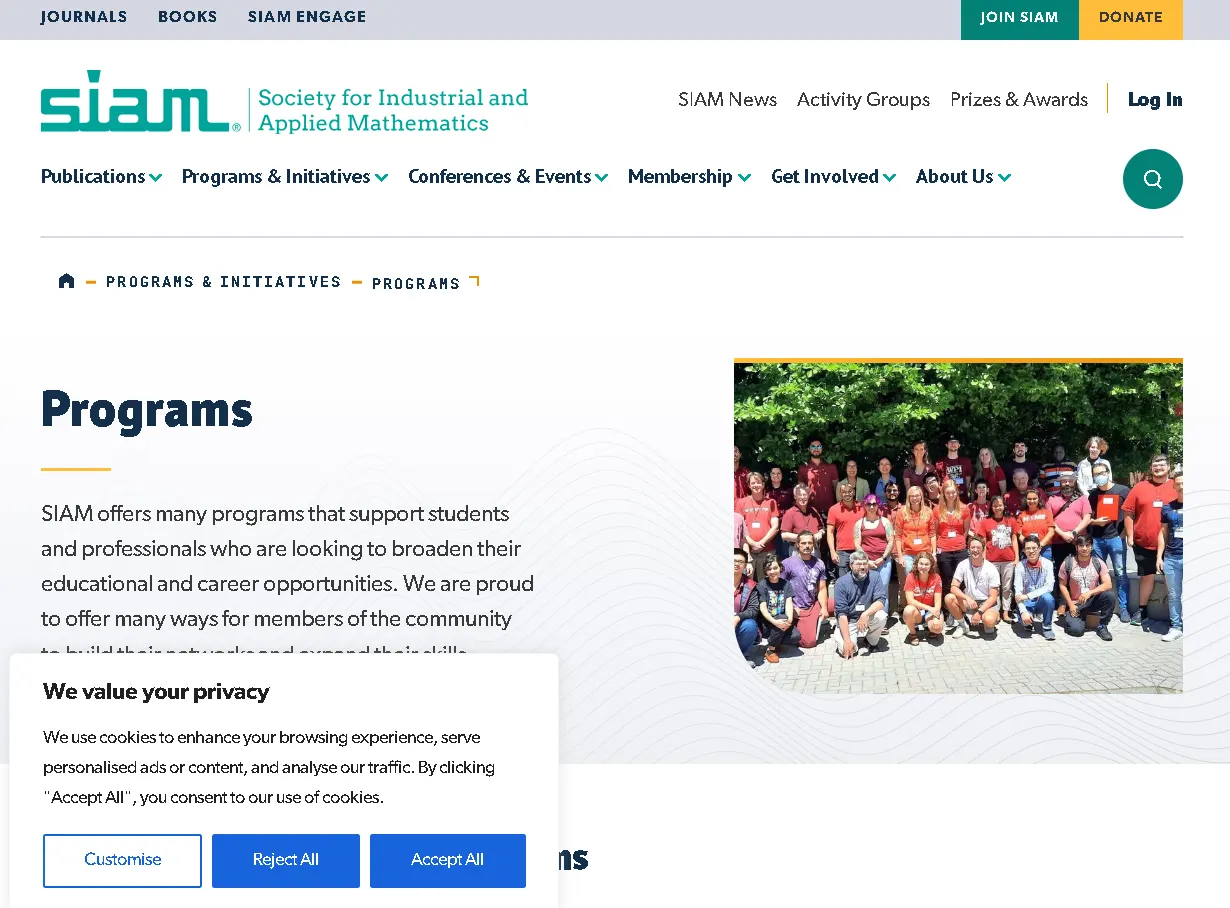
Students and professionals gather at a SIAM program event, showcasing collaboration and learning in applied mathematics.
Practice: You work through past exam questions, coding assignments, and simulation projects matched to your course style — covering algorithm implementation, error analysis, and physical interpretation across all major Computational Physics topics.
Feedback: Your tutor reviews your code and working in detail — identifying logical errors, numerical instabilities, incorrect algorithm implementation, and gaps in physical interpretation — and corrects them with specific, actionable guidance.
Retest/Reinforce: Topics where errors are consistant are revisited with fresh problems and increasing difficulty, spaced so understanding holds under timed exam and project deadline conditions.
Plan: Your tutor maintains a session roadmap anchored to your syllabus, project submission deadlines, and exam schedule — adapting as results and feedback come in across the semester.
All sessions run on Google Meet with screen sharing for live code walkthroughs, debugging sessions, and simulation output analysis alongside a digital pen-pad for algorithm diagrams and numerical method explanations.
Study Plans (Pick One That Matches Your Goal)
MPB offers three plan types: a catch-up plan (1–2 weeks intensive) for students with an imminent exam or project deadline, a full course prep plan (4–8 weeks) that covers all major topics and coding skills with worked examples and implementation practice, and ongoing weekly support across a full semester or academic year. All plans are structured after the diagnostic session based on your course syllabus, programming language, and assessment schedule.
Pricing Guide
Computational Physics tutoring at MPB starts at USD 20 per hour and typically ranges up to USD 40 per hour. Pricing varies based on tutor experience, content depth, and timeline. Sessions requiring advanced simulation or PDE work may be priced toward the higher end. For a specific quote, WhatsApp for quick quote.
FAQ
Is Computational Physics hard?
Computational Physics is challanging because it demands competence in two areas simultaneously — the physics being modeled and the programming being used to model it. Students who are strong in physics but new to programming often struggle with implementation; students comfortable with coding sometimes find the physical interpretation of results difficult. With consistent 1:1 tutoring, both sides of this challenge are addressed together.
Which programming language is used in Computational Physics?
Most undergraduate Computational Physics courses use Python — particularly with NumPy, SciPy, and Matplotlib — because of its readability and the breadth of its scientific libraries. Some courses use MATLAB, and a smaller number use C or C++. Always confirm which language your course requires and share that information when booking your first session so your tutor is prepared to work in the right environment from the start.
Can you help with Computational Physics coding assignments and projects?
Yes — MPB provides guided support for coding assignments, simulation projects, and computational lab reports. Tutors explain the relevant numerical method or algorithm, walk through similar implementation examples, and review your code logic and physical interpretation. Our services aim to provide personalized academic guidance to help you understand concepts and improve skills. You write and submit your own code in accordance with your institution’s academic integrity policy.
Do I need advanced mathematics for Computational Physics?
Comfort with calculus, linear algebra, and ordinary differential equations is important for most Computational Physics courses. Some courses also require partial differential equations and probability theory. The mathematical prerequisites vary by institution and program level. Your tutor will assess your starting point in the first session and fill mathematical gaps alongside the numerical methods and programming content where needed.
What happens in the first session?
The first session begins with a short diagnostic — your program, year, programming language, current topic or project, recent marks, and upcoming deadlines. The tutor then covers a priority topic or works through a current assignment with live explanation and Q&A. The session closes with a concrete plan for the sessions ahead. Bring your course syllabus, a current assignment or project brief, and your deadline schedule.
Does Computational Physics preparation help with research and graduate school?
Yes — significantly. Computational skills are among the most valuable assets a physics graduate student can bring to a research group. Molecular dynamics, Monte Carlo simulations, finite element methods, and data analysis are used daily in modern physics research. Students planning ahead can explore MPB’s pages for Statistical Mechanics, Quantum Mechanics, and Mathematical Physics.
Academic Integrity Note: Our services aim to provide personalized academic guidance, helping students understand concepts and improve skills. Materials provided are for reference and learning purposes only. Misusing them for academic dishonesty or violations of academic integrity policies is strongly discouraged.
Trust & Quality at My Physics Buddy
Tutor selection: Every MPB tutor goes through subject knowledge screening, a live demo session evaluation, and ongoing student feedback review. For Computational Physics, we look for tutors who are genuinely proficient in both scientific programming and physics — comfortable writing and debugging Python or MATLAB code live in a session, while simultaneously explaining the physical and numerical reasoning behind every implementation choice.
About My Physics Buddy: MPB is a Physics-focused online tutoring platform serving undergraduate and graduate students across the US, UK, Canada, Australia, and Gulf regions. Our core is Physics and closely related quantitative subjects. Students in Computational Physics can explore additional depth through MPB’s pages for Mathematical Physics, Classical Mechanics, Statistical Mechanics, and Quantum Mechanics. Students whose programs also involve data science applications can visit our page for Data Analysis in Physics.
Explore Related Physics Subjects at MPB: Computational Physics draws on and feeds into several core disciplines. MPB has dedicated pages for Mathematical Physics, Classical Mechanics, Statistical Mechanics, Quantum Mechanics, and Electrodynamics — all disciplines that Computational Physics students model, simulate, and analyze.
Content reviewed by a Computational Physics tutor at My Physics Buddy.
Next Steps
Share your program and year, the programming language your course uses, the topics or projects currently giving you the most difficulty, and your upcoming exam or submission deadlines. Let us know your preferred session times and time zone. MPB will match you with a tutor whose Computational Physics knowledge and programming proficiency fit your course needs. Your first session is a diagnostic and live teaching session — so you leave with a clearer understanding of a priority topic or project and a concrete plan ahead.

