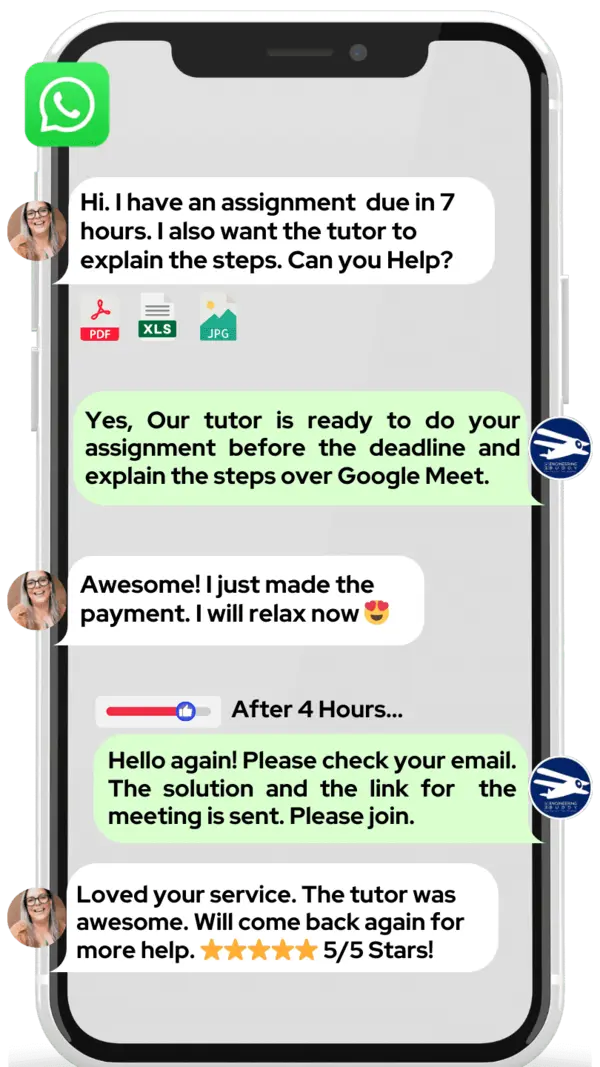
Hire Best Waves and Optics Tutors Online


Testimonials



Waves and Optics Tutor Online
My Physics Buddy (MPB) offers 1:1 online tutoring & homework help in Physics and related subjects. Waves and Optics is a core physics course taken by undergraduate students in Physics, Engineering, and Applied Sciences. It covers wave mechanics, interference, diffraction, polarisation, and geometric and physical optics — all foundational for advanced study in photonics, quantum optics, acoustics, and imaging. MPB connects you with specialist tutors for live, personalised sessions built around your university syllabus and goals. Searching for a Waves and Optics tutor near me? Our fully online format means location is never a barrier.
- 1:1 live sessions — specialist tutors in Waves and Optics, not generalists
- Covers introductory through advanced undergraduate Waves and Optics content
- Tutors matched by topic depth, mathematical level, and your course context
- Flexible scheduling across US, UK, Canada, Australia, and Gulf time zones
- Structured learning plan built after a diagnostic session
- Ethical homework and assignment guidance — we explain concepts, you submit your own work
Who This Waves and Optics Tutoring Is For
Waves and Optics is taken by a wide range of students across multiple disciplines. MPB’s program is built to serve all of them.
- Undergraduate Physics students taking Waves and Optics as a core second or third-year course
- Engineering students — Electrical, Mechanical, Biomedical — where wave mechanics and optics appear as part of a broader physics module
- Students in the US, UK, Canada, Australia, and Gulf region whose university course covers geometric optics, physical optics, or both
- Students preparing for advanced courses in Quantum Optics, Photonics, or Acoustics who want to consolidate their wave mechanics foundations
- Students needing guided help with problem sets, lab reports, or understanding derivations from standard texts such as Hecht, Born & Wolf, or French
- Parents of undergraduate students in Physics or Engineering programs looking for reliable weekly academic support
Outcomes: What You’ll Be Able To Do in Waves and Optics
Waves and Optics builds physical intuition and mathematical technique simultaneously. Strong tutoring makes both feel natural. These are observable outcomes, not guarantees.
Solve wave equation problems — transverse and longitudinal waves on strings, in fluids, and in electromagnetic contexts — using both algebraic and differential equation approaches. Analyse interference and diffraction patterns quantitatively: predict fringe positions, intensity distributions, and resolution limits for single slits, double slits, and diffraction gratings. Apply geometric optics accurately: trace rays through lenses and mirrors, locate images, and solve multi-element optical system problems using the thin lens equation and matrix methods. Explain and calculate the effects of polarisation — Malus’s law, Brewster’s angle, birefringence — on the intensity and state of light. Derive and interpret key results in physical optics — the Michelson interferometer, the Fabry-Pérot cavity, coherence length, and resolving power — with the mathematical rigour that university courses expect.
What We Cover in Waves and Optics (Syllabus / Topics)
Waves and Optics syllabi vary by institution and department. Physics courses tend to cover both geometric and physical optics with mathematical depth; Engineering courses may emphasise applications in communication, imaging, or signal processing. MPB tutors are familiar with both traditions and adapt to your specific course. Coverage is consistent with standard texts including Hecht’s Optics and French’s Vibrations and Waves.
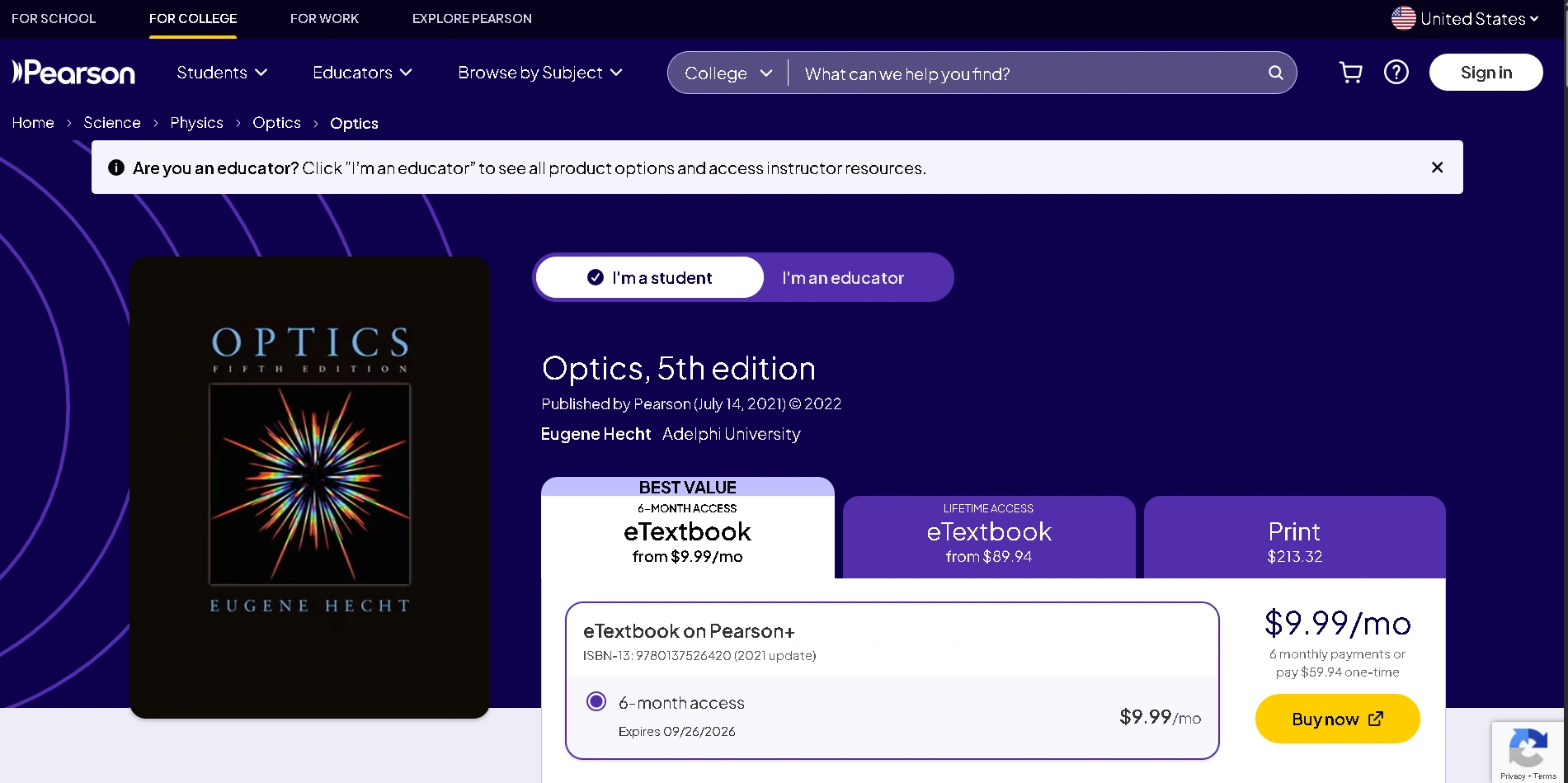
Explore the Optics 5th Edition textbook by Eugene Hecht, covering wave motion, diffraction, and modern optics for physics students.
Wave Fundamentals
- Wave motion: transverse and longitudinal waves, wave speed, amplitude, frequency, wavelength, phase
- The wave equation: derivation from Newton’s laws (string), solutions, superposition principle
- Sinusoidal waves: complex notation, phasors, phase velocity, group velocity
- Energy transport: intensity, power, the relationship between amplitude and energy
- Wave impedance: definition, reflection and transmission at boundaries
- Dispersion: dispersive vs non-dispersive media, phase vs group velocity distinction
Superposition and Interference
- Superposition of two waves: constructive and destructive interference, beat frequency
- Standing waves: nodes, antinodes, boundary conditions on strings and in pipes
- Normal modes: harmonic series, resonance frequencies for fixed and free endpoints
- Two-source interference: path difference, phase difference, fringe pattern derivation
- Young’s double-slit experiment: fringe spacing, visibility, intensity distribution
- Thin film interference: optical path length, phase shifts on reflection, Newton’s rings
- Michelson interferometer: path difference, fringe counting, coherence length measurement
Diffraction
- Huygens’ principle: wavefront construction, qualitative diffraction explanation
- Single-slit Fraunhofer diffraction: intensity pattern derivation, minima positions, central maximum width
- Circular aperture diffraction: Airy disc, angular resolution, Rayleigh criterion
- Double-slit diffraction: combined interference and diffraction envelope
- Diffraction gratings: multiple slit interference, principal maxima, resolving power, grating equation
- Fresnel diffraction: qualitative treatment, zone plates
- X-ray diffraction and Bragg’s law: application to crystalline structures
Geometric Optics
- Reflection: law of reflection, plane and curved mirrors, image formation, sign conventions
- Refraction: Snell’s law, index of refraction, total internal reflection, critical angle
- Thin lens equation: derivation, magnification, image location for converging and diverging lenses
- Mirror equation: concave and convex mirrors, real and virtual images
- Optical instruments: magnifying glass, compound microscope, telescope — angular magnification
- Aberrations: spherical aberration, chromatic aberration — qualitative treatment
- Ray transfer matrix (ABCD matrix) method: propagation through optical systems
Polarisation
- States of polarisation: linear, circular, elliptical polarisation — definition and representation
- Malus’s law: intensity after a polariser, derivation and applications
- Polarisation by reflection: Brewster’s angle, degree of polarisation
- Birefringence: ordinary and extraordinary rays, optic axis, wave plates (quarter-wave and half-wave)
- Optical activity: rotation of polarisation plane, chiral media
- Jones vectors and Jones matrices: systematic treatment of polarisation states and optical elements
Coherence and Fourier Optics
- Temporal coherence: coherence time, coherence length, relationship to spectral width
- Spatial coherence: van Cittert-Zernike theorem, coherence area
- Visibility of interference fringes as a measure of coherence
- Fourier transform in optics: spatial frequencies, the far-field as a Fourier transform
- Spatial filtering and the 4-f optical system
- Optical transfer function (OTF) and modulation transfer function (MTF): image quality in optical systems
Electromagnetic Waves and the Wave Nature of Light
- Maxwell’s equations and the wave equation for E and B fields
- Plane electromagnetic waves: transverse nature, speed of light, energy density
- Poynting vector and intensity of an electromagnetic wave
- Reflection and transmission at interfaces: Fresnel equations, reflectance and transmittance
- Dispersion in dielectrics: Sellmeier equation, normal and anomalous dispersion
- Electromagnetic waves in conductors: skin depth, absorption
Lasers and Optical Cavities (where included)
- Stimulated emission and population inversion: basic laser operation principles
- Fabry-Pérot cavity: resonance condition, free spectral range, finesse
- Gaussian beam optics: beam waist, Rayleigh range, divergence
- Laser beam properties vs conventional light: directionality, coherence, monochromaticity
Students who want to go deeper into specific Waves and Optics topic areas can also explore related MPB pages including Optics, Acoustics & Sound Physics, and Laser Physics.
How My Physics Buddy Tutors Help You with Waves and Optics (The Learning Loop)
Diagnose: Every engagement starts with a diagnostic. The tutor identifies which topic areas are solid, where the mathematics is causing difficulty, and which physical concepts — interference conditions, diffraction geometry, polarisation states — remain unclear. This shapes every session.
Explain: Waves and Optics is a subject where visual intuition and mathematical formalism need to develop together. Your tutor builds both — sketching the wavefront picture before writing the path difference formula, or drawing the phasor diagram before deriving the intensity distribution. Explanations adapt until the concept clicks.
Waves and Optics is not just a physics course — it is a foundational toolkit. The same mathematics that describes interference fringes on a screen describes coherence in quantum optics, resolution limits in microscopy, and signal processing in communications. According to the Optica Foundation (formerly OSA), optics and photonics underpin a global industry worth hundreds of billions of dollars annually. Students who build genuine fluency here carry it into every advanced field they enter.
Practice: You work through university-level problems live — deriving fringe patterns, solving lens system problems, computing Brewster’s angle, applying the grating equation, and working through Fresnel coefficient calculations. The tutor tracks your reasoning at every step.
Feedback: After each problem, you receive specific, targeted feedback. “Your single-slit minima calculation is correct but you’ve identified the central maximum width incorrectly — it’s twice the distance to the first minimum, not once” or “your Snell’s law setup is right but you’ve used the wrong sign convention for the refracted angle at this interface” — precise and tied to what your course requires.
Retest / Reinforce: Core ideas return in new problem contexts across sessions. Interference, for instance, reappears in thin films, the Michelson interferometer, the Fabry-Pérot cavity, and X-ray diffraction — each encounter reinforces the same underlying path difference logic from a different physical setup.
Plan: The tutor updates the session plan as your course progresses. You always know what the next session targets and why.
Accountability: For students on weekly plans, tutors help maintain steady progress alongside lab deadlines and exam preparation schedules.
Sessions run live on Google Meet with a digital pen-pad or iPad + Apple Pencil — essential for drawing ray diagrams, wavefront sketches, phasor diagrams, and diffraction geometry in real time. Before your first session, share your course level, current chapter, assigned text, and any upcoming deadlines. The first session includes a short diagnostic, a live working-through of your most pressing concept, and a clear plan for the next two to four sessions.
Tutor Match Criteria (How We Pick Your Tutor)
Level and course fit: Your tutor will have direct experience with Waves and Optics at your specific level — introductory undergraduate, second-year Physics course, or Engineering optics module. They know the difference in emphasis and mathematical depth between a Physics and an Engineering syllabus and teach accordingly.
Topic strengths: If your difficulty is in diffraction integrals, Fresnel coefficients, polarisation calculus, or Fourier optics, we match you with a tutor whose expertise covers that domain at the right depth.
Tools and setup: All MPB tutors use Google Meet and a digital pen-pad or iPad + Apple Pencil for real-time ray diagrams, wavefront sketches, phasor diagrams, and intensity pattern derivations.
Time zone and availability: Tutors are available across US, UK, Canada, Australia, and Gulf time zones, fitting around your university schedule and assignment deadlines.
Learning style and pace: Some students need careful visual intuition-building before touching the mathematics. Others want fast-paced problem-set practice. Your tutor adjusts accordingly.
Goals: A student building foundations for a future Quantum Optics course has different needs than one preparing for a mid-semester exam. We align on your goal before sessions begin.
Urgency and timeline: A student with an assignment due in two days gets a targeted plan. A student building foundations across a semester gets a paced structure. Tutor selection accounts for your timeline.
Study Plans (Pick One That Matches Your Goal)
MPB offers three broad plan types for Waves and Optics: a catch-up plan (one to two weeks) for closing specific topic gaps before an exam or assignment deadline, a course support plan (four to eight weeks) for structured assistance across a semester, and an ongoing weekly plan for students who want consistent expert guidance throughout an academic year. The tutor builds the specific session plan after the diagnostic — no fixed schedule is set until your starting point and goals are clearly understood.
Pricing Guide
Waves and Optics tutoring at MPB starts at USD 20 per hour and typically ranges up to USD 40 per hour for most undergraduate-level sessions. For advanced topics — Fourier optics, Fresnel diffraction theory, electromagnetic wave propagation in media — or graduate-level content, rates may go higher, up to USD 100 per hour in some cases.
Pricing depends on the tutor’s level and specialisation, the depth of content covered, and your session frequency. All rates are discussed transparently before you commit.
FAQ
Is Waves and Optics hard?
Waves and Optics is considered moderately challenging — harder than introductory mechanics for most students, but more accessible than quantum mechanics or electrodynamics. The difficulty lies in building strong visual intuition alongside the mathematics. Students who develop a clear physical picture for each phenomenon before working through the algebra consistently find the subject more manageable than those who approach it as pure formula-application.
How many sessions are needed?
A student targeting specific weak areas — diffraction patterns or polarisation optics — may need three to six sessions. A student seeking full-semester course support benefits from regular weekly sessions. Your tutor will give a more precise estimate after the diagnostic, based on your current level and course timeline.
Can you help with Waves and Optics homework and problem sets?
Yes — as guided support, not submission. Your tutor will work through problem approaches with you, explain where your derivation or setup breaks down, and help you build the understanding to complete the work independently. MPB does not complete or submit assignments for students. Students are expected to submit their own work at all times.
What happens in the first session?
The first session includes a short diagnostic on two or three topic areas, a live working-through of your most pressing concept or problem, and a clear plan for the next two to four sessions. Come prepared with your current chapter, any assigned text, recent test results if available, and any upcoming deadlines. Sessions run on Google Meet with digital pen-pad support.
What mathematical background do I need for Waves and Optics?
Single-variable calculus, basic differential equations, and trigonometry are the core requirements at the introductory level. For more advanced treatment — Fourier optics, electromagnetic wave propagation, Jones calculus — you will also need complex numbers, multivariable calculus, and some linear algebra. If your mathematical background has gaps, your tutor can identify and address them alongside the physics content. Students who want to strengthen their mathematical foundations can explore Mathematical Physics tutoring on MPB.
Can you help with lab reports for Waves and Optics experiments?
Yes, at a guidance level. Waves and Optics labs often involve measuring fringe patterns, calibrating spectrometers, or characterising optical elements. Your tutor can help you understand the underlying physics of your experiment, interpret your data, handle error analysis, and structure your report clearly. MPB does not write lab reports for students.
Is online tutoring effective for Waves and Optics?
Yes. Waves and Optics is a highly visual subject — ray diagrams, wavefront sketches, phasor diagrams, intensity patterns — all of which a tutor can draw and annotate in real time on a digital pen-pad via Google Meet. The format is particularly well-suited to this subject. Research on one-on-one instruction, including findings discussed by the American Physical Society, supports the effectiveness of personalised teaching for physics at the university level.
Explore how APS supports physics departments with programs, resources, and initiatives to enhance teaching, diversity, and student success.
Does Waves and Optics connect to other physics courses I will take?
Yes — extensively. Wave mechanics and superposition are foundational for Quantum Mechanics. Electromagnetic wave propagation connects directly to Electrodynamics. Physical optics is the direct precursor to Quantum Optics and Photonics. Students who build strong foundations in Waves and Optics consistently find these downstream courses more accessible.
What textbooks does MPB support for this course?
MPB tutors are familiar with the most commonly used texts in undergraduate Waves and Optics courses, including Hecht’s Optics, French’s Vibrations and Waves, Hecht & Zajac’s Optics, Born & Wolf’s Principles of Optics (graduate level), and Pedrotti’s Introduction to Optics. If your course uses a specific text or problem set, share it before the first session and the tutor will align sessions to it.
What related subjects does MPB cover that connect to Waves and Optics?
Waves and Optics sits at the centre of several adjacent disciplines on MPB. Students can explore Optics for deeper geometric and physical optics content, Acoustics & Sound Physics for the mechanical wave side of the subject, Laser Physics for coherent light and cavity optics, and Electromagnetism for the underlying field theory of light. All of these are available as specialist tutoring subjects on MPB.
Can MPB also support students in related Cambridge or A Level Physics syllabi covering waves and optics?
Yes. Waves and optics topics appear in several exam-based syllabi that MPB supports — including A/AS Level Physics (9702) and IGCSE Physics (0625). If you are studying waves and optics as part of a pre-university qualification rather than a university course, those pages will be more directly relevant to your syllabus and exam format.
Trust & Quality at My Physics Buddy
Tutor selection: MPB tutors for Waves and Optics hold degrees in Physics, Applied Physics, Optical Engineering, or closely related fields — many at the postgraduate level. Every tutor goes through a subject screening including a live demo session and an ongoing student feedback loop. Tutors are matched to your specific course level and topic needs, not assigned as generalists.
Academic integrity: MPB’s position is clear — we guide, you submit your own work. Tutors explain concepts, work through similar problems, and provide feedback on your derivations and setups. They do not complete assignments or any assessed work for students. All guidance is framed as explanation and conceptual clarification, consistent with your university’s academic integrity policies.
About MPB: My Physics Buddy is a Physics-focused online tutoring platform serving students from undergraduate through postgraduate level, across the US, UK, Canada, Australia, and Gulf regions. Students exploring advanced topics that build on Waves and Optics foundations can visit Quantum Optics, Photonics, and Condensed Matter (Solid State) Physics on MPB.
Physics education research consistently shows that students benefit most from tutoring that connects visual intuition to mathematical formalism — particularly in subjects like Waves and Optics where geometric reasoning and analytical calculation must develop together. A study in the Physical Review Physics Education Research journal found that students who received guided, active problem-solving instruction developed significantly stronger ability to handle unfamiliar problem types than those who relied on worked examples alone. MPB’s learning loop is built on this evidence.
APS Journals page featuring Physical Review Physics Education Research, a leading journal publishing research on physics teaching and learning.
“Optics is the branch of physics that gave us the microscope, the telescope, the laser, and fibre-optic communications. Every one of those technologies began with someone who understood waves well enough to see what was possible.”
— Adapted from historical context in Hecht, Optics, Pearson Education
Students who build a strong Waves and Optics foundation often find natural progression into Laser Physics, Quantum Optics, and Plasma Physics — all disciplines where wave propagation and field-matter interaction are central. MPB supports students across all of these at the graduate level.
“The students who struggle least with Waves and Optics are those who always ask ‘what is the wave doing physically here?’ before reaching for the formula. Building that habit early makes every downstream physics course easier.”
— Based on findings in Bloom’s 2-Sigma Study, Educational Researcher (1984)
Content reviewed by a Waves and Optics tutor at My Physics Buddy.
Next Steps
Tell us your academic level, your university course name, your current topic, any upcoming deadlines, and your main challenge areas — whether that is interference, diffraction, polarisation, geometric optics, or Fourier methods. We will match you with a tutor whose expertise fits your course depth and timeline. Most students are matched and into their first session within a few days. Scheduling is flexible across all primary time zones.

