Electrostatics Tutor Online
My Physics Buddy (MPB) offers 1:1 online tutoring & homework help in Physics and related subjects, including dedicated support for Electrostatics. This foundational subject covers the physics of electric charges at rest — electric fields, electric potential, Gauss’s law, capacitance, dielectrics, and the mathematical methods needed to solve real electrostatic problems. It appears in introductory physics courses, classical electromagnetism sequences, and electrical engineering programmes at undergraduate and graduate levels. Whether you are a first-year student working through Coulomb’s law and field line diagrams, or an advanced student tackling boundary value problems and Green’s functions, MPB connects you with a specialist tutor. If you have been searching for an Electrostatics tutor near me, MPB’s fully online model brings expert support to you — wherever you are, scheduled around your timetable. Sessions are designed to build genuine understanding, sharpen problem-solving technique, and support you through assignments and exams.
- 1:1 live sessions matched to your course level, institution, and syllabus
- Expert tutors with strong backgrounds in classical electromagnetism, mathematical physics, and engineering
- Flexible scheduling across US, UK, Canada, Australia, and Gulf time zones
- Structured learning plan built around your coursework deadlines and exam dates
- Ethical guidance on homework, assignments, problem sets, and lab report structure
Who This Electrostatics Tutoring Is For
Electrostatics tutoring at MPB serves a broad range of students across physics, engineering, and mathematics programmes. It is particularly well matched to the following.
- First- and second-year undergraduate physics students encountering electric fields, Gauss’s law, and electric potential for the first time in introductory electromagnetism courses
- Undergraduate students in Electrical and Electronic Engineering who need stronger physics foundations for their electrostatics and circuit theory modules
- Physics and Applied Mathematics students working through a full classical electromagnetism course — Griffiths, Jackson, or equivalent — where electrostatics forms the first major block
- Graduate and Masters students needing targeted support for advanced electrostatics topics such as boundary value problems, Green’s functions, or multipole expansions
- PhD students requiring conceptual clarification on specific electrostatic topics relevant to their research or qualifying examinations
- Students in the US, UK, Canada, Australia, and Gulf region preparing for exams where electrostatics is a significant component — including university finals, qualifying exams, and standardised tests
- Students needing ethical guidance on structuring and working through homework problems, problem sets, and assignments in electrostatics courses
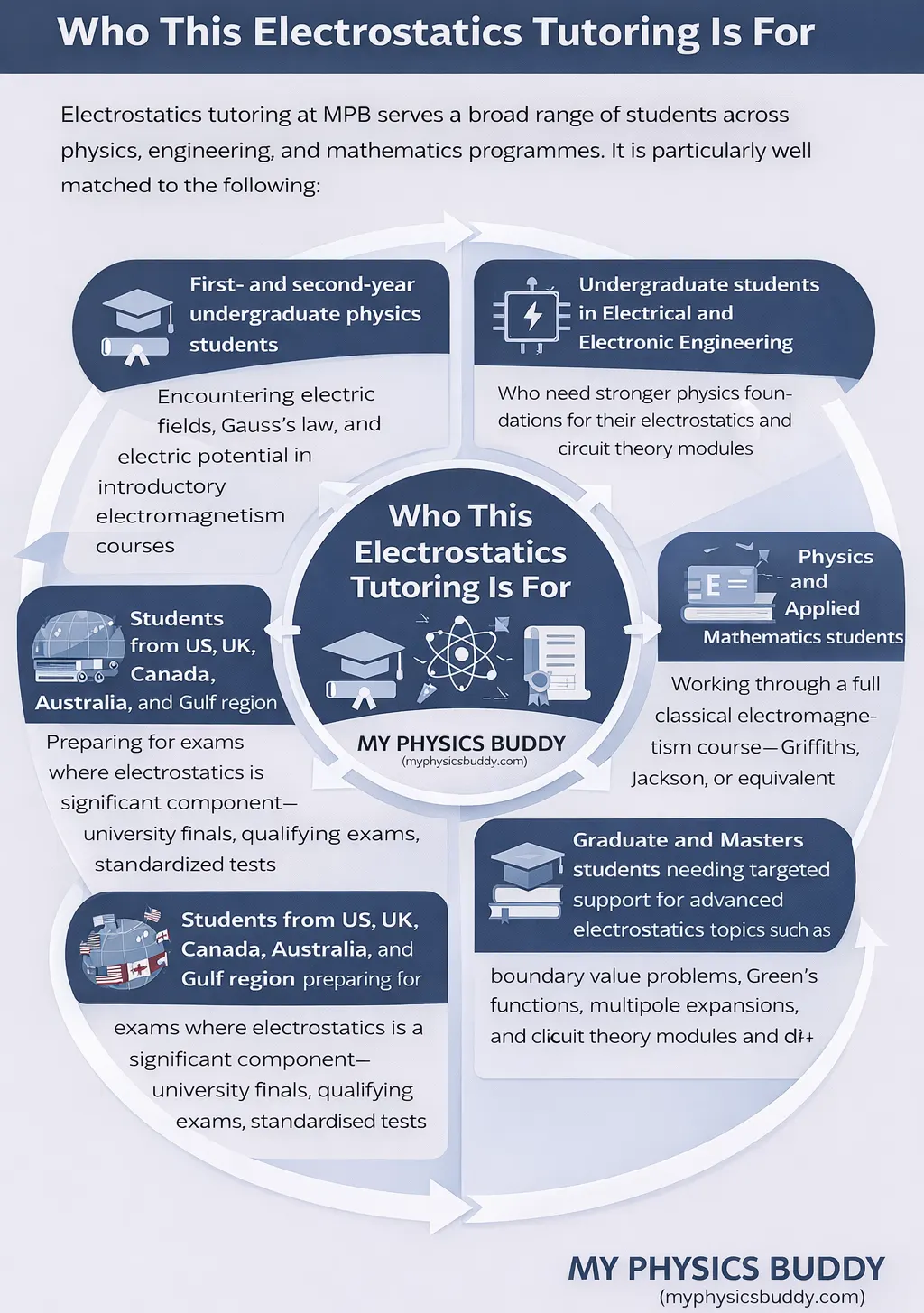
Circular overview of the student groups who benefit from electrostatics tutoring, including undergraduate physics and engineering students, graduate learners, and students preparing for university exams.
Outcomes: What You’ll Be Able To Do in Electrostatics
Tutoring at MPB targets specific, observable improvements in your ability to work through electrostatics problems independently and accurately.
Solve electric field and potential problems for point charges, charge distributions, and continuous charge configurations using Coulomb’s law, superposition, and integration with confidence. Apply Gauss’s law correctly — selecting appropriate Gaussian surfaces, identifying symmetry, and extracting field expressions cleanly. Analyse electric potential, equipotential surfaces, and the relationship between field and potential using gradient operations. Model capacitors, dielectric materials, and energy storage in electric fields with correct physical and mathematical treatment. Solve boundary value problems using Laplace’s and Poisson’s equations, separation of variables, and method of images at the level required by your course. Explain electrostatic phenomena — charge distributions on conductors, shielding, dielectric polarisation — in terms that connect mathematics to physical intuition. Write clearly structured assignment and problem-set solutions that show physical reasoning at every step, not just final numerical answers.
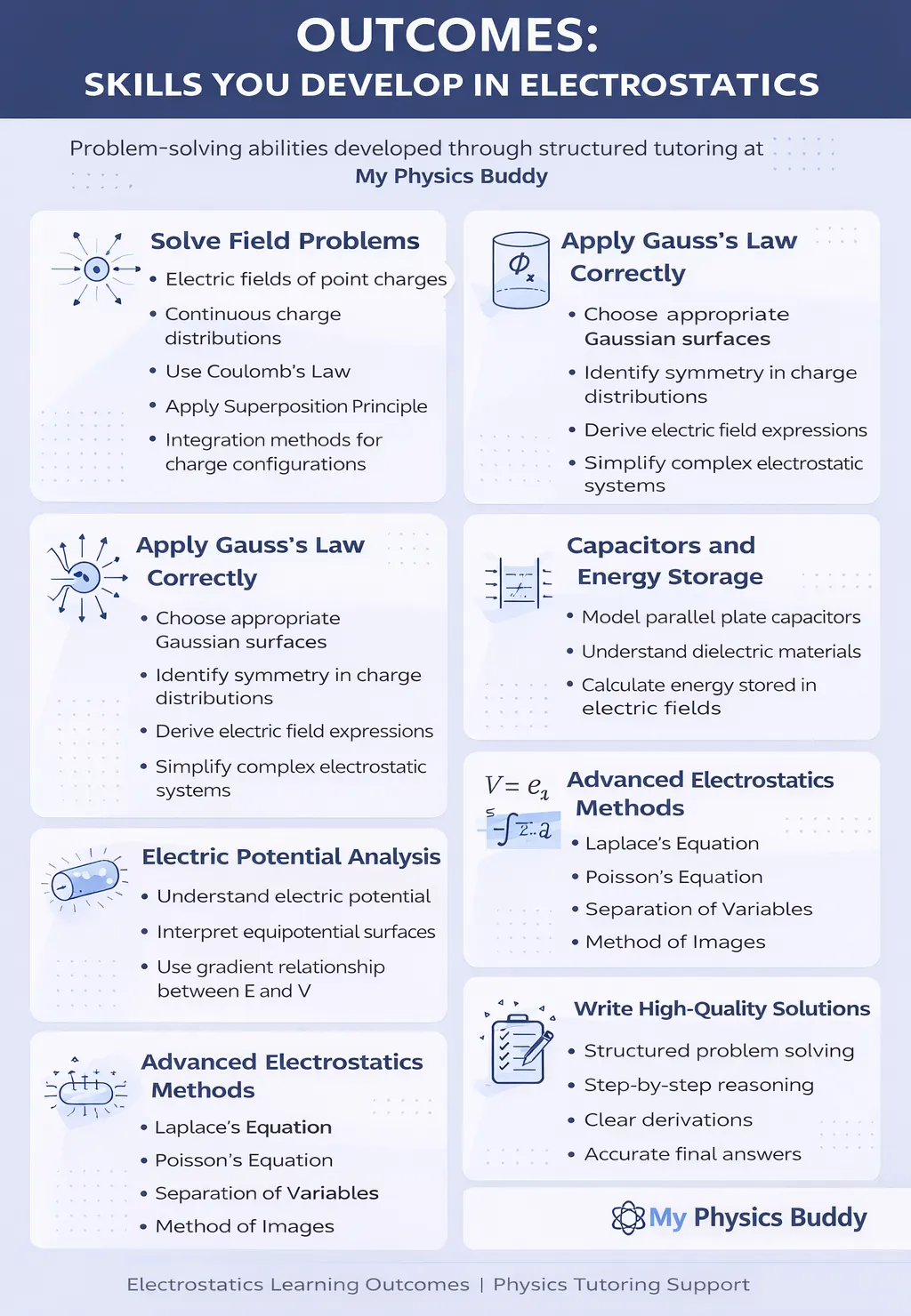
Key problem-solving skills developed in electrostatics including Coulomb’s law, Gauss’s law, electric potential analysis, capacitors, and boundary value methods.
“Electrostatics is where students first encounter the power and the difficulty of field theory. The mathematics — vector calculus, surface integrals, differential equations — is demanding. But the deeper challenge is learning to think in terms of fields as physical objects with their own reality, rather than as abstract bookkeeping tools. That conceptual shift is what separates students who merely compute answers from those who genuinely understand electromagnetism.”
— Perspective consistent with pedagogical discussions in physics education research published by the American Journal of Physics (AAPT)

Cover of the American Journal of Physics (March 2026, Volume 94 Issue 3) highlighting the double-wall bottle experiment used to study oscillations and Helmholtz resonance in physics education.
What We Cover in Electrostatics (Syllabus / Topics)
MPB tutors work directly from your course syllabus, textbook, and past exam papers. The topic tracks below reflect the standard content of Electrostatics courses from introductory undergraduate through advanced graduate level. Exact coverage depends on your programme and institution.
Foundations: Charge, Force, and Coulomb’s Law
- Electric charge: quantisation, conservation, and sign conventions
- Coulomb’s law: force between point charges, vector form, and superposition
- Electric force on charge distributions: discrete and continuous
- Linear charge density, surface charge density, and volume charge density
- Superposition principle for forces and fields — worked with multiple charge configurations
Electric Fields
- Electric field definition and physical meaning; field lines and their interpretation
- Electric field of a point charge; field from discrete charge distributions
- Electric field from continuous charge distributions: rings, discs, rods, planes — integration methods
- Dipole field: derivation, near-field and far-field behaviour
- Flux: definition, calculation through open and closed surfaces
Gauss’s Law
- Gauss’s law: statement, derivation from Coulomb’s law, and physical interpretation
- Choosing Gaussian surfaces: spherical, cylindrical, and pillbox geometries
- Applying Gauss’s law to spherically, cylindrically, and planar-symmetric charge distributions
- Electric field inside and outside conductors; surface charge on conductors
- Limitations of Gauss’s law: when symmetry arguments fail and what to do instead
Electric Potential
- Electric potential: definition, physical meaning, and relationship to work
- Potential from point charges and charge distributions: integration methods
- Relationship between electric field and potential: gradient operation
- Equipotential surfaces: geometry, orthogonality with field lines, and physical significance
- Potential difference, voltage, and the choice of reference point
- Potential energy of charge configurations; energy of a charge in an external field
Conductors and Electrostatic Equilibrium
- Properties of conductors in electrostatic equilibrium: field, potential, and charge distribution
- Induced charges and electrostatic shielding
- Surface charge density and field at conductor surfaces
- Cavities in conductors: shielding from external fields and internal charges
- Grounding and its physical meaning; charge redistribution on grounding
Capacitance and Energy in Electric Fields
- Capacitance: definition, physical meaning, and calculation for common geometries (parallel plate, spherical, cylindrical)
- Capacitors in series and parallel: equivalent capacitance
- Energy stored in a capacitor; energy density of the electric field
- Charging and discharging: energy considerations and force between plates
- Common problem types: capacitor networks, partial insertion of dielectrics
Dielectrics
- Polarisation: dipole moments, polarisation vector P, and bound charges
- Dielectric constant and relative permittivity; how dielectrics modify fields
- Displacement field D: definition, boundary conditions, and Gauss’s law in dielectrics
- Energy stored in dielectric systems; force on dielectric in a capacitor
- Linear dielectrics: constitutive relation and problem-solving approach
Laplace’s and Poisson’s Equations
- Derivation of Poisson’s equation and the special case of Laplace’s equation
- Uniqueness theorems: physical and mathematical implications
- Separation of variables in Cartesian, cylindrical, and spherical coordinates
- Method of images: point charge near a grounded plane, sphere, and related configurations
- Legendre polynomials and their role in spherically symmetric electrostatic problems
Advanced Topics (Graduate Level)
- Multipole expansion: monopole, dipole, quadrupole moments and their physical significance
- Green’s functions for the Poisson equation: derivation and application
- Electrostatics in matter: free and bound charge, susceptibility, and dielectric response
- Stress tensor in electrostatics: Maxwell stress tensor and force calculations
- Variational methods in electrostatics and energy minimisation principles
Electrostatics is the first encounter most students have with field theory, and the mathematical demands escalate quickly. Gauss’s law requires geometric reasoning; potential calculations require multi-dimensional integration; boundary value problems require differential equations and coordinate system fluency. Each topic builds directly on the previous one. If a foundational concept is unclear, difficulties compound fast. MPB tutors identify exactly where the chain breaks and rebuild from that point — making later topics accessible rather than overwhelming.
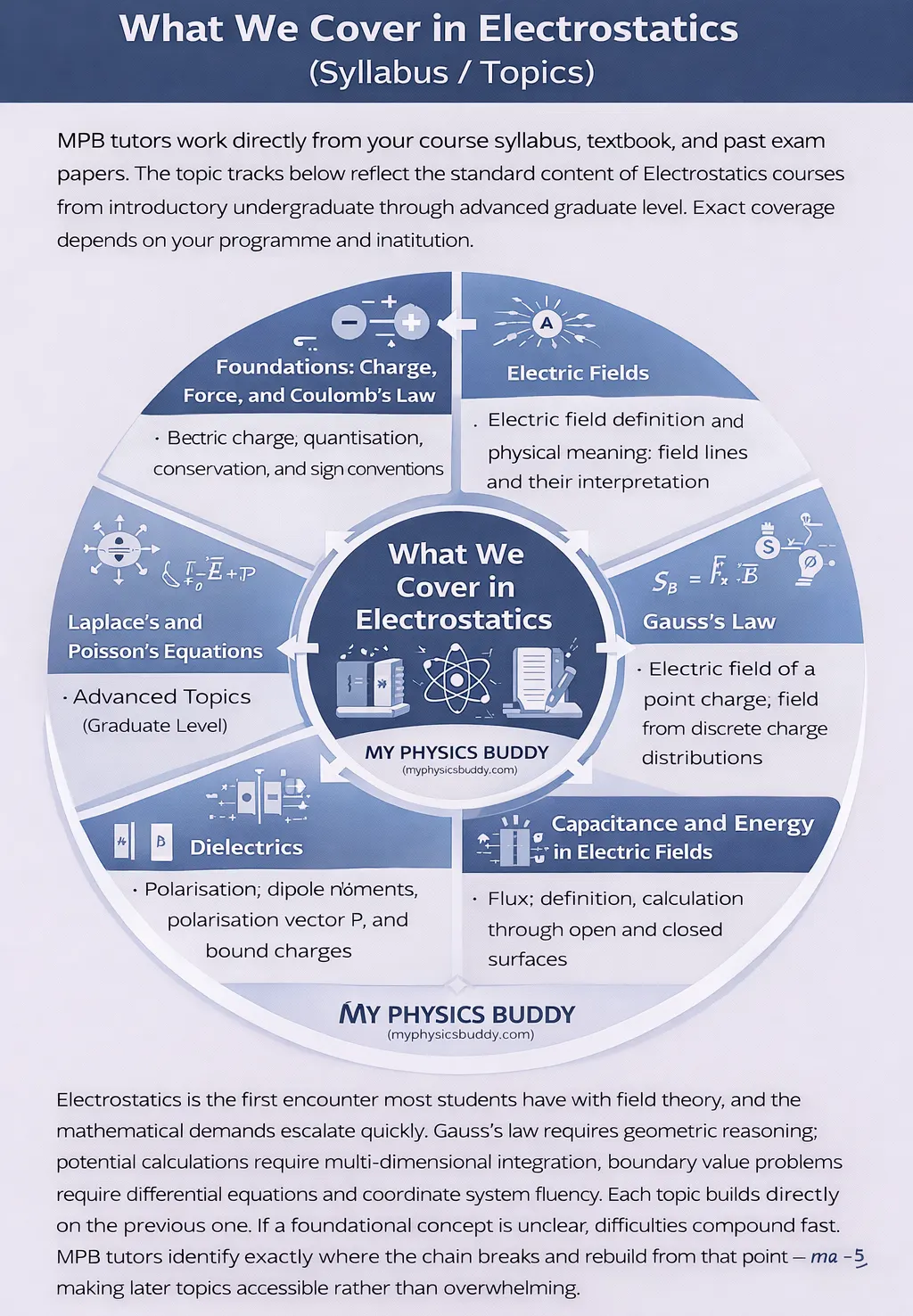
Circular overview of key electrostatics topics taught in undergraduate and graduate physics courses, including Coulomb’s law, electric fields, Gauss’s law, electric potential, capacitance, dielectrics, and boundary value problems.
How My Physics Buddy Tutors Help You with Electrostatics (The Learning Loop)
Diagnose: Your first session starts with a diagnostic. The tutor works through a short selection of problems with you — covering charge distributions, Gauss’s law, potential calculations, and any advanced topics your course is currently covering — to identify precisely where your understanding is confident and where gaps exist. This diagnostic shapes everything that follows.
Explain: Tutors connect mathematical formalism to physical meaning from the first session. They explain why Gauss’s law works, not just how to apply it — what the divergence theorem says physically, why symmetry is necessary, and what happens to the field at a conductor surface and why. Explanation is always anchored to the types of questions your specific course tests.
Practice: You work through problems drawn from your own course materials, past exam papers, and standard textbooks — Griffiths’ Introduction to Electrodynamics, Jackson’s Classical Electrodynamics, Purcell’s Electricity and Magnetism, or your institution’s specific text — depending on your level. The tutor observes your approach and reasoning process, not just whether the final answer is correct.
Feedback: After each problem or set of problems, your tutor gives specific feedback on method. If you selected the wrong Gaussian surface, mishandled boundary conditions, confused E and D in a dielectric, or dropped a sign in a potential integration, the tutor identifies the exact point of error and explains how to correct it systematically.
Retest and Reinforce: Topics are revisited with fresh problems in later sessions to confirm that understanding is retained and transferable — not just reproduced immediately after being shown the method.
Plan: Between sessions, the tutor sets targeted practice matched to your weak areas and upcoming deadlines — specific problem types, integration practice, Gaussian surface selection exercises, or boundary condition drills, depending on what is most needed.
Accountability: For students with multiple problem sets and exam deadlines, regular sessions maintain forward momentum through the course rather than allowing confusion to accumulate chapter by chapter.
All sessions run live via Google Meet. Tutors use a digital pen-pad or iPad with Apple Pencil, so field line diagrams, Gaussian surface sketches, charge distribution illustrations, and potential maps are all drawn and annotated live during explanation. Before your first session, share your course textbook name and edition, the chapters or topics currently being taught, any specific homework or assignment problems you are stuck on, and your upcoming exam or submission dates. This lets the tutor prepare a focused, immediately productive first session.
Tutor Match Criteria (How We Pick Your Tutor)
MPB matches students to tutors on criteria specific to Electrostatics — not just the subject name.
Level and syllabus fit: Introductory electrostatics (Coulomb’s law, basic fields, simple capacitors), intermediate electrostatics (Gauss’s law, potential, dielectrics), and advanced graduate-level electrostatics (boundary value problems, Green’s functions, multipole expansions) are very different in mathematical depth. Tutors are matched to the correct level for your specific course.
Topic strengths: If your course is focused on boundary value problems and separation of variables, or specifically on dielectric theory, or on the mathematical physics of Laplace’s equation, the tutor match reflects that emphasis.
Tools and setup: All tutors use Google Meet with a digital pen-pad or iPad and Apple Pencil. For electrostatics, this is essential — field line diagrams, equipotential sketches, Gaussian surface geometries, and potential plots must be drawn clearly and interactively during explanation.
Time zone and availability: Tutors are matched for your region — US, UK, Canada, Australia, or Gulf — with session slots available across morning, afternoon, and evening hours local to you.
Learning style and pace: Some students need a slower, conceptual approach that builds physical intuition before the mathematics. Others are mathematically confident but need help interpreting what the equations mean physically. Tutor selection accounts for this during the onboarding conversation.
Language and communication: Clear English-medium instruction is standard. Additional language preferences are accommodated where tutor availability allows.
Goals and urgency: Whether you are working toward a final exam, trying to understand a specific chapter that is holding back your problem-set performance, or building foundations for a full electrodynamics sequence, tutor matching and session intensity are calibrated accordingly.
“Physics education research consistently finds that students develop more robust understanding of electrostatics when instruction explicitly addresses the conceptual meaning of field and potential — not just calculation procedures. Students who learn only to compute answers without understanding what fields physically represent are significantly more likely to make systematic errors on novel problems and in higher-level courses that build on electrostatics.”
— Consistent with research findings published in the Physics Education Research community resource base (PER Central), maintained by the American Association of Physics Teachers

Homepage of PER-Central, a major online resource providing physics education research articles, curriculum materials, dissertations, and academic resources for physics educators.
Study Plans (Pick One That Matches Your Goal)
MPB offers three plan types for Electrostatics support: a short catch-up plan (1–2 weeks) for students close to an exam or problem-set deadline who need rapid, targeted help on specific topics; a structured module support plan (4–8 weeks) covering the electrostatics syllabus progressively in parallel with lectures; and ongoing weekly support for students who want a consistent tutor throughout an entire electromagnetism course. After your diagnostic session, the tutor builds the specific session-by-session plan based on your actual syllabus, weak areas, and deadlines — the above are starting frameworks, not fixed schedules.
Pricing Guide
Electrostatics tutoring at MPB is priced based on the expertise level required, the depth and complexity of your course content, and tutor availability. Hourly rates generally start at USD 20 and range up to USD 40 for most undergraduate-level sessions. For advanced graduate-level content — such as Green’s functions, multipole expansions, or Maxwell stress tensor applications — rates may go higher, up to USD 100 per hour in some cases.
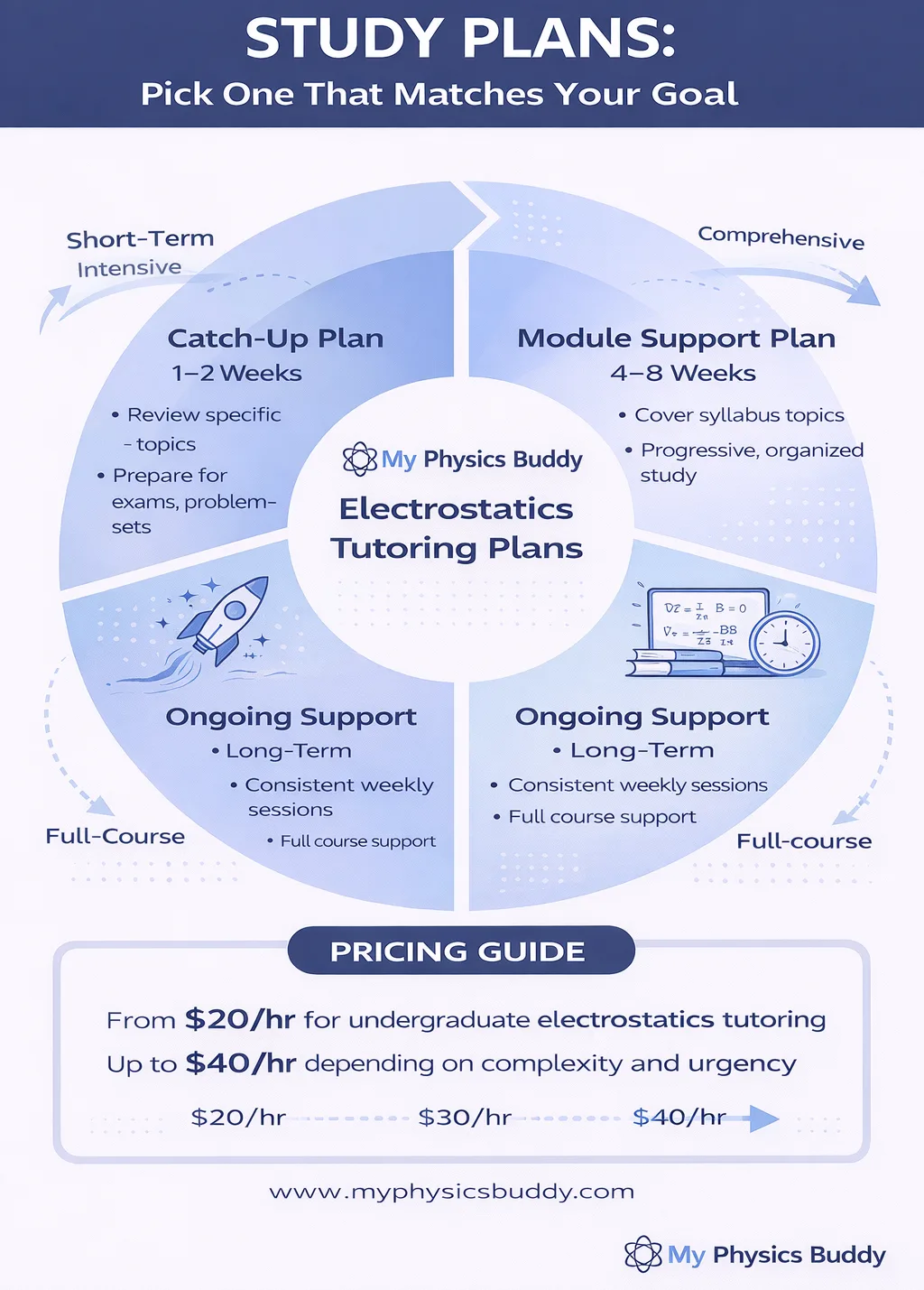
Electrostatics tutoring plans at My Physics Buddy including short catch-up support, structured module guidance, and ongoing weekly tutoring with hourly pricing from $20 to $40.
Factors influencing pricing include your academic level (introductory undergraduate vs. advanced undergraduate vs. graduate), how close your deadline is, and whether you need intensive daily sessions or standard weekly support. Shorter timelines with higher session frequency typically sit toward the upper end of the range.
FAQ
Is Electrostatics hard?
It is considered one of the more mathematically demanding topics in undergraduate physics. The difficulty comes from combining vector calculus, geometric reasoning, and multi-dimensional integration simultaneously — often in a single problem. Students who build a solid conceptual foundation alongside the mathematics typically find later topics much more approachable than those who focus on memorising procedures.
How many sessions are needed?
This depends on your current level and how much of the electrostatics syllabus needs to be covered. Students targeting a specific exam or problem set typically benefit from 4–8 focused sessions. Those wanting support throughout a full electromagnetism module work with a tutor regularly over the term. Your tutor will recommend a session plan after the diagnostic.
Can you help with homework, problem sets, and assignments?
Yes — within clear academic integrity limits. Tutors explain the principles and methods relevant to your homework problems, identify where your reasoning or setup goes wrong, and guide you toward the correct approach. MPB provides explanation and guidance; you work through and submit your own solutions. We do not complete or submit assignments on your behalf, and we strongly discourage any use of our support that would violate your institution’s academic integrity policies. Our aim is to build the understanding that lets you solve problems independently.
Do your tutors match my exact university syllabus?
Tutors work directly from your course materials — your textbook, lecture notes, and past exam papers — wherever possible. Core electrostatics content is broadly consistent across institutions, but the mathematical depth and topic sequence vary considerably between an introductory course and a graduate electrodynamics sequence. Sharing your syllabus before the first session ensures the tutor covers precisely what your course requires.
What happens in the first session?
The first session includes a short diagnostic — a selection of problems covering charge distributions, Gauss’s law application, and potential calculations — to establish your current level. The tutor then works on one or two of your most pressing current topics and outlines a recommended session plan. Come prepared with your textbook name, current lecture topics, and any specific problems or derivations you are stuck on.
Is online tutoring as effective as in-person for electrostatics?
For this subject, yes — fully. Electrostatics is taught through field diagrams, Gaussian surface sketches, potential maps, and mathematical derivations, all of which are drawn and annotated live on a shared digital board via Google Meet. The interactive quality of the session is comparable to in-person tutoring, with the added benefit of being able to work with a specialist tutor regardless of your location or time zone.
Which textbooks do MPB tutors cover?
Tutors are comfortable working from the most widely used electrostatics and electrodynamics texts, including Griffiths’ Introduction to Electrodynamics (the most common undergraduate text), Purcell and Morin’s Electricity and Magnetism, and Jackson’s Classical Electrodynamics at graduate level. Share your specific textbook and edition when booking and the tutor will align sessions directly to it.
Can you help with Gauss’s law problems specifically?
Yes — Gauss’s law is one of the most frequently requested topics in electrostatics tutoring. Sessions cover how to identify whether a charge distribution has sufficient symmetry for Gauss’s law to be useful, how to choose and construct the correct Gaussian surface for spherical, cylindrical, and planar geometries, and how to extract the electric field cleanly from the resulting integral. This is worked through with multiple problem types until the method is reliable.
Do you cover electrostatics as part of a broader electromagnetism course?
Yes. Electrostatics is typically the first major block of a classical electromagnetism sequence, followed by magnetostatics, electromagnetic induction, and Maxwell’s equations. MPB tutors can support you throughout this full sequence. Students working through broader electromagnetism topics may also find MPB’s pages on Electromagnetism and Electrodynamics relevant for the later parts of their course.
Can MPB help with graduate-level electrostatics topics like Green’s functions and multipole expansions?
Yes. MPB tutors with graduate-level electromagnetism backgrounds can work through boundary value problems, method of images, separation of variables in multiple coordinate systems, multipole expansions, and Green’s function techniques. These topics appear in graduate qualifying examinations and in courses using Jackson or equivalent graduate texts. Tutor availability for this level should be confirmed at the time of enquiry.
What related subjects does MPB support that overlap with electrostatics?
Electrostatics connects directly to several areas where MPB also offers dedicated tutoring. Students frequently benefit from parallel support in Mathematical Physics for the vector calculus and differential equation methods, Electromagnetism for the broader course context, and Semiconductor Physics where electrostatic principles appear in device physics. Students in engineering programmes may also find Engineering Physics tutoring relevant.
Academic integrity is central to how MPB operates in Electrostatics tutoring. Problem sets and assignments in this subject are designed to develop your ability to work through field theory problems independently — because that is exactly what is tested in exams and in every subsequent course that builds on electrostatics. Tutors explain, demonstrate, and give feedback on your reasoning. You do the working and the submitting. The goal is to make you genuinely capable of handling electrostatics problems on your own — which is both the academic requirement and the practical outcome that matters for your progression.
Trust & Quality at My Physics Buddy
Tutor selection: Every MPB tutor is assessed through a subject-knowledge screening and a live demonstration session before being placed with students. For Electrostatics, this means working through representative problems — from Gauss’s law applications and potential calculations to boundary value problems and dielectric theory — and demonstrating the ability to explain physical reasoning clearly at the appropriate academic level. Tutors typically hold undergraduate or postgraduate degrees in Physics, Applied Physics, Electrical Engineering, or closely related fields from recognised universities. Student feedback is reviewed regularly and informs ongoing tutor quality monitoring.
Academic integrity: MPB’s approach to homework and assignment guidance is clear and consistent. Tutors explain methods, identify errors in your reasoning, and help you understand the physics behind each problem type. They do not produce solutions for submission or complete problem sets on your behalf. This principle is stated clearly to every student and is consistent with the academic integrity standards of institutions across the US, UK, Canada, Australia, and the Gulf. Building genuine understanding is the objective — not providing shortcuts that misrepresent your own ability.
About MPB: My Physics Buddy is a Physics-focused online tutoring platform serving undergraduate students, graduate students, and advanced learners across the US, UK, Canada, Australia, and Gulf region. Electrostatics sits at the heart of several areas MPB covers. Students working through a full electromagnetism sequence may find it useful to explore MPB’s pages on Electrodynamics, Waves and Optics, and Mathematical Physics for support across the broader course. Students preparing for specific physics qualifications where electrostatics features prominently can explore AP Physics C: Electricity and Magnetism, A/AS Level Physics (9702), and GRE Physics tutoring pages for related exam-focused preparation.
For further context on electrostatics as a discipline, the American Journal of Physics publishes peer-reviewed work on physics pedagogy including research specifically on how students learn electromagnetism concepts — useful background for understanding what makes this subject challenging and what instructional approaches are most effective. Students at advanced undergraduate and graduate level should also consult the authoritative treatments in Jackson’s Classical Electrodynamics and verify current course requirements directly with their institution, as syllabus scope and depth vary considerably. The Institute of Physics provides educational resources and career context relevant to physics students at all levels working through electromagnetism sequences.

The Institute of Physics invites students, researchers, and professionals to join its global physics community through IOP membership.
Content reviewed by an Electrostatics tutor at My Physics Buddy.
Next Steps
Share your course level, institution, the textbook and chapters currently being covered, and any upcoming exam or problem-set deadlines. MPB will identify a matched tutor available in your time zone and get you into a first session promptly — typically within a few days of your enquiry. The first session includes a diagnostic and begins working on your most pressing topics immediately. Most students leave the first session with a clearer and more reliable approach to at least one problem type that was previously causing difficulty.

