Complex Systems Physics Tutor Online
My Physics Buddy (MPB) offers 1:1 online tutoring & homework help in Physics and related subjects. Complex Systems Physics is one of the most intellectually cross-cutting areas in modern science — drawing on nonlinear dynamics, statistical mechanics, information theory, and network science to explain how large collections of interacting components produce behaviors that no single component predicts. It is also one of the harder subjects to master independently, because its tools span disciplines and its concepts resist simple formulas. Whether you are a graduate student working through bifurcation theory, a PhD candidate studying emergent phenomena in biological or physical systems, or an advanced undergraduate taking a nonlinear dynamics elective, MPB connects you with a tutor who has genuine depth in this subject. If you have been looking for a Complex Systems Physics tutor near me, our fully online model removes that limitation entirely — sessions run live over Google Meet with digital handwriting tools, from any time zone. Tutoring here is designed to help you aim for confident mastery of the mathematical tools and physical intuition that Complex Systems Physics demands.
- 1:1 live online sessions — no group classes, no pre-recorded content
- Tutors with graduate-level depth in nonlinear dynamics, statistical physics, and complex systems
- Flexible scheduling for students across US, UK, Canada, Australia, and Gulf time zones
- Structured learning plan built around your course syllabus, weak areas, and exam dates
- Ethical homework, problem-set, and assignment guidance — we coach your understanding; you produce and submit your own work
Who This Complex Systems Physics Tutoring Is For
Complex Systems Physics sits at graduate and advanced undergraduate level. The tutoring here is calibrated for students who are working with mathematical rigor — phase space analysis, scaling laws, Monte Carlo simulation, network topology — not just qualitative descriptions of complexity.
- Graduate (MS and PhD) students in physics, applied mathematics, biophysics, or computational science taking a course that covers nonlinear dynamics, chaos, or emergent phenomena
- PhD candidates whose dissertation involves complex systems modeling — in condensed matter, biological physics, climate physics, or network science — and who need conceptual or analytical reinforcement
- Advanced undergraduates enrolled in a nonlinear dynamics or complex systems elective
- Students in the US, UK, Canada, Australia, and Gulf countries needing support aligned to their specific institutional course
- Students who need structured guidance on problem sets, computational assignments, and written work — approached as coached learning, not answer delivery
- Parents and academic administrators seeking credible, measurable support for students in advanced interdisciplinary physics programs
Outcomes: What You’ll Be Able to Do in Complex Systems Physics
Complex Systems Physics demands that you move fluidly between qualitative physical reasoning and quantitative mathematical analysis. The subject rewards students who build both layers together — and our tutoring is structured to do exactly that.
Analyze dynamical systems using phase portraits, fixed points, and stability analysis — including linearization and the classification of equilibria in 1D and 2D systems. Apply bifurcation theory to identify and describe saddle-node, transcritical, pitchfork, and Hopf bifurcations in physical and biological models. Explain the origin of chaos in deterministic systems, characterize sensitive dependence on initial conditions quantitatively using Lyapunov exponents, and interpret strange attractors geometrically. Model collective behavior and emergent order in physical systems using mean-field theory, renormalization group ideas, and scaling arguments near critical points. Write clearly and rigorously about complex systems results — whether for a problem set, an exam derivation, a computational project report, or a dissertation background chapter.
What We Cover in Complex Systems Physics (Syllabus & Topics)
The content below reflects typical coverage in graduate and advanced undergraduate Complex Systems Physics courses. Exact syllabus content varies by institution and instructor — your tutor works directly from your course materials.
Track 1: Nonlinear Dynamics and Dynamical Systems
- 1D flows: fixed points, stability, and bifurcations on the line
- 2D flows: phase plane analysis, nullclines, limit cycles, and the Poincaré-Bendixson theorem
- Linear stability analysis: Jacobian, eigenvalues, and classification of fixed points
- Saddle-node, transcritical, pitchfork, and Hopf bifurcations — normal forms and physical examples
- Global bifurcations: homoclinic and heteroclinic orbits
- Index theory and its constraints on phase portraits
- Common physical models: predator-prey systems, oscillators, population dynamics, and laser dynamics
Track 2: Chaos and Strange Attractors
- Sensitive dependence on initial conditions — definition and physical meaning
- Lyapunov exponents: definition, calculation, and interpretation
- The Lorenz system: derivation, phase portrait, and the Lorenz attractor
- Period-doubling route to chaos and the logistic map
- Feigenbaum universality and scaling
- Fractal geometry of strange attractors — fractal dimension and box-counting
- Poincaré sections and return maps as tools for analyzing chaos
- Controlling and synchronizing chaos — high-level overview
Track 3: Statistical Physics of Complex Systems
- Review of equilibrium statistical mechanics as a foundation: partition functions, free energy, entropy
- Phase transitions and critical phenomena: order parameters, symmetry breaking, universality classes
- Mean-field theory: derivation, self-consistency equations, and its limitations
- Scaling hypothesis and critical exponents — relations between α, β, γ, δ, η, ν
- Renormalization group (RG) ideas: block-spin transformations, RG flows, fixed points
- Ising model: exact 1D solution, mean-field approximation, and Monte Carlo simulation
- Fluctuation-dissipation theorem and linear response theory
- Self-organized criticality: sandpile models and 1/f noise
Track 4: Network Science and Graph Theory in Physics
- Graph-theoretic foundations: degree, adjacency matrix, Laplacian, and spectral properties
- Random graphs: Erdős–Rényi model, degree distribution, and the giant component
- Scale-free networks: preferential attachment, power-law degree distributions, and the Barabási–Albert model
- Small-world networks: Watts–Strogatz model, clustering coefficient, and path length
- Dynamics on networks: synchronization, epidemic spreading (SIR and SIS models), and percolation
- Community detection and modularity — principles and physical interpretation
- Robustness and fragility of complex networks under random failure and targeted attack
Track 5: Emergence, Self-Organization, and Pattern Formation
- Emergence: definitions, levels of description, and why reductionism alone falls short
- Reaction-diffusion systems: Turing instability and the origin of spatial patterns
- Morphogenesis models and biological pattern formation — physical perspective
- Swarm behavior and collective motion: Vicsek model and active matter physics
- Synchronization: Kuramoto model, coupled oscillator arrays, and phase transitions in synchrony
- Cellular automata: Game of Life, Rule 110, and computational universality
- Jamming and glass transitions as examples of disordered complex systems
Track 6: Information Theory and Complexity Measures
- Shannon entropy: definition, properties, and connections to Boltzmann entropy
- Mutual information, conditional entropy, and the data processing inequality
- Kolmogorov complexity and algorithmic information theory — conceptual overview
- Measures of complexity: logical depth, effective complexity, statistical complexity
- Maximum entropy principle and its use in statistical physics and inference
- Applications to biological systems: neural coding, gene regulation, and ecosystem dynamics
Track 7: Computational Methods for Complex Systems
- Numerical integration of ODEs: Euler, Runge-Kutta, and adaptive methods
- Monte Carlo simulation: Metropolis algorithm and applications to the Ising model
- Agent-based modeling: principles, implementation, and physical interpretation of results
- Time-series analysis: autocorrelation, power spectra, and recurrence plots
- Computational project structuring, code documentation, and result interpretation guidance
How My Physics Buddy Tutors Help You with Complex Systems Physics (The Learning Loop)
Diagnose: Every engagement begins with a short diagnostic. The tutor asks you to explain a concept or work through a problem from the area you find hardest. This surfaces whether gaps are mathematical (e.g., shaky eigenvalue analysis), conceptual (e.g., confusing chaos with randomness), or applied (e.g., unable to connect bifurcation diagrams to physical observables in your specific model).
Explain: The tutor rebuilds each topic from a clear physical starting point. In Complex Systems Physics, where many results feel abstract until they are grounded in a specific model, the tutor always anchors explanations to concrete examples — the Lorenz system for chaos, the Ising model for criticality, the Kuramoto model for synchronization.
Practice: You work through problems live during the session. The tutor observes your reasoning process, not just your final answer. For derivation-heavy work — such as linear stability analysis or the mean-field self-consistency equation — the approach matters as much as the result.
Feedback: After each problem or derivation attempt, the tutor gives targeted feedback: where your physical reasoning broke down, where notation was imprecise, and what a strong exam or homework answer would look like.
Retest / Reinforce: Topics from earlier sessions are revisited with new problems in later sessions. The tutor confirms mastery before moving into dependent material — for example, verifying that fixed-point stability is solid before tackling bifurcation theory.
Plan: Each session ends with a clear agenda for the next: specific topics, problems to attempt, and any reading or computation to do beforehand.
Accountability: For students on a course exam or qualifying exam timeline, the tutor maintains a checklist of topics covered and confidence levels, and flags areas needing attention before the deadline.
All sessions run via Google Meet. Tutors use a digital pen-pad or iPad + Apple Pencil so that phase portraits, bifurcation diagrams, and derivations are drawn live on screen — not presented as static slides. Pace adapts to you: some students need two sessions on the Lorenz attractor; others are ready to move quickly into renormalization group ideas. Before your first session, share your course syllabus, the topics you are currently stuck on, and any upcoming exam or assignment dates. The tutor uses this to make the first session immediately productive.
Tutor Match Criteria (How We Pick Your Tutor)
Complex Systems Physics demands a tutor with genuine cross-disciplinary depth — someone who is equally comfortable with phase space geometry, statistical mechanics, and network theory. Here is how MPB makes that match.
Level and syllabus fit: Tutors for this subject hold graduate degrees in physics, applied mathematics, computational science, or a closely related field — with documented coursework or research experience in nonlinear dynamics, complex systems, or statistical physics.
Topic strengths: We match based on your primary area of difficulty — whether that is chaos theory, critical phenomena, network dynamics, or computational modeling — so the tutor has genuine depth where you need it most.
Tools and setup: Google Meet for video, digital pen-pad or iPad + Apple Pencil for live diagram and derivation work. Phase portraits, bifurcation diagrams, and network graphs are drawn in real time — not copied from a textbook.
Time zone and availability: Tutors are available across US, UK, Canada, Australia, and Gulf time zones. Evening and weekend slots are available.
Learning style and pace: Some students want methodical, rigorous derivations; others want a fast-paced problem-solving partner. We account for this in matching.
Language and communication preferences: Tutors are selected for clear, precise, graduate-level English communication. Regional preferences can be noted.
Goals: Whether you are aiming to pass a course, prepare for a qualifying exam, understand the theory behind your computational research, or get unstuck on a specific bifurcation problem — the tutor match reflects that goal.
Urgency and timelines: Students with a deadline in two weeks are matched for intensive back-to-back sessions. Students with a full semester are matched for a sustainable weekly rhythm.
Study Plans (Pick One That Matches Your Goal)
MPB offers three broad plan types: a catch-up plan for students facing an imminent exam or assignment deadline (typically 1–2 weeks of high-frequency, focused sessions), a course-aligned exam prep plan for students building toward a midterm, final, or qualifying exam over 4–8 weeks, and an ongoing weekly support plan for students who want consistent help throughout a semester or research phase. In every case, the specific session plan is built by your tutor after the diagnostic — because the right plan depends on what you actually understand right now, not what the syllabus assumes you do.
Pricing Guide
Complex Systems Physics is an advanced course that spans multiple theoretical frameworks, and pricing reflects the level of expertise required. Rates at MPB typically start at USD 20 per hour and go up to USD 40 per hour for most graduate-level sessions. For highly specialized support — such as renormalization group calculations, dissertation-level modeling, or advanced computational methods — rates may reach up to USD 100 per hour depending on tutor expertise and timeline requirements.
Price is shaped by the complexity and level of the material, tutor availability, and how much lead time you have. Students who plan ahead generally find more scheduling flexibility and better-matched tutors.
All rates are confirmed before your first session — no surprises, no hidden fees. WhatsApp for a quick quote.
FAQ
Is Complex Systems Physics hard?
Yes — it is one of the more technically and conceptually demanding areas in graduate physics. It requires mathematical fluency across dynamical systems, statistical mechanics, and often computation, while simultaneously demanding strong physical intuition about emergent behavior. The interdisciplinary nature means there is no single standard textbook path, which adds to the challenge. With structured expert guidance, the subject becomes coherent and genuinely rewarding.
How many sessions are needed?
It depends on your starting point, the scope of your course, and your timeline. A graduate student covering Complex Systems Physics as one major unit within a broader course might need 8–12 focused sessions. A student whose entire course or qualifying exam is centered on the subject may need 20 or more. Your tutor will give a realistic estimate after the diagnostic session — not a sales-driven one.
Can you help with homework, problem sets, and computational assignments?
Yes — with a clear framing. Tutors explain the physics and mathematics behind your problem sets, demonstrate solution strategies on parallel examples, and coach your reasoning on computational tasks. They do not solve graded work on your behalf, and you produce and submit your own answers. This is the only approach that builds the skills your exams will test. Our services aim to provide personalized academic guidance, helping students understand concepts and improve skills. Materials provided are for reference and learning purposes only. Misusing them for academic dishonesty or violations of integrity policies is strongly discouraged.
Will the tutor follow my exact course syllabus?
Yes. Share your syllabus, reading list, or course notes before the first session and the tutor aligns teaching to your specific course. Different institutions structure Complex Systems Physics courses very differently — some lead with chaos theory, others with statistical physics, others with network science. Your tutor adapts completely to your course’s sequence and emphasis.
What happens in the first session?
The session opens with a short diagnostic — a concept explanation or a problem from the area you find hardest. The tutor then starts teaching immediately, based on what the diagnostic reveals. You leave the session with a clear 2–4 session plan. There is no lengthy intake or orientation process.
Is online tutoring effective for a subject that involves so much visual reasoning — phase portraits, bifurcation diagrams, network graphs?
Yes — and arguably more effective than a static textbook session. Tutors use digital pen-pad or iPad + Apple Pencil tools so that phase portraits, bifurcation trees, and network diagrams are drawn live as the tutor explains them. You see the diagram built in real time, which is far closer to how these concepts are actually understood than reading a finished figure in a book.
Can you help with lab reports or computational project reports?
Yes. Tutors can help you understand the physical meaning of your simulation results, explain how to structure a computational project report clearly, and clarify what your numerical outputs actually mean. You write and submit your own report; the tutor supports your physical reasoning and presentation clarity.
Can you help with thesis or dissertation work involving complex systems?
Yes, at a conceptual and structural level. Tutors can help you understand the theoretical background relevant to your dissertation, work through specific models or analytical tools you are applying, and discuss how to frame a background chapter or literature review. They do not write your dissertation content. Think of it as expert conceptual coaching for your own research thinking.
What mathematical background do I need before starting?
For most graduate-level Complex Systems Physics courses, you need solid foundations in ordinary differential equations, linear algebra, and basic probability and statistics. Familiarity with equilibrium statistical mechanics is also important for the critical phenomena and phase transition content. If any of these foundations are weak, your tutor will identify this in the diagnostic and address it alongside the main course material. Students who need parallel reinforcement in foundational physics can also explore MPB’s Statistical Mechanics and Mathematical Physics pages.
What textbooks or resources do tutors use?
Tutors are familiar with the standard texts used in complex systems and nonlinear dynamics courses — including works by Strogatz, Boccaletti, Newman, and others — as well as research literature from journals such as the Santa Fe Institute’s publication series, which is one of the leading centers for complex systems research globally. Sessions draw from your assigned reading wherever possible.
Do I need to know programming for this course?
Many Complex Systems Physics courses include computational components — numerical integration of ODEs, Monte Carlo simulation, agent-based modeling. If yours does, your tutor can help you understand the physics behind the computation and guide your code structure and result interpretation. MPB focuses on the physics and conceptual side; for deep software engineering questions, additional programming resources may be helpful alongside your sessions.
Trust & Quality at My Physics Buddy
Tutor Selection
Every MPB tutor goes through a structured vetting process. For Complex Systems Physics, candidates must hold a graduate degree in physics, applied mathematics, computational science, or a closely related field — with documented coursework or research in nonlinear dynamics, complex systems, or statistical physics. They complete a subject knowledge assessment and a live demo session evaluated for both technical depth and pedagogical clarity. Ongoing feedback reviews after onboarding ensure that quality is maintained, not just screened for at entry.
Academic Integrity
MPB’s position is straightforward: we guide, you submit your own work. Tutors explain physics, work through parallel examples, and give feedback on your reasoning. They do not complete your graded assignments, problem sets, or computational projects. For graduate students, this matters especially — your qualifying exams and dissertation must reflect your own understanding. The American Physical Society’s guidelines on research and academic integrity set the professional standard that MPB’s approach reflects.

Explore APS policy statements that define science policy positions and guide advocacy within the physics community.
We guide, you submit your own work. For a graduate student in a field built on original thinking, that distinction is everything.
About My Physics Buddy
MPB is a Physics-focused online tutoring platform serving graduate students, PhD candidates, advanced undergraduates, and their families — as well as academic administrators in universities across the US, UK, Canada, Australia, and Gulf countries. Our core is Physics and closely related quantitative subjects. Students working in adjacent areas of advanced physics can explore dedicated pages for Condensed Matter (Solid State) Physics, Statistical Mechanics, and Computational Physics — all of which provide direct theoretical and methodological foundation for Complex Systems Physics.
Students whose complex systems work intersects with biological or physical applications may also find our pages on Biophysics and Environmental Physics useful. Those working on quantum aspects of complex or many-body systems can explore Quantum Mechanics and Quantum Field Theory (QFT) for deeper theoretical grounding.
Content reviewed by a Complex Systems Physics tutor at My Physics Buddy.
“Chaos is not disorder. Chaos is a higher form of order — one that only reveals itself when you know how to look.”
— Adapted from the foundational ideas articulated by Mitchell Feigenbaum and colleagues, as documented in the Santa Fe Institute’s founding research on complex systems
That shift in perspective — from apparent disorder to structured, analyzable dynamics — is exactly what a good Complex Systems Physics tutor helps you develop. It is not enough to know the mathematics. You need to see what the mathematics is telling you about the physical world.
The interdisciplinary nature of Complex Systems Physics is part of what makes it so powerful. Researchers at institutions like the Santa Fe Institute and groups at the New England Complex Systems Institute have consistently demonstrated that the tools of complex systems — scaling, emergence, network topology, information-theoretic measures — apply across biology, climate science, economics, and physics with equal force. Understanding these tools at a graduate level opens up a genuinely wide research landscape.
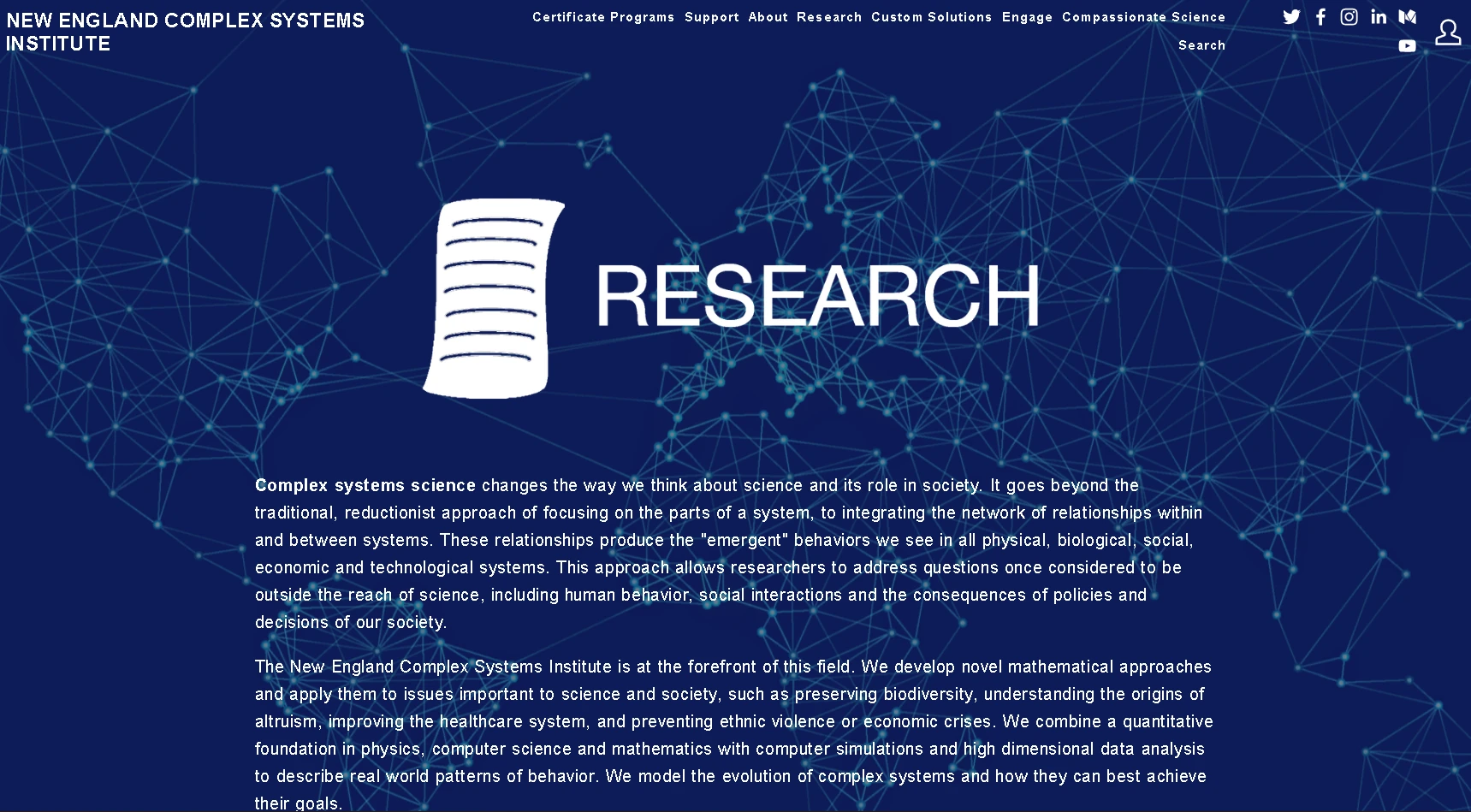
Explore NECSI research in complex systems science, addressing global challenges through data, networks, and mathematical modeling.
Work published in Physical Review E, the primary APS journal covering statistical, nonlinear, and soft matter physics, represents the frontier literature your course is preparing you to read and contribute to. MPB tutors stay current with this literature and can help you connect your coursework to the research frontier where relevant.
Students who want to strengthen the statistical physics foundations underpinning complex systems can also explore MPB’s Thermodynamics page. Those interested in the quantum mechanical side of many-body and emergent phenomena may find Superconductivity and Plasma Physics pages relevant to their broader research context.
“More is different. The behavior of large and complex aggregates of elementary particles is not to be understood in terms of simple extrapolation of the properties of a few particles.”
— Philip W. Anderson, Nobel Laureate in Physics, in his landmark essay published in Science, Vol. 177 (1972)
Anderson’s insight remains the founding philosophical statement of Complex Systems Physics. It is the reason the subject exists as a distinct field — and understanding it deeply is the first step toward mastering everything that follows. That is where MPB tutoring begins.
Next Steps
Share your current course context, the topics giving you the most difficulty, and your exam or assignment timeline. We confirm your time zone and availability, then match you with a tutor whose depth fits your specific needs. In most cases, your first session can begin within a day or two of confirmation.
No long intake forms. No upfront commitment to a session package before you have seen the quality. Just a matched tutor, a diagnostic, and a plan built around your actual gaps.

