Quantum Optics Tutor Online
My Physics Buddy (MPB) offers 1:1 online tutoring & homework help in Physics and related subjects. Quantum Optics is an advanced graduate and upper-undergraduate subject at the intersection of quantum mechanics, electrodynamics, and atomic physics. It underpins laser physics, quantum information, and quantum communication — and it is rarely covered well outside a specialist course. MPB connects you with expert tutors for live, personalised sessions built around your syllabus and research context. Searching for a Quantum Optics tutor near me? Our fully online format removes that constraint entirely.
- 1:1 live sessions — specialist Quantum Optics tutors, not generalists
- Covers upper-undergraduate through PhD-level Quantum Optics content
- Tutors matched by topic depth, mathematical level, and your course context
- Flexible scheduling across US, UK, Canada, Australia, and Gulf time zones
- Structured learning plan built after a diagnostic session
- Ethical homework and assignment guidance — we explain concepts, you submit your own work
Who This Quantum Optics Tutoring Is For
Quantum Optics is taken by a specific set of advanced learners across Physics, Photonics, and Quantum Information programs. MPB serves all of them.
- Advanced undergraduate Physics students taking a Quantum Optics elective or module
- Graduate (Masters) students in Physics, Photonics, or Quantum Engineering courses covering quantum light-matter interaction
- PhD students in laser physics, quantum information, quantum communication, or atomic physics who need to solidify theoretical foundations alongside their research
- Researchers transitioning into quantum optics who need structured, targeted conceptual support
- Students in the US, UK, Canada, Australia, and Gulf region at universities with quantum optics research groups or course offerings
- Students needing guided help with problem sets and derivations from standard texts such as Gerry & Knight, Walls & Milburn, or Mandel & Wolf
Outcomes: What You’ll Be Able To Do in Quantum Optics
Quantum Optics demands fluency in both quantum mechanics and classical electrodynamics — applied to light and its interaction with matter. Strong tutoring builds that fluency systematically. These are observable outcomes, not guarantees.
Derive and interpret the quantum description of the electromagnetic field — mode expansion, field quantisation, photon number states — and connect it clearly to the classical picture. Work confidently with coherent states, squeezed states, and Fock states: their definitions, their properties, and their physical realisation. Analyse atom-field interactions using the Jaynes-Cummings model, including Rabi oscillations, collapse and revival, and the dressed state picture. Apply quantum optical phase space methods — Wigner function, P and Q representations — to characterise and distinguish quantum and classical light. Explain and calculate measures of quantum coherence and correlations, including the Glauber coherence functions and photon bunching and antibunching.
What We Cover in Quantum Optics (Syllabus / Topics)
Quantum Optics syllabi vary by institution and research focus. Physics-department courses emphasise field quantisation and light-matter interaction; Photonics and Engineering courses may lean toward applications in quantum communication and sensing. MPB tutors are familiar with both traditions and adapt to your specific course. Coverage aligns with standard texts including Gerry & Knight’s Introductory Quantum Optics and Walls & Milburn’s Quantum Optics.
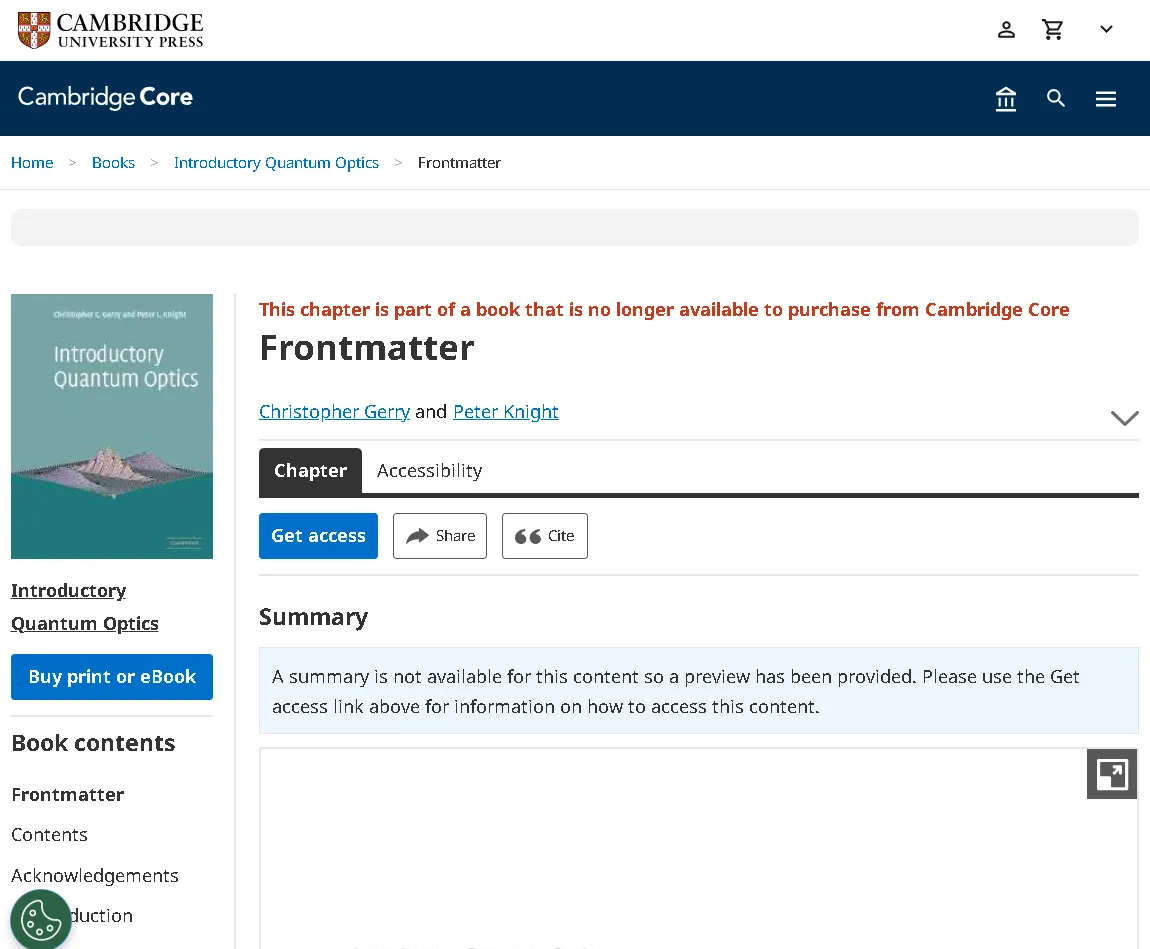
Explore the frontmatter of Introductory Quantum Optics, including authors, publication details, and course structure for advanced physics study.
Classical Optics and Coherence Review
- Classical electromagnetic field: modes, polarisation, energy density
- First and second-order coherence: the van Cittert-Zernike theorem
- Interference and the Michelson interferometer: coherence length and time
- The Hanbury Brown-Twiss effect: classical and quantum interpretation
- Thermal light vs laser light: statistical properties
Quantisation of the Electromagnetic Field
- Canonical quantisation: from classical field to quantum harmonic oscillators
- Mode expansion of the vector potential: single-mode and multi-mode fields
- Creation and annihilation operators: commutation relations, number operator
- Fock states (number states): properties, vacuum fluctuations, zero-point energy
- The quantum vacuum: spontaneous emission as a vacuum-driven process
- Multi-mode fields: tensor product structure, entangled field states
Coherent States and Phase Space Methods
- Coherent states: definition as eigenstates of the annihilation operator, properties
- Coherent state expansion: completeness, over-completeness, non-orthogonality
- Displacement operator and the coherent state as a displaced vacuum
- Squeezed states: quadrature squeezing, squeezing parameter, uncertainty relations
- Phase space representations: Wigner function, Glauber-Sudarshan P function, Husimi Q function
- Negativity of the Wigner function as a signature of non-classical light
Photon Statistics and Quantum Coherence
- Photon number distribution: Poissonian, sub-Poissonian, super-Poissonian statistics
- Mandel Q parameter: measure of deviation from Poissonian statistics
- Glauber coherence functions: g(1) and g(2) — definitions and physical meaning
- Photon bunching: thermal light, g(2)(0) > 1
- Photon antibunching: single-photon sources, g(2)(0) < 1 as a quantum signature
- Hanbury Brown-Twiss experiment: setup, measurement, and quantum interpretation
Atom-Field Interaction
- Two-level atom model: electric dipole approximation, rotating wave approximation (RWA)
- Rabi oscillations: classical driving field, Rabi frequency, Bloch sphere
- The Jaynes-Cummings model: quantised field interacting with a two-level atom
- Dressed states: energy splitting, avoided crossings
- Collapse and revival of Rabi oscillations: quantum signature of field quantisation
- Spontaneous emission: Einstein A coefficient, Wigner-Weisskopf theory
- Cavity QED: strong coupling regime, Purcell effect, vacuum Rabi splitting
Open Quantum Systems and Dissipation
- Density matrix formalism applied to quantum optical systems
- Lindblad master equation: structure, decay terms, dephasing
- Optical Bloch equations: steady state, transient response, T1 and T2 times
- Quantum jumps: Monte Carlo wave function method (conceptual)
- Laser theory: threshold condition, photon statistics above and below threshold
Entanglement and Quantum Information in Optics
- Entangled photon pairs: parametric down-conversion, polarisation entanglement
- Bell state measurement and violation of Bell inequalities with photons
- Quantum teleportation with photonic systems
- Quantum key distribution: BB84 and E91 protocols
- Linear optical quantum computing: KLM scheme, beam splitters as quantum gates
- Quantum metrology: Heisenberg limit, squeezed light in interferometry
Students strengthening foundations relevant to Quantum Optics can also explore related MPB pages including Quantum Mechanics, Laser Physics, and Photonics.
How My Physics Buddy Tutors Help You with Quantum Optics (The Learning Loop)
Diagnose: Every engagement starts with a diagnostic. The tutor identifies where your quantum mechanics formalism is solid, where field quantisation feels abstract, and which physical concepts — coherent states, photon statistics, the Jaynes-Cummings model — remain unclear. This shapes every session that follows.
Explain: Quantum Optics is a subject where the formalism is dense and the physical picture can easily get lost. Your tutor works to keep both in view — explaining what a coherent state physically represents before deriving its properties, or why the rotating wave approximation is valid and what you lose when you drop it. Explanations adapt until the concept is genuinely clear.
Quantum Optics sits at the heart of multiple transformative technologies. According to the National Institute of Standards and Technology (NIST), quantum sensing, quantum communication, and quantum computing — all of which draw on quantum optical principles — are among the highest-priority areas of the US national quantum initiative. Students who build deep fluency in Quantum Optics are entering one of the most consequential areas of modern physics and technology.
Practice: You work through graduate-level problems live — deriving coherent state properties, computing photon statistics, solving the Jaynes-Cummings model in different limits, and working out Wigner functions for specific states. The tutor watches your reasoning at every step.
Feedback: After each problem, you receive specific, targeted feedback. “Your derivation of the dressed states is correct but you haven’t taken the large-detuning limit properly” or “your Wigner function calculation is right up to the Fourier transform step — you need to use the characteristic function, not the P function” — mathematically precise and tied to what your course requires.
Retest / Reinforce: Core ideas return in new contexts. Coherent states, for instance, reappear in squeezed state derivations, the Jaynes-Cummings model, laser theory, and quantum metrology — each encounter deepens the same underlying idea from a different angle.
Plan: The tutor updates the session plan as your course progresses. You always know what the next session targets and why.
Accountability: For students on weekly plans, tutors help maintain steady progress alongside problem-set deadlines and research commitments.
Sessions run live on Google Meet with a digital pen-pad or iPad + Apple Pencil — essential for multi-line derivations, phase space diagrams, Bloch sphere sketches, and energy level diagrams in real time. Before your first session, share your course level, current chapter, assigned text, and any upcoming deadlines. The first session includes a short diagnostic, a live working-through of your most pressing concept, and a clear plan for the next two to four sessions.
Tutor Match Criteria (How We Pick Your Tutor)
Level and course fit: Your tutor will have direct experience with Quantum Optics at your specific academic level. They know the difference between what an introductory quantum optics module and a graduate-level course using Walls & Milburn demand, and teach accordingly.
Topic strengths: If your difficulty is in field quantisation, the Jaynes-Cummings model, phase space methods, or quantum information applications, we match you with a tutor whose expertise covers that domain at the right depth.
Tools and setup: All MPB tutors use Google Meet and a digital pen-pad or iPad + Apple Pencil for real-time derivation work, phase space sketches, and energy level diagrams.
Time zone and availability: Tutors are available across US, UK, Canada, Australia, and Gulf time zones, fitting around your university schedule and problem-set deadlines.
Learning style and pace: Some students need careful rebuilding of the quantum mechanics prerequisites. Others want focused, fast-paced problem-set practice. Your tutor adjusts the approach to match what works for you.
Goals: A PhD student working on cavity QED has different needs than a Masters student taking a one-semester Quantum Optics course. We align on your goal before sessions begin.
Urgency and timeline: A student with an assignment due in two days gets a targeted plan. A student building foundations across a semester gets a paced structure. Tutor selection accounts for your timeline.
Study Plans (Pick One That Matches Your Goal)
MPB offers three broad plan types for Quantum Optics: a catch-up plan (one to two weeks) for closing specific topic gaps before an exam or deadline, a course support plan (four to eight weeks) for structured assistance across a semester, and an ongoing weekly plan for PhD students and researchers needing consistent expert guidance. The tutor builds the specific session plan after the diagnostic — no fixed schedule is set until your starting point and goals are clearly understood.
Pricing Guide
Quantum Optics tutoring at MPB starts at USD 20 per hour. Most graduate-level sessions fall in the USD 50–USD 80 per hour range, reflecting the advanced and specialised nature of the subject. For highly specialised topics — cavity QED, quantum metrology, open quantum systems — or compressed timelines, rates may reach USD 100 per hour.
Pricing depends on the tutor’s specialisation, the depth of topics covered, your level, and session frequency. All rates are discussed transparently before you commit.
FAQ
Is Quantum Optics hard?
Quantum Optics is demanding because it requires simultaneous fluency in quantum mechanics, classical electrodynamics, and statistical physics — all applied to light. The formalism is dense and the physical picture can feel abstract initially. Students who invest in understanding the foundational ideas — field quantisation, coherent states, photon statistics — before pushing into advanced topics find the subject becomes progressively more tractable.
How many sessions are needed?
A student targeting specific topics — field quantisation or the Jaynes-Cummings model — may need four to eight sessions. A student seeking support across a full-semester Quantum Optics course benefits from regular weekly sessions throughout the term. Your tutor will give a more precise estimate after the diagnostic, based on your current level and course timeline.
Can you help with Quantum Optics homework and problem sets?
Yes — as guided support, not submission. Your tutor will work through problem approaches with you, explain where your derivation breaks down, and help you build the understanding to complete the work independently. MPB does not complete or submit assignments for students. Students are expected to submit their own work at all times.
What happens in the first session?
The first session includes a short diagnostic on two or three topic areas, a live working-through of your most pressing concept or problem, and a clear plan for the next two to four sessions. Come prepared with your course syllabus, current chapter, assigned text, and upcoming deadlines. Sessions run on Google Meet with digital pen-pad support.
What prerequisites do I need for Quantum Optics?
A solid foundation in Quantum Mechanics — at minimum at the Griffiths level — is essential. Familiarity with classical electrodynamics (Maxwell’s equations, mode expansion) and basic statistical physics is also important. At the graduate level, density matrix formalism and some exposure to second quantisation are expected. Students who need to strengthen their quantum mechanics first can explore Quantum Mechanics tutoring on MPB. Students who want to review classical optics foundations can explore Optics and Waves and Optics on MPB.
Is online tutoring effective for Quantum Optics?
Yes. Quantum Optics involves multi-line derivations, phase space diagrams, Bloch sphere sketches, and energy level diagrams — all of which a tutor can work through in real time on a digital pen-pad via Google Meet. The format closely replicates a whiteboard session. Research on personalised instruction, including work published by the American Physical Society, consistently supports the effectiveness of one-on-one teaching for advanced physics.
Explore how APS supports physics departments with programs, resources, and initiatives to enhance teaching, diversity, and student success.
Can you help with lab reports or experimental work in Quantum Optics?
Yes, at a guidance level. Quantum Optics experiments often involve photon counting statistics, interferometric measurements, or characterisation of entangled photon pairs. Your tutor can help you understand the underlying physics of your experiment, interpret your data, estimate uncertainties, and structure your lab report clearly. MPB does not write lab reports for students.
Can MPB help with PhD qualifying exams that include Quantum Optics?
Yes. Qualifying exams that include Quantum Optics typically test field quantisation, coherent and squeezed states, photon statistics, and atom-field interaction at a depth requiring both derivation fluency and physical intuition. Share your qualifying exam syllabus and any past papers and the tutor will build a targeted preparation plan around them.
What is the difference between Quantum Optics and Photonics?
Quantum Optics focuses on the quantum mechanical nature of light — field quantisation, photon statistics, entanglement, and light-matter interaction at the single-photon level. Photonics is a broader engineering and applied physics discipline covering optical devices, waveguides, fibre optics, and integrated photonic circuits — some of which involve quantum effects and some of which do not. Students interested in the Photonics side of the spectrum can explore Photonics tutoring on MPB.
What related subjects does MPB cover that connect to Quantum Optics?
Quantum Optics connects closely to several adjacent disciplines on MPB. Students can explore Quantum Computing for quantum information applications of optical systems, Laser Physics for the applied side of coherent light, Atomic Physics for the atom-field interaction context, and Quantum Field Theory (QFT) for the deeper theoretical framework underlying field quantisation.
Can you help with thesis or dissertation work involving Quantum Optics?
At a guidance level, yes. MPB tutors can help PhD students work through theoretical derivations relevant to their research, clarify conceptual questions in their specific area of quantum optics, and discuss frameworks used in their thesis work. MPB does not write or contribute original research content. All support is focused on helping students develop their own understanding and analysis.
Trust & Quality at My Physics Buddy
Tutor selection: MPB tutors for Quantum Optics hold postgraduate degrees — typically at PhD level — in Physics, Applied Physics, or Photonics, with specific coursework or research experience in quantum optics or closely related areas. Every tutor goes through a subject screening including a live demo session and an ongoing student feedback loop. Quantum Optics is a rare specialisation in the tutoring market; MPB’s matching process prioritises demonstrated subject depth over broad coverage.
Academic integrity: MPB’s position is clear — we guide, you submit your own work. Tutors explain concepts, work through similar problems, and provide feedback on your derivations. They do not complete assignments or any assessed work for students. All guidance is framed as explanation and conceptual clarification, consistent with your university’s academic integrity policies.
About MPB: My Physics Buddy is a Physics-focused online tutoring platform serving students from undergraduate through postgraduate level, across the US, UK, Canada, Australia, and Gulf regions. Students exploring adjacent topics can visit Quantum Mechanics, Electrodynamics, and Statistical Mechanics on MPB — all foundational subjects for Quantum Optics at the graduate level.
Physics education research consistently shows that students in mathematically intensive graduate courses benefit most from active problem-solving with expert feedback, rather than passive review. A study published in the Physical Review Physics Education Research journal found that targeted, formative feedback during problem-solving produces significantly stronger conceptual retention. MPB’s learning loop is built on this evidence.
APS Journals page featuring Physical Review Physics Education Research, a leading journal publishing research on physics teaching and learning.
“Quantum Optics has moved from a purely theoretical curiosity to the experimental and technological frontier — from quantum cryptography to gravitational wave detection with squeezed light. The physics is no longer abstract. It is being built in laboratories right now.”
— Adapted from research context described by the National Institute of Standards and Technology (NIST), Quantum Information Science
Students with strong Quantum Optics foundations often move naturally into research in Condensed Matter (Solid State) Physics, Semiconductor Physics, and Plasma Physics — all areas where light-matter interaction and quantum field methods are increasingly central.
“The students who thrive in Quantum Optics are not those with the strongest memory — they are those who build genuine physical intuition for quantum states of light, one well-guided problem at a time.”
— Based on findings in Bloom’s 2-Sigma Study, Educational Researcher (1984)
Content reviewed by a Quantum Optics tutor at My Physics Buddy.
Next Steps
Tell us your academic level, your university course name, your current topic, any upcoming deadlines, and your main challenge areas — whether that is field quantisation, coherent and squeezed states, photon statistics, the Jaynes-Cummings model, or open quantum systems. We will match you with a tutor whose expertise fits your course depth and timeline. Most students are matched and into their first session within a few days. Scheduling is flexible across all primary time zones.

