Spintronics Physics Tutor Online
My Physics Buddy (MPB) offers 1:1 online tutoring & homework help in Physics and related subjects — and Spintronics Physics is one of our specialist advanced subject areas. Spintronics, short for spin transport electronics, is a rapidly growing field that exploits the intrinsic spin of electrons — alongside their charge — to develop next-generation electronic devices, quantum computing components, and high-density memory systems. Whether you’re an advanced undergraduate, a graduate student, or a researcher seeking conceptual clarity, MPB connects you with tutors who understand this field at a deep level. If you’ve been looking for a Spintronics Physics tutor near me and prefer the depth and flexibility of personalized online learning, you’re in the right place. Our sessions are designed to improve your theoretical grounding, mathematical fluency, and ability to engage with research literature — without shortcuts or generic explanations.
- 1:1 live sessions — fully personalized to your course level and research context
- Expert tutors with advanced knowledge of quantum magnetism, spin transport, and spintronics devices
- Flexible time zones — sessions available for students across the US, UK, Canada, Australia, and Gulf regions
- Structured learning plan built around your course syllabus, weak topics, and assignment or exam dates
- Ethical homework and assignment guidance — we explain concepts and review your reasoning; you complete and submit your own work
Who This Spintronics Physics Tutoring Is For
Spintronics is typically encountered at the advanced undergraduate or graduate level, sitting at the intersection of condensed matter physics, quantum mechanics, materials science, and electrical engineering. This tutoring is for students who need expert, personalized support at that level.
- Advanced undergraduate students in physics, electrical engineering, or materials science whose coursework includes a spintronics module or elective
- Graduate (Masters and PhD) students in the US, UK, Canada, Australia, and Gulf regions whose research or coursework requires a strong spintronics foundation
- Students struggling with specific topics — spin-orbit coupling, the quantum Hall effect, magnetoresistance phenomena, or spin wave dynamics — who need targeted conceptual help
- Researchers and PhD candidates preparing for qualifying exams or needing to consolidate theory behind their experimental or computational work
- Students needing homework, problem set, and assignment guidance — to work through derivations, understand journal paper arguments, and structure written analysis correctly
- University faculty, deans, or academic managers sourcing high-quality supplemental instruction for students enrolled in advanced condensed matter or device physics programs
Outcomes: What You’ll Be Able To Do in Spintronics Physics
Consistent, structured work with an MPB Spintronics Physics tutor is designed to build observable, functional skills across the field’s core areas.
Explain the quantum mechanical origin of electron spin, the distinction between spin-up and spin-down states, and how spin angular momentum interacts with orbital angular momentum in real materials — moving well beyond textbook definitions into physical intuition. Analyze magnetoresistance phenomena including Giant Magnetoresistance (GMR), Tunneling Magnetoresistance (TMR), and Anisotropic Magnetoresistance (AMR) in terms of spin-dependent scattering, density of states, and device geometry. Solve problems involving spin transport in ferromagnetic and non-magnetic layers, applying drift-diffusion models, the Valet-Fert formalism, and spin diffusion length concepts at a quantitative level. Model the behavior of spintronic devices — magnetic tunnel junctions, spin valves, spin-transfer torque oscillators, and spin Hall effect geometries — connecting device physics to underlying quantum and classical theory. Apply knowledge of spin-orbit coupling, the Rashba and Dresselhaus effects, and topological insulator surface states to understand emerging spintronics platforms relevant to quantum computing and next-generation memory architectures.
What We Cover in Spintronics Physics (Syllabus / Topics)
Spintronics Physics courses vary in scope and depth depending on the institution, department, and level (undergraduate elective vs. graduate core). The coverage below reflects the most common units encountered across university programs globally. Always share your exact syllabus with your tutor in the first session so coverage can be precisely aligned.
Track 1: Foundations of Spin in Quantum Mechanics
- Electron spin as a quantum mechanical degree of freedom
- Spin-1/2 systems, Pauli matrices, and spinors
- Spin angular momentum operators and eigenvalues
- Stern-Gerlach experiment and its interpretation
- Addition of angular momenta: spin-orbit coupling fundamentals
- Zeeman effect and spin precession in external magnetic fields
- Problem types: operator algebra, expectation values, eigenstate calculations
Track 2: Magnetism and Magnetic Materials
- Diamagnetism, paramagnetism, ferromagnetism, antiferromagnetism, and ferrimagnetism
- Exchange interaction and the Heisenberg Hamiltonian
- Magnetic domains, domain walls, and the Bloch/Néel wall structure
- Magnetic anisotropy: crystalline, shape, and surface contributions
- Hysteresis loops and coercivity in ferromagnetic materials
- Magnons and spin wave dispersion relations
- Problem types: susceptibility calculations, exchange energy minimization, magnon dispersion
Track 3: Spin-Dependent Transport
- Two-current model of conductivity in ferromagnets
- Spin-dependent scattering and the role of density of states
- Giant Magnetoresistance (GMR): physics, discovery, and device geometry
- Tunneling Magnetoresistance (TMR) and magnetic tunnel junctions
- Spin diffusion length and spin relaxation mechanisms
- Valet-Fert formalism for spin transport in multilayers
- Problem types: MR ratio calculations, spin current continuity equations, diffusion length problems
Track 4: Spin-Orbit Coupling and Topological Effects
- Rashba spin-orbit coupling in two-dimensional systems and interfaces
- Dresselhaus spin-orbit coupling in bulk and quantum well structures
- Spin Hall effect and inverse spin Hall effect
- Anomalous Hall effect: intrinsic and extrinsic contributions
- Topological insulators and spin-momentum locking on surface states
- Berry phase and topological concepts in band theory
- Problem types: effective Hamiltonian derivations, Hall conductivity calculations, band topology analysis
Track 5: Spintronic Devices and Applications
- Spin valve structure, operation, and applications in read heads
- Magnetic tunnel junction (MTJ) devices and MRAM architecture
- Spin-transfer torque (STT): mechanism, threshold current, and switching dynamics
- Spin-torque nano-oscillators (STNOs) and their microwave emission
- Spin injection from ferromagnetic contacts into semiconductors
- Spin field-effect transistor (spin-FET) concept and challenges
- Problem types: switching current calculations, device geometry analysis, FMR linewidth questions
Track 6: Experimental Methods and Characterization
- Ferromagnetic resonance (FMR) and spin wave spectroscopy
- Magneto-optical Kerr effect (MOKE) microscopy
- Spin-polarized scanning tunneling microscopy (SP-STM)
- X-ray magnetic circular dichroism (XMCD) for element-specific magnetometry
- Transport measurement techniques: Hall bar, four-probe methods
- Thin film deposition and patterning techniques relevant to spintronic devices
- Problem types: interpreting FMR spectra, MOKE signal analysis, Hall measurement data
Students whose coursework bridges into related areas can also explore our dedicated pages for Quantum Mechanics, Condensed Matter (Solid State) Physics, and Semiconductor Physics.
How My Physics Buddy Tutors Help You with Spintronics Physics (The Learning Loop)
Diagnose: Every engagement begins with a structured diagnostic. The tutor asks about your course level, the topics you’ve covered, your mathematical background (linear algebra, quantum mechanics, solid-state theory), and where your understanding currently breaks down — whether that’s spin-orbit coupling derivations, magnetoresistance device analysis, or topological concepts. This determines the entire structure of your sessions.
Explain: The tutor introduces and builds concepts using precise, layered explanations — starting from physical intuition before moving into the mathematical formalism. For Spintronics, this often means anchoring abstract quantum spin ideas to real device behavior so the theory becomes meaningful, not just symbolic.
Practice: You work through problem sets drawn from your course materials, supplemented by representative problems from advanced texts in the field. Problem types include Hamiltonian derivations, transport calculations, device analysis questions, and conceptual reasoning — the full range encountered in advanced physics exams and assignments.
Feedback: After each worked problem, the tutor reviews your reasoning process — flagging errors in setup, sign conventions in spin operators, incorrect physical assumptions, or gaps in the derivation chain. Corrections are given in context, not in isolation, so you understand why the error occurred.
Retest/Reinforce: Topics where errors recur are revisited in subsequent sessions with varied problem types, ensuring the understanding is genuine and transferable — not just pattern-matched to one question type.
Plan: The tutor maintains a session roadmap anchored to your assignment deadlines, exam dates, and remaining syllabus. The plan adapts as your performance improves or new coursework priorities emerge.
Accountability: For students who want it, tutors set structured self-study tasks between sessions — reading sections, problem set attempts, or derivation reviews — and follow up on progress at the start of each session to maintain momentum.
All sessions run on Google Meet, with a digital pen-pad or iPad + Pencil for live derivations, diagrams of device structures, and spin transport schematics. Teaching pace and mathematical depth are calibrated to your course level — an upper-year undergraduate session looks different from a PhD-level session, and both are handled appropriately.
First session flow: The first session opens with a diagnostic discussion — the tutor asks about your course structure, current unit, mathematical background, and the specific concepts or problems giving you trouble. The tutor then moves into live teaching on a priority topic, with a full worked example and Q&A. The session closes with a concrete plan for the next steps. Before the session, it helps to share your course syllabus, recent problem sets or assignments, any lecture notes on your current unit, and your assignment or exam timeline.
Tutor Match Criteria (How We Pick Your Tutor)
MPB selects your Spintronics Physics tutor based on several interconnected criteria — subject depth alone is not sufficient at this level.
Level and syllabus fit: We match based on whether you need undergraduate-level conceptual support, graduate coursework help, or PhD-level research foundation work. Spintronics tutors at MPB have advanced backgrounds in condensed matter physics, quantum mechanics, and materials physics.
Topic strengths and tools: For Spintronics, we prioritize tutors who are strong across spin transport theory, magnetism, spin-orbit coupling, and device physics — the core areas of most university courses. Tools used include Google Meet and digital pen-pad or iPad + Pencil for live derivations and device diagram work.
Time zone and availability: Tutors are matched for availability across US (ET, CT, PT), UK (GMT/BST), Canada, Australia (AEST/AEDT), and Gulf (GST/AST) time zones, with evening and weekend slots commonly available for students in full-time programs.
Learning style and pace: Some students at this level prefer to work through derivations step by step; others prefer a top-down device-physics-first approach. Your tutor adapts to the approach that builds your understanding fastest.
Language and communication preferences: All MPB tutors communicate in clear English, with the ability to adjust the density and formalism of technical language based on your comfort and course level.
Goals: Whether your priority is passing a course exam, completing problem sets, understanding a specific derivation, or consolidating theory behind your own research, the tutor’s approach is calibrated to that goal from the first session.
Urgency and timelines: Students with an exam or assignment deadline within days get a different structure than students seeking semester-long weekly support. Short timelines trigger triage-first planning; longer timelines allow deeper conceptual building.
Study Plans (Pick One That Matches Your Goal)
MPB offers three broad plan types for Spintronics Physics: a catch-up plan (typically 1–2 weeks of intensive sessions) for students who need to quickly cover missed units or consolidate before a near-term exam, an exam or assignment prep plan (typically 4–8 weeks) that works systematically through your course syllabus and problem types, and ongoing weekly support for students who want consistent expert guidance throughout a semester or research period. The specific session plan — topics, sequencing, problem set focus, and derivation work — is built by the tutor after the diagnostic session, ensuring it reflects your actual course structure and gaps rather than a generic template.
Pricing Guide
Spintronics Physics tutoring at MPB starts at USD 20 per hour and typically ranges up to USD 40 per hour for standard advanced undergraduate sessions. Given that Spintronics is a specialist, graduate-level field requiring tutors with deep advanced physics backgrounds, sessions at the Masters, PhD, or research level may be priced higher — in some cases up to USD 100 per hour — depending on the tutor’s expertise, the complexity of the content, and timeline urgency. Supply and demand also affects rates: availability of specialist tutors and the frequency or duration of sessions can influence the final quote.
For a specific quote based on your level, course, and schedule, WhatsApp for quick quote.
FAQ
Is Spintronics Physics hard?
Spintronics is generally considered a challenging advanced topic. It requires solid prior knowledge of quantum mechanics, condensed matter physics, and electromagnetism. The mathematical formalism — Pauli matrices, effective Hamiltonians, spin transport equations — can be steep without proper guidance. With structured 1:1 tutoring, the conceptual and mathematical layers become progressively clearer and manageable.
How many sessions are needed?
It varies based on your starting point, course pace, and goal. Students doing intensive exam prep over 4–8 weeks typically benefit from 2–3 sessions per week. Students seeking semester-long weekly support usually do 1–2 sessions per week. Your tutor will give a clearer estimate after the first diagnostic session, once your background and gaps are understood.
Can you help with Spintronics homework, problem sets, and assignments?
Yes — MPB provides guided homework and assignment help. Tutors explain the relevant theory, walk through analogous worked examples, and review your reasoning and setup. Our services aim to provide personalized academic guidance, helping you understand concepts and improve skills. Materials provided are for reference and learning purposes only. Submitting another person’s work as your own, or using guidance in ways that violate your institution’s academic integrity policy, is strongly discouraged. You complete and submit your own work.
Does the tutoring match my exact university syllabus?
MPB tutors work from standard advanced physics course content in Spintronics, but university syllabi vary significantly by institution, department, and instructor. Share your course syllabus, lecture slides, and problem sets in the first session so the tutor can align support precisely to your specific course structure rather than a generic curriculum.
What happens in the first session?
The first session includes a diagnostic discussion covering your course level, mathematical background, current unit, and specific areas of difficulty. The tutor then moves into live teaching on a priority topic — with a full worked derivation or problem example and Q&A. The session closes with a clear plan for next steps. Bring your syllabus, recent problem sets, and any upcoming deadline details.
Is online tutoring effective for a highly technical subject like Spintronics?
Yes — for advanced physics subjects, online 1:1 sessions are well-suited. Using Google Meet with a digital pen-pad or iPad + Pencil, tutors work through derivations, draw energy band diagrams, sketch device schematics, and annotate equations in real time. The ability to share screens, review papers together, and record sessions for later review is particularly valuable at the graduate level.
What mathematical background do I need before starting Spintronics tutoring?
You will benefit most if you have prior exposure to quantum mechanics (including Dirac notation and operators), linear algebra (matrices, eigenvalues), and basic solid-state or condensed matter physics. If your background in any of these has gaps, your tutor can identify and address those gaps as part of the structured learning plan. MPB also offers dedicated tutoring in Quantum Mechanics and Mathematical Physics if you need to build those foundations separately.
Can MPB help with Spintronics thesis or dissertation work?
MPB can provide high-level guidance on understanding the theoretical framework behind your thesis topic, structuring your literature review, and clarifying concepts relevant to your research direction. Tutors do not write, draft, or directly contribute to dissertation submissions. All guidance is framed as explanation, concept clarification, and structural feedback — so the intellectual work remains entirely yours.
Are lab report guidance and experimental data interpretation available?
Yes, within ethical limits. If your Spintronics course includes experimental components — such as FMR measurements, Hall bar transport data, or MOKE analysis — a tutor can help you understand the underlying physics of the technique, interpret your results conceptually, and structure your lab report correctly. MPB does not write reports for students; guidance is always framed as explanation and feedback on your own work.
Can you help with Spintronics topics that overlap with quantum computing?
Yes. Spintronics has significant overlap with quantum information science — particularly in areas like spin qubits, spin-orbit qubit designs, and topological quantum computing via Majorana fermions. If your course or research touches these intersections, your tutor can help bridge the gap between the spintronics device physics perspective and the quantum computing context. Students interested in these overlaps can also explore our dedicated page for Quantum Computing.
Academic Integrity Note: Our services aim to provide personalized academic guidance, helping students understand concepts and improve skills. Materials provided are for reference and learning purposes only. Misusing them for academic dishonesty or violations of academic integrity policies is strongly discouraged.
Trust & Quality at My Physics Buddy
Tutor selection: Every MPB tutor undergoes a subject knowledge screening, a live demo session evaluation, and an ongoing student feedback review process. For Spintronics Physics, we specifically look for tutors with advanced academic backgrounds in condensed matter or solid-state physics, quantum mechanics, and materials physics — fields that form the direct theoretical foundation of spintronics. Tutors are also evaluated on their ability to explain complex, abstract material at a level appropriate to the student’s course and background.
Academic integrity: MPB’s role is to guide and explain — not to complete work for students. In all homework, problem set, assignment, thesis, and lab report support, tutors explain concepts, work through analogous examples, and provide feedback on the student’s own reasoning. Students write, derive, and submit their own work. This approach builds the genuine understanding that holds up in exams and research settings, where no external help is available.
About My Physics Buddy: MPB is a Physics-focused online tutoring platform serving advanced undergraduates, graduate students, Masters and PhD candidates, and their families across the US, UK, Canada, Australia, and Gulf regions. Our core is Physics and closely related quantitative subjects. Students working across advanced condensed matter and quantum topics can explore our dedicated pages for Spintronics Physics, Condensed Matter (Solid State) Physics, Atomic Physics, and Particle Physics. Students whose programs also touch electromagnetism fundamentals or modern physics can explore Electromagnetism and Modern Physics for subject-level support.
“Spintronics is one of the most exciting areas in modern physics and technology. It sits at the intersection of quantum mechanics, materials science, and device engineering — and it is already reshaping how we store and process information.”
Stuart Parkin, Director, Max Planck Institute of Microstructure Physics — as quoted in Max Planck Society research communications
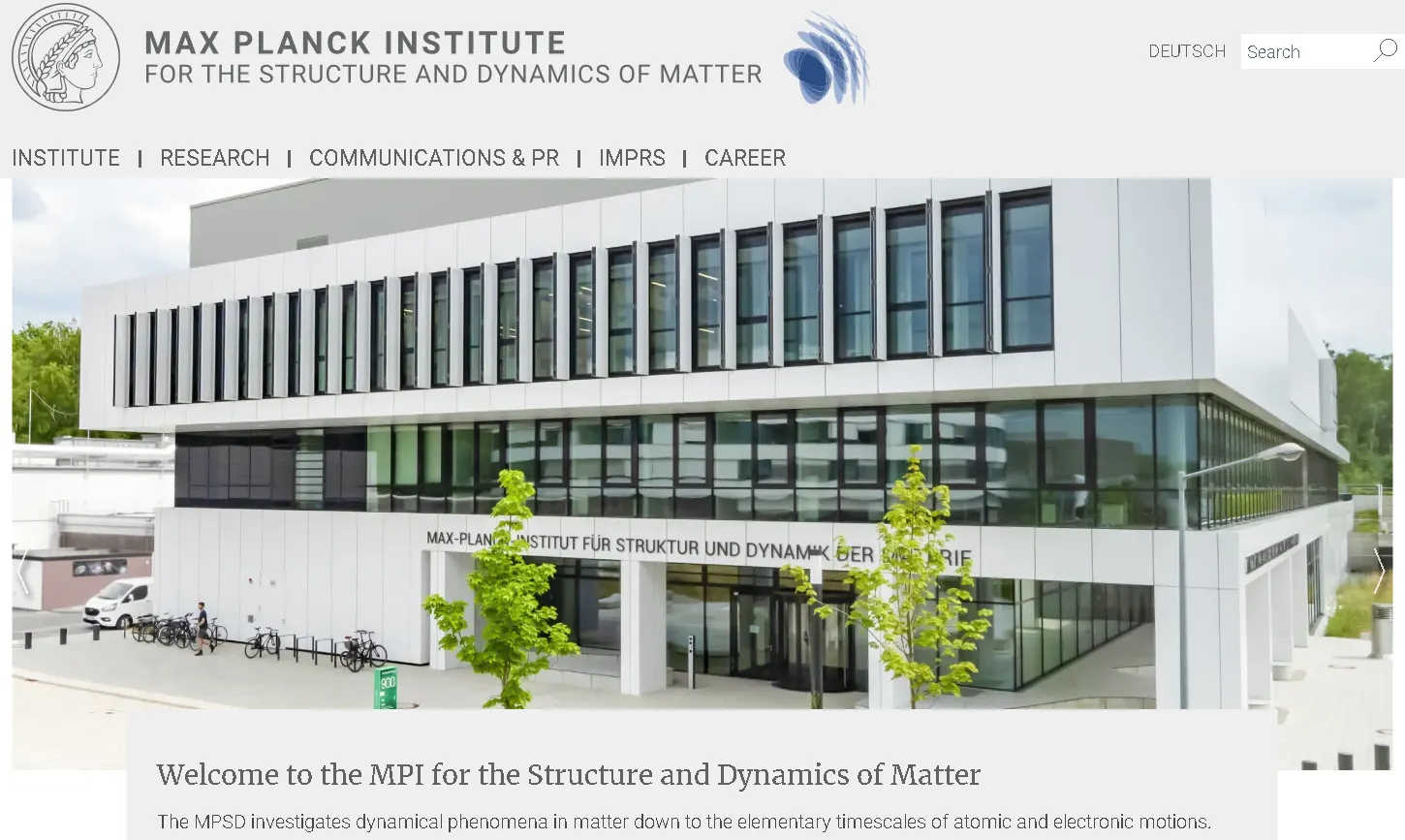
Explore advanced research at MPSD, focusing on quantum materials, ultrafast dynamics, and atomic-scale physics.
“The discovery of Giant Magnetoresistance was the birth of spintronics. It showed that the spin of an electron, not just its charge, could be used to carry and control information.”
Albert Fert, Nobel Laureate in Physics (2007) — as referenced in the Nobel Prize lecture by Albert Fert, Nobel Prize Organization
Explore Related Advanced Physics Subjects at MPB: Spintronics draws heavily from several other advanced physics disciplines. If you’re looking for targeted support in adjacent areas, MPB has dedicated tutoring pages for Quantum Field Theory (QFT), Laser Physics, Plasma Physics, and Experimental Physics & Lab Skills — all of which can complement a Spintronics course at the advanced level.
Content reviewed by a Spintronics Physics tutor at My Physics Buddy.
Next Steps
Getting started is straightforward. Share your current course level — undergraduate elective, graduate core, or PhD research — along with which topics feel least clear and your assignment or exam timeline. Let us know your preferred session times and time zone. MPB will match you with a tutor whose subject depth, availability, and teaching approach fit your specific program and goals. Your first session is a diagnostic and live teaching session, giving both you and your tutor a clear picture of exactly where to focus and how to structure the sessions ahead.

