D Page
asked on February 3, 2026
Open closed pipe resonance problems
How do open and closed pipe resonance problems work?
Need Help?
Hire one of our expert Physics tutor online. 24/7 Service. Available now.
Expert Answer
Answered on February 5, 2026 by EXPERT TUTOR
Nothing Found
Dear D Page,
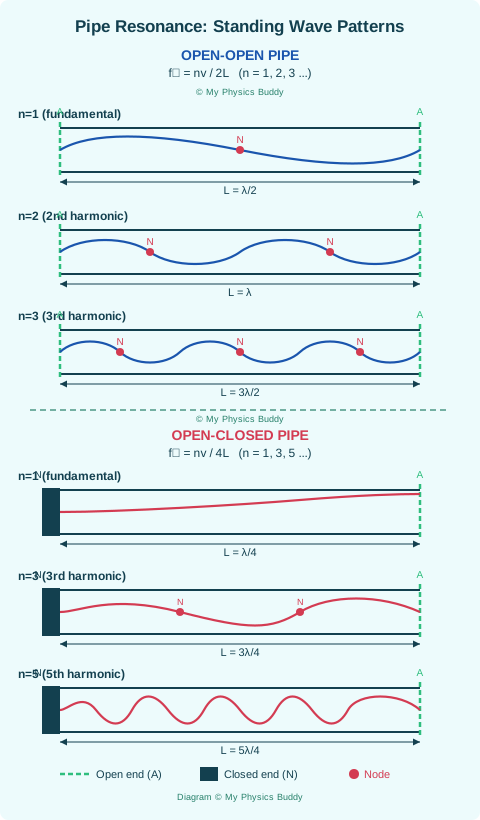
Open and closed pipe resonance problems rely on understanding where displacement nodes and antinodes form at each end of the pipe. An open end always has a displacement antinode, while a closed end always has a displacement node. According to expert tutors at My Physics Buddy, mastering these boundary conditions is the entire key to solving every pipe resonance problem.
How Open and Closed Pipe Resonance Works in AP Physics 1
Think of a pipe as a playground for sound waves. The wave bounces back and forth, and resonance occurs when the reflected wave reinforces the original wave — forming a standing wave. The conditions at each end of the pipe determine which wavelengths fit, and that is exactly what sets open and closed pipes apart.
Boundary Conditions: The Foundation of Everything
Every pipe resonance problem starts with two rules you must memorize cold:
- Open end: air molecules are free to move — this is a displacement antinode (maximum vibration).
- Closed end: air molecules cannot move through the wall — this is a displacement node (zero vibration).
A helpful analogy: imagine a jump rope tied firmly to a wall at one end (closed — node) and held loosely at the other end (open — antinode). Only certain rope-wiggle patterns fit between those two constraints. Sound in a pipe works the same way.
Open-Open Pipes
A pipe open at both ends has an antinode at each end. The simplest standing wave that fits has exactly half a wavelength inside the pipe. The allowed harmonics are:
fn = nv / (2L) where n = 1, 2, 3, 4, …
- fn = frequency of the n-th harmonic (Hz)
- n = harmonic number (all positive integers allowed)
- v = speed of sound in air, approximately 343 m/s at 20°C
- L = length of the pipe (m)
Open-open pipes support all harmonics — first, second, third, and so on. This is why a flute (open at both ends) produces a rich, bright tone.
Open-Closed Pipes
A pipe open at one end and closed at the other has an antinode at the open end and a node at the closed end. The simplest wave that satisfies both conditions fits a quarter wavelength inside the pipe. The allowed harmonics are:
fn = nv / (4L) where n = 1, 3, 5, 7, … (odd integers only)
Only odd harmonics are present in a closed pipe. A clarinet behaves like a closed-open pipe and has a characteristically hollow sound because the even harmonics are missing.
Quick Comparison Table
| Pipe Type | Ends | Formula | Harmonics Allowed |
|---|---|---|---|
| Open-Open | A — A | fn = nv/2L | All (1, 2, 3 …) |
| Open-Closed | A — N | fn = nv/4L | Odd only (1, 3, 5 …) |
Worked Example
A closed-open organ pipe is 0.85 m long. The speed of sound is 340 m/s. Find the frequencies of the first three resonant modes.
Step 1 — Identify pipe type. Closed at one end, open at the other → use fn = nv / (4L), odd n only.
Step 2 — Substitute values.
- n = 1 (fundamental): f1 = (1 × 340) / (4 × 0.85) = 340 / 3.4 = 100 Hz
- n = 3 (3rd harmonic): f3 = (3 × 340) / (4 × 0.85) = 1020 / 3.4 = 300 Hz
- n = 5 (5th harmonic): f5 = (5 × 340) / (4 × 0.85) = 1700 / 3.4 = 500 Hz
Step 3 — Check the pattern. Each resonant frequency is an odd multiple of 100 Hz. ✓
If you want to go deeper into standing waves and resonance, the AP Physics 1 resource pages at My Physics Buddy cover this topic thoroughly, and the broader Acoustics & Sound Physics section adds great context on real instruments. For a rigorous reference, the NIST unit definitions and the Physics Classroom’s standing wave guide are both excellent external reads.
As a 20-year math and physics teacher, I can tell you that the single biggest conceptual leap for students is realising the wave pattern inside the pipe is a displacement wave — not a pressure wave diagram — and the node/antinode labels flip when you switch to pressure. Keep that in mind if you ever see a pressure-wave version on an exam.
Common Mistakes with Pipe Resonance Problems
✗ Mistake: Using fn = nv/2L for a closed pipe and allowing even harmonics.
✓ Fix: For an open-closed pipe, use fn = nv/4L with odd n only (1, 3, 5 …). If you are not sure which formula to use, draw the node-antinode pattern first — it will tell you the wavelength directly.✗ Mistake: Forgetting that the fundamental wavelength for a closed pipe is 4L, not 2L.
✓ Fix: Sketch the wave inside the pipe. One quarter-wavelength fills the closed pipe at the fundamental, so λ1 = 4L. Use v = fλ to cross-check your answer every time.✗ Mistake: Confusing displacement nodes with pressure nodes and labelling diagrams incorrectly.
✓ Fix: Remember that displacement nodes are pressure antinodes and vice versa. A closed end is a displacement node but a pressure antinode. Whenever the question specifies displacement or pressure, redraw your diagram accordingly before reading off the pattern.
Exam Relevance: Open and closed pipe resonance appears in AP Physics 1 (Unit 10: Mechanical Waves and Sound), IB Physics HL/SL (Topic 4), and VCE Physics. Questions range from identifying harmonic patterns to calculating resonant frequencies given pipe length and wave speed.
💡 Pro Tip from Katherine H: Always sketch the standing wave pattern inside the pipe first. Once you can see where the nodes and antinodes sit, the correct formula and harmonic number follow immediately without memorisation.
Related Questions
How to calculate the speed of a wave on a string?
What are standing waves and how do harmonics work?
How to explain physics concepts qualitatively for AP Physics 1 FRQs?
What is the best way to review for AP Physics 1 in two weeks?
How to apply Newton’s second law in rotational form?
How does energy transfer work in simple harmonic motion?
How to solve problems with pulleys and tension in AP Physics 1?
What is mechanical energy and when is it conserved?