M Archer
asked on February 7, 2025
Moment of inertia different shapes
How do you calculate the moment of inertia for different shapes?
Need Help?
Hire one of our expert Physics tutor online. 24/7 Service. Available now.
Expert Answer
Answered on February 27, 2025 by EXPERT TUTOR
Nothing Found
Dear M Archer,
The moment of inertia for different shapes is calculated using the formula I = ∫r² dm, which sums how mass is distributed relative to a rotation axis. According to expert tutors at My Physics Buddy, each standard shape has a memorised result from that integral, and the parallel axis theorem extends these to any axis.
Understanding Moment of Inertia for Different Shapes in AP Physics
Think of moment of inertia as the rotational equivalent of mass. In linear motion, a large mass resists acceleration. In rotational motion, a large moment of inertia resists angular acceleration. What makes it richer than plain mass is that where the mass sits relative to the axis matters enormously. Spread the same mass farther from the axis and it becomes much harder to spin — this is exactly why a figure skater pulls their arms in to spin faster.
The general definition is:
I = ∫ r² dm
where I is the moment of inertia (kg·m²), r is the perpendicular distance from the rotation axis to each mass element, and dm is an infinitesimal mass element. For uniform objects, you express dm in terms of a density and a geometric variable, then integrate over the object’s extent.
In AP Physics C: Mechanics, you are expected to derive these integrals from scratch. In AP Physics 1, you use the pre-derived results directly. Let me walk you through both the formulas and the derivation method so you are covered either way.
Standard Moment of Inertia Formulas
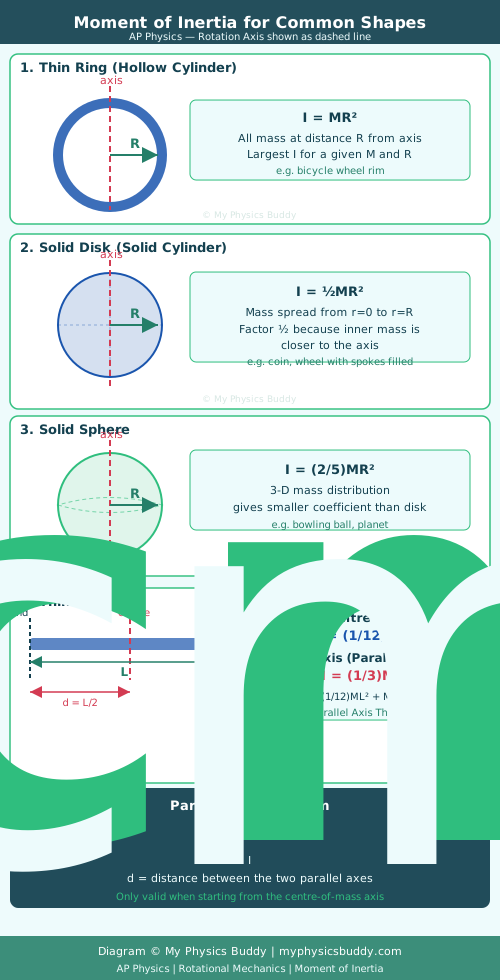
Here are the most commonly tested shapes. M is the total mass, R is the radius, and L is the length.
| Shape | Axis | Formula |
|---|---|---|
| Solid cylinder / disk | Central axis | I = ½MR² |
| Hollow cylinder (thin ring) | Central axis | I = MR² |
| Solid sphere | Through centre | I = (2/5)MR² |
| Hollow sphere (thin shell) | Through centre | I = (2/3)MR² |
| Thin rod | Through centre | I = (1/12)ML² |
| Thin rod | Through one end | I = (1/3)ML² |
Notice the pattern: mass farther from the axis always gives a larger numerical coefficient. A hollow ring has I = MR² (all mass at radius R), while a solid disk has I = ½MR² because half the mass sits closer to the centre. This intuition is tested directly in AP Physics free-response questions.
Deriving I for a Thin Rod (Centre Axis) — Full Worked Example
Let the rod have mass M, length L, and uniform linear mass density λ = M/L. Place the axis at the centre, so the rod runs from x = −L/2 to x = +L/2.
Step 1 — Express dm: dm = λ dx = (M/L) dx
Step 2 — Set up the integral:
I = ∫−L/2+L/2 x² · (M/L) dx
Step 3 — Integrate:
I = (M/L) · [x³/3]−L/2+L/2
I = (M/L) · (1/3) · [(L/2)³ − (−L/2)³]
I = (M/L) · (1/3) · 2 · (L³/8)
I = (M/L) · L³/12 = (1/12)ML² ✓
The Parallel Axis Theorem
Once you know I about the centre of mass, you can shift to any parallel axis using:
I = Icm + Md²
where Icm is the moment about the centre of mass, M is the total mass, and d is the perpendicular distance between the two parallel axes. For the thin rod pivoting at one end, d = L/2, so:
Iend = (1/12)ML² + M(L/2)² = (1/12)ML² + (1/4)ML² = (1/3)ML² ✓
As an IBDP & A-Level Physics Specialist, I find that students who master the parallel axis theorem can solve about 80% of AP rotational dynamics problems without memorising extra formulas. It is one of the most powerful tools in your toolkit. You can read more about how moment of inertia connects to rotational kinetic energy and angular momentum at Khan Academy’s AP Physics rotational inertia review.
One struggle I see very often in students studying AP Physics is treating moment of inertia as a fixed property of an object. It is not — it depends on which axis you choose. Always specify your axis before writing any formula.
Common Mistakes with Moment of Inertia
✗ Mistake: Using I = MR² for a solid disk instead of I = ½MR².
✓ Fix: Remember that a solid disk has mass distributed from r = 0 to r = R, so the average r² is half of R², giving the factor of ½. Only a thin ring or hollow cylinder gives I = MR².✗ Mistake: Applying the parallel axis theorem starting from an axis that is not the centre of mass.
✓ Fix: The theorem only works when Icm is specifically about the centre-of-mass axis. Always start from Icm, then add Md² to shift to your new axis.✗ Mistake: Forgetting to square the distance d when using I = Icm + Md².
✓ Fix: Write the formula out fully every time and check units: Md² must have units of kg·m² to match Icm. If d is in metres and M in kg, d² in m² gives the correct units immediately.
Exam Relevance: Moment of inertia and the parallel axis theorem appear in AP Physics C: Mechanics (Unit 5), AP Physics 1 (Unit 7), and A/AS Level Physics 9702. Each exam tests both formula recall and derivation at different depths.
💡 Pro Tip from Mamatha M: Always sketch the axis of rotation first. Once you clearly see where the axis sits relative to the shape, choosing the right formula or setting up the integral becomes almost automatic.
Related Questions
How to analyze motion graphs for AP Physics?
What is the difference between static and kinetic friction in AP Physics?
How to handle unit conversions in AP Physics problems?
What are the FRQ scoring guidelines for AP Physics?
How to solve impulse and momentum problems on the AP exam?
What is the best AP Physics prep book for self-study?
How to approach experimental design questions on AP Physics?
How do you calculate the moment of inertia for different shapes?