L van der Meer
asked on December 7, 2025
Capacitor RC circuit problem solving
How does a capacitor work and how to solve RC circuit problems?
Need Help?
Hire one of our expert Physics tutor online. 24/7 Service. Available now.
Expert Answer
Answered on December 30, 2025 by EXPERT TUTOR
Nothing Found
Dear L van der Meer,
A capacitor works by storing electric charge on two parallel conducting plates separated by an insulating gap, creating an electric field between them. According to expert tutors at My Physics Buddy, understanding how charge builds up and decays through a resistor is the core skill for RC circuit problems in AP Physics 2.
How a Capacitor Works and How to Solve RC Circuit Problems
The Physics of a Capacitor
Imagine pushing water into a sealed elastic balloon through a pipe. The more water you push in, the more the balloon resists further flow. A capacitor behaves exactly like that balloon. When you connect a voltage source, positive charge accumulates on one plate and an equal negative charge accumulates on the opposite plate. No charge actually crosses the gap — instead, the growing electric field between the plates opposes further charge movement, just like the balloon resisting more water.
The key relationship is: Q = CV, where Q is the charge stored (in coulombs), C is the capacitance (in farads, F) — a measure of how much charge the capacitor can store per volt — and V is the voltage across the plates (in volts). A larger capacitance means more charge stored at the same voltage.
The energy stored in a charged capacitor is:
U = ½CV²
where U is stored energy in joules. This energy lives in the electric field between the plates.
Charging and Discharging: The Exponential Behaviour
When a capacitor charges or discharges through a resistor, the current and voltage don’t change linearly — they follow an exponential curve. This is because as the capacitor charges up, it opposes the current more and more, slowing the process. The governing equations are:
- Charging — voltage across capacitor: VC(t) = V0(1 − e−t/RC)
- Discharging — voltage across capacitor: VC(t) = V0 e−t/RC
- Current during charging: I(t) = (V0/R) e−t/RC
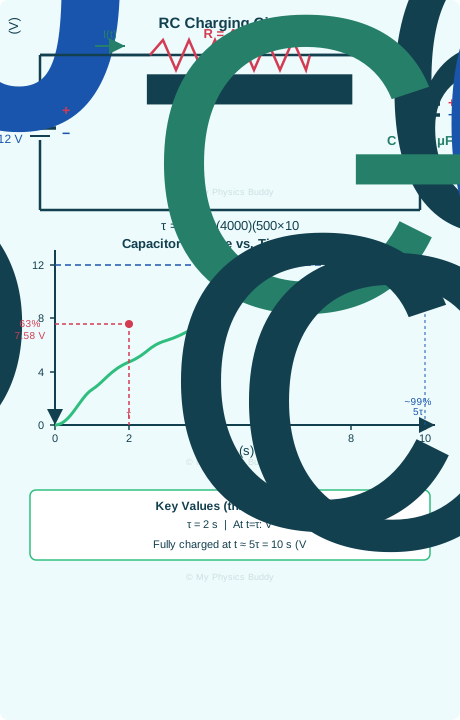
Here V0 is the initial (or supply) voltage, R is resistance in ohms, C is capacitance in farads, and t is time in seconds. The product τ = RC is called the time constant (in seconds). It tells you how quickly the circuit responds — after one time constant, the capacitor has charged to about 63% of its final voltage, and after five time constants it is considered fully charged (over 99%).
Worked Example: Charging an RC Circuit
As a dual MS graduate in Physics and Astronomy, I can tell you that the single most common place students lose marks is forgetting to calculate τ first. Let’s fix that with a clean worked example.
Given: A 12 V battery is connected in series with a 4 kΩ resistor and a 500 µF capacitor. The capacitor starts uncharged. Find: (a) the time constant, (b) the voltage across the capacitor after 2 s, and (c) the current at t = 2 s.
Step 1 — Calculate the time constant τ:
τ = RC = (4 × 10³ Ω)(500 × 10−6 F) = 2.0 s
Step 2 — Voltage across capacitor at t = 2 s:
VC(2) = 12(1 − e−2/2) = 12(1 − e−1) = 12(1 − 0.368) = 12 × 0.632 ≈ 7.58 V
Notice this is exactly the “63% rule” in action — at t = τ, the capacitor has charged to 63% of 12 V.
Step 3 — Current at t = 2 s:
I(2) = (V0/R) e−t/RC = (12/4000) × e−1 = 0.003 × 0.368 ≈ 1.10 × 10⁻³ A = 1.10 mA
Notice how the current is largest at t = 0 (when the uncharged capacitor acts like a short circuit) and decays toward zero as the capacitor charges up. This is a pattern you’ll see on every AP Physics exam that tests RC circuits. For a deeper theoretical treatment of exponential decay in circuits, the MIT OpenCourseWare Physics II materials provide excellent supplementary reading.
Key Strategy for Any RC Problem
- Always find τ = RC first — it anchors all other calculations.
- Identify whether the capacitor is charging (voltage rising toward V0) or discharging (voltage falling from V0).
- At t = 0: a fully uncharged capacitor acts like a wire (short circuit); a fully charged capacitor acts like an open circuit (no current flows).
- At t = 5τ: treat the capacitor as fully charged or fully discharged for practical purposes.
Common Mistakes
✗ Mistake: Using the discharging formula when the capacitor is charging, or vice versa — this gives the completely wrong voltage direction.
✓ Fix: Ask first: is voltage going up toward V0 (charging: use 1 − e−t/RC) or going down from V0 (discharging: use e−t/RC)?✗ Mistake: Forgetting to convert units before computing τ, for example leaving capacitance in µF instead of converting to F.
✓ Fix: Always convert to base SI units (ohms and farads) before multiplying R × C. 500 µF = 500 × 10−6 F = 5 × 10⁻⁴ F.✗ Mistake: Assuming the capacitor reaches full charge at exactly t = τ (one time constant).
✓ Fix: At t = τ the capacitor is only 63% charged. Use t = 5τ as the practical “fully charged” threshold, or substitute the exact time into the exponential formula.
Exam Relevance: RC circuit charging and discharging is tested in AP Physics 2, AP Physics C: Electricity and Magnetism, A/AS Level Physics (9702), and IB Physics HL. All four courses expect both qualitative graph interpretation and quantitative exponential calculations.
Pro Tip from Koustubh B: Sketch the VC vs. time curve before calculating anything — identifying charging versus discharging visually eliminates the most common formula-selection error instantly.
Related Questions
How to solve impulse and momentum problems on the AP exam?
What is the best AP Physics prep book for self-study?
How to approach experimental design questions on AP Physics?
How do you calculate the moment of inertia for different shapes?
What are common AP Physics mistakes students make on the exam?
What is the difference between AP Physics 1, 2, and C?
How to calculate gravitational field strength at a distance from a planet?
What are the key differences between gravitational and electric fields 9702?