I Fisher
asked on September 3, 2025
Bernoulli's principle and airplane lift
How does Bernoulli’s principle explain airplane lift?
Need Help?
Hire one of our expert Physics tutor online. 24/7 Service. Available now.
Expert Answer
Answered on September 23, 2025 by EXPERT TUTOR
Nothing Found
Dear I Fisher,
Bernoulli’s principle explains airplane lift by linking fluid speed to pressure: air moving faster over the curved upper wing surface creates lower pressure there than beneath the wing, and this pressure difference produces an upward net force. According to expert tutors at My Physics Buddy, this principle is one of the most beautifully practical results in all of Physics.
How Bernoulli’s Principle Generates Lift on an Airplane Wing
To really understand how Bernoulli’s principle explains airplane lift, you need to start with what Bernoulli’s equation actually says about energy in a moving fluid. The core idea is the conservation of energy applied to fluid flow: in a steady, incompressible, non-viscous flow along a streamline, the total mechanical energy per unit volume stays constant. That gives us the famous equation:
P + ½ρv² + ρgh = constant
Where:
- P = static pressure of the fluid (Pa)
- ρ (rho) = fluid density (kg/m³) — for air at sea level, roughly 1.225 kg/m³
- v = fluid flow speed (m/s)
- g = acceleration due to gravity (9.81 m/s²)
- h = height above a reference level (m)
For the wing of an aircraft, the height difference between the top and bottom surfaces is small enough that the ρgh term can be neglected. The equation simplifies to:
P + ½ρv² = constant
This tells you something profound: if the speed v increases, the static pressure P must decrease to keep the sum constant. More speed means less pressure. This is the heart of the lift mechanism.
The Wing Shape (Aerofoil) and Asymmetric Flow
An aircraft wing — called an aerofoil — is designed with a curved upper surface and a flatter lower surface. When air approaches the wing, it splits at the leading edge. The air travelling over the top follows a longer, more curved path. Because it must cover more distance in the same time as the air beneath (a simplified but useful model), it moves faster. By Bernoulli’s equation, faster flow means lower static pressure. The air below the wing moves more slowly and therefore maintains higher static pressure.
This pressure difference — higher pressure below, lower pressure above — produces a net upward force on the wing. That net force is lift.
Quantifying the Lift Force
The pressure difference across the wing surfaces gives us the lift force. For a wing of surface area A:
L = (Pbelow − Pabove) × A
Using Bernoulli, if the speed above the wing is vabove and below is vbelow:
Pbelow − Pabove = ½ρ(vabove² − vbelow²)
So the lift becomes:
L = ½ρ(vabove² − vbelow²) × A
Worked Example: Suppose a small aircraft wing has area A = 20 m², the air density is ρ = 1.2 kg/m³, the speed over the top surface is vabove = 80 m/s, and the speed under the bottom surface is vbelow = 60 m/s.
Step 1 — Calculate the speed-squared difference:
vabove² − vbelow² = 80² − 60² = 6400 − 3600 = 2800 m²/s²
Step 2 — Calculate the pressure difference:
ΔP = ½ × 1.2 × 2800 = 1680 Pa
Step 3 — Calculate lift:
L = 1680 × 20 = 33,600 N ≈ 33.6 kN
That is about 3,430 kg-force of lift from just 20 m² of wing — entirely consistent with real light aircraft performance.
An Everyday Analogy
Hold a sheet of paper by its near edge and blow steadily across the top surface. The paper rises upward, even though you’re blowing over it, not under it. The fast-moving air above creates lower pressure, and the relatively still air below pushes the paper up. Your aircraft wing does the same thing, just with a refined aerodynamic shape and at much higher speed. As a Condensed Matter Physics PhD tutor, I’ve seen students immediately grasp the concept the moment they try this simple paper experiment — it turns an abstract equation into something tangible.
It’s also worth noting that lift is not purely a Bernoulli effect in isolation. Newton’s third law also plays a role: the angled wing deflects air downward, and by Newton’s third law, air pushes the wing upward. Real aerodynamic lift is a combination of both the pressure difference (Bernoulli) and momentum change of the airflow (Newtonian). Most courses at introductory level focus on Bernoulli, but strong students in Fluid Mechanics & Dynamics appreciate both contributions.
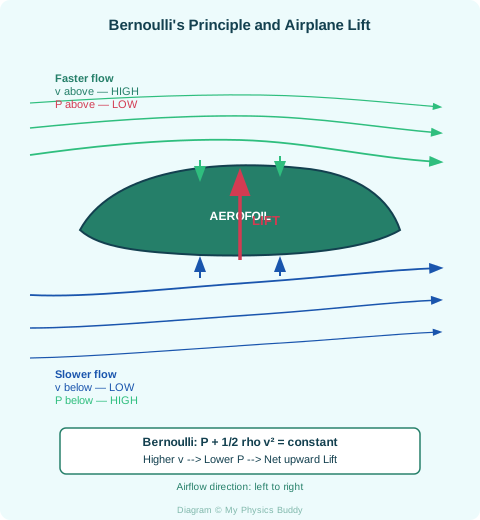
The angle of attack also matters. Tilting the wing nose-up increases the effective curvature difference and amplifies lift — up to a critical angle beyond which the airflow separates from the upper surface, causing a dramatic loss of lift called a stall. You can read more about the physics of aerofoils and boundary layer separation at NASA’s Beginner’s Guide to Aeronautics, which is an excellent authoritative resource.
| Region | Flow Speed | Static Pressure | Effect on Wing |
|---|---|---|---|
| Above wing (upper surface) | Higher | Lower | Suction (pulls up) |
| Below wing (lower surface) | Lower | Higher | Push (pushes up) |
For deeper reading on the fluid dynamics behind this, the Engineering Toolbox’s Bernoulli equation reference offers clear worked examples alongside the theoretical background.
Common Mistakes Students Make with Bernoulli’s Principle and Lift
✗ Mistake: Assuming the “equal transit time” explanation — that air parcels split at the leading edge must reunite at the trailing edge simultaneously, forcing faster flow above.
✓ Fix: This equal-transit-time idea is a widespread myth. Air above the wing actually arrives at the trailing edge before the air below. The real reason for faster upper flow is the wing’s curved shape and the physics of continuous flow, not a timing reunion rule.✗ Mistake: Thinking Bernoulli’s principle alone fully explains lift, ignoring the Newtonian momentum-change contribution entirely.
✓ Fix: Recognise that lift arises from both the pressure difference described by Bernoulli and the downward deflection of airflow described by Newton’s third law. Both explanations are correct and complementary.✗ Mistake: Applying Bernoulli’s equation without checking its assumptions — especially applying it to compressible high-speed flow (near or above Mach 0.3) where compressibility effects become significant.
✓ Fix: State the conditions explicitly: steady, incompressible, non-viscous flow along a streamline. For subsonic aircraft below roughly 100 m/s, the standard Bernoulli approach is valid and reliable.
Exam Relevance: This topic appears in A/AS Level Physics (9702), IB Physics HL/SL, AP Physics 2, and HSC Physics, typically testing pressure-speed relationships and the conditions for Bernoulli’s equation.
Pro Tip from Arun K: Always sketch the streamlines above and below the wing first — once you see the streamlines bunching closer together above, the faster speed and lower pressure follow immediately from Bernoulli.
Related Questions
How to analyze motion graphs for AP Physics?
What is the difference between static and kinetic friction in AP Physics?
How to handle unit conversions in AP Physics problems?
What are the FRQ scoring guidelines for AP Physics?
How to solve impulse and momentum problems on the AP exam?
What is the best AP Physics prep book for self-study?
How to approach experimental design questions on AP Physics?
How do you calculate the moment of inertia for different shapes?