Amani Al Zahrani
asked on December 7, 2025
Conservation of momentum in collisions
How does conservation of momentum work in collisions?
Need Help?
Hire one of our expert Physics tutor online. 24/7 Service. Available now.
Expert Answer
Answered on December 30, 2025 by EXPERT TUTOR
Nothing Found
Dear Amani Al Zahrani,
Conservation of momentum in collisions states that the total momentum of a closed system remains constant before and after any collision, provided no external forces act on it. According to expert tutors at My Physics Buddy, this principle is one of the most powerful and universally applicable laws in all of Physics. It holds whether the collision is elastic, inelastic, or perfectly inelastic.
Understanding Conservation of Momentum in Collisions
Momentum is defined as the product of an object’s mass and its velocity. In vector form:
p = mv
where p is momentum (kg·m/s), m is mass (kg), and v is velocity (m/s). Because velocity is a vector, momentum is also a vector — direction matters enormously here, and this is exactly where many students trip up.
The Law of Conservation of Momentum
The conservation law states that for a system of two objects colliding:
m₁u₁ + m₂u₂ = m₁v₁ + m₂v₂
where m₁ and m₂ are the masses of objects 1 and 2, u₁ and u₂ are their velocities before the collision, and v₁ and v₂ are their velocities after the collision. The left side is total initial momentum; the right side is total final momentum. They must be equal.
This law follows directly from Newton’s Third Law. When two objects collide, they exert equal and opposite forces on each other for the same duration. By Newton’s Second Law, equal and opposite impulses mean equal and opposite changes in momentum — so the total change in the system is zero.
An Everyday Analogy
Think of two ice skaters standing still on frictionless ice. One skater pushes the other. They fly apart in opposite directions. The total momentum before was zero (both were stationary), and it remains zero after — the momentum each skater gains is equal in magnitude but opposite in direction. The ice surface is nearly frictionless, so no significant external horizontal force acts, making this a near-perfect real-world demonstration of the principle.
Types of Collisions
| Type | Momentum Conserved? | Kinetic Energy Conserved? | Example |
|---|---|---|---|
| Elastic | Yes | Yes | Billiard balls |
| Inelastic | Yes | No (some lost to heat/sound) | Car crash (bounces apart) |
| Perfectly Inelastic | Yes | No (maximum loss) | Clay lumps sticking together |
As a PhD physicist, I can tell you that one of the most common student struggles I see is assuming that because kinetic energy is lost in an inelastic collision, momentum must be lost too. These are entirely independent quantities — momentum conservation holds for all collision types as long as the system is closed.
Worked Example — Perfectly Inelastic Collision
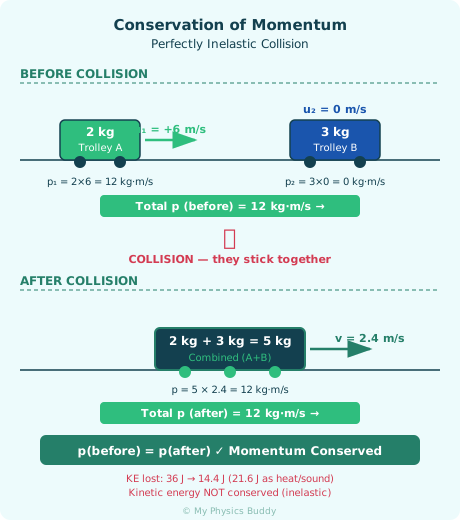
Let’s work through a concrete example. A 2 kg trolley moving at +6 m/s collides with a stationary 3 kg trolley, and they stick together. What is their combined velocity after the collision?
Step 1 — Write total initial momentum:
pinitial = m₁u₁ + m₂u₂ = (2)(6) + (3)(0) = 12 kg·m/s
Step 2 — Write total final momentum (they move together, so combined mass = 5 kg):
pfinal = (m₁ + m₂)v = 5v
Step 3 — Apply conservation of momentum:
12 = 5v → v = 2.4 m/s in the original direction of motion.
Step 4 — Check for kinetic energy loss (confirming inelastic):
KEbefore = ½(2)(6²) = 36 J | KEafter = ½(5)(2.4²) = 14.4 J
Energy lost = 21.6 J — dissipated as heat, sound, and deformation. Momentum? Still perfectly conserved at 12 kg·m/s.
For a deeper exploration of how this connects to Newton’s Laws and impulse-momentum theorem, the Classical (Newtonian) Mechanics resources at My Physics Buddy are an excellent next step. You can also find rigorous derivations and practice sets through Khan Academy’s linear momentum section, which is freely available and well-structured. For AP Physics 1 students in particular, the College Board tests conservation of momentum both conceptually and with full calculations, so mastering the worked-example method above is essential.
Common Mistakes Students Make
✗ Mistake: Ignoring the vector nature of momentum and treating all velocities as positive numbers regardless of direction.
✓ Fix: Always assign a positive direction at the start, then give any velocity in the opposite direction a negative sign before substituting into the equation.✗ Mistake: Assuming that because kinetic energy is not conserved in an inelastic collision, momentum is not conserved either.
✓ Fix: Keep momentum and energy conservation completely separate in your working. Momentum is always conserved in a closed system; kinetic energy is only conserved in elastic collisions.✗ Mistake: Applying conservation of momentum when an external force is clearly present — for example, a collision on a surface with significant friction acting throughout.
✓ Fix: Before applying the law, confirm that external horizontal forces are negligible or zero. If friction or another external force acts for a significant time, the system is not closed and the law does not directly apply without accounting for the impulse from that force.
Exam Relevance: Conservation of momentum in collisions is a core topic in GCSE Physics, A/AS Level Physics (9702), IB Physics HL/SL, and AP Physics 1. Questions range from single-calculation problems to multi-step analysis combining momentum and energy principles.
Pro Tip from Sriram S: Always set up a clear “before and after” momentum table with explicit signs for direction — this single habit eliminates the majority of collision errors I see in student work.
Related Questions
How to answer 9702 Paper 5 planning questions effectively?
How does electromagnetic induction work and what is Faraday’s law?
What is the difference between nuclear fission and fusion in A Level?
How to calculate specific heat capacity from experimental data?
What is simple harmonic motion and how to derive its equations?
How to solve problems involving circular motion and centripetal force?
What are the common mistakes in 9702 Paper 2 structured questions?
How to interpret and draw electric field line diagrams?