H Mcdonald
asked on November 28, 2025
Electromagnetic induction Faraday's law
How does electromagnetic induction work and what is Faraday’s law?
Need Help?
Hire one of our expert Physics tutor online. 24/7 Service. Available now.
Expert Answer
Answered on February 5, 2026 by EXPERT TUTOR
Nothing Found
Dear H Mcdonald,
Electromagnetic induction is the process by which a changing magnetic flux through a conductor induces an electromotive force (EMF) in that conductor. Faraday’s law quantifies this effect, stating that the magnitude of the induced EMF equals the rate of change of magnetic flux linkage. According to expert tutors at My Physics Buddy, mastering this single relationship unlocks a huge portion of the A/AS Level Physics (9702) electromagnetism syllabus.
Understanding Electromagnetic Induction and Faraday’s Law
Let’s build this up from first principles, H, because the students I work with most often struggle not with the formula itself but with understanding why something is induced at all. Once that clicks, everything else follows naturally.
What is Magnetic Flux?
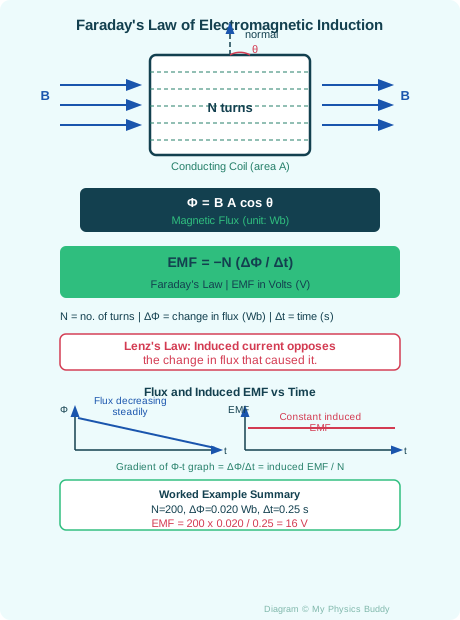
Magnetic flux (Φ) is a measure of how much magnetic field passes through a given area. Think of it like counting how many field lines thread through a loop of wire. The formula is:
Φ = B A cos θ
- Φ = magnetic flux (measured in Webers, Wb)
- B = magnetic flux density (Tesla, T) — the strength of the field
- A = area of the loop (m²)
- θ = angle between the magnetic field direction and the normal to the plane of the loop
Notice that flux is maximised when the field is perpendicular to the loop (θ = 0°, cos θ = 1) and is zero when the field runs parallel to the plane of the loop (θ = 90°). This geometry matters enormously in exam questions.
Faraday’s Law of Electromagnetic Induction
Faraday’s law states that the induced EMF in a circuit is directly proportional to the rate of change of magnetic flux linkage through that circuit. For a coil with N turns, the flux linkage is NΦ, and the law is written:
EMF = −N (ΔΦ / Δt)
- EMF = induced electromotive force (Volts, V)
- N = number of turns in the coil
- ΔΦ = change in magnetic flux (Wb)
- Δt = time interval over which the change occurs (s)
- The negative sign comes from Lenz’s law (see below)
Here is a useful everyday analogy. Imagine you are opening a window blind — the light flooding into the room represents the magnetic flux. If you open the blind quickly (large ΔΦ/Δt), the room brightens fast. The induced EMF is like your eyes’ automatic squinting response — it reacts to the rate of change, not to the brightness itself. A steady, bright room (constant flux) produces no squinting response at all. That is exactly how electromagnetic induction works: only a changing flux induces an EMF.
Lenz’s Law and the Negative Sign
Lenz’s law explains the negative sign in Faraday’s equation. It states that the direction of the induced current is always such that it opposes the change in flux that caused it. This is nature’s way of conserving energy — if the induced current helped the flux increase further, you would get runaway energy production, which violates the conservation of energy.
In practice, for your A/AS Level Physics exam, you will use the right-hand grip rule or Fleming’s right-hand rule to determine the direction of the induced current, and the magnitude is given by Faraday’s law.
Worked Example
A rectangular coil of 200 turns has an area of 0.050 m². It is placed in a uniform magnetic field of flux density 0.40 T with the plane of the coil perpendicular to the field. The field is reduced uniformly to zero in 0.25 s. Calculate the magnitude of the induced EMF.
Step 1 — Find the initial flux:
Φ = B A cos θ = 0.40 × 0.050 × cos 0° = 0.020 Wb
Step 2 — Find the change in flux linkage:
ΔΦ = 0.020 − 0 = 0.020 Wb (field drops to zero, so flux drops to zero)
Flux linkage change = N ΔΦ = 200 × 0.020 = 4.0 Wb
Step 3 — Apply Faraday’s law:
|EMF| = N (ΔΦ / Δt) = 4.0 / 0.25 = 16 V
Always track units carefully. Wb/s = V, so your answer comes out in volts directly.
What Can Change the Flux?
Flux can change in three ways, and all three induce an EMF:
| What changes | Real-world example |
|---|---|
| Magnetic flux density B changes | Switching an electromagnet on or off near a coil |
| Area A changes | Stretching or compressing a coil in a field |
| Angle θ changes | Rotating a coil in a generator — this is how AC is produced |
As a CSIR NET rank holder in Physics, I can tell you that the rotating-coil case is the most frequently examined scenario across all boards. Understanding that the EMF is maximum when flux is changing fastest (and zero when flux is at its peak) is a subtle but critical insight — one that even strong students sometimes get backwards. For a deeper dive into the mathematical treatment, the Physics Classroom’s EMF resource is an excellent reference alongside your Cambridge notes.
For the Cambridge 9702 specification specifically, you are expected to recall and use both Faraday’s law and Lenz’s law and apply them to simple coil and straight-wire scenarios. The Cambridge International past papers contain several structured questions where you must calculate induced EMF and justify the direction of the induced current using Lenz’s law — both skills are worth practising together.
Common Mistakes
✗ Mistake: Students confuse magnetic flux (Φ = BA cos θ) with flux linkage (NΦ) and use N only sometimes, inconsistently.
✓ Fix: Always write out flux linkage = NΦ as a separate step before applying Faraday’s law. This makes it impossible to accidentally drop N.✗ Mistake: Students think a large, steady magnetic field induces a large EMF.
✓ Fix: Remember that only a changing flux induces an EMF. Constant B, constant A, constant θ = zero induced EMF, regardless of the field strength.✗ Mistake: Students ignore the angle θ in flux calculations or always set cos θ = 1 without checking the geometry.
✓ Fix: Sketch the coil and field direction quickly in every question. Identify whether the field is along the normal to the coil or along its plane, then assign θ correctly before substituting.
Exam Relevance: Electromagnetic induction and Faraday’s law appear in Cambridge A/AS Level Physics 9702 (Paper 4), Edexcel A Level Physics, IB Physics HL, and AP Physics C: Electricity and Magnetism. All four boards require both quantitative calculation and qualitative direction arguments.
Pro Tip from Neha A: Sketch flux linkage against time for every induction problem — the gradient at any point equals the induced EMF, making sign and magnitude errors almost impossible.
Related Questions
How to calculate the speed of a wave on a string?
What are standing waves and how do harmonics work?
How to explain physics concepts qualitatively for AP Physics 1 FRQs?
What is the best way to review for AP Physics 1 in two weeks?
How to apply Newton’s second law in rotational form?
How does energy transfer work in simple harmonic motion?
How to solve problems with pulleys and tension in AP Physics 1?
What is mechanical energy and when is it conserved?