Amaya Moore
asked on February 6, 2025
Energy transfer simple harmonic motion
How does energy transfer work in simple harmonic motion?
Need Help?
Hire one of our expert Physics tutor online. 24/7 Service. Available now.
Expert Answer
Answered on February 15, 2025 by EXPERT TUTOR
Nothing Found
Dear Amaya Moore,
Energy transfer in simple harmonic motion is a continuous exchange between kinetic energy (KE) and elastic potential energy (PE), with the total mechanical energy remaining constant throughout the motion. According to expert tutors at My Physics Buddy, mastering this energy interplay is the key to unlocking every SHM problem you’ll face in AP Physics 1.
How Energy Transfer Works in Simple Harmonic Motion
Think of a mass attached to a horizontal spring on a frictionless surface — the classic SHM system. When you pull the mass to one side and release it, you are storing elastic potential energy in the spring. The moment you let go, that stored energy begins converting into kinetic energy as the mass accelerates toward equilibrium. This back-and-forth conversion is the heartbeat of simple harmonic motion.
The Analogy: A Rollercoaster
Imagine a rollercoaster with no friction. At the top of a hill, the car moves slowly — maximum gravitational PE, minimum KE. At the bottom, it flies through at top speed — maximum KE, minimum PE. An SHM oscillator works exactly the same way: the amplitude positions (maximum displacement) are the “hilltops,” and the equilibrium position is the “valley floor.”
The Energy Equations
For a spring-mass system with spring constant k and mass m, the energies at any displacement x from equilibrium are:
- Elastic potential energy: PE = ½kx²
x = displacement from equilibrium (metres), k = spring constant (N/m) - Kinetic energy: KE = ½mv²
m = mass (kg), v = speed at that instant (m/s) - Total mechanical energy: Etotal = ½kA²
A = amplitude, the maximum displacement (metres)
Because the surface is frictionless, energy is conserved at every point:
½mv² + ½kx² = ½kA²
This single equation lets you find the speed at any position, which is one of the most common AP Physics 1 exam tasks.
Worked Example
A 0.5 kg mass on a spring with k = 200 N/m is released from rest at an amplitude of A = 0.10 m. Find the speed when x = 0.06 m.
Step 1 — Write the energy conservation equation:
½mv² + ½kx² = ½kA²
Step 2 — Rearrange for v:
v² = (k/m)(A² − x²)
v² = (200/0.5)(0.10² − 0.06²)
v² = 400 × (0.0100 − 0.0036)
v² = 400 × 0.0064 = 2.56 m²/s²
v = 1.6 m/s
Step 3 — Check units: (N/m ÷ kg) × m² = (kg·m/s²·m⁻¹ ÷ kg) × m² = m²/s² ✓
Notice that the speed is maximum at x = 0 (equilibrium) and zero at x = ±A (the turning points). As a Masters-level physics specialist, I can tell you this energy conservation approach is far faster on timed exams than using kinematics or force equations alone.
Energy as a Function of Position
The table below summarises the energy state at the three key positions in one half-cycle:
| Position | Displacement x | KE | PE |
|---|---|---|---|
| Amplitude (right) | +A | 0 | ½kA² (max) |
| Equilibrium | 0 | ½kA² (max) | 0 |
| Amplitude (left) | −A | 0 | ½kA² (max) |
One teaching pattern I see repeatedly: students correctly compute total energy but then forget that both turning points have zero KE, not just the starting point. The system is symmetric — it momentarily stops at both ends.
The diagram below shows the PE and KE curves plotted against displacement, making the energy exchange visually clear:
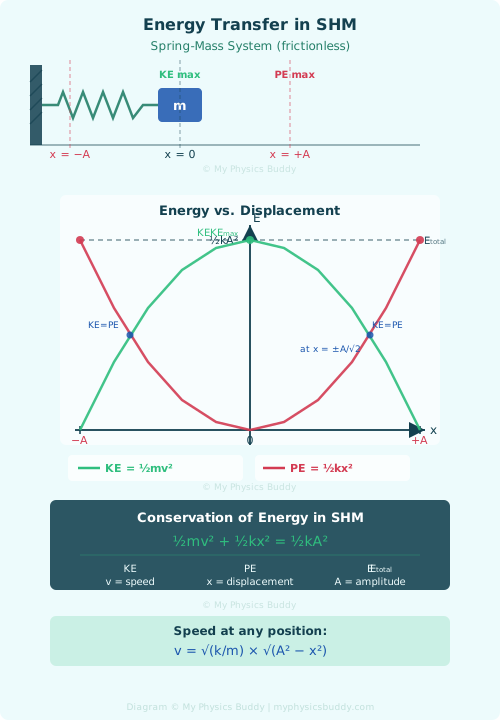
For a deeper look at how oscillatory motion connects to wave behaviour, the AP Physics programme explores SHM alongside wave mechanics in a very complementary way. You can also explore the mathematics of energy in oscillating systems through the PhET Masses and Springs simulation from the University of Colorado Boulder, which lets you visualise the KE–PE exchange in real time.
Common Mistakes in SHM Energy Problems
✗ Mistake: Setting total energy equal to KE alone (writing ½mv² = ½kA² only at non-equilibrium positions).
✓ Fix: Always write the full conservation equation ½mv² + ½kx² = ½kA² first, then substitute the known displacement x before solving for v.✗ Mistake: Assuming maximum speed occurs at maximum displacement.
✓ Fix: Maximum speed occurs at x = 0 (equilibrium), where all PE has converted to KE. Use vmax = A√(k/m) to find it directly.✗ Mistake: Doubling the amplitude when the mass passes through equilibrium going in the opposite direction, thinking energy “resets.”
✓ Fix: Total mechanical energy ½kA² is constant throughout the entire oscillation. Amplitude does not change unless energy is added or removed by an external force.
Exam Relevance: Energy transfer in SHM appears directly on the AP Physics 1 exam (Unit 6: Oscillations), the AP Physics C: Mechanics free-response section, and IB Physics HL/SL. Each exam tests both qualitative description and quantitative energy conservation calculations.
Pro Tip from Manikanta J: Sketch the PE and KE curves on every SHM problem before calculating — seeing where the curves cross at x = ±A/√2 instantly tells you where KE equals PE.
Related Questions
How to calculate Young modulus from a stress-strain graph?
What is the difference between progressive and stationary waves 9702?
How does a potential divider circuit work in CIE physics?
How to determine internal resistance of a cell using a graph?
What is the photoelectric effect and how to solve threshold frequency problems?
How to calculate gravitational field strength at a distance from a planet?
What are the key differences between gravitational and electric fields 9702?
How to use the decay equation for radioactive decay problems?