A Roy
asked on February 20, 2026
AP Physics exam curve explained
How does the AP Physics exam curve work?
Need Help?
Hire one of our expert Physics tutor online. 24/7 Service. Available now.
Expert Answer
Answered on March 5, 2026 by EXPERT TUTOR
Nothing Found
Dear A Roy,
The AP Physics exam curve works through a process called score scaling, where your raw points are converted to a final AP score of 1 to 5. According to expert tutors at My Physics Buddy, you do not need a perfect raw score to earn a 5 — the thresholds shift each year based on exam difficulty.
How the AP Physics Exam Curve Actually Works
A Roy, this is one of the most misunderstood parts of the entire AP exam process, and I see students stress about it unnecessarily every year. Let me walk you through exactly how the scoring works so you can plan your preparation with confidence.
Step 1 — Raw Score Calculation
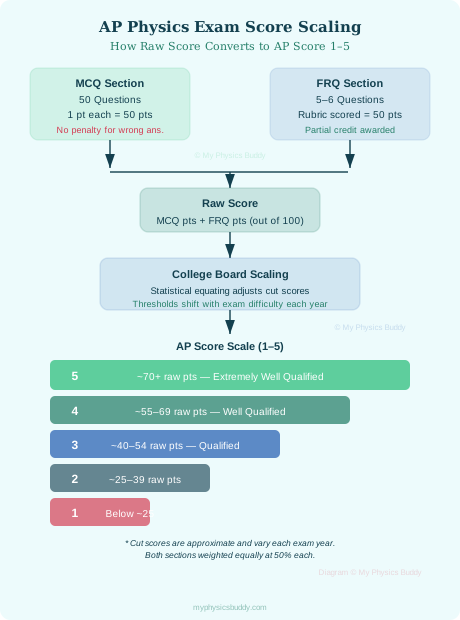
Your journey begins with a raw score. Every correct answer on the multiple-choice section earns you 1 point. There is no penalty for wrong answers, so guessing is always worth attempting. On the free-response section, each question is scored by trained AP readers on a detailed rubric, typically out of a fixed number of points per part.
The raw score formula for a typical AP Physics exam looks like this:
Raw Score = (MCQ Points Earned) + (FRQ Points Earned)
For example, in AP Physics 1, the multiple-choice section has 50 questions worth 1 point each (50 points total), and the free-response section is worth 50 points total, giving a combined raw score out of 100.
Step 2 — Composite Score and Scaling
Once your raw score is calculated, the College Board applies a statistical scaling process to convert it into a composite score, which then maps onto the familiar 1–5 AP scale. Think of it like a curved grading scale that adjusts slightly every year depending on how difficult that particular exam was.
A useful analogy: imagine a physical education teacher who sets a fitness test. If the test turned out to be unusually hard on a windy day, the teacher lowers the passing threshold slightly so the results fairly reflect student ability rather than external difficulty. The College Board does something similar — statistically.
The mapping from composite score to AP score looks roughly like this for AP Physics 1 (note: exact thresholds vary by year):
| AP Score | Approx. Raw Score Range (out of 100) | College Credit Qualification |
|---|---|---|
| 5 | ~70 and above | Extremely well qualified |
| 4 | ~55 – 69 | Well qualified |
| 3 | ~40 – 54 | Qualified |
| 2 | ~25 – 39 | Possibly qualified |
| 1 | Below ~25 | No recommendation |
These thresholds are illustrative. The College Board does not publicly release exact cut scores each year. However, the College Board’s official AP Physics page does publish score distributions after each exam cycle so you can see how students performed nationally.
Step 3 — Why the Curve Exists
As a BSc Physical Science graduate preparing for IIT-JAM Physics, I deeply understand why standardized scaling matters: no two exam administrations are identical in difficulty. The curve ensures that a student who took a slightly harder version of the exam is not penalized compared to someone who took an easier one. The process uses equating — a psychometric method that compares performance on anchor questions that appear across multiple years.
The key insight for your preparation is this: you are competing against a fixed standard of physics understanding, not against other students. A strong raw score is always the goal, because the curve can only help you, never hurt you.
MCQ vs FRQ Weighting
Both sections are typically weighted equally at 50% each in the final composite calculation. This means performing well on free-response questions — where you show your reasoning, units, and diagrams — is just as important as speed and accuracy on multiple choice. Many students I have tutored focus almost entirely on MCQ practice and then struggle on FRQ because they cannot articulate their physics reasoning clearly. Write out every step, state the relevant principle, and always include units.
Common Mistakes Students Make About the AP Physics Curve
✗ Mistake: Assuming the AP score curve works like a traditional classroom curve where everyone’s score shifts up by a fixed number of points.
✓ Fix: Understand that AP scaling uses statistical equating, and the cut scores for each AP score level shift based on overall exam difficulty — it is not a simple additive boost.✗ Mistake: Leaving multiple-choice questions blank because they are unsure of the answer, thinking there is a wrong-answer penalty.
✓ Fix: There is no point deduction for incorrect MCQ answers on AP exams. Always attempt every question — eliminate at least one or two choices and make your best guess.✗ Mistake: Focusing only on getting the final numerical answer correct on free-response and skipping justification.
✓ Fix: AP Physics FRQ rubrics award points for correct reasoning, identifying the right principle, showing correct substitution, and using proper units — even a partially correct solution can earn significant partial credit.
Exam Relevance: The AP Physics score scaling system is specific to AP Physics 1, AP Physics 2, AP Physics C: Mechanics, and AP Physics C: Electricity and Magnetism, all administered by the College Board in the United States.
💡 Pro Tip from Mohit H: Target the free-response section strategically — showing correct physics reasoning with units earns partial credit even when your final number is wrong.
Related Questions
What is the best way to review for AP Physics 1 in two weeks?
How to apply Newton’s second law in rotational form?
How does energy transfer work in simple harmonic motion?
How to solve problems with pulleys and tension in AP Physics 1?
What is mechanical energy and when is it conserved?
How to interpret position vs time and velocity vs time graphs?
How do open and closed pipe resonance problems work?
What are the most difficult topics on AP Physics 1?