A Hines
asked on August 5, 2025
AP Physics motion graph analysis
How to analyze motion graphs for AP Physics?
Need Help?
Hire one of our expert Physics tutor online. 24/7 Service. Available now.
Expert Answer
Answered on August 11, 2025 by EXPERT TUTOR
Nothing Found
Dear A Hines,
To analyze motion graphs for AP Physics, you read position-time, velocity-time, and acceleration-time graphs by interpreting slope and area. According to expert tutors at My Physics Buddy, mastering all three graph types together — not in isolation — is the key to scoring full marks on kinematics questions.
Reading Motion Graphs in AP Physics: The Complete Guide
Motion graphs are one of the most tested skills in AP Physics, and they reward students who understand the physical meaning behind slope and area rather than just memorizing rules. I find in my teaching that students who struggle with these graphs are usually treating them as abstract math — once you connect each graph feature to actual physical motion, everything clicks.
Think of it this way: imagine you’re on a road trip. The position-time graph is like your GPS distance readout, the velocity-time graph is your speedometer, and the acceleration-time graph tells you how hard you’re pressing the gas or brake. All three tell the same story, just from different perspectives.
The Three Graph Types and What They Tell You
Here is a summary of what each graph encodes:
| Graph Type | Slope Gives | Area Under Curve Gives |
|---|---|---|
| Position–Time (x–t) | Velocity | Not directly useful |
| Velocity–Time (v–t) | Acceleration | Displacement |
| Acceleration–Time (a–t) | Rate of change of acceleration (jerk — rarely tested) | Change in velocity |
Position–Time Graph Analysis
Slope = velocity. This is the single most important rule. If the x–t graph is a straight line with positive slope, the object moves with constant positive velocity. A curve means changing velocity — which means acceleration is present. A horizontal line (zero slope) means the object is stationary.
The formula for slope on an x–t graph:
v = Δx / Δt
where v is velocity (m/s), Δx is the change in position (m), and Δt is the change in time (s).
A concave-up curve on an x–t graph means the slope is increasing — the object is speeding up in the positive direction. A concave-down curve means the slope is decreasing — the object is slowing down or reversing direction.
Velocity–Time Graph Analysis
Slope = acceleration. A positive slope on a v–t graph means the object is accelerating in the positive direction. A negative slope means deceleration or acceleration in the negative direction. A flat (horizontal) line means constant velocity — zero acceleration.
Area under the v–t graph = displacement. This is a critical AP exam skill. The area is signed: area above the time axis is positive displacement, area below is negative displacement.
For a straight-line v–t segment:
a = Δv / Δt
where a is acceleration (m/s²), Δv is change in velocity (m/s), and Δt is elapsed time (s).
Worked Example — Reading a v–t Graph
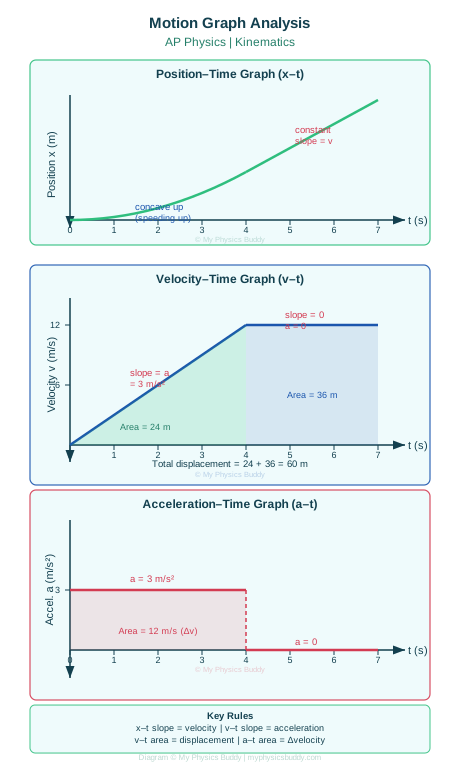
Suppose a v–t graph shows velocity increasing linearly from 0 m/s at t = 0 s to 12 m/s at t = 4 s, then staying constant at 12 m/s from t = 4 s to t = 7 s.
Step 1 — Find acceleration during 0 to 4 s:
a = Δv / Δt = (12 − 0) / (4 − 0) = 3 m/s²
Step 2 — Find acceleration during 4 to 7 s:
The line is horizontal, so Δv = 0. Therefore a = 0 m/s²
Step 3 — Find total displacement over 0 to 7 s:
Area = triangle + rectangle
Triangle: ½ × base × height = ½ × 4 × 12 = 24 m
Rectangle: 12 × 3 = 36 m
Total displacement = 24 + 36 = 60 m
This is exactly the kind of multi-part analysis you will encounter in both the AP Physics 1 free-response and multiple-choice sections. You can find more worked kinematics problems at AP Central by College Board, the official source for AP exam resources.
Connecting the Three Graphs to Each Other
As a PhD in Physics, I can tell you that one powerful strategy is to sketch all three graphs for the same scenario and verify they are consistent. If your v–t graph has a positive constant slope in a time interval, the corresponding a–t graph must show a horizontal positive line in that same interval. The x–t graph must be parabolic and concave up. If any one graph contradicts another, you have an error.
For students exploring deeper kinematics and graph interpretation, our Kinematics resources offer extensive practice across multiple exam styles.
A useful external reference for understanding graphical analysis of motion is the NIST Physics Reference, which underpins the standard units and definitions used in AP physics problems.
Common Mistakes When Analyzing Motion Graphs
✗ Mistake: Confusing the value of the graph with the slope — for example, reading a high point on a v–t graph as high acceleration.
✓ Fix: Always ask “what does the slope tell me?” — a high velocity value with zero slope means zero acceleration, not large acceleration.✗ Mistake: Forgetting that area below the time axis on a v–t graph represents negative displacement, and cancelling it with positive area to find total distance.
✓ Fix: Calculate positive and negative areas separately. Sum them with signs for displacement; sum absolute values for total distance travelled.✗ Mistake: Assuming a curved x–t graph always means the object is speeding up.
✓ Fix: Check the concavity. Concave up means increasing slope (speeding up in positive direction); concave down means decreasing slope (slowing down or reversing).
Exam Relevance: Motion graph analysis appears directly in AP Physics 1 (Unit 1: Kinematics), AP Physics C: Mechanics, IB Physics SL/HL (Topic 2), and A-Level Physics 9702. All four assessments test slope interpretation and area-under-curve calculations.
💡 Pro Tip from Dr Shivani G: When given any motion graph, immediately write “slope = ?” and “area = ?” beside it. This two-second habit prevents the most common exam errors instantly.
Related Questions
How to interpret and draw electric field line diagrams?
What is the best revision strategy for CIE A Level Physics?
What is the difference between transverse and longitudinal waves?
What is the difference between series and parallel circuits?
How does Bernoulli’s principle explain airplane lift?
What is the relationship between frequency wavelength and speed of a wave?
How to calculate net force when multiple forces act on an object?
What is the work-energy theorem and how do you apply it?