Julia R
asked on February 16, 2025
9702 Paper 5 planning strategies
How to answer 9702 Paper 5 planning questions effectively?
Need Help?
Hire one of our expert Physics tutor online. 24/7 Service. Available now.
Expert Answer
Answered on June 11, 2025 by EXPERT TUTOR
Nothing Found
Dear Julia R,
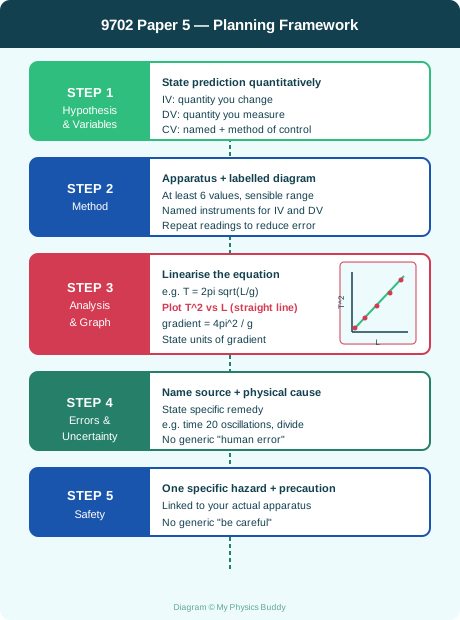
Answering 9702 Paper 5 planning questions effectively requires a structured approach that covers hypothesis, variables, method, analysis, and safety in a logical sequence. According to expert tutors at My Physics Buddy, students who learn this five-part framework consistently score full marks on planning questions. Mastering this format transforms Paper 5 from the most feared component into one of the most predictable.
How to Answer 9702 Paper 5 Planning Questions: The Complete Framework
Paper 5 of A/AS Level Physics (9702) tests your ability to design a complete experiment from scratch. Think of it like writing a recipe for someone who has never cooked before — every step, every ingredient, and every potential mishap needs to be spelled out clearly. The examiner is not in the room with you; your written plan is the only thing they have to judge your scientific thinking.
The mark scheme for planning questions is almost always structured around the same five areas. If you address each one confidently, you rarely leave marks on the table.
1. Defining the Hypothesis and Identifying Variables
Start by stating a clear, testable hypothesis — a prediction of the relationship between two physical quantities. A good hypothesis is quantitative wherever possible. For example: “I predict that the period T of oscillation is proportional to the square root of the length L of the pendulum, consistent with T = 2π√(L/g).”
Then define your three variable types precisely:
- Independent variable: the quantity you deliberately change (e.g., length L of the pendulum).
- Dependent variable: the quantity you measure as a result (e.g., period T).
- Control variables: all other quantities kept constant (e.g., amplitude of swing kept small, same location so g is constant, same mass of bob).
A common student struggle I see repeatedly in my sessions is listing control variables vaguely. Saying “keep everything else the same” scores zero. You must name each specific variable and state how you would keep it constant.
2. Describing the Experimental Method
Your method should be detailed enough that another competent physicist could replicate your experiment exactly. Include:
- A labelled diagram of the apparatus (described in words for the written plan, but draw it if the question asks).
- The range and number of values for your independent variable — aim for at least six different values spread across a sensible range.
- How you will measure both the independent and dependent variables, naming specific instruments (e.g., metre rule for length, stopwatch for time).
- Techniques to reduce random error — for example, measuring 10 oscillations and dividing by 10 to find T reduces timing uncertainty significantly.
3. Describing the Analysis — Graph and Gradient
This is where many students lose the most marks, and it is also where you can gain the most. The examiner wants to see that you know how to linearise the relationship so that your graph is a straight line through the origin (or with a calculable intercept).
Take the pendulum example. The equation is:
T = 2π√(L/g)
Squaring both sides gives:
T² = (4π²/g) × L
Here, T² is your y-axis variable, L is your x-axis variable, the gradient equals 4π²/g, and the line should pass through the origin. This tells you to plot T² against L. From the gradient, you can calculate g:
g = 4π² / gradient
where gradient has units of s² m⁻¹, giving g in m s⁻². Always state the units of your gradient and show explicitly how you extract the target quantity from it.
Think of linearisation like straightening a curved road on a map — once it is a straight line, reading off the gradient and intercept becomes straightforward and unambiguous.
4. Addressing Sources of Uncertainty and Errors
Identify at least two realistic sources of systematic error or random error and explain how you would reduce them. Be specific:
- Random error in timing: Use a fiducial marker at the equilibrium position and time multiple oscillations. Take repeated readings and average them.
- Systematic error in length: The effective length of the pendulum is from the pivot to the centre of mass of the bob, not just to its top. Measure to the midpoint of the bob and account for its radius.
For the Cambridge 9702 mark scheme, simply writing “human error” or “parallax error” without explanation earns no credit. Be precise about the physical cause and the remedy. You can also find the official syllabus and specimen papers directly on the Cambridge International website to cross-check what is expected.
5. Safety Considerations
Always include at least one genuine safety precaution relevant to your specific experiment. For a pendulum: “Ensure the pendulum is secured firmly and swings in a vertical plane only, away from other students, to prevent injury from the swinging bob.” Generic statements like “be careful” score nothing.
Quick Reference: Planning Question Checklist
| Section | What to Include | Common Mark Earner |
|---|---|---|
| Hypothesis & Variables | State prediction, list IV, DV, CVs with detail | Named CVs with method of control |
| Method | Apparatus, range of values, measurement technique | At least 6 values, named instruments |
| Analysis | Linearised graph, axes, gradient meaning | Show algebra for linearisation explicitly |
| Errors & Uncertainty | Named sources, physical cause, specific remedy | Specific not generic descriptions |
| Safety | One specific hazard and precaution | Linked to your actual apparatus |
As an MSc Physics graduate with CSIR NET Rank 71, I can tell you that the planning question is essentially a structured physics essay — and like any essay, it rewards students who have a clear template in their head before the exam begins. Explore more about experimental skills and lab technique through resources on Experimental Physics & Lab Skills. For additional guidance on Cambridge A Level expectations, the Cambridge 9702 syllabus page is your most reliable reference.
Common Mistakes in 9702 Paper 5 Planning Questions
✗ Mistake: Writing “keep all other variables constant” without naming them.
✓ Fix: Name every control variable explicitly and state the specific method used to keep each one constant — for example, “keep the temperature of the liquid constant by using a thermostatically controlled water bath.”✗ Mistake: Plotting the raw relationship (e.g., T against L for a pendulum) instead of linearising.
✓ Fix: Always rearrange your equation into the form y = mx + c, identify your y-axis and x-axis variables explicitly, and show the algebra step by step so the examiner can follow your reasoning.✗ Mistake: Describing error sources as “human error” or “parallax” with no further detail.
✓ Fix: State the physical cause — for example, “reaction time delay when starting and stopping the stopwatch increases the measured period” — and give a specific remedy such as timing 20 oscillations to reduce the percentage uncertainty in T.
Exam Relevance: This planning framework is tested in Cambridge A/AS Level Physics (9702) Paper 5, and similar experimental design skills are assessed in IB Physics HL/SL Internal Assessment and Edexcel A Level Physics practical endorsements.
Pro Tip from Neha A: Write your linearisation algebra before drawing your graph axes — once the algebra is right, your axis labels and gradient calculation follow automatically without confusion.
Related Questions
How to analyze motion graphs for AP Physics?
What is the difference between static and kinetic friction in AP Physics?
How to handle unit conversions in AP Physics problems?
What are the FRQ scoring guidelines for AP Physics?
How to solve impulse and momentum problems on the AP exam?
What is the best AP Physics prep book for self-study?
How to approach experimental design questions on AP Physics?
How do you calculate the moment of inertia for different shapes?