H Hayes
asked on September 3, 2024
AP Physics experimental design questions
How to approach experimental design questions on AP Physics?
Need Help?
Hire one of our expert Physics tutor online. 24/7 Service. Available now.
Expert Answer
Answered on December 2, 2024 by EXPERT TUTOR
Nothing Found
Dear H Hayes,
Approaching experimental design questions on AP Physics requires a clear, structured method: identify your independent and dependent variables, control all others, and justify every choice with physics reasoning. According to expert tutors at My Physics Buddy, students who master this framework consistently earn full marks on these high-value free-response questions.
How to Tackle Experimental Design Questions in AP Physics
Experimental design questions appear in the AP Physics free-response section and ask you to plan, analyse, or critique an investigation. Think of it like being a scientist handed a research problem — your job is not just to say “measure this,” but to explain how, why, and what to watch out for. The College Board rewards structured scientific thinking, and once you learn the anatomy of a strong answer, these questions become one of the most predictable and scorable parts of the exam.
Step 1 — Identify Your Variables
Every experimental design answer starts with three clearly named variables:
- Independent variable (IV): What you deliberately change. Example: the mass hanging from a spring.
- Dependent variable (DV): What you measure in response. Example: the extension of the spring.
- Controlled variables: Everything else you hold constant. Example: the spring itself, the ruler used, the temperature of the room.
A helpful analogy: imagine you are testing how different amounts of fertiliser affect plant height. You change the fertiliser amount (IV), measure the plant height (DV), and keep the soil type, pot size, sunlight, and water the same (controlled variables). The logic is identical in a physics lab — isolate one cause and measure one effect.
Step 2 — Describe the Procedure Clearly
Write a step-by-step procedure that another student could replicate without asking you a single question. AP Physics graders are explicitly looking for:
- Named equipment (ruler, force sensor, motion detector, stopwatch, etc.)
- How you will vary the independent variable (e.g., “add 50 g masses one at a time from 50 g to 300 g”)
- How you will measure the dependent variable (e.g., “record the extension using a metre rule to the nearest 1 mm”)
- How you will repeat trials (e.g., “repeat each measurement three times and average”)
Step 3 — Connect to a Physics Relationship
This is where most students lose marks. You must link your experiment to the underlying physics equation and explain what graph you would plot and why. For example, if you are investigating Hooke’s Law:
The relevant equation is:
F = kx
where F is the applied force (in N), k is the spring constant (in N/m), and x is the extension (in m).
You would then say: “Plot a graph of F (y-axis) against x (x-axis). If Hooke’s Law holds, the graph will be a straight line through the origin. The gradient of the line equals the spring constant k.”
This is the key move — linearisation. AP Physics rewards students who choose a graph that produces a straight line because the gradient or intercept directly gives a physical quantity. If your relationship is F = kx², you should plot F against x² to linearise it, and the gradient equals k.
The general linearisation strategy is:
y = mx + c
where m is the gradient (your target physical quantity), c is the y-intercept, and x is the chosen x-axis variable. Always state what the gradient represents physically.
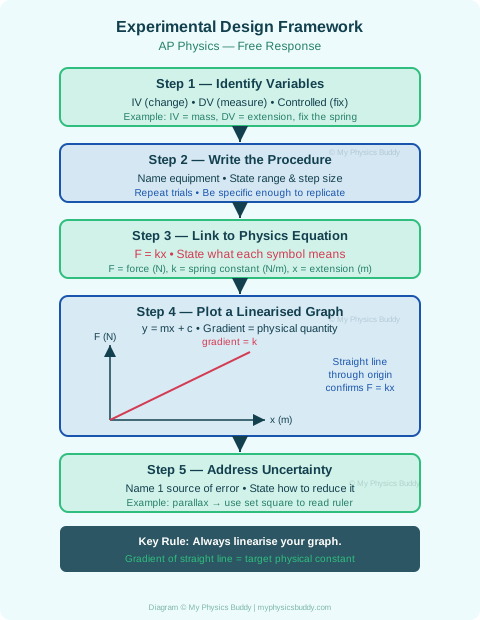
Step 4 — Address Uncertainty and Safety
AP Physics 1 and AP Physics C both reward brief acknowledgement of measurement uncertainty and experimental precautions. Mention at least one source of systematic or random error (e.g., parallax error when reading a ruler, air resistance affecting a pendulum) and one step to reduce it (e.g., use a set square to read the scale perpendicularly, conduct the experiment in a closed room). You do not need a long error analysis — two to three focused sentences are enough.
For deeper guidance on lab methodology, the College Board AP Physics exam page provides official free-response scoring guidelines that show exactly what graders expect in experimental design responses. Reviewing past scored samples is one of the highest-value revision activities you can do. You can also explore our Experimental Physics & Lab Skills resources for more worked examples on designing and analysing investigations.
As an IBDP & A-Level Physics Specialist, I can tell you that one authentic struggle I see almost every student face is writing a procedure that is too vague — phrases like “change the mass and measure the result” earn zero marks. Specificity wins. Name the instrument, the range, the step size, and the number of repeats every single time.
Common Mistakes in AP Physics Experimental Design
✗ Mistake: Listing variables but not explaining how the independent variable will be changed in measurable steps.
✓ Fix: State the specific range and increments — for example, “increase mass from 100 g to 600 g in steps of 100 g using calibrated slotted masses.”✗ Mistake: Plotting a curved graph and trying to read off a value from it, instead of linearising.
✓ Fix: Always ask yourself: which two quantities, when plotted against each other, give a straight line? State the gradient and what physical constant it represents.✗ Mistake: Ignoring uncertainty entirely, which signals to the grader that you do not understand real experimental practice.
✓ Fix: Name one specific source of error for your setup and describe one concrete action taken to minimise it, such as repeating measurements and averaging.
Exam Relevance: Experimental design questions appear in AP Physics 1, AP Physics 2, and AP Physics C: Mechanics and Electricity & Magnetism free-response sections. The College Board Science Practices framework explicitly assesses experimental planning and data analysis skills across all AP Physics courses.
💡 Pro Tip from Mamatha M: Before writing your procedure, sketch a quick labelled diagram of your setup — it forces you to think through every piece of equipment you actually need.
Related Questions
What is the best way to review for AP Physics 1 in two weeks?
How to apply Newton’s second law in rotational form?
How does energy transfer work in simple harmonic motion?
How to solve problems with pulleys and tension in AP Physics 1?
What is mechanical energy and when is it conserved?
How to interpret position vs time and velocity vs time graphs?
How do open and closed pipe resonance problems work?
What are the most difficult topics on AP Physics 1?