A Underwood
asked on January 12, 2024
Gravitational field strength at distance
How to calculate gravitational field strength at a distance from a planet?
Need Help?
Hire one of our expert Physics tutor online. 24/7 Service. Available now.
Expert Answer
Answered on November 15, 2024 by EXPERT TUTOR

Dear A Underwood,
To calculate gravitational field strength at a distance from a planet, you use Newton’s law of gravitation: g = GM/r², where G is the gravitational constant, M is the planet’s mass, and r is the distance from the planet’s centre. According to expert tutors at My Physics Buddy, this single equation is the foundation of all gravitational field calculations at A-level.
Understanding Gravitational Field Strength at a Distance from a Planet
Gravitational field strength, given the symbol g, tells you the gravitational force experienced per unit mass at any point in a gravitational field. Its unit is N kg⁻¹, which is equivalent to m s⁻². Think of it as a measure of how strongly a planet “pulls” on every kilogram of mass placed at a given location.
A brilliant everyday analogy: imagine standing near a bonfire. The closer you are, the more intense the heat. Move further away, and the heat weakens — and it weakens fast, not just slowly. Gravity behaves the same way. Double your distance from a planet’s centre and the gravitational field strength drops to a quarter of its previous value. That rapid drop-off is captured by the inverse square law.
The Key Formula
The equation you need for A/AS Level Physics (9702) is:
g = GM / r²
- g — gravitational field strength at the point of interest (N kg⁻¹)
- G — universal gravitational constant = 6.67 × 10⁻¹¹ N m² kg⁻²
- M — mass of the planet (kg)
- r — distance from the centre of the planet to the point (m)
This formula comes directly from combining Newton’s law of gravitation (F = GMm/r²) with the definition of gravitational field strength (g = F/m). The test mass m cancels, leaving g dependent only on the planet’s mass and your distance from its centre. This is a really elegant result — the field strength at any point is a property of the planet and location alone, not of the object placed there.
Why the Inverse Square Law Matters
The r² in the denominator is what gives gravity its inverse square character. If you move from a distance r to a distance 2r, g becomes:
g_new = GM / (2r)² = GM / 4r² = g_original / 4
This means the field strength falls to one quarter. At 3r, it falls to one ninth. This pattern is central to gravitational field problems on the Cambridge 9702 paper and is tested frequently in both structured and data-based questions. You’ll also encounter it in the context of Physics topics like orbital motion and satellite calculations.
Worked Example — Step by Step
Let’s calculate the gravitational field strength at a distance of 8.0 × 10⁶ m from the centre of a planet of mass 6.0 × 10²⁴ kg.
Step 1 — Write down the formula:
g = GM / r²
Step 2 — Substitute the values with units:
g = (6.67 × 10⁻¹¹ N m² kg⁻²) × (6.0 × 10²⁴ kg) / (8.0 × 10⁶ m)²
Step 3 — Calculate the numerator:
6.67 × 10⁻¹¹ × 6.0 × 10²⁴ = 4.002 × 10¹⁴ N m² kg⁻¹
Step 4 — Calculate the denominator:
(8.0 × 10⁶)² = 6.4 × 10¹³ m²
Step 5 — Divide:
g = 4.002 × 10¹⁴ / 6.4 × 10¹³ = 6.25 N kg⁻¹
As a IBDP Physics Facilitator and Head of Sciences with 22+ years of experience, I can tell you that the most common place students lose marks here is not in the formula — it’s in forgetting to square r in the denominator, or using the radius from the planet’s surface rather than from its centre. Always be explicit with your substitution and unit tracking.
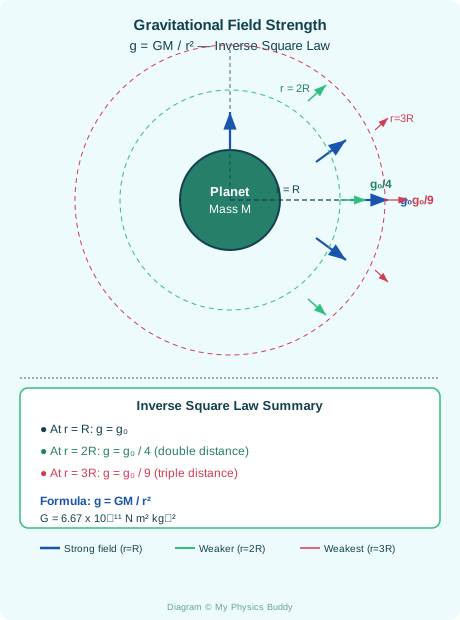
Variation with Distance — Graphical Behaviour
It helps to visualise how g changes with r. The relationship is a curve, not a straight line. As r increases, g decreases rapidly at first, then more gradually — this is the classic shape of an inverse square relationship. Inside a uniform planet, the relationship changes to a linear one, but for Cambridge 9702 the key region you need is outside the planet’s surface, where g = GM/r² applies fully.
| Distance r from centre | g (N kg⁻¹) — approximate | Relative to surface value |
|---|---|---|
| R (surface) | g₀ | 1 |
| 2R | g₀ / 4 | 0.25 |
| 3R | g₀ / 9 | 0.11 |
| 4R | g₀ / 16 | 0.0625 |
For a deeper look at how gravitational fields connect to orbital mechanics and planetary data, the Cambridge Assessment International Education syllabus resources are an excellent reference for 9702 topic coverage and mark scheme conventions.
Common Mistakes
✗ Mistake: Using the distance from the planet’s surface instead of from its centre when substituting into g = GM/r².
✓ Fix: Always measure r from the centre of the planet. If the question gives height above the surface h, calculate r = R_planet + h before substituting.✗ Mistake: Forgetting to square r in the denominator — writing GM/r instead of GM/r².
✓ Fix: Write the formula out fully before substituting numbers and bracket (r)² explicitly in your working so the squaring is never skipped.✗ Mistake: Confusing gravitational field strength g (N kg⁻¹) with gravitational force F (N) — writing the answer without checking whether the question asks for g or F.
✓ Fix: g = GM/r² gives field strength; F = mg or F = GMm/r² gives force. Read the question carefully and check your units match what is being asked.
Exam Relevance: This topic appears in Cambridge A/AS Level Physics (9702) Unit 13 (Gravitational fields), Edexcel A Level Physics, and IB Physics HL/SL. It is regularly assessed in structured calculation and multiple-choice questions.
Pro Tip from Jiya B: Always write g = GM/r² first, then substitute — examiners award a method mark for the correct formula even if arithmetic slips occur.
Related Questions
What is the difference between AP Physics 1 and AP Physics 2?
How to solve Gauss’s law problems in AP Physics 2?
What is the right-hand rule and how to apply it for magnetic fields?
How to calculate electric potential and potential energy?
How does a capacitor work and how to solve RC circuit problems?
What is Bernoulli’s equation and how to apply it to fluid flow?
What is the relationship between period and frequency for oscillations?
How to calculate the speed of a wave on a string?