A Kim
asked on February 6, 2024
Gravitational potential energy calculation
How to calculate gravitational potential energy near Earth’s surface?
Need Help?
Hire one of our expert Physics tutor online. 24/7 Service. Available now.
Expert Answer
Answered on November 9, 2024 by EXPERT TUTOR
Nothing Found
Dear A Kim,
To calculate gravitational potential energy near Earth’s surface, use the formula GPE = mgh, where m is mass, g is gravitational field strength, and h is height above a reference point. According to expert tutors at My Physics Buddy, this approximation holds beautifully close to Earth’s surface where g stays nearly constant at 9.81 m s⁻².
Understanding Gravitational Potential Energy Near Earth’s Surface
Gravitational potential energy (GPE) is the energy stored in an object because of its position within a gravitational field. The higher an object sits above a chosen reference level, the more gravitational potential energy it holds. Think of it like a stretched spring — the more you lift an object against gravity’s pull, the more energy gets “stored” ready to be released when the object falls.
The Everyday Analogy
Imagine carrying a heavy backpack up a flight of stairs. Every step you climb, you do work against gravity, and that energy doesn’t disappear — it gets stored as GPE. If you were to drop the bag from the top step, all that stored energy would convert back into kinetic energy on the way down. This energy transformation is at the heart of Classical (Newtonian) Mechanics and appears constantly in energy conservation problems.
The Formula and What Each Variable Means
Near Earth’s surface, the gravitational potential energy of an object is given by:
GPE = mgh
- m = mass of the object (measured in kilograms, kg)
- g = gravitational field strength near Earth’s surface ≈ 9.81 m s⁻² (sometimes rounded to 10 m s⁻² in school-level problems)
- h = height above your chosen reference level (measured in metres, m)
- GPE = gravitational potential energy (measured in joules, J)
The key thing to notice is that h is always measured relative to a reference level you choose — usually the ground, a table surface, or whatever base level makes your problem easiest to work with. The absolute value of GPE doesn’t matter; what matters physically is the change in GPE.
Why This Formula Works Near Earth’s Surface
As a PhD physicist, I can tell you that the full expression for gravitational potential energy between two masses involves an inverse-distance relationship. However, near Earth’s surface, the distance from the centre of the Earth changes so little as an object moves up or down by a few metres or even kilometres, that g stays essentially constant. This makes the simpler linear formula GPE = mgh an excellent and very practical approximation for all everyday and exam-level problems in Physics.
Step-by-Step Worked Example
In my teaching experience, students often get the method right but lose marks by forgetting units or misidentifying the height. Here is a clean worked example to show you the full process:
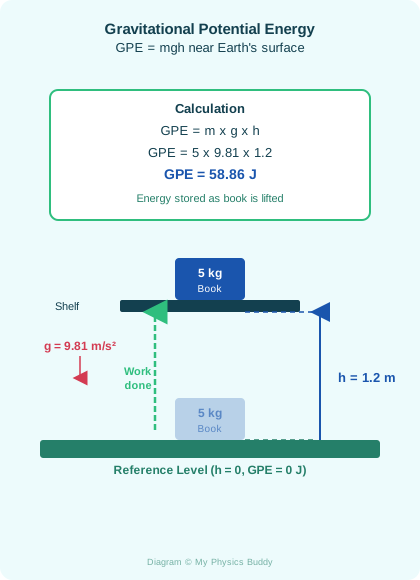
Problem: A 5 kg book is lifted from the floor onto a shelf that is 1.2 m high. Calculate the gravitational potential energy gained by the book. Take g = 9.81 m s⁻².
Step 1 — Identify the variables:
- m = 5 kg
- g = 9.81 m s⁻²
- h = 1.2 m (height above the floor, which is our reference level)
Step 2 — Write the formula:
GPE = mgh
Step 3 — Substitute and calculate:
GPE = 5 × 9.81 × 1.2
GPE = 58.86 J
Step 4 — State the answer with units:
The book gains 58.86 J (approximately 58.9 J) of gravitational potential energy.
Notice how we tracked units throughout: kg × m s⁻² × m = kg m² s⁻² = J. Unit tracking is a habit that will save you marks across every exam board.
The Change in GPE — What Really Matters
In most exam questions, you are asked about a change in gravitational potential energy:
ΔGPE = mgΔh
where Δh is the change in height. If an object moves upward, ΔGPE is positive (energy is gained). If it moves downward, ΔGPE is negative (energy is released). This connects directly to the principle of conservation of energy, which states that the total mechanical energy of a system remains constant when no non-conservative forces (like friction) act on it. You can read more about energy principles at Khan Academy’s guide on gravitational potential energy.
| Quantity | Symbol | Unit | Typical Value |
|---|---|---|---|
| Mass | m | kg | Given in problem |
| Gravitational field strength | g | m s⁻² | 9.81 (Earth surface) |
| Height | h | m | Measured from reference |
| Gravitational PE | GPE | J | Calculated result |
Common Mistakes When Calculating Gravitational Potential Energy
✗ Mistake: Using height measured from an inconsistent or undefined reference level, leading to a negative or nonsensical GPE value.
✓ Fix: Always state your reference level explicitly before substituting. The reference level is your choice — just be consistent throughout the entire problem.✗ Mistake: Using g = 9.81 m s⁻² when the question specifies g = 10 m s⁻², or vice versa, causing an arithmetic error that loses a mark.
✓ Fix: Read the question carefully for the value of g to use. If no value is given, use 9.81 m s⁻² unless your exam board guidance says otherwise.✗ Mistake: Forgetting to convert mass from grams to kilograms or height from centimetres to metres before substituting into GPE = mgh.
✓ Fix: Convert all quantities to SI units (kg and m) as your very first step, before writing the formula.
Exam Relevance: Gravitational potential energy using GPE = mgh is tested in GCSE Physics, A/AS Level Physics (9702), IB Physics SL/HL, and AP Physics 1. It commonly appears in energy conservation and work-done questions across all these specifications.
Pro Tip from Dr Shivani G: Always link GPE = mgh to energy conservation — if GPE decreases by 58.9 J, ask yourself exactly where those joules went. That habit scores full marks.
Related Questions
How to interpret and draw electric field line diagrams?
What is the best revision strategy for CIE A Level Physics?
What is the difference between transverse and longitudinal waves?
What is the difference between series and parallel circuits?
How does Bernoulli’s principle explain airplane lift?
What is the relationship between frequency wavelength and speed of a wave?
How to calculate net force when multiple forces act on an object?
What is the work-energy theorem and how do you apply it?