A Bell
asked on February 8, 2023
Calculating net force from multiple forces
How to calculate net force when multiple forces act on an object?
Need Help?
Hire one of our expert Physics tutor online. 24/7 Service. Available now.
Expert Answer
Answered on March 4, 2023 by EXPERT TUTOR
Nothing Found
Dear A Bell,
To calculate the net force when multiple forces act on an object, you add all the individual force vectors together — accounting for both magnitude and direction. According to expert tutors at My Physics Buddy, this vector sum is called the resultant force or net force. It tells you exactly how the object will accelerate under Newton’s Second Law.
Understanding Net Force: Vectors, Components, and Newton’s Second Law
Force is a vector quantity, meaning it has both a size (magnitude) and a direction. This is what makes calculating net force more involved than simple arithmetic. When your friend pushes a box to the right with 20 N and you push it to the left with 8 N, you can’t just add those numbers — you must respect their directions. This is the single biggest conceptual hurdle I see students hit in Classical (Newtonian) Mechanics, and it’s completely fixable once the vector thinking clicks.
The Core Principle: Vector Addition
The net force (often written Fnet or ΣF) is the vector sum of every force acting on an object. Newton’s Second Law then connects that net force to motion:
ΣF = m × a
where ΣF = net force (N), m = mass of the object (kg), a = resulting acceleration (m/s²)
If ΣF = 0, the object is in equilibrium — it either stays at rest or moves at constant velocity. If ΣF ≠ 0, the object accelerates in the direction of the net force.
The Component Method — Your Most Reliable Tool
When forces point in different directions that aren’t simply left/right or up/down, the component method is the cleanest approach. Here’s the procedure, step by step:
- Draw a free-body diagram. Sketch the object as a dot and draw every force acting on it as an arrow, labeled with its magnitude and angle.
- Resolve each force into x and y components. For a force F at angle θ above the horizontal:
Fx = F cos θ (horizontal component)
Fy = F sin θ (vertical component) - Choose a sign convention. Right and upward are typically positive; left and downward are negative. Stick to this throughout.
- Sum all x-components and all y-components separately.
ΣFx = F1x + F2x + F3x + …
ΣFy = F1y + F2y + F3y + … - Find the magnitude of the net force:
|Fnet| = √(ΣFx² + ΣFy²) - Find the direction of the net force:
θnet = arctan(ΣFy / ΣFx)
Everyday Analogy
Think of a tug-of-war. If Team A pulls with 500 N to the right and Team B pulls with 500 N to the left, the rope doesn’t move — net force is zero, equilibrium. Now if Team A pulls with 600 N and Team B with 400 N, the net force is 200 N to the right, and the rope (and everyone on Team B) accelerates in that direction. Direction always matters.
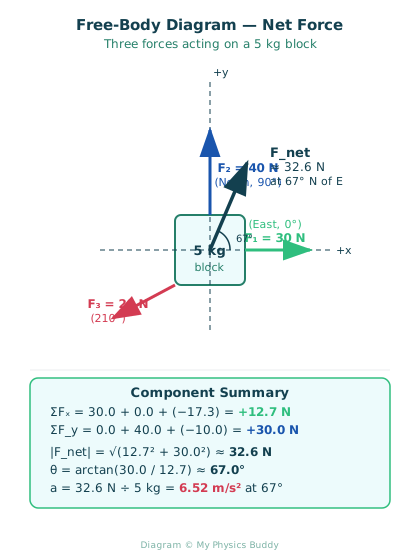
Worked Example — Three Forces Acting on a Block
Suppose three forces act on a 5 kg block on a frictionless surface:
- F₁ = 30 N directed due East (0°)
- F₂ = 40 N directed due North (90°)
- F₃ = 20 N directed at 210° (Southwest, i.e., 30° below the negative x-axis)
Step 1 — Resolve into components:
| Force | x-component (N) | y-component (N) |
|---|---|---|
| F₁ = 30 N, 0° | +30.0 | 0.0 |
| F₂ = 40 N, 90° | 0.0 | +40.0 |
| F₃ = 20 N, 210° | −17.3 | −10.0 |
F₃ components: cos 210° = −0.866, sin 210° = −0.5, so F₃x = 20 × (−0.866) = −17.3 N and F₃y = 20 × (−0.5) = −10.0 N.
Step 2 — Sum the components:
ΣFx = 30.0 + 0.0 + (−17.3) = +12.7 N
ΣFy = 0.0 + 40.0 + (−10.0) = +30.0 N
Step 3 — Magnitude of net force:
|Fnet| = √(12.7² + 30.0²) = √(161.3 + 900) = √1061.3 ≈ 32.6 N
Step 4 — Direction:
θ = arctan(30.0 / 12.7) = arctan(2.362) ≈ 67.0° above the positive x-axis (i.e., 67° North of East)
Step 5 — Acceleration (if needed):
a = Fnet / m = 32.6 N / 5 kg = 6.52 m/s² at 67° North of East
As a PhD researcher in physics, I can tell you that drawing the free-body diagram before touching any numbers is never wasted time — it removes sign errors almost entirely. If you want to deepen your understanding of how force and motion connect at a deeper level, our Physics resources are a great next step. You can also explore the official treatment of Newton’s laws at the Khan Academy Physics: Forces and Newton’s Laws section for additional worked examples.
For problems in AP Physics 1 and similar courses, you will frequently encounter forces at angles, so mastering the component method early saves enormous time later. A pattern I notice consistently is that students who practise drawing the x–y axes right on their free-body diagram make far fewer sign errors than those who try to work from memory.
Common Mistakes When Calculating Net Force
✗ Mistake: Adding force magnitudes without considering direction — for example, treating a 30 N rightward force and a 20 N leftward force as giving 50 N.
✓ Fix: Assign positive and negative signs before adding. Right is +30 N, left is −20 N, so net = +10 N to the right.✗ Mistake: Using the angle incorrectly when resolving components — confusing which trig function gives the x-component versus the y-component depending on how the angle is measured.
✓ Fix: Always measure the angle from the positive x-axis (or state clearly what your angle is measured from). Then Fx = F cos θ and Fy = F sin θ without ambiguity.✗ Mistake: Forgetting to include all forces — students often omit weight (mg downward) or the normal force when the object is on a surface.
✓ Fix: Before writing any equation, list every force acting on the object in your free-body diagram and verify you have accounted for gravity, normal force, applied forces, friction, and tension as relevant.
Exam Relevance: Net force and vector addition of forces appear in GCSE Physics, IGCSE Physics (0625), A/AS Level Physics (9702), and AP Physics 1. All four assess free-body diagrams, component resolution, and applying Newton’s Second Law in both one and two dimensions.
Pro Tip from Nasir A.: Always redraw your free-body diagram with x–y axes marked on it. That single habit eliminates nearly every sign error students make when resolving force components.
Related Questions
How to interpret and draw electric field line diagrams?
What is the best revision strategy for CIE A Level Physics?
What is the difference between transverse and longitudinal waves?
What is the difference between series and parallel circuits?
How does Bernoulli’s principle explain airplane lift?
What is the relationship between frequency wavelength and speed of a wave?
How to calculate net force when multiple forces act on an object?
What is the work-energy theorem and how do you apply it?