Charlotte Wilson
asked on January 29, 2026
Specific heat capacity from experiments
How to calculate specific heat capacity from experimental data?
Need Help?
Hire one of our expert Physics tutor online. 24/7 Service. Available now.
Expert Answer
Answered on February 10, 2026 by EXPERT TUTOR

Dear Charlotte Wilson,
To calculate specific heat capacity from experimental data, you rearrange the equation Q = mcΔT and use measured values of energy supplied, mass, and temperature change. According to expert tutors at My Physics Buddy, this is one of the most reliably tested practical skills in A/AS Level Physics (9702). Getting the method right — especially how you read and correct for heat losses — is what separates a good answer from a great one.
Understanding Specific Heat Capacity From the Ground Up
Think of specific heat capacity as a material’s stubbornness about changing temperature. Water has a very high specific heat capacity — it takes a lot of energy to warm it up even a little. A piece of copper, on the other hand, heats up quickly with far less energy. This everyday contrast is exactly what the quantity c captures mathematically.
The governing equation is:
Q = mcΔT
- Q = thermal energy supplied to the material (joules, J)
- m = mass of the material (kilograms, kg)
- c = specific heat capacity (J kg⁻¹ K⁻¹ or J kg⁻¹ °C⁻¹)
- ΔT = change in temperature (K or °C — the numerical difference is the same)
Rearranging to make c the subject:
c = Q / (m × ΔT)
Your experiment gives you the numbers on the right-hand side. Your job is to measure them carefully and then divide.
The Standard Electrical Method
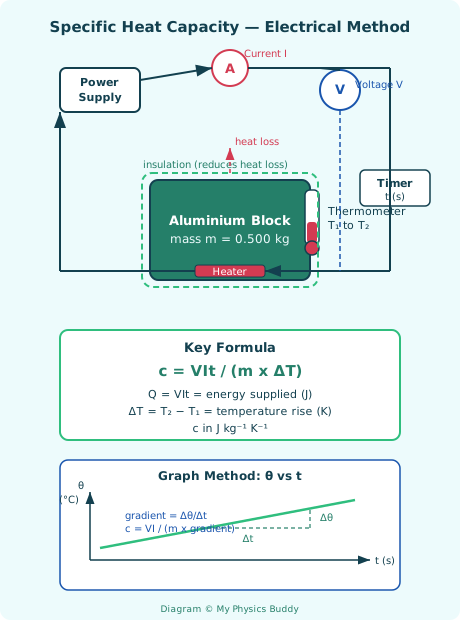
The most common practical you will encounter in Physics uses an electrical heater embedded in a solid block (commonly aluminium). A joulemeter or a voltmeter and ammeter combination measures the energy input, while a thermometer or thermocouple tracks the temperature rise.
Energy supplied electrically is:
Q = VIt
- V = voltage across the heater (volts, V)
- I = current through the heater (amperes, A)
- t = time the heater is on (seconds, s)
So the full working expression becomes:
c = VIt / (m × ΔT)
Worked Example
Suppose you heat a 0.500 kg aluminium block with a 12.0 V supply drawing 2.50 A for 5 minutes (300 s). The temperature rises from 20.0 °C to 46.4 °C.
Step 1 — Calculate energy supplied:
Q = VIt = 12.0 × 2.50 × 300 = 9000 J
Step 2 — Calculate temperature change:
ΔT = 46.4 − 20.0 = 26.4 °C (= 26.4 K)
Step 3 — Calculate specific heat capacity:
c = Q / (m × ΔT) = 9000 / (0.500 × 26.4) = 9000 / 13.2 = 682 J kg⁻¹ K⁻¹
The accepted value for aluminium is approximately 900 J kg⁻¹ K⁻¹. The gap here illustrates heat loss to the surroundings — which is why your experimental value will almost always be lower than the true value. The energy you put in partly heats the block and partly escapes into the bench and the air.
Using a Graph to Find c (The Gradient Method)
A more robust approach — and one the Cambridge 9702 examiners love — is to plot a graph of temperature θ against time t while keeping voltage and current constant. The gradient of this graph gives you dθ/dt, and since:
VI = mc × (dθ/dt)
you can find c as:
c = VI / (m × gradient)
This method is more reliable because it averages over many data points rather than relying on a single start and end reading. As a dual MS graduate who has worked through many experimental physics problems, I can tell you that the graph method consistently gives results closer to the accepted value because random errors in individual temperature readings are smoothed out.
Reducing Systematic Error From Heat Losses
Wrap the block in insulating material to reduce heat loss. Stir liquids continuously if you are heating a fluid. Start recording temperature slightly before switching the heater on, and continue for a little while after switching it off — the block keeps warming briefly after the heater stops as heat redistributes internally. You can use a cooling correction by extrapolating the cooling curve back to find the true maximum temperature rise.
For further reading on practical calorimetry techniques, the STEM Learning resource on specific heat capacity is an excellent reference that aligns with the Cambridge syllabus style.
| Quantity | Symbol | Unit | How Measured |
|---|---|---|---|
| Energy supplied | Q | J | Joulemeter or V × I × t |
| Mass | m | kg | Top-pan balance |
| Temperature change | ΔT | K or °C | Thermometer or thermocouple |
| Specific heat capacity | c | J kg⁻¹ K⁻¹ | Calculated from Q/(mΔT) |
Common Mistakes
✗ Mistake: Using mass in grams instead of kilograms in the calculation.
✓ Fix: Always convert mass to kilograms before substituting into c = Q/(mΔT), since the unit of c is J kg⁻¹ K⁻¹.✗ Mistake: Assuming the experimental value of c should exactly match the accepted value and treating any difference as a personal error.
✓ Fix: Recognise that heat loss to surroundings is a systematic effect that makes your experimental c smaller than the true value. Discuss this explicitly in your conclusion.✗ Mistake: Reading the temperature at the moment the heater is switched off and treating that as the final temperature.
✓ Fix: Continue monitoring temperature for at least 30–60 seconds after switching off, because the block’s temperature often continues to rise slightly as internal heat redistributes. Use the true peak temperature as your final reading.
Exam Relevance: Calculating specific heat capacity from experimental data appears in Cambridge A/AS Level Physics 9702 (Paper 3 and Paper 5), Edexcel A Level Physics, and IB Physics HL/SL. All boards assess both the calculation and the quality of experimental analysis.
Pro Tip from Koustubh B: Always check whether your calculated c is lower than the accepted value — if it is, that strongly points to heat loss, and saying so explicitly earns you analysis marks.
Related Questions
What is the difference between AP Physics 1 and AP Physics 2?
How to solve Gauss’s law problems in AP Physics 2?
What is the right-hand rule and how to apply it for magnetic fields?
How to calculate electric potential and potential energy?
How does a capacitor work and how to solve RC circuit problems?
What is Bernoulli’s equation and how to apply it to fluid flow?
What is the relationship between period and frequency for oscillations?
How to calculate the speed of a wave on a string?