J Walker
asked on February 24, 2026
Electric field from point charge calculation
How to calculate the electric field due to a point charge?
Need Help?
Hire one of our expert Physics tutor online. 24/7 Service. Available now.
Expert Answer
Answered on February 26, 2026 by EXPERT TUTOR
Nothing Found
Dear J Walker,
The electric field due to a point charge is calculated using Coulomb’s law in field form: E = kQ/r², where the field strength decreases with the square of distance. According to expert tutors at My Physics Buddy, this inverse-square relationship is one of the most fundamental results in Electrostatics and underpins nearly all of classical electromagnetism.
Understanding the Electric Field of a Point Charge
Before diving into the formula, let’s build the right intuition. Imagine you place a small positive charge at the centre of a room. That charge affects the space around it — it creates an electric field, which is a vector quantity that describes the force per unit positive charge at any location in that space. You don’t need a second charge present to define the field; the field exists whether or not anything is there to feel it.
A great everyday analogy: think of a lit candle in a dark room. The brightness (intensity) you experience depends on how far you are from the candle — move twice as far away, and the light drops to one quarter. The electric field from a point charge behaves the same way, governed by an inverse-square law.
The Formula
The magnitude of the electric field at a distance r from a point charge Q is given by:
E = kQ / r²
where:
- E = electric field strength (units: N/C or V/m)
- k = Coulomb’s constant = 8.99 × 10⁹ N·m²/C² (sometimes written as 1/4πε₀)
- Q = the source charge in Coulombs (C)
- r = distance from the point charge to the field point in metres (m)
You can also write this in full vector form:
E⃗ = (kQ / r²) r̂
Here, r̂ is the unit vector pointing radially outward from the charge. If Q is positive, the field points away from the charge. If Q is negative, the field points toward the charge.
Where Does This Come From?
The electric field is defined as the force a test charge q₀ would experience, divided by that test charge:
E⃗ = F⃗ / q₀
Coulomb’s law tells us the force between two charges: F = kQq₀ / r². Dividing both sides by q₀ immediately gives us the electric field expression above. This is why the field is a property of the source charge and location alone — the test charge cancels out.
As a PhD in Physics, I can tell you that students who truly grasp this derivation never confuse force with field again. The field is a property of space; force only appears when a second charge enters that space.
Step-by-Step Worked Example
Let’s work through a concrete calculation so you can see exactly how to apply this in a problem.
Problem: A point charge of Q = +5 µC is fixed in space. Calculate the electric field at a point P located 0.30 m away from the charge.
Step 1 — Write the known values:
- Q = +5 µC = +5 × 10⁻⁶ C
- r = 0.30 m
- k = 8.99 × 10⁹ N·m²/C²
Step 2 — Apply the formula:
E = kQ / r²
E = (8.99 × 10⁹) × (5 × 10⁻⁶) / (0.30)²
Step 3 — Calculate numerator:
(8.99 × 10⁹) × (5 × 10⁻⁶) = 44,950 N·m²/C = 4.495 × 10⁴ N·m²/C
Step 4 — Calculate denominator:
(0.30)² = 0.09 m²
Step 5 — Divide:
E = 4.495 × 10⁴ / 0.09 = 4.99 × 10⁵ N/C ≈ 5.0 × 10⁵ N/C
Step 6 — State direction:
Since Q is positive, the electric field at point P points radially away from the charge, directly along the line from Q to P.
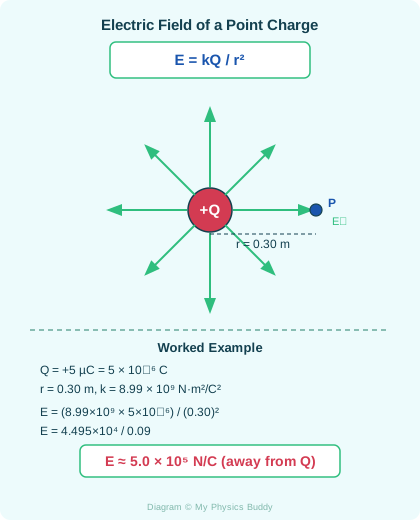
Visualising Field Lines
The diagram above shows the radial electric field lines spreading outward from a positive point charge. Notice that the field lines are closest together (densest) near the charge, indicating a stronger field, and spread apart with increasing distance. For a negative charge, all arrows would reverse direction — pointing inward toward the charge.
This topic sits at the heart of Electromagnetism, and it also provides the foundation for understanding capacitors, Gauss’s law, and electric potential. A strong grasp here pays dividends across your entire course. For deeper background on Coulomb’s law and field theory, the NIST CODATA reference on fundamental constants is an authoritative source for the exact values of k and ε₀ used in calculations.
One pattern I notice consistently in my teaching: students who first master the scalar magnitude formula and then layer on the vector direction step separately make far fewer sign errors than those who try to handle both at once. Take it in two clean steps every time — magnitude first, then direction.
| Quantity | Symbol | SI Unit | Notes |
|---|---|---|---|
| Electric field | E | N/C or V/m | Vector quantity |
| Source charge | Q | Coulomb (C) | Can be + or − |
| Distance | r | Metre (m) | Always positive scalar |
| Coulomb’s constant | k | N·m²/C² | 8.99 × 10⁹ N·m²/C² |
Common Mistakes
✗ Mistake: Using r instead of r² in the denominator, writing E = kQ/r.
✓ Fix: Always square the distance. The inverse-square law means doubling the distance reduces the field by a factor of four, not two.✗ Mistake: Forgetting to convert units, especially leaving charge in microcoulombs (µC) without converting to coulombs (C).
✓ Fix: Before substituting, always convert: 1 µC = 1 × 10⁻⁶ C. Write out the conversion explicitly as part of Step 1 every time.✗ Mistake: Stating the field direction based on the sign of E (treating it as a negative number) rather than from physics — for example, getting a negative E value when Q is negative and then reporting the field points outward.
✓ Fix: Calculate the magnitude using |Q| in the formula first, then separately determine direction: away from the charge if Q is positive, toward the charge if Q is negative.
Exam Relevance: This topic is assessed in AP Physics C: Electricity And Magnetism, A/AS Level Physics (9702), IB Physics HL, and MCAT Physics, often as both a direct calculation and a conceptual field-lines question.
Pro Tip from Dr. Vipul S: Memorise E = kQ/r² alongside the candle analogy — double the distance, quarter the field. That mental image alone prevents the most common exam error.
Related Questions
How to calculate the speed of a wave on a string?
What are standing waves and how do harmonics work?
How to explain physics concepts qualitatively for AP Physics 1 FRQs?
What is the best way to review for AP Physics 1 in two weeks?
How to apply Newton’s second law in rotational form?
How does energy transfer work in simple harmonic motion?
How to solve problems with pulleys and tension in AP Physics 1?
What is mechanical energy and when is it conserved?